Extrusion Coated Board Barrier Mechanics in High Humidity Converting
Extrusion coatings resist humidity until creasing strain shears polymer-fiber bonds, opening edge-wicking pathways that inflate converting scrap.

Interface
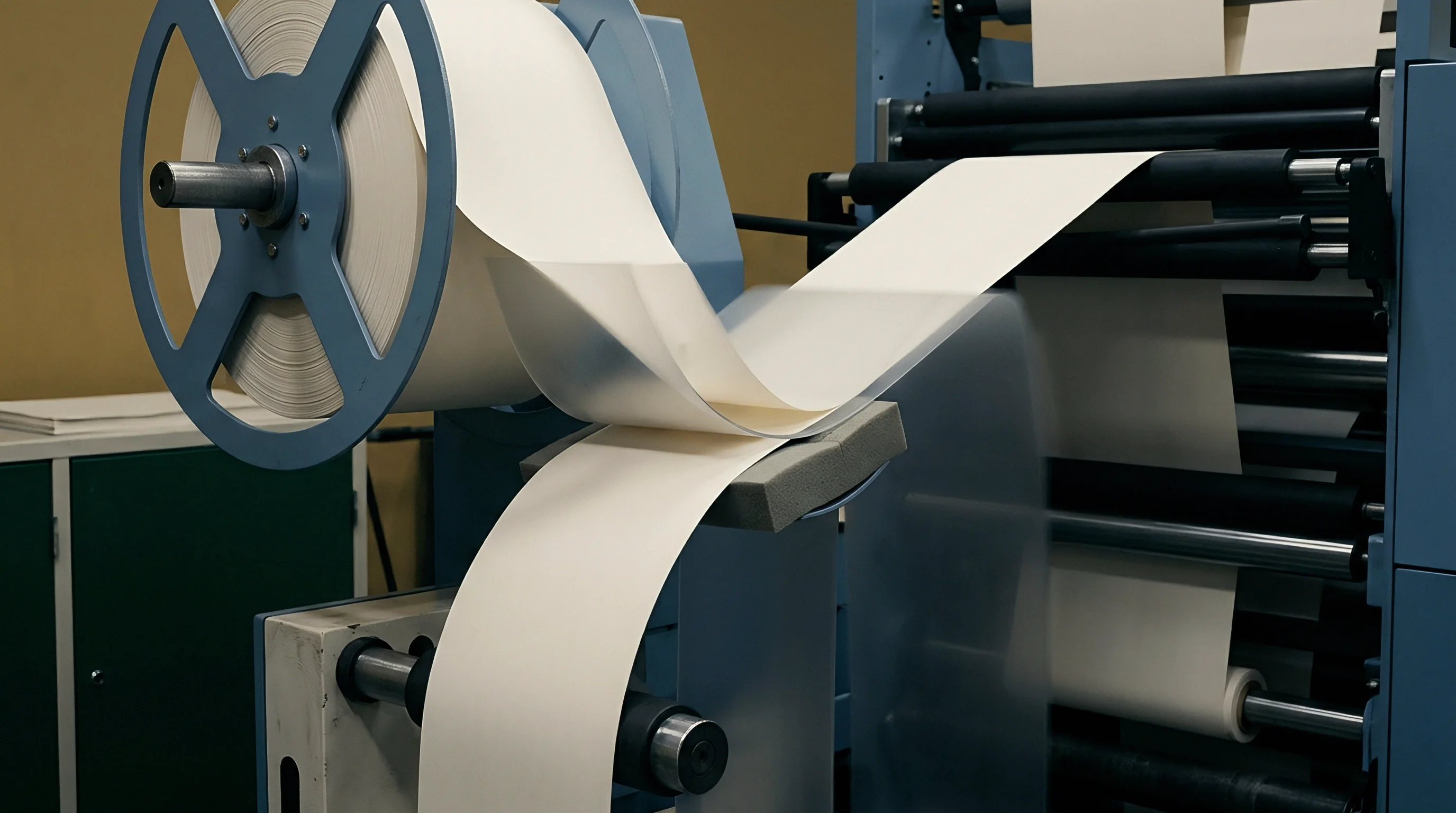
A micrometer spindle lands on an 18-gram low-density polyethylene film extruded over solid bleached sulfate board. The target film thickness measures exactly 20 microns. At standard room conditions of 23 degrees Celsius and 50 percent relative humidity, mechanical interlocking holds the polymer anchor firmly against raw surface fibers.
When ambient relative humidity rises to 85 percent, water molecules penetrate the porous cellulose structure beneath the plastic cap. Board fibers swell immediately. Delamination destroys barrier continuity.
Moisture sorption causes lateral expansion of the fibrous web while the polyolefin film remains dimensionally stable. This hygrometric mismatch generates steady shear stress along the adhesive boundary. On converting lines operating in unconditioned tropical facilities, the peel strength between low-density polyethylene and folding boxboard drops from 180 Newtons per meter to less than 65 Newtons per meter within four hours of web exposure.
The failure mode shifts from cohesive fiber tear inside the paperboard to adhesive release along the polyolefin face.
Adhesive strength degrades whenever cellulose expands beneath a rigid polymer boundary.
Extrusion temperature directly influences how well molten resin wets oxidized cellulose fibers during web coating. When polyolefin resins exit the extrusion die at 315 to 325 degrees Celsius, thermal oxidation generates polar carbonyl and carboxyl groups along the polymer backbone. These polar functional groups form hydrogen bonds with hydroxyl groups on individual cellulose fibrils.
In humid converting plants, incoming moisture competes directly for those hydroxyl sites, displacing the polymer bonds through competitive hydration.
Polymer Anchoring and Moisture Gradients
Molten extrudate driven into the surface valleys of bleached chemical pulp solidifies through mechanical locking. Porosity measurements evaluated by Gurley air resistance under ISO 5636-5 determine the depth of polymer penetration into the surface layer. Board furnishes possessing low surface roughness, such as double-blade coated folding boxboards, offer fewer accessible pores for molten resin penetration than uncoated kraft liners.
Saturated air softens the paperboard fibers, loosening the mechanical grip around anchored polymer fingers.
| Resin Type | Coating Weight (g/m²) | Substrate Grade | Dry Peel Force (N/m) | Humid Peel Force (N/m) | Equilibrium Moisture Content (%) |
|---|---|---|---|---|---|
| Low-Density Polyethylene | 18 | Solid Bleached Sulfate | 195 | 62 | 9.8 |
| High-Density Polyethylene | 15 | Folding Boxboard | 140 | 45 | 11.2 |
| Polypropylene | 20 | Unbleached Kraft Board | 220 | 95 | 8.7 |
| Polybutylene Succinate | 22 | Coated Recycled Board | 160 | 38 | 12.4 |
Extrusion coaters running polybutylene succinate experience elevated vulnerability during summer operations. Biodegradable polyesters possess intrinsic ester linkages that undergo slow hydrolytic cleaving when exposed to sustained atmospheric moisture. Water molecules diffuse through the bulk biopolymer phase toward the fiber plane.
The rate of bond degradation accelerates once internal moisture content inside the cellulose reaches ten percent by weight.
Corona Treatment Decay in Moist Air
Surface energy generated by electric discharge drops from 44 dynes per centimetre within forty-eight hours of ambient exposure. Polar chemical species created by corona discharge rearrange into the bulk phase of the polymer film during humid storage. When printers attempt water-based ink application or dispersion adhesive gluing on these surfaces, surface wetting fails, producing uneven laydown and pinholing.
- Interfacial hydrolytic cleavage weakens chemical bonds between oxidized resin chains and paperboard fibers.
- Hygro-expansion shear stress splits the boundary layer as moisture swells cellulose plies beneath inert films.
- Plasticizer migration accumulates at the coating boundary, promoting spontaneous film release under converting tension.
- Pore anchor pullout occurs when softened fibers release embedded polyolefin roots during die-cutting cycles.
Extrusion line managers explain that bond failure traces back to seasonal humidity swings in unconditioned customer storage facilities.
Score
Creasing rules compress cellulose plies against a counter matrix to form a defined hinge for carton folding. In dry conversion, the internal fiber network delaminates intentionally into several discrete plies to prevent surface cracking. High humidity alters this deformation process entirely.
Water plasticizes amorphous cellulose and hemicellulose, reducing cross-directional stiffness by forty percent. Moisture softens the hemicellulose matrix.
Instead of creating sharp, clean internal delamination planes, humid board compresses into a dense, solid core under the impact of the rule. The creasing rule crushes the fibers without creating functional internal shear zones. When the blank meets the folding sword on a folder-gluer, the board refuses to roll along the preformed hinge.
Bending stress concentrates directly at the exterior tensile surface, stretching the extrusion film beyond its elongation limit.

Crease Rupture Mechanics under Web Expansion
Cross-direction fiber swelling expands sheet caliper while reducing internal ply bond strength below 120 joules per square meter. Standard matrix channels designed for dry board become too narrow for the swollen sheet. Tool clearance governs shear distribution.
When a board conditioned at 85 percent relative humidity enters a 0.7-millimeter scoring rule paired with a 1.4-millimeter counter matrix, the swollen caliper jams into the channel groove. Shear forces slice through the polymer film along the crease shoulders.
- Calibrate the die-cutting platen pressure using carbon impression paper across all cutting rules.
- Measure sheet thickness with an automated micrometer across five locations on the parent pallet.
- Select matrix groove widths using the formula adding 1.5 times the swollen sheet thickness to the creasing rule width.
- Verify score depth using an optical micrometer to ensure internal plies shear without puncturing the exterior film.
- Fold sample creases through a 180-degree arc while checking the polymer surface with dye penetrant under magnification.
Grammage variations distort score depth. When moisture increases local basis weight across unconditioned webs, die impact forces deviate substantially across the bed. Polyolefin films tolerate considerable elongation under tension, yet localized notch stress created by crushed fibers initiates tear propagation.
A microscopic puncture along a crease seam ruins liquid holding performance.
Polyolefin Elongation across Hinge Geometries
Tensile strain on the exterior bead reaches twenty percent during ninety-degree carton erection. Under standard conditions, low-density polyethylene exhibits an elongation at break exceeding 300 percent, absorbing this strain without fracture. In humid converting plants, the underlying fiber structure loses tensile modulus while the plastic film maintains its mechanical resistance.
The plastic takes the entirety of the bending load.
A creasing channel width calibrated to dry caliper cuts through polyolefin coatings when processing boards swollen to eleven percent moisture content.
Brittle resins like polypropylene crack immediately along carton corners if scoring occurs in humid, warm conditions. Polypropylene chains lack the branching needed to distribute multi-axial strain under impact loads. Converting engineers incorporate ethylene-propylene copolymers into the extrusion layer to mitigate cracking risks.
These copolymer modifications elevate raw material purchase costs while narrowing the extrusion processing window.

Anvil Profiles and Caliper Swell Compensation
Machinists adjust channel widths from 1.4 to 1.7 millimetres when ambient moisture elevates sheet caliper by six percent. Failure to widen the creasing channel increases tonnage requirements on platen presses by fifteen percent. Over-pressuring the platen crushes the flutes in microflute board and splits solid bleached board coatings along the hinge root.
Anvil wear accelerates delamination.
Rotary die-cutting units present greater operational challenges than flatbed platens. The instantaneous nip contact between rotary scoring cylinders exerts concentrated shear forces on swollen boards. Web tension pull pulls the coated board through the rotary nip before the crease matrix fully disengages.
The resulting micro-tears run parallel to the machine direction along the hinge boundary.
Running uncompensated scoring tools through saturated caliper stocks splits polyolefin barriers along carton corners, creating pinhole leakage across every packed carton.
Wick
Raw cut edges of bleached chemical pulp draw moisture along exposed lumen channels through capillary suction. Extrusion coating protects the top and bottom faces of the cartonboard sheet, but slit edges leave cellulose fiber bundles exposed to ambient air. In humid environments, these open channels pull atmospheric water vapor and condensed droplets deep into the core.
Raw edges draw moisture rapidly.
Capillary penetration weakens structural rigidity and discolors packaging flaps. For chilled and frozen goods packed in humid processing halls, moisture absorption through unprotected board edges ruins stacking strength within forty-eight hours. The compressive strength of corrugated and folding cartons drops proportionally to edge moisture uptake.
Capillary Suction in Cut Board Edges
Liquid penetration proceeds along fiber lengths following the Lucas-Washburn relation. Pore radius, surface tension, and liquid viscosity dictate the rate of edge wicking into the carton core. Internal sizing agents like alkyl ketene dimer and alkenyl succinic anhydride slow liquid uptake by altering the fiber contact angle.
High humidity environments weaken these sizing barriers over extended storage periods.
| Board Substrate | Internal Sizing Chemistry | Cobb 60 Value (g/m²) | Edge Wick Rate (mm/24h at 85% RH) | Edge Swell Factor (%) |
|---|---|---|---|---|
| Bleached Chemical Pulp | Alkyl Ketene Dimer | 22 | 1.8 | 8.5 |
| Unbleached Kraft Pulp | Rosin Soap Size | 35 | 3.4 | 12.2 |
| Chemi-Thermomechanical Pulp | Alkenyl Succinic Anhydride | 28 | 2.6 | 10.1 |
| Recycled Fiber Furnish | Polymer Surface Size | 48 | 5.2 | 16.8 |
Recycled fiber substrates exhibit faster edge wicking than virgin chemical pulps. Hornification and mechanical damage from recycling cycles leave individual fibers with broken cell walls and wider interstitial voids. Atmospheric moisture migrates through these voids unchecked, loosening starch binders and releasing mineral filler particles along the cut edge.

Skiving and Hemming Barrier Seals
Milling wheels remove half the caliper thickness along carton flap margins before folding the polymer flap over exposed cellulose. Skiving removes the outer plies. The remaining polyolefin-coated flap folds inward over the raw paperboard edge, heat-sealing directly to the interior coating.
This folded edge geometry prevents moisture contact with the fiber core, eliminating capillary penetration in liquid packaging and chilled goods.
- Rotary skiving passes mill away board fibers down to the inner polyethylene boundary layer without tearing the plastic film.
- Edge hemming folds curl the overhanging resin margin across the raw cellulose boundary, sealing it under heat.
- Ultrasonic edge welding melts facing plastic layers together, forming a hermetic plastic barrier around cut board fibers.
- Flame pretreatment exposure oxidizes plastic flaps prior to folding, ensuring reliable adhesion during high-speed seam passes.
Carton edges sealed against ambient air remain dry longer than unskived cut lines exposed to humid warehouse drafts.

Chamber
Tropical test rooms maintained at 38 degrees Celsius and 90 percent relative humidity accelerate physical deformation of polyolefin-coated stock. Standard testing protocols evaluate water vapor transmission rates under ISO 2528 and ASTM E96 gravimetric procedures. Under these severe atmospheric conditions, partial pressure differentials drive moisture molecules across the barrier polymer layer at accelerated rates.
Water vapor transmission climbs exponentially.
Polymer morphology dictates how well an extruded coating resists vapor flux. Low-density polyethylene contains extensive short-chain and long-chain branching, resulting in low crystallinity between 45 and 55 percent. High-density polyethylene features linear polymer chains with crystallinity exceeding 70 percent.
Crystalline domains block diffusing water molecules, forcing them along tortuous paths through amorphous regions. High-density coatings provide superior resistance to humid air penetration.

Water Vapor Transmission under Saturated Air
Fickian diffusion through low-density polyethylene quadruples when ambient vapor pressure rises from 2.3 to 5.6 kilopascals. When converted board samples contain micro-cracks along scored hinges, vapor flow shifts from slow molecular diffusion to rapid hydrodynamic flow. Pinhole defects allow direct vapor entry into dry interior packaging cavities, ruining product shelf life.
Barrier film permeability quadruples when ambient vapor pressure increases across unconditioned packaging spaces.
Cellulose fibers located directly beneath permeable coatings absorb diffused moisture, expanding in volume and distorting the planar flatness of carton blanks. Asymmetrical moisture distribution causes severe carton curl. When an extrusion coating sits on only one side of a solid bleached board, the uncoated reverse side absorbs ambient humidity rapidly while the coated face remains partially sheltered.
The unbalanced expansion curls blanks toward the plastic side, causing feeding jams on packaging lines.
Gravimetric Permeation Cups versus Infrared Sensors
Electrolytic detection cells register steady-state transmission across barrier films within twelve hours of test initiation. In contrast, gravimetric desiccant cup methods require several days of continuous conditioning inside environmental cabinets to register measurable weight gains. Discrepancies between sensor-based instrumental data and traditional cup tests widen when testing scored carton samples.
Flexing actions during score preparation open invisible stress fractures that sensor chambers register as immediate spikes in vapor flow.
Laboratory consensus has not established whether dynamic stress micro-cracks in folded polyethylene heal under high ambient vapor pressure or expand permanently under mechanical vibration.
Ledger
Converting yields decline when atmospheric moisture alters web dimensions on high-speed folder-gluers. Board reels unwound in non-air-conditioned converting plants absorb moisture from ambient air, expanding in cross-direction width by up to 0.4 percent across a 1500-millimeter web. This dimensional drift shifts printing and die-cutting registration out of specification.
Ambient conditions shift machine tension. High humidity slows production output.
Feed section jams multiply when curled carton blanks enter automated hopper magazines. Folder-gluer machines operating at 400 meters per minute trip automatic safety stops whenever warped blanks fail to feed cleanly between suction belts. Each machine stoppage generates make-ready waste and scorches blanks resting inside heat-sealing sections.
Waste accrues on every stop. Register drift compounds converting scrap.
Yield Loss from Dimensional Web Drift
Sheet registration shifting by 1.5 millimetres forces folder-gluer operators to discard forty blanks per setup pause. Over an eight-hour shift producing 100,000 cartons, unmanaged ambient humidity can elevate total spoilage rates from 2.5 percent to 7.8 percent of input tonnage. These material losses directly erode project profit margins on fixed-price packaging contracts.
| Production Metric | Controlled Plant (23°C / 50% RH) | Uncontrolled Plant (32°C / 82% RH) | Operational Variance |
|---|---|---|---|
| Line Speed (blanks/min) | 650 | 420 | -35.4% |
| Die-Cutting Scrap Rate (%) | 1.8 | 4.2 | +133.3% |
| Folder-Gluer Jam Frequency (stops/hour) | 0.4 | 2.8 | +600.0% |
| Seam Leakage Rejection Rate (%) | 0.2 | 2.1 | +950.0% |
| Delivered Cost per 1,000 Blanks (USD) | 48.50 | 57.20 | +17.9% |
Consider a commercial run processing 50 tonnes of 280 g/m² solid bleached sulfate board extrusion-coated with 18 g/m² low-density polyethylene. Under controlled factory conditions, production yields 165,000 finished cartons at a baseline scrap rate of 2.5 percent. Moving this job into an unconditioned facility with 82 percent relative humidity increases total scrap to 8.5 percent through edge curl, crease fracture, and heat-sealing misalignments.
The loss represents 3.0 additional tonnes of discarded stock, inflating delivered unit cost by 8.70 USD per thousand cartons.
Extended Producer Responsibility Surcharges on Barrier Laminates
Packaging levies classify polyolefin coatings exceeding fifteen percent of total carton mass as composite waste streams. Standard repulping schemes in European and North American recovery mills separate plastic films from paper fibers through hydrapulpers equipped with extraction plates. When high humidity damages the board during conversion, the resulting scrap cannot enter standard dry broke repulping loops without specialized screening systems to remove detached plastic flakes.
Standard recycling protocols penalize plastic-coated paperboard scrap that exceeds standard contamination thresholds in chemical repulping vats.
Converters running barrier boards face tiered fees based on substrate repulpability under CEPI and Western Michigan University testing protocols. A clean, easily separable extrusion layer incurs minimal end-of-life disposal fees, whereas fragmented coatings generated from damaged, over-creased humid board foul pulper screens and attract severe recycling penalties.
Standard purchase specifications containing ISO 187 conditioning compliance clauses shift financial liability for moisture-induced line stoppages from carton converters back to raw board suppliers.