Hydrophobic Varnish Interaction Failure Modes in Flotation Deinking Systems for Barrier Coated Packaging
Hydrophobic varnish failure in flotation deinking stems from poor particle fragmentation and surface energy mismatches that generate micro-stickies and reduce pulp brightness.

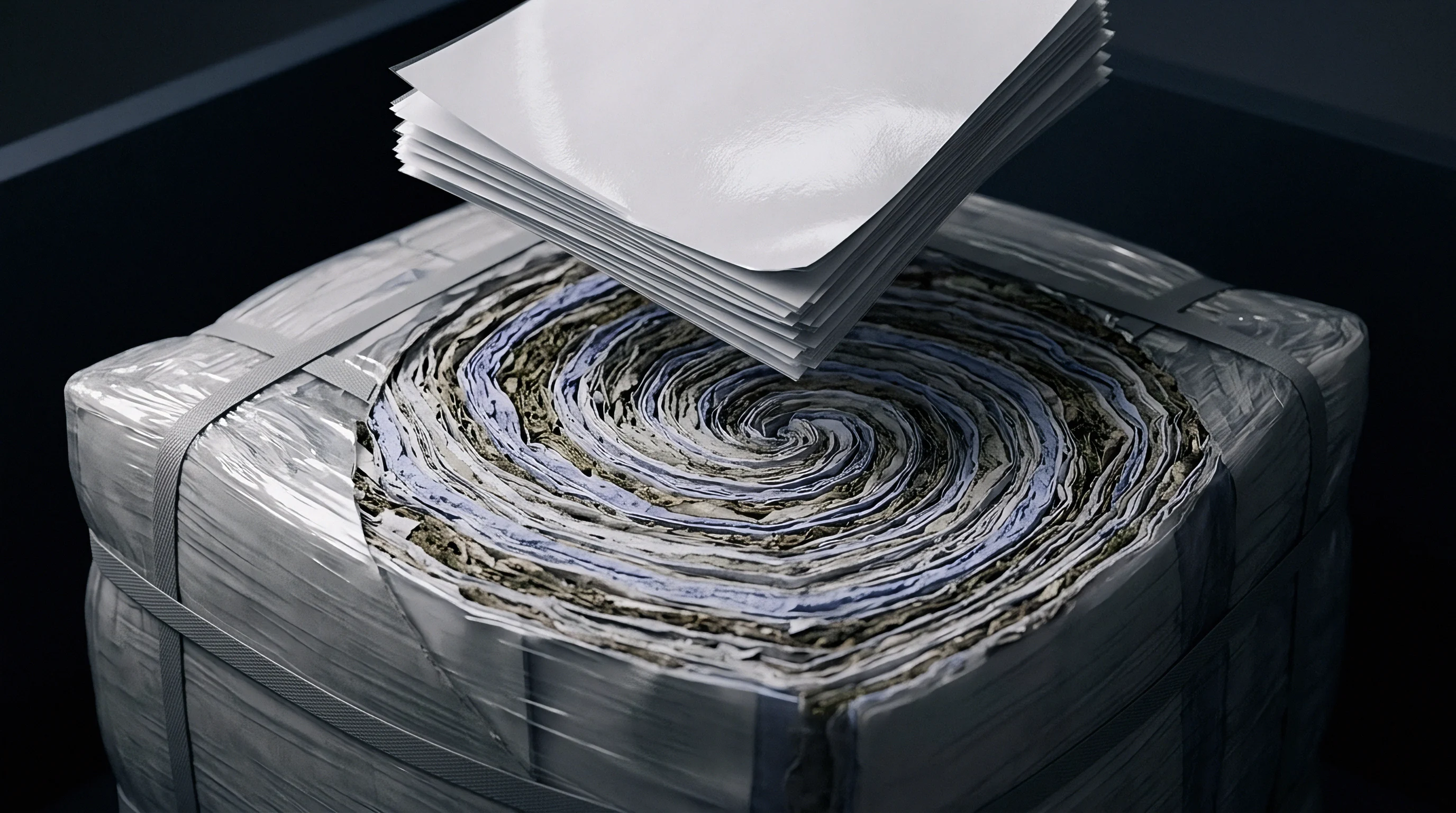
Flake

Polymer Disintegration Mechanics during Pulping
During pulping operations, barrier coatings on paperboard break down into discrete polymer fragments. High-consistency pulping at 12 to 15 percent solids subjects the substrate to intense inter-fibre friction and hydraulic shear. Under these forces, hydrophobic overprint varnishes, crosslinked acrylic dispersions, and wax-modified synthetic resins fracture along mechanical stress lines.
Whether the coating peels off in coherent sheets or shatters into fine particulate matter depends largely on the structural elasticity of the cured resin matrix.
Mechanical shear inside the pulper has to overcome the adhesion energy binding the functional coating layer to the underlying cellulose fibre network. When wet-strength resin levels in the base paperboard run high, fibre hydration slows down, concentrating mechanical energy directly at the polymer interface. Varnish formulations with high glass transition temperatures fracture brittly at standard pulping temperatures of 45 to 55 degrees Celsius.
This brittle failure leaves behind irregular, sharp-edged particles ranging from 5 to 500 micrometres in equivalent spherical diameter.
Because cold slurries slow detachment, thin varnish films below 3 micrometres in coat weight tend to detach as micro-flakes rather than disintegrating into spherical droplets. Inside the flotation cell, these elongated micro-flakes display anisotropic hydrodynamic behavior, aligning with fluid streamlines and dodging collisions with rising air bubbles.
Surface Energy and Water Contact Angle Dynamics
Sessile drop measurements using deionized water outline the wettability profile of cured resin films. Raw, unprinted virgin paperboard typically shows a water contact angle between 45 and 60 degrees, allowing quick fibre wetting and hydrogen bond dissolution. Hydrophobic barrier varnishes push this contact angle above 85 degrees, while wax-fluoropolymer hybrid formulations exceed 105 degrees under ISO 8296 test standards.
High contact angles reflect low polar surface energy, keeping water molecules from penetrating the coating layer. The total surface energy of a deinkable substrate splits into dispersive and polar components under the Owens-Wendt-Rabel-Kaelble calculation method. Hydrophobic varnishes dominated by dispersive surface forces resist charge development in aqueous suspensions, a thermodynamic state that stops standard anionic collectors from adsorbing uniformly across the particle surface.
Surface energy governs bubble binding: when the polar component of varnish surface energy drops below 5 millinewtons per metre, the thermodynamic driving force for bubble attachment changes. The work of adhesion between the polymer particle and the air bubble increases, but detachment forces under turbulent flotation conditions escalate as well due to contact angle hysteresis.

Froth

Collector Chemistry and Calcium Soap Precipitation
Air bubble attachment inside flotation cells depends on precise surface tension management at the air-water interface. Fatty acid collectors, mostly sodium oleate and sodium stearate blends, work by precipitating insoluble calcium soaps onto hydrophobic particles. This reaction requires a controlled concentration of dissolved calcium ions, kept between 10 and 20 degrees of German hardness (1.8 to 3.6 millimoles per litre of calcium carbonate equivalents).
Calcium ions act as ionic bridges between the weakly negative carboxylate groups of the fatty acid collector and the negative surface charge on the varnish particles. If the barrier-coated board contains residual chelating agents or high concentrations of polyacrylates from dry-strength additives, those calcium ions get sequestered. That stops calcium soap precipitation, leaving varnish particles without the surface hydrophobicity needed for stable bubble attachment.
| Varnish Resin Base | Water Contact Angle (Degrees) | Polar Surface Energy (mN/m) | Particle Size d50 (µm) | Flotation Yield (Percent) |
|---|---|---|---|---|
| Styrene-Acrylic Dispersion | 78.5 | 8.2 | 45.0 | 88.4 |
| Crosslinked Wax-Acrylic | 96.2 | 3.1 | 120.5 | 64.2 |
| Bio-Based Polyester | 68.0 | 14.5 | 22.0 | 91.0 |
| Polyurethane Barrier | 89.4 | 4.8 | 210.0 | 42.5 |
Overdosing collectors leads to micelle formation rather than localized surface modification on the particles. Free surfactant micelles then compete with varnish particles for space at the gas-liquid interface of rising air bubbles. The resulting froth layer becomes over-stabilized, dense, and wet, pulling large volumes of good wood fibre out through the rejects stream and dragging down total mill yield.
Particle Size Thresholds for Gas Flotation
Hydrophobic fragments have to fall within a tight hydrodynamic size window to be removed effectively from the cell. The optimal particle diameter for flotation deinking spans from 30 to 150 micrometres. Below 10 micrometres, particles rarely collide with air bubbles because fluid streamlines deflect around the rising gas sphere.
A particle diameter between 30 and 150 micrometres produces flotation efficiency above 85 percent under standard ISO 21993 laboratory froth conditioning.
Under high shear, sub-micron particles formed by over-emulsified varnishes generate colloidal specking and stay suspended in the pulp matrix through Brownian motion, bypassing flotation screens entirely. Conversely, varnish particles exceeding 250 micrometres carry too much kinetic inertia; turbulent eddies in the flotation cell tear these large flakes off bubble surfaces before they ever reach the top froth layer.
Proprietary collector chemistries are often presented as floating varnish fragments of any physical dimension without process modification. Mill data demonstrates, however, that chemical collectors cannot override the physical hydrodynamics of particle collision and inertia within standard flotation cells.

Deposition
Optical Speck Formation and ISO Brightness Loss
Varnish fragments that escape flotation migrate downstream, causing physical defects on the paper machine. Particles between 50 and 250 micrometres show up as visual specks or dirt counts on the finished sheet surface. Image analysis per ISO 5350 quantifies these flaws as total dirt area in square millimetres per square metre of recycled board.
Carryover of colloidal varnish causes widespread optical graying across the web. Fine polymer particles adsorb dissolved ink pigments and bind them directly to cellulose fibre surfaces. This redeposition drops the ISO 2470 diffuse blue reflectance brightness of the deinked pulp by 3 to 8 percentage points compared to clean furnish runs.
As ink carryover degrades pulp brightness, residual hydrophobic resin on fibre surfaces changes the refractive index of the sheet interface, altering light scattering coefficients measured via Kubelka-Munk equations. The finished board then displays reduced opacity and a yellow-gray color shift marked by positive b-star values under ISO 5631-2 colorimetry.
Wet End Blinding and Sticky Agglomeration
Tacky organic particles stick to press felts and former wires, choking drainage. When hydrophobic varnish carryover enters the white water circuit, it interacts with residual papermaking chemicals, cationic retention aids, and alum. Thermomechanical stress at the press nip then forces soft varnish particles deep into the porous weave of synthetic felt structures.
Soft water in pulping converts hydrophobic varnish into colloidal micro-stickies that slip past flotation cells.
Micro-stickies coalesce into macro-stickies under shifts in temperature, pH, and shear gradients. When wet-end temperatures drop below the glass transition point of the synthetic resin, varnish particles agglomerate into dense, rubbery deposits that blind screen baskets. Unmanaged varnish deposition on the paper machine leads to severe operational failures across the converting floor:
- Wire Blinding occurs when soft varnish particles fill the open area of forming fabrics, causing localized drainage drops and basis weight streaks across the web.
- Felt Plugging develops as tacky organic deposits fill the inner void volume of press felts, reducing water removal capacity and driving up press-section steam consumption.
- Drying Cylinder Pick arises when low-melting-point resin fragments transfer onto heated cylinder surfaces, tearing fibres from the sheet and creating pinholes.
- Slitter Blade Gumming happens during reel slitting, where friction heat melts residual varnish deposits onto circular blades, causing rough cuts and dust generation.
Ignoring wet-end deposition dynamics guarantees frequent unscheduled shutdowns for solvent washing, raising chemical costs and pushing machine lost-time metrics past budgeted thresholds.
Bench
INGEDE Method 11 Evaluation Criteria
Standardized testing protocols quantify deinkability through controlled laboratory pulping and flotation runs. INGEDE Method 11 serves as the core testing methodology for assessing printed, varnished, and barrier-coated paper packaging. The protocol mandates pulping test stock under set temperature, chemical, and consistency conditions, followed by flotation in a standard laboratory cell such as the PTS or INFORSED apparatus.
| Evaluation Parameter | Standard Test Method | Target Performance Threshold | Max Score Weight | Failure Threshold |
|---|---|---|---|---|
| Luminance Factor (Y) | ISO 2470 / ISO 5631 | Greater than 60.0 percent | 30 Points | Less than 45.0 percent |
| Color Parameter (a ) | ISO 5631-2 | Between -1.0 and +1.0 | 15 Points | Outside -2.0 to +2.0 |
| Dirt Area (>50 µm) | ISO 5350-2 / INGEDE 4 | Less than 600 mm²/m² | 20 Points | Greater than 2000 mm²/m² |
| Speck Count (>250 µm) | ISO 5350-2 | Zero visible specks | 15 Points | Greater than 5 specks/m² |
| Filtrate Appearance | INGEDE Method 11 Annex | Clear to slightly turbid | 20 Points | Dark or strongly colored |
Evaluation requires calculating an overall Deinkability Score from 0 to 100 points based on the weighted sum of individual parameter scores. Stocks scoring above 70 points pass for standard recycling streams, while samples scoring below 50 points are classified as non-deinkable due to excessive speck area, low brightness, or filtrate discoloration.
Optical Dirt Area and Image Analysis Standards
Flatbed scanners paired with thresholding software measure speck counts per square metre of handsheet. Image resolution must be set to at least 600 dots per inch, calibrated against certified grey scales per ISO 15755 guidelines. Software algorithms apply a binary contrast threshold to separate the cellulose fibre background from dark varnish and ink particles.
Failure to meet the INGEDE Method 11 total deinkability score of 70 points triggers the maximum fee penalty under European recyclability schemes.
Standard image analysis often struggles to capture transparent or highly translucent varnish particles that lack trapped pigment. To detect these unpigmented hydrophobic fragments, laboratories use specialized staining techniques with oil-soluble dyes like Sudan IV or Nile Red, which selectively stain synthetic resins while leaving cellulose fibres uncolored.
- Condition the barrier-coated board sample at 23 degrees Celsius and 50 percent relative humidity for 24 hours per ISO 187 standards.
- Tear the conditioned sample into 20 by 20 millimetre squares, taking care to avoid clean guillotine cuts that alter fibre detachment kinetics.
- Disintegrate the sample in an INGEDE standard pulper at 15 percent consistency, 45 degrees Celsius, using 0.6 percent sodium hydroxide, 1.8 percent sodium silicate, and 0.8 percent oleic acid.
- Dilute the pulped slurry to 0.8 percent consistency with water adjusted to 15 degrees German hardness using calcium chloride solutions.
- Transfer the diluted stock into an ISO 21993 compliant flotation cell and operate the aeration rotor at 1450 revolutions per minute for exactly 10 minutes.
- Filter the flotation accepts and froth rejects separately to produce quantitative yield pads and handsheets for optical scanner evaluation.
Supply contracts specifying barrier board recyclability ought to incorporate a mandatory clause stating that compliance is verified strictly according to ISO 21993 flotation procedures at an independent accredited laboratory, shifting all costs of off-spec tonnage back to the substrate converter.

Vat
Rotor Geometry and Temperature Control
Pulping equipment configuration dictates how quickly overprint coatings detach from primary wood fibres. Helical rotor designs impart lower peak shear while maintaining bulk slurry movement. High-shear drum pulpers break brittle varnish films into sub-micron particles, whereas low-shear batch pulpers give the underlying paperboard time to hydrate and swell, causing the hydrophobic film to detach in large, screenable flakes.
Temperature control inside the pulping chest governs resin phase behavior. Operating above the softening point or glass transition temperature of a wax-acrylic varnish turns rigid coating fragments into sticky, deformable globules. Under hydraulic pressure, these soft particles deform and squeeze directly through 100-micrometres slotted screen baskets designed to catch solid contaminants.
Operating pulping circuits between 40 and 45 degrees Celsius keeps synthetic resins below their softening threshold, allowing slotted screens to remove coarse flakes cleanly. This temperature discipline preserves particle rigidity, facilitating mechanical separation in early-stage coarse hydrocyclones and fine screening stages.
Which Operational Changes Prevent Varnish Agglomeration?
Shifting pulping pH from alkaline to neutral ranges alters the electrical double layer of synthetic resins. Conventional alkaline pulping at pH 9.5 swells acrylic acid segments within the varnish matrix, increasing water solubility and driving colloidal dispersion. Neutral pulping at pH 7.0 to 7.5 suppresses this swelling, keeping the varnish intact as a cohesive hydrophobic film.
Screen blinding shifts mechanical downtime directly onto the mill conversion cost per tonne.
While neutral pulping preserves fibre length, lowering pH requires changing collector chemistry, as traditional fatty acid soaps fail to precipitate without alkaline saponification. Non-ionic surfactants and synthetic ethoxylated alcohols replace oleates under neutral conditions, forming smaller, controlled bubble structures that carry non-swollen varnish flakes into the scum trough without generating colloidal stickies.
Whether mill operators can balance the chemical costs of neutral surfactant packages against the lower energy demands and higher yield recovery of neutral pulping remains an open question in the industry.
Ledger
Yield Loss Arithmetic and Reject Disposal Costs
Commercial accounting for barrier-coated paperboard weighs raw fibre yield losses against end-of-life recycling liabilities. Flotation deinking of standard packaging board produces a mass reject rate between 4 and 8 percent, consisting mainly of mineral fillers, ink solids, and fine fibres. Heavy hydrophobic varnishes on barrier-coated boards push those mass reject rates up to 15 to 25 percent.
High-density cleaner rejects take solid fibre with them, reducing total usable pulp output. Consider a mill processing a 100-tonne lot of barrier-coated folding boxboard: a 20 percent reject rate removes 20 tonnes of material right out of the production stream. If raw virgin fibre costs 850 Euros per tonne and recovered board stock costs 220 Euros per tonne, that net material loss shifts landed pulp costs dramatically.
| Furnish Grade Profile | Usable Fibre Yield (Tonnes) | Sludge & Reject Mass (Tonnes) | EPR Eco-Fee Rate (€/Tonne) | Landed Pulp Cost (€/Tonne) |
|---|---|---|---|---|
| Standard Folding Boxboard (Uncoated Varnish) | 94.0 | 6.0 | 0.00 | 234.04 |
| Dispersion Barrier Board (Deinkable Pass) | 88.0 | 12.0 | 45.00 | 295.45 |
| Hydrophobic Varnish Board (Low Deinkability) | 78.0 | 22.0 | 180.00 | 461.54 |
| Wax-Laminated Barrier Board (Deink Failure) | 65.0 | 35.0 | 350.00 | 688.46 |
Disposing of deinking sludge adds further financial penalties. Solid waste landfill fees and incineration surcharges average 120 Euros per wet tonne of sludge at 50 percent dryness. Processing 100 tonnes of low-deinkability stock generates 44 tonnes of wet sludge, adding 5280 Euros in direct disposal fees to the batch ledger.
Eco-Modulation Fee Structures and Sourcing Penalties
Packaging compliance bodies levy financial penalties on packaging stocks that drop deinking yield below target limits. Extended Producer Responsibility schemes across European markets use eco-modulation to vary fee structures based on certified recyclability metrics. Packaging materials achieving INGEDE Method 11 pass credentials pay base fee rates, while non-deinkable barrier boards incur substantial malus surcharges.
Yield loss directly shifts landed cost, as malus surcharges can double or triple the compliance cost per thousand finished packages. Sourcing managers specifying barrier-coated packaging substrates must audit mill deinking certificates before signing volume procurement contracts.
- Deinkability Certification Clauses mandate that substrate suppliers provide current ISO 21993 test MTRs matching the specific grammage and coat weight delivered.
- Reject Liability Guarantees establish financial indemnification mechanisms where the board converter reimburses the mill for disposal fees incurred due to off-spec coating formulations.
- Batch Traceability Requirements enforce reel-level tracking tags to identify the source mill and coating batch when stickies outbreaks occur on the paper machine.
- Eco-Fee Pass-Through Rules define how regulatory EPR surcharges shift between brand owner, converter, and mill based on final recyclability grading scores.
Substrate specifications must integrate both print performance and end-of-life deinking arithmetic into the baseline purchasing equation. Grade selection determines converting yield, press room efficiency, and environmental compliance liabilities long before raw board reels arrive at the converting plant loading dock.