Optimizing Creasing Rule Geometry for Coated Paperboard Packaging
Optimizing creasing rule tip radius and channel geometry enables controlled internal board delamination, eliminating coating cracking and springback jams.
Blade
Creasing rule steel is supplied to the die-cutting chase as a cold-rolled, high-carbon strip ground to precise height, thickness, and edge profile. Manufacturing dimensional accuracy determines how evenly compressive force distributes across the sheet during high-speed flatbed converting. As die-cutting pressure drives the steel into coated paperboard, the tip profile starts localized delamination without cutting through the top liner’s fiber structure.
Thicknesses range from 1.5-point (0.53 mm) for lightweight cartons to 6-point (2.13 mm) for heavy corrugated or multi-ply solid bleached board, though standard folding boxboard jobs typically use 2-point (0.71 mm) and 3-point (1.05 mm) rules for 90-degree and 180-degree folds.
Hardness determines how long a rule lasts and how well its tip resists deforming under constant impact against the die anvil. Standard bending rules run between 30 HRC and 38 HRC so die-makers can form tight angles without cracking the steel. Medium-hard rules, from 40 HRC to 46 HRC, hold their dimensions through runs over 250,000 impressions.
For abrasive mineral coatings filled with calcium carbonate or titanium dioxide, deep-hardened tips up to 50 HRC prevent early wear. Once a tip flattens, the contact point broadens, changing the crease geometry and shifting the delamination threshold as the run progresses across successive pallets.
Rule Width Selection and Steel Hardness
Matching rule thickness to paperboard caliper depends mainly on substrate thickness. A 2-point rule (0.71 mm wide) works well on coated board up to 0.45 mm (450 micrometers) caliper. Pushing a 2-point rule past that thickness concentrates compressive stress into a narrow band, cracking the pigmented top coating.
Between 0.45 mm and 0.70 mm, a 3-point rule (1.05 mm wide) widens the compression footprint, spreading the force to protect the surface. For heavy solid unbleached board and recycled chipboard over 0.70 mm, 4-point (1.42 mm) or 6-point (2.13 mm) rules are needed to form a wide enough hinge without tearing the outer fibers.
Fibre orientation governs sheet stiffness, but rule height has to be set against die-cutting plate clearance, steel jacket thickness, and board compression under load. Standard creasing rule heights are 23.80 mm (0.937 inches) or 23.30 mm, depending on whether a cylinder press or flatbed die system is used. Variations as small as 0.02 mm across a single chase cause uneven score depths, leading to inconsistent folding torque on automatic cartoning lines.
Deep-hardened tips preserve profile geometry over long runs, preventing scores from stiffening as the steel wears.
Conditioned paperboard at 23 C and 50 percent relative humidity requires a tip radius equal to half the rule thickness to prevent top-liner strain from exceeding 4.2 percent during initial creasing indentation.
Because rule height controls penetration depth, counterplate hardness directly shifts the delamination zone when tip profiles drift off spec. Running soft steel rules on high-density coated bleached sulfate stock causes tip rollover within the first 50,000 cycles. That rollover turns a rounded contact profile into an asymmetrical trapezoid, driving peak shear forces into one side of the channel and splitting the coating along a single shoulder during folder-gluer pre-breaking.
Tip Radius Dynamics across Coated Surfaces
How a rule tip is ground determines how compressive strain spreads through the top coating layer. Full-round rules have a radius equal to half the rule thickness, giving a smooth curve across the entire contact zone. Semi-round rules use a flatter tip with tighter corner radii, which concentrates force along the shoulders.
Crown profiles feature a slightly raised center peak that seats the core deeper without widening the score. On mineral-coated boards, full-round tips distribute strain best by avoiding the sharp edge stresses that tear latex coating binders.
Thicker coatings demand larger radii. Double-coated folding boxboard carrying 20 to 30 grams per square meter of mineral coating needs full-round profiles to prevent surface cracking. Semi-round tips with abrupt corner transitions shear the binder matrix before the internal plies have a chance to delaminate.
Once that surface layer breaks, the ink film splits along the fold and shows raw white board beneath dark print. Grinding burrs on rule edges must be completely polished out, as microscopic defects act as stress risers that split coatings on the first impact.
| Substrate Caliper (mm) | Rule Thickness (pt / mm) | Tip Profile Type | Tip Radius (mm) | Steel Hardness (HRC) | Target Substrate Class |
|---|---|---|---|---|---|
| 0.20 – 0.35 | 1.5 pt / 0.53 mm | Full Round | 0.26 | 38 – 42 | Coated SBS / SBB |
| 0.35 – 0.45 | 2.0 pt / 0.71 mm | Full Round | 0.35 | 40 – 44 | Coated FBB / SBS |
| 0.45 – 0.60 | 3.0 pt / 1.05 mm | Semi-Round | 0.50 | 42 – 46 | Heavy FBB / CRB |
| 0.60 – 0.85 | 4.0 pt / 1.42 mm | Crown Profile | 0.70 | 44 – 48 | Coated Recycled Board |
Specialty coatings like aqueous barriers or extruded polyethylene require adjusted rule profiles to avoid pinholes. While extrusion coatings stretch under tensile load, sharp semi-round edges can slice the polymer layer and ruin the liquid barrier. Combining a full-round tip with a slightly lower rule height allows the poly film to stretch cleanly into the channel.
Unpolished rules with residual micro-serrations will snag and tear thin barrier films at high press speeds.
Attributing score fracturing entirely to board elasticity often leads to specifying softer steel profiles that merely mask tool wear. Widening tip radii across all board grades also carries trade-offs, as overly broad tips raise folding torque and bow carton panels during automatic assembly.
Channel
Female matrix channels define the cavity where the creasing rule forces the board fibers. Channel dimensions determine whether the sheet undergoes controlled internal delamination or destructive surface shearing. Too narrow a channel restricts fiber movement, crushing high-density solid bleached board under extreme hydrostatic pressure.
Too wide a channel fails to build sufficient shear strain in the middle plies, leaving the crease weak and prone to springback during cartoning. Converting lines use press-cut phenolic resin plates, steel counterplates, or self-adhesive vulcanized fiber matrix strips to set these channel dimensions.
Aligning the channel to the male rule requires tight tolerances on flatbed presses. An off-center shift of just 0.03 mm unevenly distributes indentation force, pulling internal delamination toward one side of the score line. This asymmetry distorts the score shoulders, causing cartons to fold out of square on high-speed folder-gluers.
Modern platen presses rely on optical register systems to align the die and counterplate, holding centering across large sheets containing hundreds of blanks.
Counter Matrix Dimensional Formulas
Calculating channel width and depth relies on standard empirical formulas tied to board caliper and rule thickness. Baseline channel width (W) follows W = (1.5 × t) + w, where t is board caliper in millimeters and w is rule thickness in millimeters. For high-density solid bleached board (SBS) with strong z-directional tensile strength, the multiplier rises to 1.7, giving W = (1.7 × t) + w.
For softer folding boxboard (FBB) with bulky mechanical pulp centers, it drops to 1.4, since those bulkier fibers compress more easily under vertical load.
Channel depth (D) tracks board caliper directly, matching sheet thickness or adding a small clearance allowance. The baseline rule is D = t for standard board at normal ambient humidity. When running dry board below 5.5 percent moisture, deepening the channel by 10 percent (D = 1.1 × t) gives fibers extra room to shift and eases tensile stress on the top liner.
Conversely, board with moisture above 7.5 percent needs a slightly shallower channel (D = 0.9 × t) to avoid over-stretching and weakening the reverse liner.
Matching female channel width to board stiffness prevents surface bursting while retaining clean hinge registration on high-speed folder-gluers.
Groove width controls liner tension. When a channel is too narrow, board fibers drag against the matrix sidewalls, creating friction that stops the sheet from drawing smoothly into the trough. That resistance spikes tensile stress on the outer coating until it splits.
Oversized channels remove that friction, but they lose the bending leverage needed to delaminate inner plies, leaving an incomplete crease that won’t fold straight.
Milled Steel versus Phenolic Resin Counterplates
Choosing between counterplate materials comes down to dimensional stability, heat resistance, and repeat accuracy across long runs. Milled steel counterplates hold tolerances within ± 0.01 mm over millions of impressions, with channels CNC-milled directly into hardened steel sheets matched to the die. They resist humidity shifts and physical wear, making them standard for long-run pharmaceutical and tobacco packaging where tolerances are tightest.
Phenolic resin counterplates are a lower-cost option for short to medium runs. Reinforced with glass or paper layers, phenolic sheets mill or laser-cut easily and give sharp initial channel definition, though ambient humidity shifts can swell them over time. Self-adhesive vulcanized fiber matrix strips allow fast setup changes, but their adhesive backing compresses under heavy platen pressure, causing slight depth drift on runs past 50,000 sheets.
Finding the right channel dimensions requires step-by-step verification on press. Setup typically follows this sequence to lock in matrix geometry:
- Measure paperboard caliper across three web positions using an ISO 534 compliant digital micrometer.
- Calculate baseline channel width using the specific substrate multiplier corresponding to board density and pulp furnish.
- Select counterplate matrix material matching run length, required dimensional tolerance, and environmental control conditions.
- Install counterplate and perform initial impression pull at reduced platen pressure to verify spatial alignment.
- Inspect crease impression symmetry under 10x magnification to check for channel off-center deviation.
- Adjust overall press impression depth until internal delamination occurs without tearing reverse-side liner fibers.
- Verify score springback angle on a laboratory bending tester before releasing the press for full-speed production.
Getting penetration right produces clean hinges. Straying from calculated matrix dimensions throws off the balance between compressive shearing and tensile stretch, leading to erratic score performance on high-speed packaging lines.
Channel width must expand in proportion to board caliper to keep a uniform strain profile across the outer liner.
Strata
Paperboard is a multi-ply composite built for high bending stiffness, but it has to tolerate sharp localized deformation during creasing. Folding boxboard (FBB) uses outer plies of bleached chemical pulp around a middle layer of mechanical pulp like stone groundwood or thermo-mechanical pulp. Solid bleached board (SBS) uses bleached chemical pulp throughout, giving high internal cohesion and uniform density.
Coated recycled board (CRB) relies on recovered fibers, leading to variable fiber length and bond strength. As a result, each substrate shears differently under the male rule.
Mineral coatings applied to paperboard use calcium carbonate and kaolin clay bound with synthetic latex like styrene-butadiene or styrene-acrylic polymers. While this coating provides print smoothness and ink holdout, the mineral content makes it far more brittle than the underlying cellulose fibers. When the creasing rule strikes the board, the top coating stretches along the outer shoulders of the impression.
If that tensile strain passes the latex binder’s elongation limit, microscopic cracks spread through the coating, ruining print appearance along folded edges.
Internal Delamination Shear in Multi-Ply Board
Delamination is what allows paperboard to fold 90 or 180 degrees without tearing the outer fibers. As the rule drives fibers into the female channel, shear stresses build between internal plies and break the hydrogen bonds holding the fiber network together. This creates horizontal delamination planes through the center of the sheet.
Once separated, the plies slide past each other during folding like a stack of loose sheets instead of a single rigid board.
In high-density SBS, uniform chemical fibers form strong z-directional bonds that resist initial delamination. SBS requires higher rule pressure to initiate internal shear. If impression force is insufficient and plies fail to separate, folding forces the rigid core outward, driving extreme tensile strain into the top liner and cracking the score.
The mechanical pulp cores in FBB have lower internal bond strength, so delamination happens smoothly under less force. Bulky mechanical fibers collapse under vertical load, acting as a cushion that absorbs deformation. However, if the chemical top liner is too thin, the rule can shear right through it ~ a defect called score shearing.
Balancing top-liner grammage against middle-ply thickness ensures clean delamination without cutting the top layer.

Where Does Latex Coating Binder Selection Prevent Score Fracture?
Binder formulation determines how much flexural strain a coating layer accepts before cracking. Styrene-butadiene latex offers higher elongation at break than rigid styrene-acrylic options, absorbing tensile stretch as the crease forms. Raising binder concentration from 11 parts per hundred pigment to 14 parts per hundred increases the strain-to-break threshold from 2.5 percent to 4.2 percent under ambient conditions.
That added binder improves cracking resistance, but too much latex reduces coating porosity, slowing ink drying and risking ink set-off on offset presses.
The glass transition temperature (Tg) of the latex binder determines how scores behave across temperature changes. Below its Tg, synthetic latex turns brittle and cracks under impact. Using low-Tg latex polymers keeps the binder flexible down to 5 C, protecting cartons shipped in cold storage.
Harder, high-Tg polymers produce higher surface gloss, but they leave brittle coating films that break under creasing strain.
Specifying ISO 187 conditioning compliance prior to press trials eliminates rejection disputes caused by low ambient humidity embrittlement during seasonal transport.
Converting defects show up as structural or visual failures when cartons are folded. Common failure modes tied to poor substrate matching or wrong crease geometry include:
- Top Coating Micro-Cracking appears as fine, hairline fractures along the outer fold axis, caused by latex binder elongation failure under excessive surface strain.
- Reverse-Liner Delamination Splitting occurs when the bottom fiber layer tears open inside the channel trough due to excessive rule penetration depth.
- Score Shearing develops when sharp creasing rule shoulders slice directly through the top chemical liner instead of initiating internal shear layers.
- Incomplete Core Delamination leaves internal plies bonded intact, forcing outer board layers to absorb folding strain and causing structural panel bowing.
- Asymmetrical Crease Rolling forms an uneven, slanted score line, resulting from off-center rule-to-channel alignment during die-cutting platen stroke.
- Fluting along Crease Edges creates micro-buckling parallel to the main fold line, caused by excessive female matrix channel width.
Moisture Dynamics and Environmental Strain Limits
Moisture acts as a natural plasticizer in cellulose fibers, directly controlling flexibility and strain capacity. Board conditioned to ISO 187 standards (23 C and 50 percent relative humidity) maintains equilibrium moisture between 6.0 and 7.5 percent. In this range, hydrogen bonds flex under stress, allowing the sheet to deform without tearing.
When relative humidity drops below 35 percent during winter transit, board moisture falls under 4.5 percent, making fibers stiff and brittle.
Dry board loses z-directional strain capability, leading to top-liner cracks under standard press settings. Bumping pressroom humidity up to 55 percent restores fiber elasticity and reduces seasonal cracking problems. On the other hand, board with moisture over 8.5 percent loses internal stiffness, producing soft, spongy scores that refuse to fold square on packing lines.
| Substrate Class | Furnish Type | Scott Bond Value (J/m²) | Z-Tensile Strength (kPa) | Coating Binder Tg (°C) | Max Surface Strain (%) |
|---|---|---|---|---|---|
| Solid Bleached Board (SBS) | 100% Bleached Chemical | 220 – 280 | 380 – 450 | +12 to +18 | 3.0 – 3.5 |
| Folding Boxboard (FBB) | Chemical Outer / Mechanical Core | 130 – 170 | 220 – 290 | +5 to +10 | 4.0 – 4.8 |
| Coated Recycled Board (CRB) | 100% Recrecovered Fiber | 90 – 130 | 150 – 210 | +15 to +22 | 2.2 – 2.8 |
When evaluating mill certificates against incoming board shipments, grammage numbers often hide variations in z-directional tensile strength. A delivery of nominal 350 gsm board can hit target weight while dropping 20 percent in Scott Bond strength if refining energy shifted at the paper mill. That hidden drop changes the required creasing penetration, throwing off standard die setups and causing sudden cracking on established jobs.
Board mills constantly trade off brightness against score durability, balancing pigment load for print optics against latex content for elasticity. Whether future biopolymer binders can match synthetic latex strain without compromising repulpability in recycling streams remains an open question.


Fixture
Evaluating score quality in the lab relies on standardized bending force tests to measure crease efficiency before production runs. Stiffness testing measures the resistance of a scored line bent to a set angle ~ usually 15 or 90 degrees ~ on dedicated test equipment. Comparing the force needed to bend a creased sample against an uncreased sample of the same board gives the score ratio as a percentage.
A lower score ratio means a clean crease that folds easily, reducing springback pressure against folder-gluer belts and packaging line equipment.
Standards like ISO 2493-1 and TAPPI T 829 specify exact sample sizes, bending speeds, and clamp distances to ensure repeatable results. Samples must condition in an ISO 187 atmosphere (23 C, 50% RH) for at least 24 hours before testing. Testing both machine direction (MD) and cross-machine direction (CD) scores is critical, as fiber orientation creates distinct anisotropy in bending resistance.
CD creases push across perpendicular fibers, requiring precise channel adjustments to hit target ratios.
Standardized Bending Resistance and Score Ratio Testing
The score ratio (Rs) is calculated as Rs = (Fc / Fu) × 100, where Fc is peak force to bend the creased line to 90 degrees, and Fu is peak force for uncreased board at the same angle. Commercial target ratios generally fall between 30 and 50 percent. Ratios above 60 percent indicate poor internal delamination, causing excessive springback, panel bowing, and frequent jams on folder-gluers.
A score ratio below 20 percent signals over-creasing, where the rule has crushed or severed internal fibers. Over-creased board loses hinge stability, causing panels to fishtail or misalign at high folder speeds. Testers like the Lorentzen & Wettre or PCA Score Bend Tester plot force-displacement curves across the 90-degree fold, pinpointing core structural failure and elastic recovery.
Uncreased board resistance dictates the ultimate structural rigidity of the carton, but the score ratio controls the mechanical torque exerted on folder-gluer belts.
Analyzing bending force curves helps pinpoint rule tip profiles that lower score ratios without cracking the top liner. When testing reveals erratic force spikes during early bending, the coating layer is actively micro-fracturing, signaling a need to widen the matrix channel or increase the tip radius.
Crease Springback Angle and Folder-Gluer Efficiency
Springback angle measures how much a crease opens back up after folding force is removed. When a folder-gluer pre-breaks a panel to 90 or 180 degrees, the internal fibers deform plastically, but residual elasticity causes the panel to spring back slightly. Automatic packaging lines need low, consistent springback angles so cartons open square, load smoothly, and seal tightly.
Magnification provides useful qualitative checks on coating integrity along the score shoulder. Digital systems rate surface crack severity from 0 (no micro-cracks at 20x magnification) to 5 (complete linear rupture exposing raw fiber). Combining score ratio testing with visual crack grading provides a clear qualification dossier for critical printed jobs.
| Score Ratio Range (%) | Crease Quality Class | Folder-Gluer Springback Behavior | Carton Assembly Defect Risk | Corrective Tooling Action |
|---|---|---|---|---|
| > 65 % | Under-Creased | High springback force (> 18°) | Carton bulging, gluer jams | Increase penetration depth / Narrow channel |
| 50 – 65 % | Marginal Crease | Moderate springback (12° – 18°) | Slight panel bowing under speed | Slightly expand rule tip radius |
| 30 – 50 % | Optimal Crease | Low springback (< 10°) | Smooth high-speed conversion | Maintain baseline target parameters |
| 15 – 30 % | Over-Creased | Negligible springback (< 4°) | Fishtailing, weak carton hinges | Reduce impression depth / Widen channel |
| < 15 % | Sheared Board | Zero resistance (hinge collapse) | Carton tear-apart, structural rejection | Replace sharp rule / Increase channel width |
A structured qualification program eliminates converting variables before starting production runs. Tool sets are typically qualified through these steps:
- Substrate Baseline Audit records sheet caliper, moisture content, Scott Bond internal strength, and grain direction across five representative sample sheets.
- Impression Step-Test executes sequential creasing penetration adjustments in 0.01 mm increments to establish the precise lower and upper limits of sound internal delamination.
- Stiffness Force Ratio Analysis measures Fc and Fu parameters across cross-machine and machine direction scores using an ISO compliant laboratory bending tester.
- Optical Micro-Fracture Scan evaluates top-liner coating continuity along folded shoulders under 20x optical magnification using a standardized visual crack rating scale.
- Springback Angle Recovery Track logs final panel equilibrium angles 60 seconds post-folding to predict performance on automated high-speed cartoning lines.
Precision-ground crown profiles reduce peak bending force by 14 percent compared to standard semi-round geometries on 400 gsm SBS board. Tighter channel width tolerances are consequently required when running multi-ply folding boxboard to keep score ratios stable.
Packaging supply contracts often incorporate DIN 55437-1 specifications, defining creasing rule dimensions and requiring score ratios between 30 and 50 percent on finished cartons to prevent automated line rejects.

Outlay
Tooling geometry directly drives press efficiency, substrate waste, and unit carton costs. Standard steel creasing rules and adhesive matrix strips make up a small part of initial tooling costs, but wrong choices quickly compound through long make-readies, slower press speeds, board scrap, and folder-gluer downtime. Optimizing crease geometry upfront gives the press room wide operational leeway across board variations.
Tool wear gradually increases score stiffness. As rule tips flatten and matrix edges round over hundreds of thousands of impressions, effective channel width narrows and compressive forces shift. Score ratios drift upward over long runs, moving cartons from an optimal 35 percent score ratio into the problematic 60 percent range.
If operators fail to catch this drift during routine checks, thousands of cartons can be produced with high springback, leading to jams on automated packaging lines.
Make-Ready Waste and Press Speed Penalties
Make-ready burns machine time and board while operators adjust platen pressure, patch shims, and check alignment. Running a standard flatbed press at 8,000 sheets per hour carries overhead exceeding $250 per hour. A two-hour setup delay caused by incorrect matrix depth or rule misalignment burns $500 in press time and wastes hundreds of sheets in test scrap.
Running equipment below rated speed is a quiet drain on plant productivity. When creasing parameters aren’t tuned properly, operators often back press speed down from 8,000 sheets per hour to 5,500 to prevent coating cracks or sheet registration bounce. That 31 percent drop in throughput raises converting costs per sheet and erodes margins on fixed-price contracts.
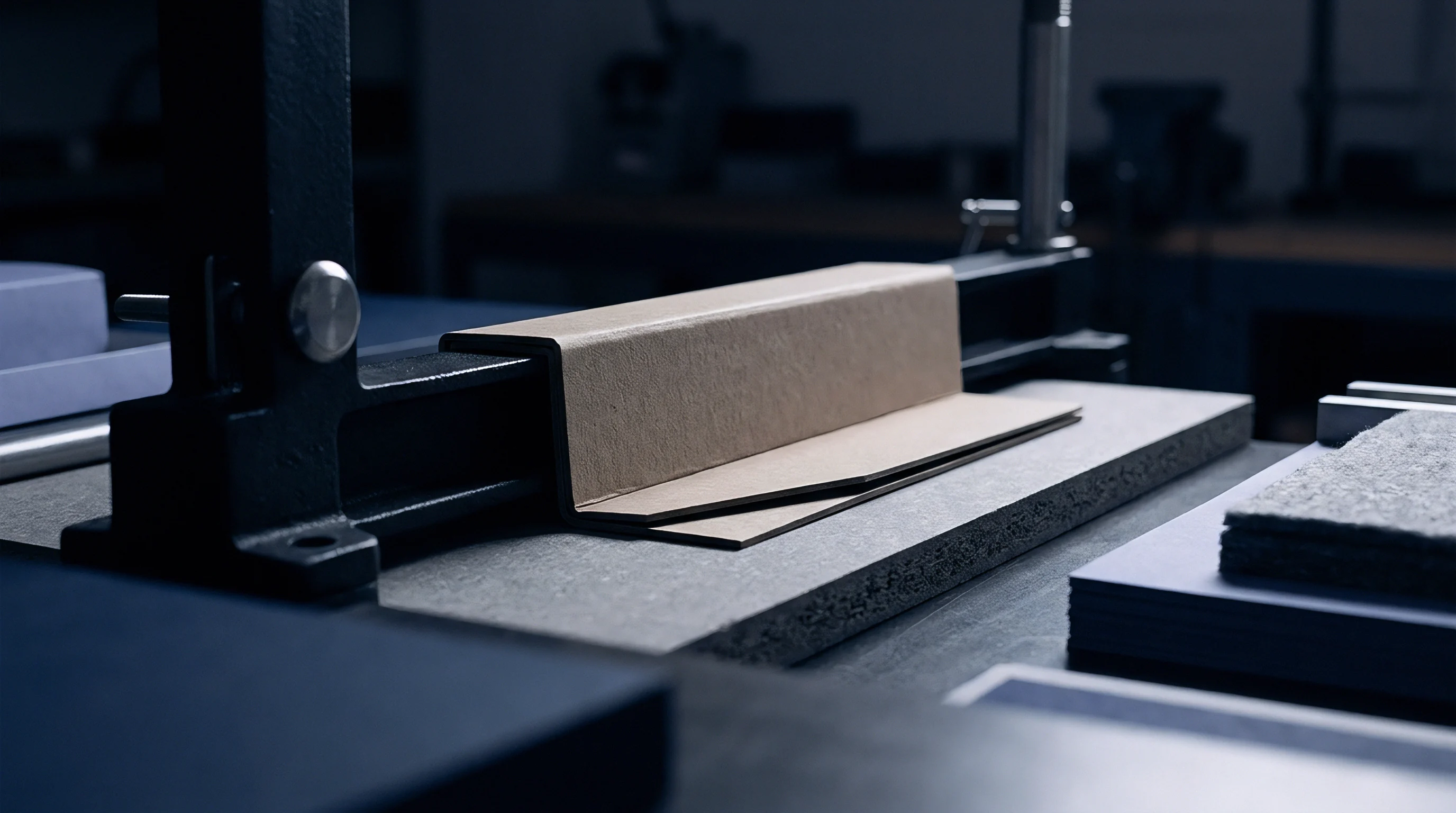
Carton Conversion Yield and Landed Unit Economics
Consider a commercial comparison from a high-volume job: a consumer brand orders 500,000 custom cartons printed on 350 gsm (0.48 mm caliper) coated folding boxboard (FBB). The plant evaluated two creasing setups: Option A used off-the-shelf vulcanized fiber matrix strips on a standard steel jacket, while Option B used a CNC-milled phenolic counterplate aligned to deep-hardened steel rules.
Option A cost $450 in upfront tooling versus $1,800 for Option B’s phenolic plate. But 120,000 impressions into the run, Option A’s matrix compressed and rounded along the channel edges. That wear broadened the score shoulder, pushing score ratios from 38 percent up to 58 percent and cracking dark printed edges.
To stop the cracking, the operator dropped press speed from 7,500 to 5,200 sheets per hour and added localized steam misting to raise humidity.
Substrate scrap under Option A hit 3.8 percent from make-ready sheets, score cracking, and gluer waste from panel springback. Producing 500,000 finished cartons required 519,750 sheets. At $1,400 per metric tonne ($0.182 per sheet), paperboard material cost came to $94,594.
Running time took 100 hours at a $250 hourly rate, adding $25,000. With setup labor and tooling included, Option A’s total converting cost landed at $120,044, or $240.09 per thousand finished cartons.
Option B required $1,800 up front, but held its channel geometry through the full 500,000-carton run. Channel dimensions stayed stable, keeping score ratios between 34 and 38 percent with no surface cracking. The press ran continuously at 7,500 sheets per hour.
Board scrap dropped to 1.1 percent (505,560 total sheets), reducing substrate cost to $92,012 ~ a savings of $2,582.
Press time under Option B dropped to 67.4 hours, costing $16,850 in press overhead ~ saving $8,150 in pressroom time. Adding tooling ($1,800), board ($92,012), and press overhead ($16,850) gave a landed cost of $110,662, or $221.32 per thousand units. Option B saved $9,382 on the run while eliminating rejection risks on the customer’s packaging line.
Investing in dedicated rule tip profiles and rigid milled counterplates pays off quickly through board savings, faster press speeds, and reliable performance on packaging lines.
The economic payback of optimizing crease geometry scales directly with volume, turning small tooling adjustments into notable cost reductions per thousand cartons.