Creasing Rule Thickness Selection for Folding Carton Converters
Match rule thickness to carton caliper using 2-point steel under 450 microns and 3-point above, sizing matrix width to rule plus 1.5 times caliper.


Caliper
Die-cutting platens transfer tonnage across steel rules to create folding hinges rather than mere indentations. The mechanical objective centers on crushing the internal fibrous layers while leaving the exterior liners undamaged. When cartonboard enters the impression zone, the creasing rule pushes the sheet into a counter matrix channel, forcing a controlled delamination of the plies.
This internal separation creates an inverted bead on the reverse side of the board. The bead acts as an internal expansion joint during folder-gluer operations. Selecting the correct rule point size prevents both surface cracking along the printed face and ragged, erratic folds that jam automated packing machinery.
Rule thickness follows the point system, where one point equals 0.014 inch or approximately 0.353 millimeters. Folding carton converters handle material calipers ranging from 200 microns to over 1000 microns, making uniform tooling specifications unworkable across varying boxboard grades. Solid bleached sulfate, coated unbleached kraft, folding boxboard, and white lined chipboard react differently under downward platen load.
Solid bleached sulfate consists of virgin chemical pulp, producing dense fiber cohesion that resists delamination. White lined chipboard contains recycled fibers with lower tensile strength, causing plies to split under lower compression levels.
Creasing 450-micron folding boxboard at 23 degrees Celsius and 50 percent relative humidity establishes an optimal hinge when creasing rule thickness matches 0.71 millimeters.
The standard industry guideline aligns rule width with substrate thickness. Sheets under 400 microns run on 1.5-point or 2-point rules, translating to 0.53 or 0.71 millimeters. Calipers spanning 400 to 650 microns switch to 2-point or 3-point rules, which measure 0.71 to 1.05 millimeters.
Heavy substrates exceeding 700 microns operate on 3-point or 4-point steel, equivalent to 1.05 or 1.42 millimeters. Deviating from these boundaries causes severe mechanical defects. A rule that is too narrow pierces the liner like a blunt knife.
A rule that is too wide crushes excessive surface area, increasing bending resistance and preventing ninety-degree carton erection.

Point Thickness and Board Weight Ratios
Platen converters choose steel tooling according to caliper rather than basis weight alone. Grammage reflects fiber density and mineral filler content, but caliper governs physical displacement inside the counter matrix. High-yield mechanical pulps present elevated thickness at modest basis weights, whereas recycled fibers pack tightly with higher densities.
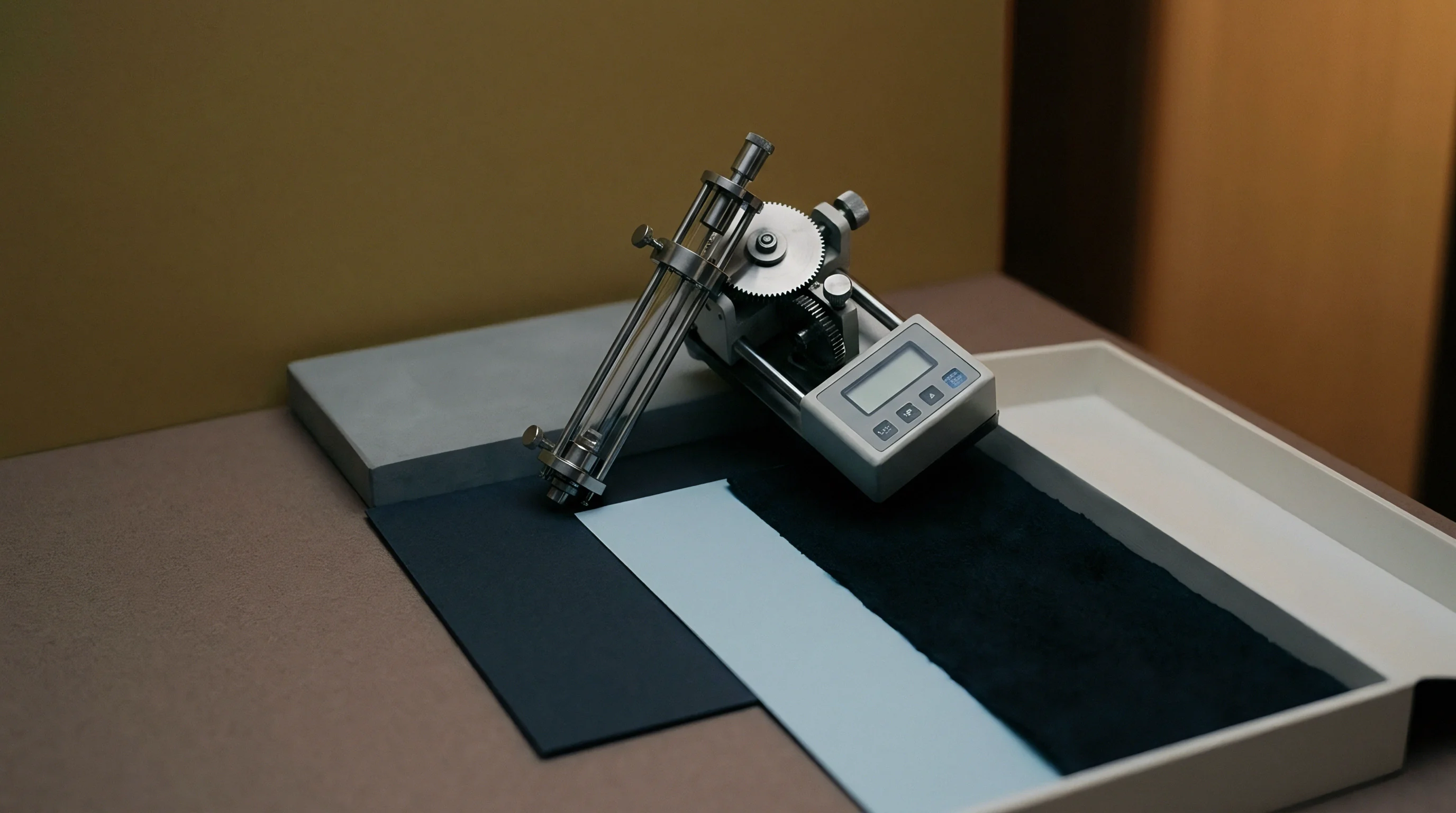
Machine operators confirm caliper through micrometer audits before signing off on cutting dies. The rule height remains 23.80 millimeters. This dimension matches standard 18-millimeter birch die boards paired with 0.35-millimeter steel make-ready plates.
Selecting rule dimensions without accounting for surface finishes yields erratic crease formations. Water-based dispersion varnishes add minimal thickness, usually below three microns. Double-sided polyethylene extrusion coatings add 15 to 30 microns of dense polymer.
Film laminations of oriented polypropylene or polyethylene terephthalate introduce high tensile films that resist stretching over the male creasing bead. When running film-laminated stock, converters step up the rule thickness by half a point to distribute compressive stress across a broader radius. This adjustment prevents the film from snapping or shearing the underlying clay coat.
| Board Caliper Range (microns) | Substrate Classification | Creasing Rule Point | Rule Thickness (mm) | Nominal Rule Height (mm) |
|---|---|---|---|---|
| 200 to 350 | FBB / SBS / WLC | 1.5 pt | 0.53 | 23.80 |
| 350 to 550 | FBB / SBS / CUK | 2.0 pt | 0.71 | 23.80 |
| 550 to 750 | SBS / CUK / WLC | 3.0 pt | 1.05 | 23.80 |
| 750 to 1000 | Heavy WLC / Carrier Board | 4.0 pt | 1.42 | 23.60 |

Substrate Fiber Geometry and Penetration Limits
Fiber orientation dictates the internal reaction of the sheet during die impression. Across the machine direction, fibers lie perpendicular to the creasing rule. This orientation resists rule intrusion, demanding precise penetration depths to break internal fiber bonds without bursting the top liner.
Parallel to the machine direction, fibers separate easily, requiring lower cutting pressure to establish an identical bead profile. Converters sometimes run differential rule heights, setting cross-direction rules 0.05 millimeters lower than machine-direction rules to balance folding resistance across the blank.
- Virgin kraft fibers retain high tensile elongation, flexing across the male rule profile without premature exterior splitting.
- Recycled mixed pulp plies exhibit brittle internal shear planes, crumbling into localized powder when subjected to narrow creasing edges.
- Mechanical groundwood cores provide high bulk and springback, demanding deeper female matrix penetration to prevent crease recovery.
- Double clay coatings show zero elongation capacity, cracking whenever tensile strain exceeds two percent along the outer shoulder.
Laboratory data published in 2018 established that crease stiffness drops by forty percent when relative humidity shifts from 35 percent to 65 percent. That specific measurement rested on 200 test samples of 400-micron folding boxboard conditioned under ISO 187 parameters. If the mill modifies the refining intensity or alters starch spray levels between plys, that exact forty percent figure shifts significantly.
Moisture softens the hydrogen bonds connecting hemicellulose chains, enabling easier delamination during creasing. Platen settings calibrated for dry winter warehouse conditions will over-crease damp summer stock, slicing through weakened base liners.
A broad rule distributes mechanical tonnage while a slender rule concentrates shear along the crease centerline.
Channel
Female matrix channels define the boundary conditions of the carton fold. When the male creasing rule drives paperboard downward, the female channel determines the width and height of the resulting reverse bead. The interaction between rule gauge and channel width sets the shear clearance.
If the channel walls sit too close to the rule, the board encounters crushing forces rather than bending deformation. If the channel spreads too wide, the board sags without developing the internal delamination planes necessary for an accurate hinge.
The standard converting formula calculates matrix channel width as the rule thickness plus 1.5 times the board caliper. For solid bleached sulfate and folding boxboard, this multiplier reliably produces crisp, crack-free creases. On recycled white lined chipboard, converters increase the multiplier to 1.7 or 1.8 times the caliper to prevent shearing fragile recycled fibers.
Matrix channel depth matches the exact caliper of the paperboard, though dense kraft grades often perform better with a depth equal to ninety percent of board thickness. These dimensions prevent the male rule from bottoming out against the steel jacket.
ISO 187 conditioning mandates 23 degrees Celsius and 50 percent relative humidity, without which channel clearance calculations lose running validity.
Phenolic counter plates provide milled grooves corresponding directly to the die layout. These monolithic counters eliminate operator error during make-ready because channel positions remain fixed on a single sheet. Press operators mount the phenolic plate over locating pins, tape it down, and draw carbon transfers to verify registration.
Self-adhesive pertinax strips and pressboard matrix channels offer an alternative for short production volumes. While self-adhesive strips permit fast corrections on press, they suffer from adhesive drift across long shifts, widening the functional channel clearance under continuous heating cycles.

Does Board Caliper Dictate Matrix Depth?
Thickness measurements directly establish channel depth specifications on press dockets. Using a channel shallower than the material thickness causes premature rule strike against the counter base. This bottoming action shears the liner plies and creates an unsightly witness line on the carton exterior.
Selecting a channel deeper than the caliper fails to compress the internal plies against the channel shoulders, creating an under-formed bead. Folding carton gluers struggle to fold boxes with weak beads, resulting in crooked cartons and skewed glue flaps.
Milled steel counterplates represent the ultimate tooling option for high-volume consumer goods packaging. Machined from hardened steel plates, these counters survive millions of die impressions without channel wall erosion. The channel shoulders maintain sharp radii, maintaining identical bead geometry from the first sheet through the entire production run.
Steel plates demand exacting register alignment with the cutting chase. Misalignment of 0.05 millimeters causes the male rule to clip the steel shoulder, instantly destroying the creasing rule edge.
Phenolic Counters and Steel Counterplates
Tooling suppliers deliver phenolic counters milled with high-speed CNC routers. Cutter bit geometry determines channel shoulder contours. Rounded shoulders reduce friction as the board slides into the cavity, minimizing scratch marks on delicate printing inks and hot foil stampings.
Straight-walled channels deliver sharper fold definition on heavy cartons but increase the risk of surface scuffing. When processing carton blanks with heavy ink coverage and matt varnishes, chamfered channel shoulders prevent pigment pick-off along the outer scoreline.
Converters running short runs frequently encounter suppliers claiming their standard channel dimensions function universally across all paperboard brands of identical caliper.

Shear
Mechanical stress during platen closure resolves into tensile, compressive, and shear components. Compressive force drives the rule into the sheet surface. Tensile forces stretch the lower liner across the open span of the counter channel.
Interlaminar shear forces tear the internal fiber bonds between adjoining plies. The primary converting goal involves initiating interlaminar shear before tensile limits rupture the top clay coating. Solid bleached sulfate delaminates under shear.
If shear delamination stalls, tensile forces concentrate entirely on the exterior liner, snapping the coating and exposing bare white fiber along the scoreline.
Coated surfaces remain vulnerable to tensile fracture due to their mineral pigment formulation. Clay and calcium carbonate coatings utilize latex binders with minimal elongation limits. When a 2-point rule presses into 500-micron board, the exterior coating stretches across the profile radius.
If the converter selects a 1.5-point rule to sharpen the fold, the tighter bending radius increases localized strain past the fracture limit. Thicker rules displace excessive paper volume. Selecting a 3-point rule expands the radius of curvature, spreading the tensile elongation across a wider arc and protecting the coating integrity.
Cracking along the exterior scoreline exposes raw substrate fibers and invalidates the carton moisture barrier.
Relative humidity shifts on the production floor directly alter shear resistance. When paperboard drops below seven percent moisture content, fiber plies stiffen and resist internal sliding. The plies act as a solid composite beam rather than a laminated stack, transferring all folding strain directly into the outer surface coating.
In dry conditions, converters must increase matrix width to reduce shear severity. In humid environments where board moisture exceeds ten percent, fiber plies slide too easily, producing soft, spongy creases that fail to hold structural shape during high-speed carton erection.
Modern high-speed folder-gluers run at line speeds exceeding 400 meters per minute. Packaging blanks pass through folding belts, hooks, and pre-breakers within milliseconds. Crease resistance, measured in millinewton-meters on specialized testers, governs the force needed to bend panels ninety degrees.
A properly sheared crease reduces folding resistance to between thirty and fifty percent of the uncreased board stiffness. Creases that fall outside this operating envelope cause carton skew, feeder jams, and uneven adhesive application across the manufacturer joint.
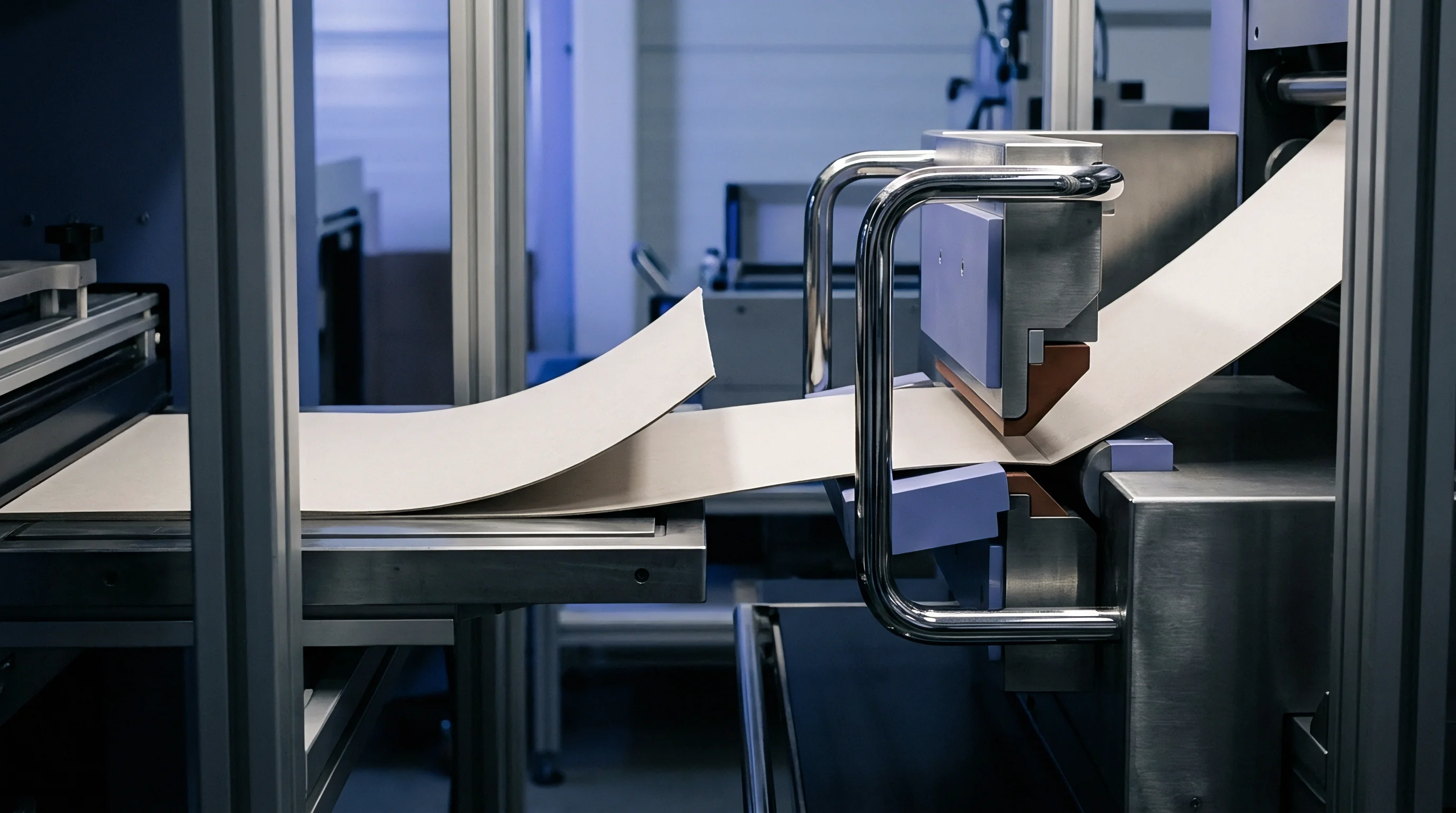
Coated Surface Rupture and Moisture Equilibrium
Barrier coatings and surface lamination films alter mechanical strain distribution across the crease zone. Extrusion-coated polyethylene barriers deform plastically under compressive load, buffering the underlying paper fibers. Biaxially oriented polypropylene films stretch substantially under tension, holding cracked clay coatings together invisibly.
Metallized polyester laminations behave differently. The vacuum-deposited aluminum layer fractures easily under tensile elongation, leaving micro-fissures that compromise vapor barrier properties even when the plastic carrier film remains intact.
Similar to composite wing spars in aerospace engineering where bonded layers distribute deflection stress to prevent catastrophic brittle failure, cartonboard plies must delaminate internally to absorb folding displacement. When internal delamination proceeds correctly, the central and back plies form a hollow bead inside the carton. The outer ply arches smoothly without fracture.
If the ply bond strength proves excessively high due to over-application of internal sizing starches, the board refuses to shear internally, forcing the outer plies to absorb all displacement energy until structural tearing occurs.

Troubleshooting Crease Cracking on High Speed Runs
Press operators follow a systematic troubleshooting procedure when creasing defects appear on running sheets.
- Audit substrate moisture content with a handheld capacitive moisture meter, confirming readings match the five to eight percent specification range.
- Inspect creasing rule profile edges under ten-times magnification, checking for steel burrs, mechanical chipping, or flattening along the contact tip.
- Verify channel alignment relative to cutting rules using carbon impression paper, confirming identical clearance on left and right matrix shoulders.
- Increase matrix channel width by 0.05 to 0.10 millimeters to relieve excessive tensile strain across the exterior coated liner.
- Exchange creasing rules for larger point dimensions to distribute bending radii over wider substrate zones.
- Adjust platen impression tonnage downward in increments of five tons until surface splitting ceases while maintaining bead formation.

Grain Direction Influence on Hinge Performance
Fiber alignment across the carton blank dictates rule selection on complex multi-panel cartons. Scores running parallel to the grain fold easily but exhibit low hinge stiffness, leading to panel bowing on automated cartoning lines. Scores running perpendicular to the grain show high folding resistance, demanding wider matrix channels and thicker creasing rules to prevent external fiber rupture.
Converters designing structural packaging position major carton body scores perpendicular to the grain to maximize stack compression strength, accepting the need for heavier creasing rules on those specific panels.
Platen pressure rises across wider profiles. When a layout combines 2-point scores parallel to the grain with 3-point scores across the grain, the die maker balances the rule heights. Rules with broader tips require slightly greater height to displace fiber volume into the matrix.
The knife cuts through the sheet. Meanwhile, the creasing rule creates the hinge. Imbalanced heights between cutting and creasing elements result in premature rule wear, fractured counter channels, and erratic blank delivery into the stripper section.
Incorrect rule selection ruptures the moisture barrier of the carton, causing packaging failure in chilled distribution chains and generating extensive customer reject claims.


Ledger
Tooling decisions directly affect converting economics through make-ready duration, running waste, and machine operating speeds. A standard flatbed die-cutter costs between 150 and 250 euros per machine hour to operate. Spending three hours tuning matrix channels, shimming low spots, and clearing score splits erodes job profitability.
Selecting the verified creasing rule thickness and matching counter matrix before burning the die board eliminates on-press experimentation. Proper tooling packages mount quickly, register instantly, and achieve target running speeds within fifty make-ready sheets.
Assumptions for a standard folding carton production run illustrate the commercial stakes. Take a run of 100,000 sheets running across a 106-centimeter flatbed die-cutter with eight cartons per sheet, totaling 800,000 units. The substrate is 450-micron coated virgin folding boxboard valued at 1,400 euros per metric ton.
Machine shop rate runs at 180 euros per hour. Make-ready waste with a pre-milled steel counterplate averages 150 sheets, while manual matrix alignment consumes 500 sheets. This difference represents 350 saleable sheets, saving 490 euros in raw board material on make-ready setup alone.
Standard commercial converting contracts mandate that dimensional carton variation across creased hinges must not exceed plus or minus 0.50 millimeters during automated cartoning.
Running waste on high-speed folder-gluers creates an even larger financial exposure. A gluer operating at 50,000 cartons per hour jams instantly when an under-creased blank fails to fold along the scoreline. Each jam causes machine stops lasting between five and fifteen minutes, destroying twenty to fifty blanks inside the folding section.
Gluer downtime costs 120 euros per hour in machine overhead, plus operator labor. If suboptimal creasing rule selection triggers four feeder jams per shift, the plant loses two operating hours, costing 240 euros in lost production time and 300 euros in damaged cartons.
| Tooling Specification | Make-Ready Duration (hours) | Make-Ready Waste (sheets) | Folder-Gluer Speed (cartons/hr) | Gluer Jam Rate (stops/shift) | Total Waste Cost (EUR) |
|---|---|---|---|---|---|
| Standard 2 pt Rule with Generic Matrix | 2.5 | 650 | 32,000 | 6.2 | 2,140 |
| Custom 2 pt Rule with Phenolic Counter | 1.2 | 200 | 45,000 | 1.8 | 680 |
| Milled Steel Plate with Matched 2 pt Rule | 0.8 | 120 | 52,000 | 0.4 | 290 |

Tooling Downtime and Matrix Replacement Costs
Pressrooms running abrasive recycled chipboard experience matrix wear within 30,000 impressions. Matrix channel shoulders round off under continuous platen friction, expanding the functional clearance and degrading crease definition. Replacing self-adhesive matrix strips mid-run consumes 45 minutes of die-cutter time, adding 135 euros in machine idle cost.
Phenolic counters survive up to 150,000 impressions without edge deterioration, while hardened steel counterplates exceed one million impressions. Investing an extra 800 euros in a dedicated steel counterplate repays its cost on any job running beyond 120,000 sheets.
Plant managers evaluate tooling investments by balancing initial tooling charges against total run waste. Steel dies built with laser-cut slots and calibrated creasing rules command higher upfront supplier invoices. However, cheap tooling packages built with inconsistent rule points and manual make-ready tapes generate scrap rates exceeding three percent across the full converting cycle.
On a 100,000-euro board order, that scrap spread represents 3,000 euros in wasted substrate, dwarfing the initial 500-euro price difference between budget and high-precision cutting dies.
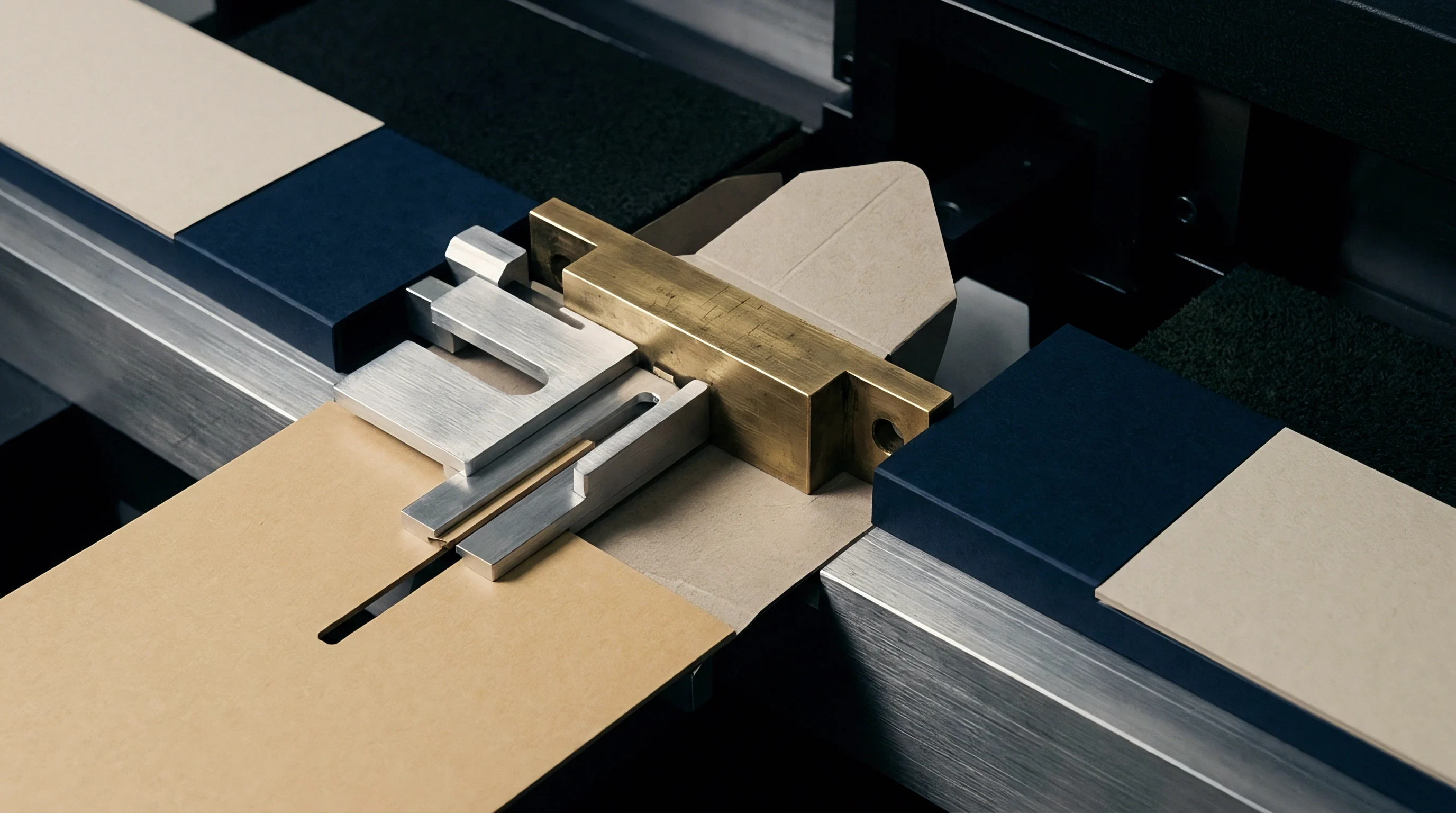
Gluing Line Waste and Jam Frequency
Folding carton converters handle customer rejection claims when finished boxes misbehave on client packaging lines. Pharmaceutical cartons running on blister cartoning machines at 400 packs per minute demand absolute crease uniformity. If a carton flap resists bending, the insertion pusher jams, stopping the packaging line and damaging product blisters.
Packaging contracts specify that opening force and ninety-degree bending resistance must remain within twenty percent of approved specifications. Uncontrolled rule thickness variations immediately breach these quality agreements.
- Documented board caliper variance exceeding five percent warrants a tooling review to prevent matrix channel pinching.
- Die cutting speed ceilings drop by fifteen percent when operators run oversized rules to compensate for poor matrix alignment.
- Recyclability certifications penalize converters who introduce high-tack adhesive tapes to anchor wandering matrix strips during production.
The desk cannot fully defend the widely cited figure that automated packing lines tolerate a maximum opening force variation of 150 millinewtons across all carton formats, as high-speed pharmaceutical machines demand much tighter limits while manual packing lines tolerate far wider swings; packaging buyers protect themselves by specifying opening force windows directly on technical drawings rather than relying on standard converter tolerances.
European packaging specifications incorporate DIN 55437-1 guidelines, which stipulate that crease bending resistance must remain between thirty and sixty percent of base board stiffness to prevent line stoppages.


Steel
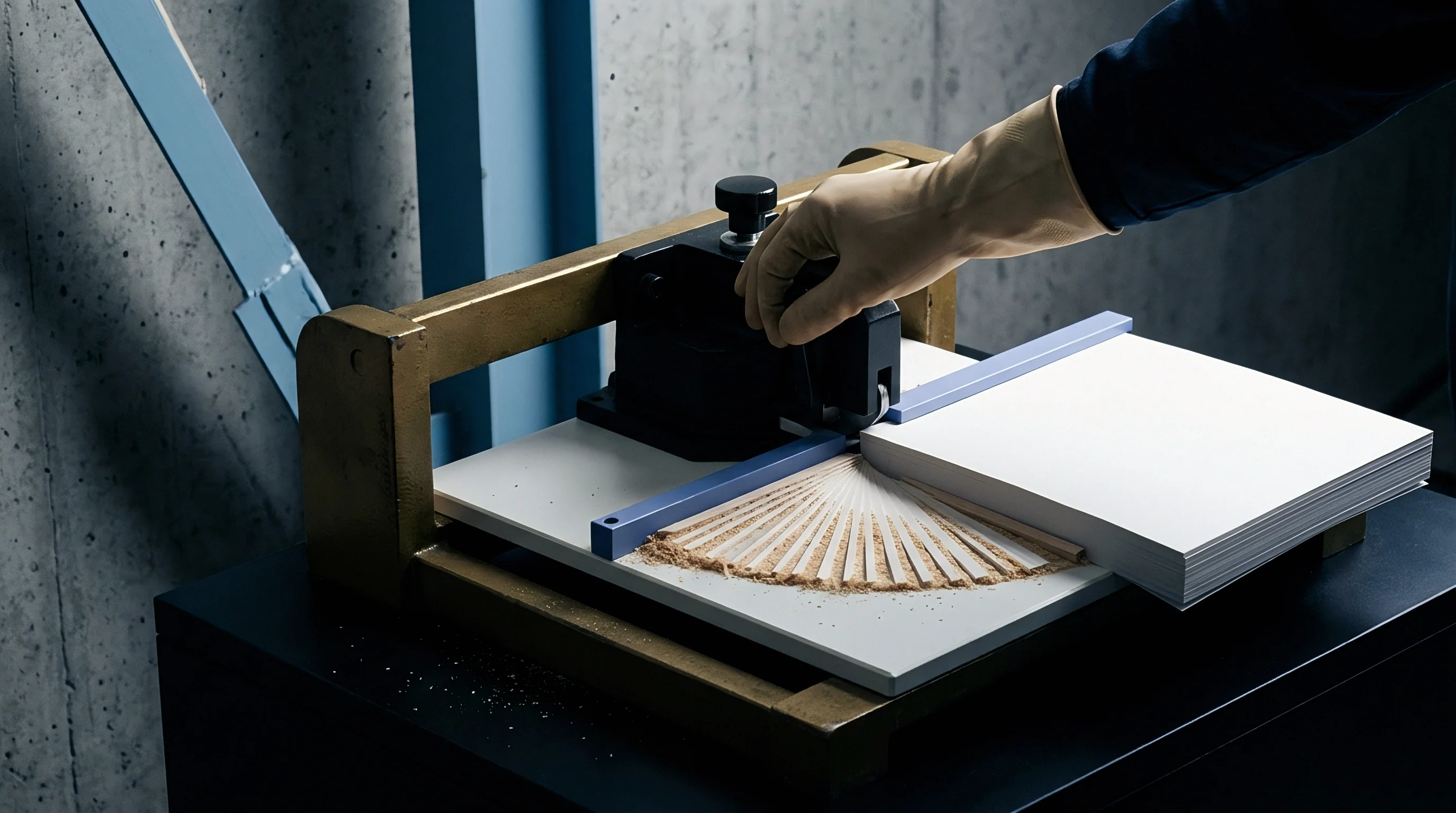
Manufacturing tolerances for creasing rules separate standard packaging dies from precision converting tools. Rule height tolerance must remain within plus or minus 0.02 millimeters across an entire sheet. If rule height fluctuates, platen pressure concentrates on high spots, cutting into the board while leaving low spots under-creased.
Folding carton dies demand exact heights. Rule thickness tolerance requires equal precision, held within 0.01 millimeters of nominal specifications to ensure uniform fit inside laser-cut die-board channels.
Die makers bend rules using automated computer numerical control bending equipment. Harder steels resist edge deformation during production but prove brittle during tight bending, cracking at sharp corners. Softer steels bend effortlessly into intricate contours but flatten rapidly under repetitive platen impacts.
Selecting the correct steel hardness balances fabrication capability against press longevity. Standard commercial rules exhibit hardness ratings between 35 and 40 Rockwell C, offering reliable bending properties for general folding carton layouts. Long-run packaging converters select rules induction-hardened along the working tip to 50 Rockwell C, preserving tip geometry across multi-million sheet contracts.

Profile Geometries and Edge Radii
Contact tips of creasing rules feature distinct geometric profiles tailored to specific converting requirements. Round profiles represent the industry default, presenting a smooth, semi-circular radius that minimizes surface scuffing on clay-coated boards. Flat profiles feature chamfered edges with a broad contact zone, ideal for displacing bulky corrugated flutes or heavy solid fiberboard.
Double-crease rules combine two narrow profiles onto a single steel body, creating parallel scorelines for thick, double-wall book wraps and luxury presentation boxes.
Specialty rules solve specific mechanical challenges on high-speed packaging lines. Perforation rules intersperse cutting teeth with creasing lands, creating tear strips and easy-open features on retail packaging. Crease-cut rules combine cutting and creasing edges at differing heights to initiate deep fold lines on dense barrier boards without complete separation.
Choosing edge profiles with smaller radii concentrates pressure, lowering the total platen tonnage required to crease rigid boxboards.

Hardness Ratings and Wear Resistance
Frictional wear degrades creasing rule tips during long production runs on abrasive substrates. Recycled boxboards contain silica particles and titanium dioxide pigments that grind against steel surfaces. Over 200,000 impressions, a standard round-edge rule flattens by 0.03 millimeters, increasing its effective width and reducing penetration depth.
Press operators compensate by increasing overall platen tonnage, which accelerates wear on cutting knives and overstresses press mechanical components. Harder steel resists premature rounding. Converting facilities track impression counts per die, retiring worn tooling before rule degradation damages carton foldability.
Laser kerf widths inside birch die boards match rule thickness down to the hundredth of a millimeter. Inserting a 3-point rule into a kerf cut for a 2-point rule splits the plywood, ruining die registration. Inserting a 2-point rule into a loose 3-point slot allows the steel to lean under impression load, producing slanted, off-center creases that skew carton panels during folder-gluer operations.
Tooling engineers document rule gauges, edge profiles, and steel hardness specifications on die drawings to guarantee identical replacement tooling when reordering production dies.