Optimizing Creasing Tool Geometry for Barrier Coated Boxboard Converting
Optimizing creasing geometry for barrier board requires expanding female channel width and applying polished male rule radii to prevent barrier film splitting.

Substrate
Folding boxboard engineered for liquid, moisture, or grease resistance relies on a multi-ply structural sheet combined with a thin polymer or aqueous dispersion barrier layer. How these layers accommodate rapid localized shear during conversion dictates machine performance. Solid bleached sulfate, folding boxboard, and coated unbleached kraft react differently under the compressive stress of scoring dies.
Bleached chemical pulps have high Z-directional tensile strength, while mechanical pulp layers in folding boxboard supply bulk and compressibility at the expense of internal bond strength. Adding a functional surface barrier introduces a non-porous, inextensible film that resists normal ply deformation during scoring.
Internal layer mechanics dictate how a rigid flat sheet transforms into a hinge. As the board penetrates the female channel, the upper liner experiences localized compression that forces central plies to delaminate along shear planes. Standard boxboard grades without functional coatings absorb these forces through moisture distribution and internal micro-fractures, protecting outer print surfaces.
Applying an aqueous acrylic dispersion or an extruded polyethylene barrier changes that surface elasticity. Polymer barrier coatings display elongation-at-break values between two percent and five percent for rigid dispersions, and up to two hundred percent for low-density polyethylene films under room-temperature conditions. When creasing tools engage the coated surface, the barrier must stretch without micro-fissuring, pinholing, or delaminating from the fiber.

Polymer Dispersion versus Extrusion Barrier Systems
Extruded polyolefins behave quite differently from water-based dispersion barriers under male tool penetration. Low-density polyethylene extrusion coatings form a continuous, rubbery matrix that yields elastically under male rule pressure, deforming into the channel and preserving water vapor barrier integrity even in narrow scoring geometries. Aqueous dispersions, applied via blade or air-knife coaters, use cross-linked polymer particles such as styrene-butadiene or synthetic acrylic lattices that dry into thin, brittle films between three and eight micrometers thick.
Lacking the structural compliance of extruded polyolefins, these water-based coatings tend to fracture under high tensile stress along the outer fold line.
Aqueous barrier films are sensitive to substrate surface roughness and binder penetration depth. If a water-based dispersion sinks too deep into the top fiber layer, the polymer anchors firmly but creates a rigid outer skin that cracks during ninety-degree or one-hundred-and-eighty-degree folding. Poor adhesion leads to the opposite problem: the film peels away from the top liner and flakes along the crease.
Unbleached kraft substrates carrying high-pigment dispersion barriers show Z-directional tensile failures during low-temperature converting. Measuring internal bond strength via TAPPI T 569 using a Scott Bond tester provides an initial indicator of whether a sheet can endure internal shear delamination without destroying its barrier cap.
At 23 degrees Celsius and 50 percent relative humidity, a solid bleached board with an internal bond strength below 110 Joules per square meter exhibits outer-liner micro-tearing during a ninety-degree fold.
Coating grammage directly influences shear resistance. Light dispersion applications between four and six grams per square meter yield grease resistance without sacrificing flexural recovery. Heavier applications, exceeding twelve grams per square meter for liquid barrier duties, form a rigid top shell that resists male rule penetration.
How that top shell behaves under load depends on the physical properties of the underlying virgin or recycled fiber furnish. Key parameters evaluated during incoming quality control audits include:
- Z-Directional Tensile Strength measured per ISO 15754 determines the internal layer strength necessary to sustain controlled ply separation without surface layer tearing.
- Scott Bond Energy evaluated according to TAPPI T 569 quantifies the total energy absorbed during rapid ply delamination across the sheet thickness.
- Water Vapor Transmission Rate recorded under ISO 15106 at thirty-eight degrees Celsius and ninety percent relative humidity establishes baseline barrier continuity before tool impact.
- Kit Test Value conducted per TAPPI T 559 measures surface grease resistance across smooth and folded board samples using aggressive solvent mixtures.
- Conditioned Caliper Uniformity measured under ISO 534 verifies sheet thickness stability across the entire web width within a three percent margin.

Internal Bond Strength and Ply Delamination Physics
Delamination in the middle plies absorbs compressive energy and prevents outer liner tensile failure during folding. In folding boxboards with mechanical pulp cores, weak hydrogen bonds between short mechanical fibers break under pressure. This controlled failure forms a soft, uniform internal bead that fills the female matrix channel.
Solid bleached boards made entirely of long chemical fibers require more energy to delaminate, producing a firmer internal hinge. If internal bond strength is too high, compressive forces fail to separate the inner plies, redirecting stress outward to the barrier surface and splitting the polymer film along the crease axis.
Board moisture alters fiber flexural modulus and layer separation behavior. Moisture plasticizes the cellulose matrix, lowering the energy needed for internal delamination. Standard protocol ISO 187 requires conditioning samples at twenty-three degrees Celsius and fifty percent relative humidity.
When converted at ambient humidities below thirty-five percent, sheets lose internal moisture quickly, turning chemical fibers brittle and raising Scott Bond energy values. Dry board creased with standard profiles suffers immediate barrier failure, showing hairline fractures under ten-times optical magnification. Controlling relative humidity on the plant floor preserves the viscoelastic balance of both furnish and barrier film.
Substrate bulk, expressed in cubic centimeters per gram per ISO 534, is a critical variable in tool calculations. High-bulk boards have lower-density cores that yield readily under tool load, permitting wider clearance in the matrix channel. Conversely, low-bulk, highly calendered sheets offer strong resistance to male rule penetration, transferring heavy pressure to the female matrix walls.
Formulas designed for standard folding boxboard fail when applied to dense, calendered liquid packaging board carrying extrusion or dispersion barriers. Questions remain about how low-temperature storage affects the viscoelastic recovery of water-based dispersion polymers when converting lines run at ambient humidities below thirty percent.

Rule
Male creasing elements drive paperboard into the female groove, initiating controlled internal ply shear along the fold line. Steel creasing rules require precise width, height, and tip geometry to process barrier-coated boxboard without cutting surface fibers. Standard rules feature flat tops, single-bevel edges, or fully radiused crowns.
On uncoated folding boxboard, standard rules with slightly dressed edges work adequately. Applied to barrier-coated substrates, however, narrow-radius rules cut the protective film. The male rule profile functions as a forming tool, stretching the top polymer film smoothly while pushing core plies into the channel.
Steel rule thickness selection follows standard printer points, where one point equals 0.353 millimeters or 0.014 inches. Typical rule thicknesses include two-point (0.71 mm), three-point (1.05 mm), and four-point (1.42 mm) profiles. Processing thick barrier board above four hundred micrometers requires four-point rules to distribute penetration force across a wider surface.
Sharp shoulders on the male rule concentrate stress and shear thin dispersion coatings; equipping die-cutting plates with fully radiused rules eliminates localized mechanical shear along that contact zone to prevent coating fractures.
Male Tooling Profile and Edge Radiusing Mechanics
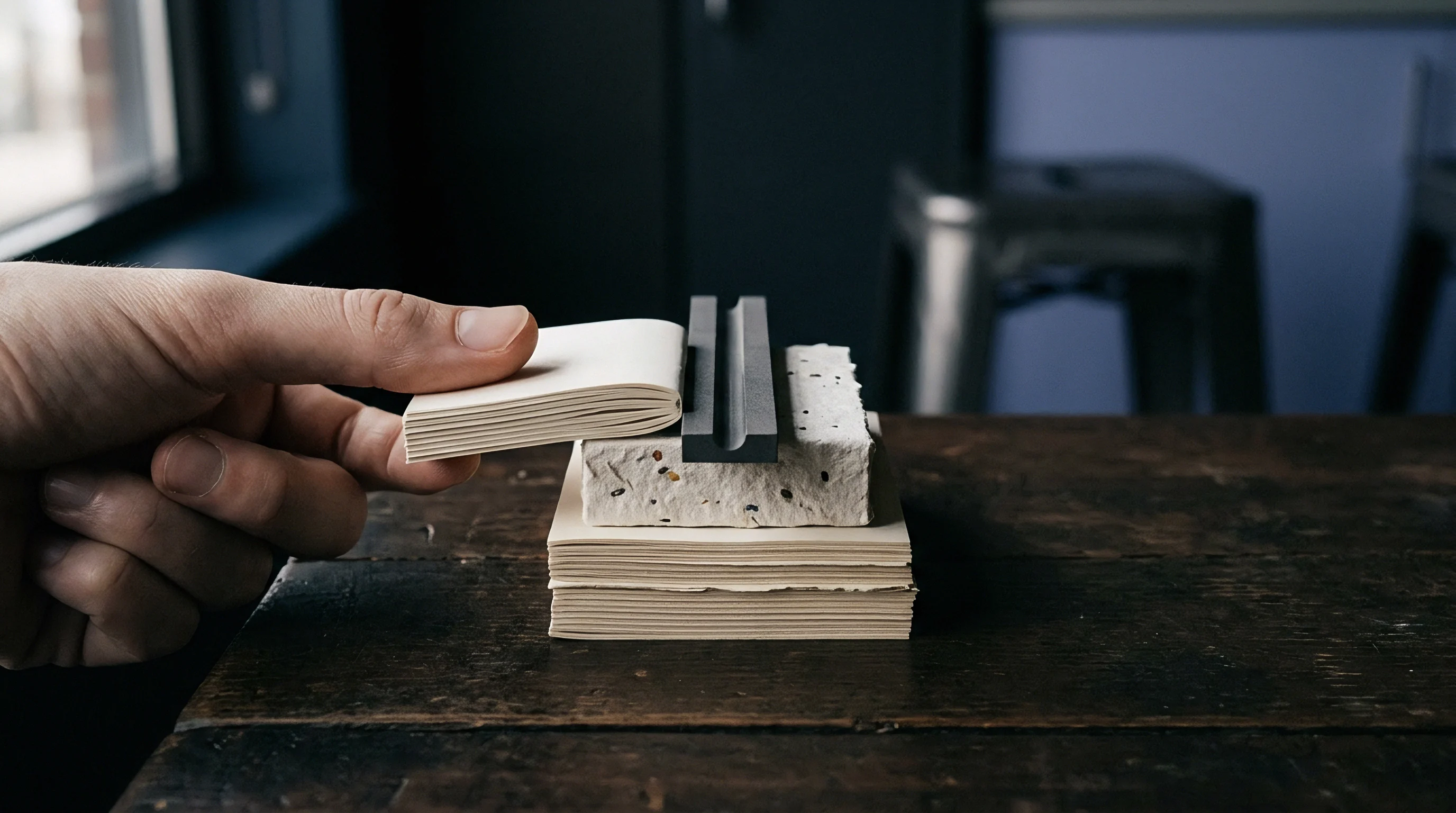
Tip radius dimensions on male creasing rules dictate the strain rate applied to surface coatings. A sharp tip with a radius below 0.20 millimeters concentrates force into a narrow contact line, exceeding the elongation limit of acrylic or styrene-butadiene dispersion films. Increasing the tip radius to between 0.35 and 0.70 millimeters spreads compressive force across a parabolic arc.
This distribution slows the elongation strain rate of the polymer film, permitting plastic deformation without micro-fissuring. On a Bobst die-cutter running at 7,500 sheets per hour, this profile maintained grease barrier integrity post-folding without pinholing.
Specialized male rule profiles feature polished micro-finishes along the working edge. Standard ground steel rules retain microscopic machining marks that act like saws against polymer coatings under pressure. Polishing male rule crowns down to a surface roughness average below 0.2 micrometers reduces friction as the rule draws board into the female channel.
High friction pulls the barrier film laterally, stretching the polymer away from its fiber anchorage and creating micro-voids that ruin liquid proofing. Table 1 details recommended male rule geometries based on substrate caliper and coating chemistry.
| Coating Category | Board Caliper (mm) | Rule Thickness (Pt) | Rule Tip Radius (mm) | Crown Surface Finish (Ra) |
|---|---|---|---|---|
| Aqueous Dispersion | 0.25 to 0.35 | 2 Pt (0.71 mm) | 0.35 mm | 0.2 micrometers |
| Aqueous Dispersion | 0.36 to 0.50 | 3 Pt (1.05 mm) | 0.50 mm | 0.2 micrometers |
| PE Extrusion | 0.30 to 0.45 | 2 Pt (0.71 mm) | 0.35 mm | 0.4 micrometers |
| PE Extrusion | 0.46 to 0.65 | 3 Pt (1.05 mm) | 0.60 mm | 0.4 micrometers |
| PLA Bio-Polymer | 0.35 to 0.55 | 3 Pt (1.05 mm) | 0.55 mm | 0.1 micrometers |
| Test conditions: Creasing executed at 23 degrees Celsius, 50 percent relative humidity under standard die-cutting platen pressure per ISO 187. | ||||

Stepwise Case Analysis of Crease Line Configuration
A converting facility processed 350 gram per square meter folding boxboard carrying an aqueous dispersion barrier for fast-food greaseproof packaging. The initial tooling setup used a standard 3 Pt (1.05 mm) flat-top steel rule with a standard pressboard counter matrix, running at six thousand sheets per hour. Quality control testing via TAPPI T 559 revealed catastrophic failure along the primary score lines: red dyed solvent penetrated instantly, yielding a Kit rating of 1 instead of the required Kit 12.
Optical analysis showed continuous line cracks traversing the acrylic barrier.
Replacing the standard 3 Pt rule with a custom ground 3 Pt rule featuring a 0.50 millimeter continuous radius tip reduced strain on the barrier surface. Platen penetration depth was backed off by 0.05 millimeters to limit board crushing. Re-testing under TAPPI T 559 showed immediate improvement, holding Kit 10 along ninety-degree folds.
To reach Kit 12, the team overhauled female channel dimensions, widening the groove to prevent lateral pinching of the broad rule tip. Modifying male rule tip radiusing proved to be only one part of a balanced setup.
Male creasing elements for water-based dispersion barrier boards require a tip radius equal to at least half the total sheet caliper to prevent surface shearing.
Tooling engineers should audit creasing setups systematically when switching between standard board grades and barrier-coated stocks. Adjusting tool geometry during setup follows this sequence:
- Measure Base Sheet Caliper using an ISO 534 compliant micrometer across ten web points to establish true baseline thickness.
- Identify Barrier Coating Elongation limits from supplier technical datasheets to distinguish high-stretch polyolefins from low-stretch dispersions.
- Select Male Rule Thickness ensuring rule width matches or exceeds base caliper for dense chemical board furnish types.
- Apply Radiused Tip Profiles specifying polished crowns with radii between 0.35 and 0.70 millimeters depending on coating brittleness.
- Verify Platen Penetration Depth using carbon impression paper to confirm uniform contact without over-penetrating sheet structure.
Rule height adjustment requires precision on flatbed die-cutters. Creasing rules must stand lower than surrounding cutting rules by the board caliper plus matrix base thickness. If rules stand too high, the male rule pinches the board against the bottom of the female groove, crushing the furnish and splitting the barrier layer.
Steel shim packs placed under cutting dies allow adjustments in steps of 0.025 millimeters. Fine-tuning penetration depth prevents bottom-out crushing while ensuring enough penetration to trigger core ply delamination. A rounded tip with a polished surface finish helps maintain barrier continuity across heavy grammages.

Matrix
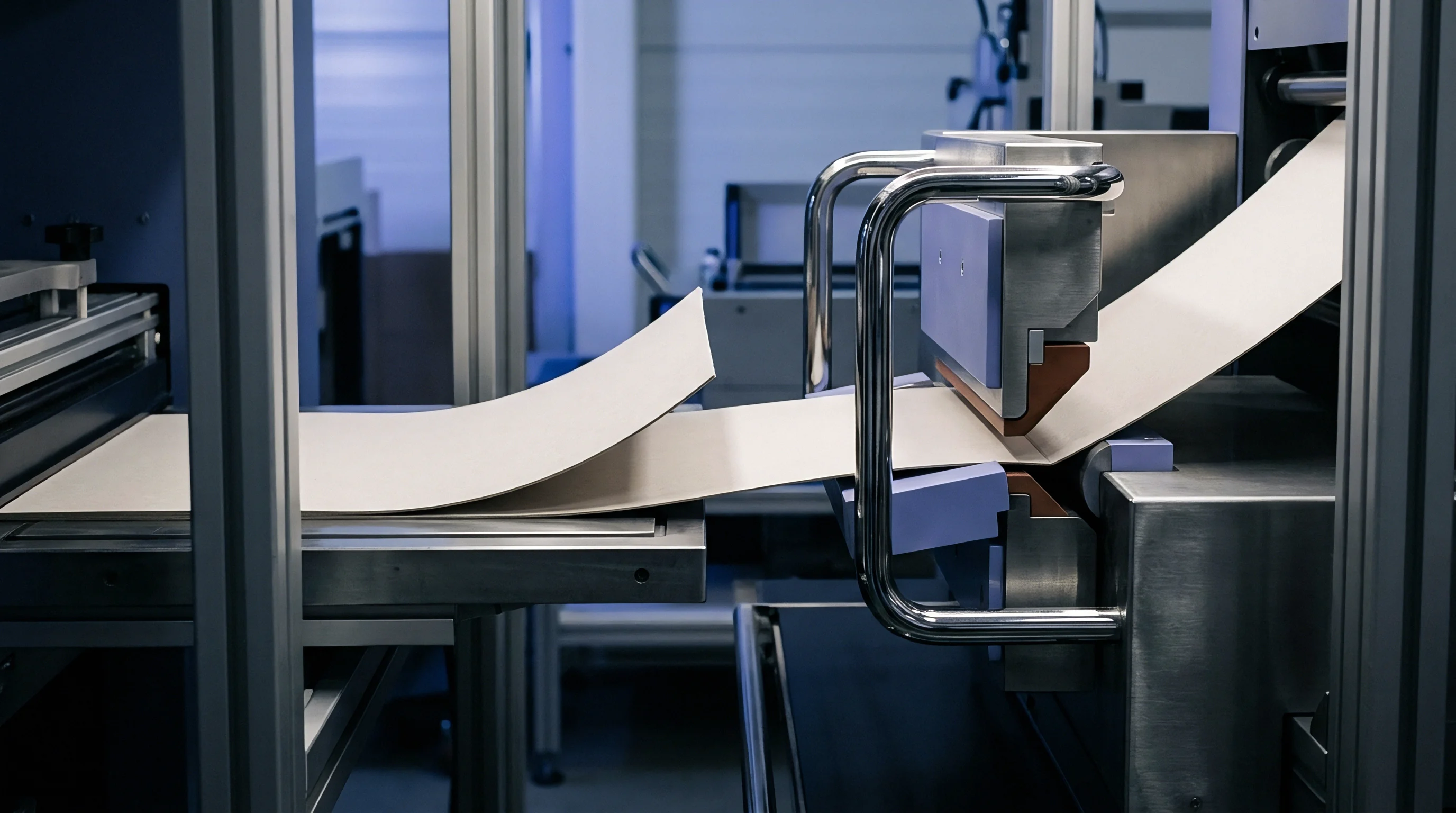
Female counter channels supply the lateral restraint and volumetric clearance needed for internal bead displacement during creasing. Tooling choices for matrix materials include vulcanized fiber pressboard, milled steel counter plates, or phenolic channel strips. Pressboard offers low tooling costs and fast setup for short runs, but fiber channels wear down rapidly under high platen pressure, widening the channel and degrading fold precision over long runs.
Milled steel counter plates provide dimensional stability across millions of impressions, maintaining tight channel tolerances for delicate barrier coatings.
Calculating female channel dimensions relies on formulas based on sheet caliper and male rule thickness. The standard formula for female channel width wm is expressed as:
wm = tr + 1.5 h + δ
where tr equals male rule thickness, h equals board caliper, and δ represents a clearance factor tailored to coating compressibility. For standard uncoated folding boxboard, δ is zero, giving the baseline formula wm = tr + 1.5 h. Barrier-coated boards require an expanded clearance factor δ between 0.10 millimeters and 0.25 millimeters.
Widening the channel prevents lateral pinching of the polymer coating against the upper shoulders of the female matrix.
Female Channel Width and Depth Calculations
Channel depth dm must accommodate the displaced board volume without compressing it against the bottom of the matrix groove. Baseline channel depth calculation uses dm = h, matching board caliper directly. Highly calendered barrier boxboards require deeper channels, calculated as dm = 1.1 h to 1.2 h.
If the groove is too shallow, the male rule drives the sheet into the steel platen base, crushing the fiber core and fracturing brittle acrylic dispersion coatings. Depth calculations must account for the adhesive backing tape, which adds approximately 0.05 millimeters to the profile.
Inadequate channel width forces board edges against upper matrix shoulders at steep entering angles. This creates high shear stress along both sides of the fold line, damaging the barrier film. Table 2 outlines recommended female channel dimensions and tolerance bands for various barrier boxboard grades calculated per standard converting equations.
| Substrate Type | Caliper h (mm) | Rule Thickness tr (mm) | Channel Width wm (mm) | Channel Depth dm (mm) |
|---|---|---|---|---|
| Aqueous FBB | 0.30 | 0.71 (2 Pt) | 1.25 to 1.30 | 0.33 to 0.35 |
| Aqueous FBB | 0.45 | 1.05 (3 Pt) | 1.85 to 1.95 | 0.50 to 0.52 |
| PE Coated SBS | 0.35 | 0.71 (2 Pt) | 1.30 to 1.35 | 0.38 to 0.40 |
| PE Coated SBS | 0.50 | 1.05 (3 Pt) | 1.95 to 2.05 | 0.55 to 0.58 |
| Kraft Barrier | 0.60 | 1.42 (4 Pt) | 2.45 to 2.60 | 0.68 to 0.72 |
Which Channel Shoulder Radius Prevents Barrier Film Shearing?
Upper entry shoulders of the female matrix groove exert heavy mechanical force during initial creasing. Standard milled steel channels feature sharp, right-angled shoulders that slice into the paperboard’s lower liner. On board coated on the reverse side, sharp shoulders split the lower barrier film, destroying liquid proofing.
Rounding the upper edges with a radius between 0.15 millimeters and 0.30 millimeters reduces edge shear stress during female penetration.
Chamfered matrix shoulders let fibers slide smoothly into the creasing channel without snagging. High-speed die-cutters running above eight thousand sheets per hour generate heat from continuous friction. Un-chamfered edges concentrate that heat along narrow contact lines, softening low-density polyethylene barriers and smearing film along channel walls.
Applying smooth chamfers or radiused shoulders to milled steel counter plates eliminates heat-induced film drag and keeps crease lines clean.
Milled steel counter plates maintain dimensional stability across long production runs where composite pressboard channels widen under heat and friction.
Matrix positioning relative to male rules requires precise centerline alignment. Lateral displacement over 0.05 millimeters creates asymmetrical crease profiles, stretching one side of the crease line excessively while the opposite side bunches. The over-stretched side suffers immediate coating rupture, while the bunched side forms an uneven hinge that jams high-speed folder-gluers.
Laser-milled steel counter plates pinned directly to die-chase location holes guarantee male-to-female alignment across the entire impression area. Aggressive scoring with un-chamfered steel grooves can slice through barrier board across long production runs, destroying liquid-holding integrity.
Deformation
Strain distribution across sheet thickness dictates whether a folded carton maintains barrier integrity or develops micro-fissures. Under male tool impact inside a female channel, paperboard experiences multi-axial strain fields: the layer facing the rule undergoes compression, while the reverse layer facing the matrix undergoes tensile elongation. Mid-plane fiber layers experience intense shear that breaks hydrogen bonds and allows individual plies to slide over one another, forming the characteristic double-hinge creasing bead.
Functional barrier coatings sit on either the outer tensile side or inner compressive side, depending on package construction. Liquid packaging usually places the barrier on the interior surface, subjecting the film to compression during initial creasing and severe tension during final folding. Water-based dispersion coatings have low elongation capacity under tension; if the outer fiber layer stretches beyond three percent elongation during folding, the film fractures along microscopic boundary lines between pigment particles and binder.

Shear Mechanics and Delamination Bead Formation
Successful creasing deforms the middle plies without damaging outer surface skins. Mechanical energy delivered by the male rule must exceed the Z-directional shear strength of central plies while remaining below the ultimate tensile strength of coated outer liners. If internal delamination fails, the sheet acts as a solid beam; folding it forces the outer liner to absorb all flexural strain, splitting the top liner and fracturing the film along the fold line.
The internal delamination bead acts as a shock absorber, relieving strain on outer barrier layers. High-density solid bleached sulfate sheets generate tight, localized shear zones that yield narrow crease beads. Folding boxboards with mechanical pulp cores spread shear forces over a wider zone, producing broad, flexible beads.
Adjusting tool geometry forces the delamination zone to form at specific depths in the furnish, protecting the barrier coating from peak flexural stress.
Barrier Integrity Testing Protocols Post Folding
Evaluating score line performance requires standardized testing immediately after creasing and one-hundred-and-eighty-degree folding operations. Visual inspection under white light cannot detect microscopic pinholes or micro-fissures that degrade shelf life. Standard testing protocols combine chemical dye penetration, liquid absorption, and gas permeation measurements to quantify barrier retention across converted crease lines.
Grease resistance evaluation uses TAPPI T 559 Kit testing protocols applied directly to ninety-degree and one-hundred-and-eighty-degree fold intersections. Test solutions with varying ratios of castor oil, toluene, and heptane are dropped onto folded crease lines. The Kit rating corresponds to the highest-numbered solvent mixture that remains on the crease for fifteen seconds without penetrating the board.
A drop in Kit rating from flat baseline to folded crease indicates barrier failure from tool strain. Standard testing follows these steps:
- Cut representative paperboard samples containing primary creased fold lines from die-cut sheets according to ISO 187 sampling guidelines.
- Fold the conditioned samples one hundred and eighty degrees along the crease axis using a standard two-kilogram rubber-covered manual roll down roller.
- Unfold the sample to a ninety-degree angle and secure the specimen flat on a clean non-absorbent testing bench surface.
- Apply one drop of TAPPI T 559 Kit solution onto the fold axis and start a precision stopwatch immediately.
- Wipe the chemical solution away after exactly fifteen seconds using clean lint-free absorbent tissue paper.
- Inspect the reverse side of the board for liquid stain penetration to record pass or fail status for that specific Kit solution number.
- Repeat the process using higher Kit numbers until chemical penetration occurs, recording the highest passing Kit value.
According to TAPPI T 559 conditions, grease resistance ratings dropping by more than two kit numbers after folding indicate severe barrier film fracture.
Moisture barrier continuity relies on Cobb testing per ISO 535 modified for creased surfaces, alongside MOCON water vapor transmission testing per ASTM F1249. A creased sheet section containing a fifty-millimeter score line is placed in a test cell held at thirty-eight degrees Celsius and ninety percent relative humidity. Micro-cracks along the crease line allow water vapor to bypass the polymer barrier, driving up transmission rates relative to flat control samples.
Liquid barrier applications for chilled juice or milk cartons require zero dye stain penetration after five minutes of exposure to a one percent solution of methyl blue dye in isopropyl alcohol. Micro-fissuring during high-speed folding frequently stems from poor moisture equilibrium rather than low film elongation.

Tolerance
Operational variations on the converting floor directly alter the creasing gap. Dynamic deflection of flatbed platen presses under load, thermal expansion of die-chases during long runs, and mechanical wear of female matrix channels shift the geometric relationship between male rules and female grooves. Running a die-cutter above eight thousand sheets per hour generates vibration and frame flexure that can shift tooling alignment by up to 0.04 millimeters, destroying narrow clearance margins required for brittle dispersion barrier coatings.
Board caliper variations across a single mill roll present another challenge. Standard mill specifications allow caliper tolerances within plus or minus five percent of target thickness. On 0.40 millimeter board, five percent variation creates a 0.02 millimeter thickness swing.
When caliper drifts high, effective clearance inside the female channel shrinks, raising compression and slicing surface coatings. When caliper drifts low, internal shear forces drop, preventing complete delamination and leaving stiff, poorly defined hinges that distort finished cartons.

Wear Dynamics and Tooling Displacement Control
Female matrix channels made from synthetic resin or composite pressboard wear rapidly under continuous board friction. Paperboard furnishes contain abrasive mineral fillers like calcium carbonate and titanium dioxide for opacity and brightness. These mineral particles act as grinding agents, scouring channel shoulders during tool penetration.
As shoulders wear down, matrix width expands, causing crease lines to soften and lose definition over time. Table 3 details matrix material performance and wear progression during high-volume converting runs.
| Matrix Material Class | Useful Tool Life (Impressions) | Channel Width Wear (mm) | Barrier Failure Risk Point | Relative Tooling Cost |
|---|---|---|---|---|
| Standard Pressboard Tape | 25,000 to 50,000 | + 0.08 mm | At 35,000 impressions | 1.0 x (Baseline) |
| Phenolic Composite Channel | 100,000 to 250,000 | + 0.03 mm | At 180,000 impressions | 2.8 x Baseline |
| Milled Steel Counter Plate | 1,000,000 to 3,000,000 | + 0.005 mm | Negligible over run | 8.5 x Baseline |
| Through-Hardened Steel Plate | 5,000,000+ | < 0.002 mm | Zero wear failure | 14.0 x Baseline |
Commercial Economics and Landed Sheet Yields
Tooling strategy and material selection directly drive the total landed cost per thousand delivered cartons. Buyers sometimes focus narrowly on initial die tooling expenses, opting for low-cost pressboard matrix tape over milled steel counter plates. Pressboard tape degrades after forty thousand impressions, widening channels and triggering micro-fissures along dispersion barrier crease lines.
Waste during folding-gluing operations can then exceed three percent of job volume, erasing initial tooling savings through rejected pallets and customer claims.
Investing in precision-milled steel counter plates locks in channel tolerances across multi-million carton production contracts. Milled plates eliminate manual press adjustments, cutting make-ready times from two hours down to twenty minutes. Reduced setup waste saves valuable barrier-coated substrate tonnage that would otherwise enter the scrap stream.
Specifying channel depth tolerances in supply agreements maintains consistency across converting locations running identical packaging formats.
Managing converting performance across global supply chains requires clear technical standards in purchasing contracts and equipment specs. Mill certificates must guarantee caliper uniformity within plus or minus three percent and Scott Bond values within defined bands. Converting plants should test conditioned board samples during incoming inspection before mounting die-cutting tooling.
Standard purchasing agreements specifying maximum allowable crease stiffness variations within plus or minus ten percent under ISO 5628 enforce strict supplier compliance on substrate bulking uniformity.