Calculating Interfacial Shear Delamination Thresholds in Aqueous Dispersion Barrier Coated Multi Ply Folding Boxboards
Interfacial shear delamination in dispersion-coated folding boxboards occurs when converting flexure stresses exceed polymer-fiber bond fracture energy.

Ply

Substrate Architecture across Layered Boxboard Furnishes
Bleached chemical pulp layers sandwich a thick core of mechanical fibers to establish structural stiffness in folding boxboard constructions. This multi-layer arrangement generates high bending stiffness at low total weight by placing dense, high-modulus chemical pulp on the outer faces where flexural stresses reach their peak. The middle furnish layer consists of stone groundwood or thermomechanical pulp, characterized by short, stiff fibers and low internal bonding strength.
Z-directional tensile strength varies through the thickness of the board sheet, dropping to its lowest value within the bulky mechanical middle layer. When an aqueous dispersion barrier coating is applied to the top chemical pulp layer, the stiff polymer film creates a sharp structural boundary at the surface fiber network.
The coating application introduces synthetic latex particles, waterborne acrylics, or bio-based polymers that fill surface pores and form a continuous film. Polymer chains penetrate into the upper fiber network to a depth determined by baseboard absorbency, coating solids content, viscosity, and application pressure. Penetration depth creates an interphase zone where wood fibers are locked inside a rigid polymer matrix.
This composite surface layer exhibits a flexural modulus significantly higher than the underlying fiber furnish, altering the distribution of mechanical forces during converting.
Aqueous dispersion barrier polymers form a stiff surface skin that alters the shear distribution across underlying fiber networks during mechanical deformation.
Interfacial integrity hinges on the balance between coating film cohesion, fiber-to-polymer adhesion, and internal fiber-to-fiber bond strength within the upper chemical layer. Standard folding boxboard formulations utilize surface sizing and starches to reinforce the top chemical ply against surface picking. Aqueous dispersion barrier formulations generate higher lateral film tension during drying and flexure than conventional pigment-clay coatings, transferring converting stress directly into the fiber layer underneath.
| Furnish Layer | Fiber Composition | Density (g/cm³) | Z-Tensile Strength (kPa) | Shear Modulus (MPa) |
|---|---|---|---|---|
| Top Layer | Bleached Kraft Hardwood/Softwood | 0.82 | 410 | 310 |
| Upper Middle Layer | Thermomechanical Pulp (TMP) | 0.52 | 180 | 120 |
| Lower Middle Layer | Stone Groundwood (SGW) | 0.48 | 160 | 105 |
| Bottom Layer | Bleached Chemical Kraft | 0.78 | 380 | 280 |

Aqueous Dispersion Topography and Polymer Penetration Depth
Dispersion formulations wet individual surface fibers before film formation locks the polymer matrix. Surface roughness, measured via Bendtsen or Parker Print Surf methods, dictates the uniformity of the applied liquid film. Latexes with glass transition temperatures below ambient drying temperatures coalesce into non-porous membranes, while higher glass transition polymers demand coalescing aids to achieve film continuity.
The boundary between the hydrophobic synthetic barrier skin and the hydrophilic cellulosic network remains the primary focus of shear stress concentration.
When mills increase dispersion coating weight to improve water vapor or grease resistance, total polymer thickness increases while relative penetration depth decreases. Excessive coating thickness concentrates strain energy at the polymer-fiber boundary during scoring and folding. Increasing surface starch pick values may reduce top-layer lifting, but this measure does not prevent internal shearing within the mechanical core directly beneath the chemical skin.


Delamination
Shear Stress Distribution at the Polymeric Boundary
Forces applied during scoring, folding, and gluing generate complex stress fields inside multi-layer paperboard structures. The interfacial region between the barrier film and the top furnish experiences both transverse compression and longitudinal shear. When the boxboard sheet undergoes bending, the outer barrier coating suffers tensile elongation while the internal furnish layers undergo inter-ply sliding.
The interfacial shear stress, denoted as tau, reaches a critical value along the boundary where elastic moduli mismatch is highest. Evaluating this stress distribution requires treating the coated board as a multi-layered laminate subject to Classical Laminated Plate Theory. The transverse shear force V acting on a cross-section of width b creates an interfacial shear stress governed by the material properties of the individual furnish layers and the coating film.
Mathematical modeling of this stress state utilizes the beam shear formula modified for composite plies:
tau = (V Q) / (I b)
In this expression, Q represents the first moment of area of the outer dispersion coating layer relative to the neutral axis of the multi-ply composite, while I represents the second moment of area of the entire multi-ply cross-section. The maximum shear stress occurs at the neutral plane, but a sharp stress peak emerges at the dispersion coating interface due to the abrupt step-change in elastic shear modulus from polymer to fiber network.
Measured interfacial shear failure occurs at 1.42 MPa when conditioned at 23 C and 50 percent relative humidity under ASTM D3165 lap shear geometry.

Mathematical Formulation of Interfacial Shear Failure
Energy release rate criteria provide a fracture mechanics model for coating separation. The strain energy release rate G characterizes the mechanical energy available per unit area of crack growth. Failure initiates when the total strain energy release rate equals or exceeds the critical energy release rate G_c of the interface or the adjacent mechanical ply furnish.
The total energy release rate splits into Mode I tensile opening and Mode II in-plane shear components:
G = G_I + G_II
For score line bending, Mode II in-plane shear dominates crack propagation at the barrier interface. Calculating the critical shear delamination threshold tau_c involves relating the critical Mode II fracture energy G_IIc to the equivalent shear modulus E_eq and effective flaw size a_0 within the boundary region:
tau_c = sqrt( (G_IIc E_eq) / (pi a_0) )
The flaw size a_0 corresponds to un-wetted fiber pits, micro-bubbles, or uncoated valleys along the rough paper surface. Higher surface roughness creates larger effective flaw sizes, reducing the critical interfacial shear delamination threshold. Delamination occurs when external converting stress exceeds tau_c, triggering catastrophic separation of the barrier film from the furnish core.
The exact proportion of mechanical strain energy absorbed by plastic deformation of the polymer coating versus brittle fracture of mechanical pulp fiber bonds remains difficult to isolate across dynamic speed variations on commercial packaging lines.


Bench

Standardized Shear Testing Vs Z-Directional Tensile Dynamics
Laboratory assessment of ply bonding traditionally relies on internal bond strength tests like the Scott Bond impact method covered by TAPPI T 569. Standard Scott Bond procedures measure total energy absorbed during dynamic out-of-plane impact delamination. The impact pendulum applies combined tensile and shear stress at high speed, obscuring the precise interfacial shear threshold of a surface coating.
Determining interfacial shear delamination thresholds requires isolated shear loading methods. Double-notch shear specimens, tested under ASTM D3165 or ISO 11003-2 geometry, isolate in-plane shear forces along a defined plane. Z-directional tensile tests following ISO 15754 or TAPPI T 541 evaluate perpendicular pulling resistance, providing a baseline z-strength metric for comparing directional anisotropy within the multi-ply structure.
- Cut test coupons to 25.4 mm width and 150 mm length with long axis aligned to machine direction.
- Condition samples at 23 degrees Celsius and 50 percent relative humidity for a minimum of 24 hours under ISO 187 rules.
- Precision-score counter-notches through opposing faces to establish an isolated 12.5 mm overlapping test zone centered on the dispersion barrier boundary.
- Clamp coupon ends in pneumatically driven tensile grips applying 0.5 bar clamping pressure to prevent end slipping.
- Apply uniaxial extension at a constant crosshead velocity of 1.0 mm/min until complete interfacial separation occurs.
- Record peak load and plot stress-strain curves to identify initial yield, micro-cracking, and ultimate shear fracture.
- Inspect fractured surfaces under 40x optical magnification to verify whether failure occurred along the coating interface or within the mechanical furnish core.

How Does Scott Bond Testing Correlate with Interfacial Shear?
Impact energy values from Scott Bond testing do not convert linearly into interfacial shear strength figures. Scott Bond results reflect the bulk toughness of the weakest ply layer, usually the bulky groundwood middle core, rather than the localized adhesion of a surface coating. A boxboard with high Scott Bond impact resistance can still undergo surface delamination if the dispersion film exhibits poor specific adhesion to top chemical fibers.
| Test Method | Governing Standard | Primary Loading Mode | Measured Parameter | Sensitivity to Barrier Interface |
|---|---|---|---|---|
| Scott Bond Impact | TAPPI T 569 / ISO 16260 | High-Speed Mixed Mode | Energy Absorbed (J/m²) | Low |
| Z-Directional Tensile | ISO 15754 / TAPPI T 541 | Pure Transverse Tension | Tensile Stress (kPa) | Moderate |
| Double-Notch Shear | ASTM D3165 / ISO 11003-2 | In-Plane Pure Shear | Interfacial Shear (MPa) | High |
| 90-Degree Peel Test | ASTM D6862 | Peel / Tensile Mismatch | Peel Force (N/m) | High |
Double-notch lap shear testing provides precise stress-strain metrics specifically isolated to the coating-paper interface. Tensile testing machines executing this protocol operate at controlled crosshead speeds, eliminating kinetic impact variability. Data captured during low-speed shear testing enables direct calculation of tau_c in absolute pressure units (MPa).
Technical specifications referencing ISO 15754 without specifying crosshead displacement rates allow suppliers to pass brittle barrier stocks that fail under rotary creasing.
In standard supply specifications, paragraph 4.2 of European board delivery conditions specifies that testing shall occur strictly under ISO 187 climate conditioning, and any failure to control relative humidity within plus or minus two percent invalidates all interfacial shear dispute claims.
Crease

Matrix Geometry and Scoring Rule Deformation
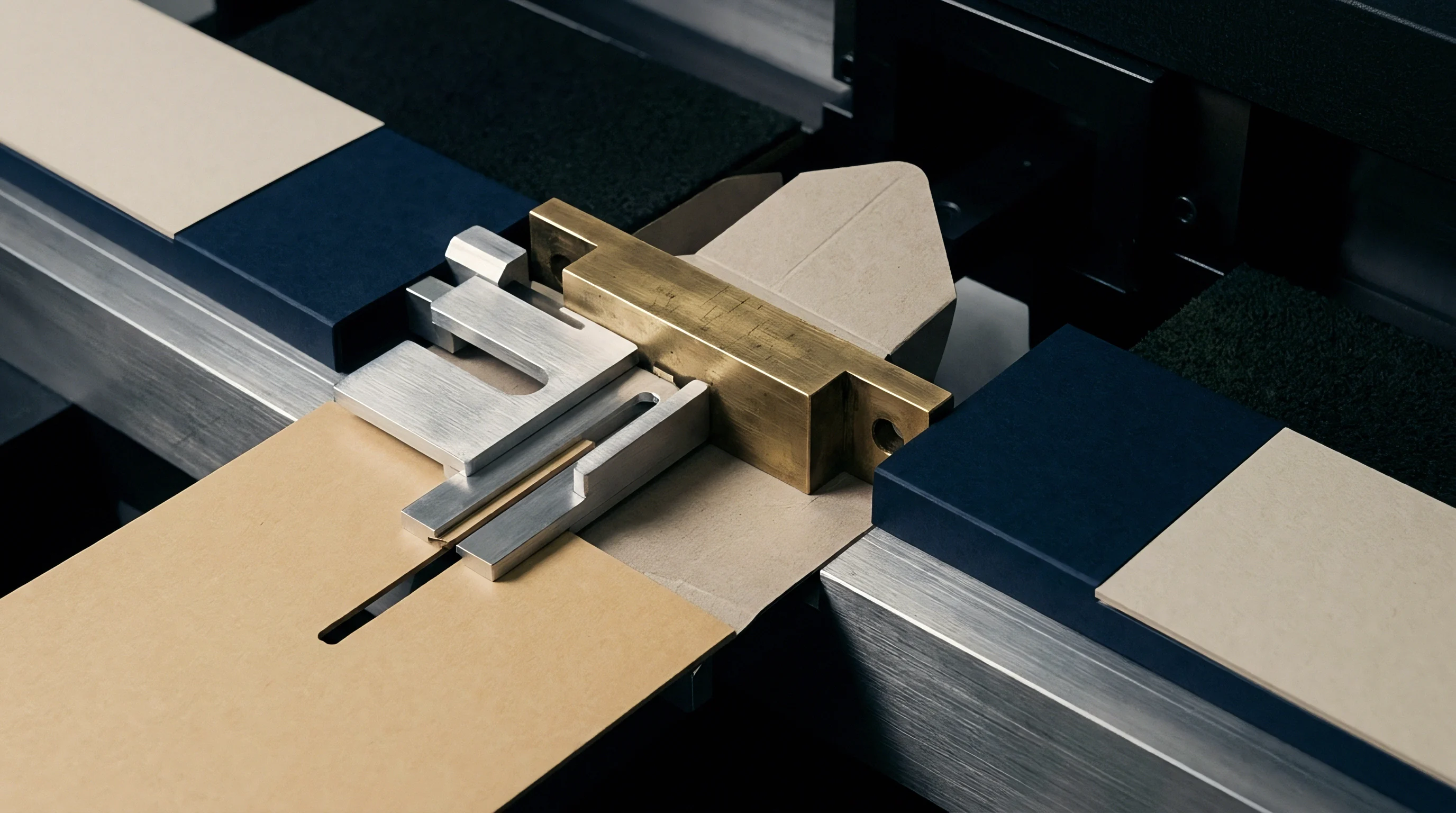
Scoring operations prepare folding boxboard for clean, precise 90-degree and 180-degree corner folds. Creasing tools force the multi-ply board into a female matrix groove using a male steel creasing rule. This deformation breaks internal fiber bonds in a controlled shear pattern, creating internal delamination zones that act as mechanical hinges during final carton folding.
When an aqueous dispersion barrier coating covers the top chemical layer, creasing dynamics change. The male rule compresses the coated face into the female matrix, inducing high shear and tensile strains along the outer dispersion barrier. If the interfacial shear strength between the barrier polymer and the top ply is lower than the shear resistance of the internal mechanical plies, premature surface delamination occurs along the crease shoulders.
Optimal matrix width selection relies on board caliper and layer stiffness parameters:
Matrix Width = (1.5 Board Caliper) + Rule Thickness
Calculated matrix depth matches board thickness to ensure proper impression depth without cutting outer fibers. High dispersion coating stiffness requires increasing matrix channel width by 10 to 15 percent compared to standard uncoated board. Expanding the matrix groove reduces local shear concentration at the coating boundary, spreading flexural deformation across a wider crease zone.
Scoring rule width matched precisely to board caliper prevents premature ply separation along the outer score line.

Converting Thresholds during High-Speed Folding
Modern packaging conversion lines operate at speeds exceeding 300 meters per minute, subjecting score lines to rapid impact bending. High strain rates increase the effective elastic modulus of synthetic dispersion coatings, making polymer films stiffer and more brittle during folding. Delamination manifests as surface blistering, coating flaking, or complete separation of the barrier layer along fold lines.
- Interfacial Blistering occurs when localized shear stress detaches the barrier coating from the paper surface without rupturing the polymer film, forming hollow pockets along score lines.
- Chalking and Flaking develops when high shear strain fractures brittle dispersion formulations, breaking the continuous film into micro-fragments that shed during high-speed carton erecting.
- Delamination Fiber-Tear happens when interfacial adhesion exceeds internal top-ply shear strength, causing the barrier coating to pull intact chemical pulp fibers away from the underlying mechanical core.
- Crease Shoulder Splitting arises when excessive matrix narrowness concentrates transverse shear forces directly on the coated surface edge, shearing both the polymer skin and outer chemical ply.
Creasing tool geometry adjustments manage shear stress distribution across high-speed converting runs without sacrificing carton squareness.


Dossier
Specification Parameters for Dispersion Coated Stock
Technical specifications for aqueous dispersion barrier multi-ply folding boxboards require clear thresholds for interfacial shear resistance. Relying solely on basic grammage, total caliper, and conventional Cobb water absorption values exposes converting operations to high failure rates. Procurement teams establish binding quality criteria that include explicit interfacial shear delamination threshold values.
Contractual documentation includes required test standards, sample conditioning protocols, and statistical compliance limits. Interfacial shear delamination metrics belong alongside water vapor transmission rate (WVTR), grease resistance (Kit test or heptane vapor), and Cobb 1800 values. Defining clear mechanical thresholds prevents mills from substituting inferior furnish recipes or changing coating formulation binders without notice.
| Application Grade | Target WVTR (g/m²/day) | Minimum Interfacial Shear (MPa) | Minimum Scott Bond (J/m²) | Converting Line Speed (m/min) |
|---|---|---|---|---|
| Chilled Food Packaging | < 5.0 | 1.65 | 210 | 250 – 350 |
| Dry Bakery Folding Box | < 15.0 | 1.35 | 175 | 300 – 450 |
| Frozen Food Outer Carton | < 2.5 | 1.85 | 230 | 200 – 300 |
| Fast Food Grease Barrier | < 25.0 (Kit 10) | 1.20 | 160 | 350 – 500 |

Commercial Risk and Delivery Qualification Protocols
Establishing clear goods-in inspection protocols protects buyers from costly conversion failures and line stoppages. Acceptance sampling plans following ISO 2859-1 set strict acceptable quality limits (AQL) for barrier delamination failures during initial lot qualification.
- Mill Test Certificate Validation requires verifiable double-notch shear test values alongside standard grammage, bulk, and moisture content data for each production tambour.
- Conditioned Retain Sampling mandates retaining six un-printed board sheets per pallet position stored under ISO 187 atmospheric conditions for dispute arbitrations.
- Rotary Crease Qualification verifies score line performance using a laboratory creasing press before releasing full tonnage lots to commercial printing presses.
- Interfacial Adhesion Verification employs standard cross-hatch tape adhesion tests combined with 180-degree manual fold audits to detect latent boundary weakness.
Substandard interfacial shear strength causes extensive financial loss when barrier integrity fails on commercial packaging lines. A barrier failure invalidates moisture or grease protection, leading to soft cartons, compromised contents, total product recalls, and severe commercial penalties imposed by retail customers.