Ultrasonic Wave Attenuation Basics for Paperboard Creasing Quality
Non-destructive ultrasonic wave attenuation evaluates paperboard crease quality by measuring acoustic energy loss caused by internal shear delamination.

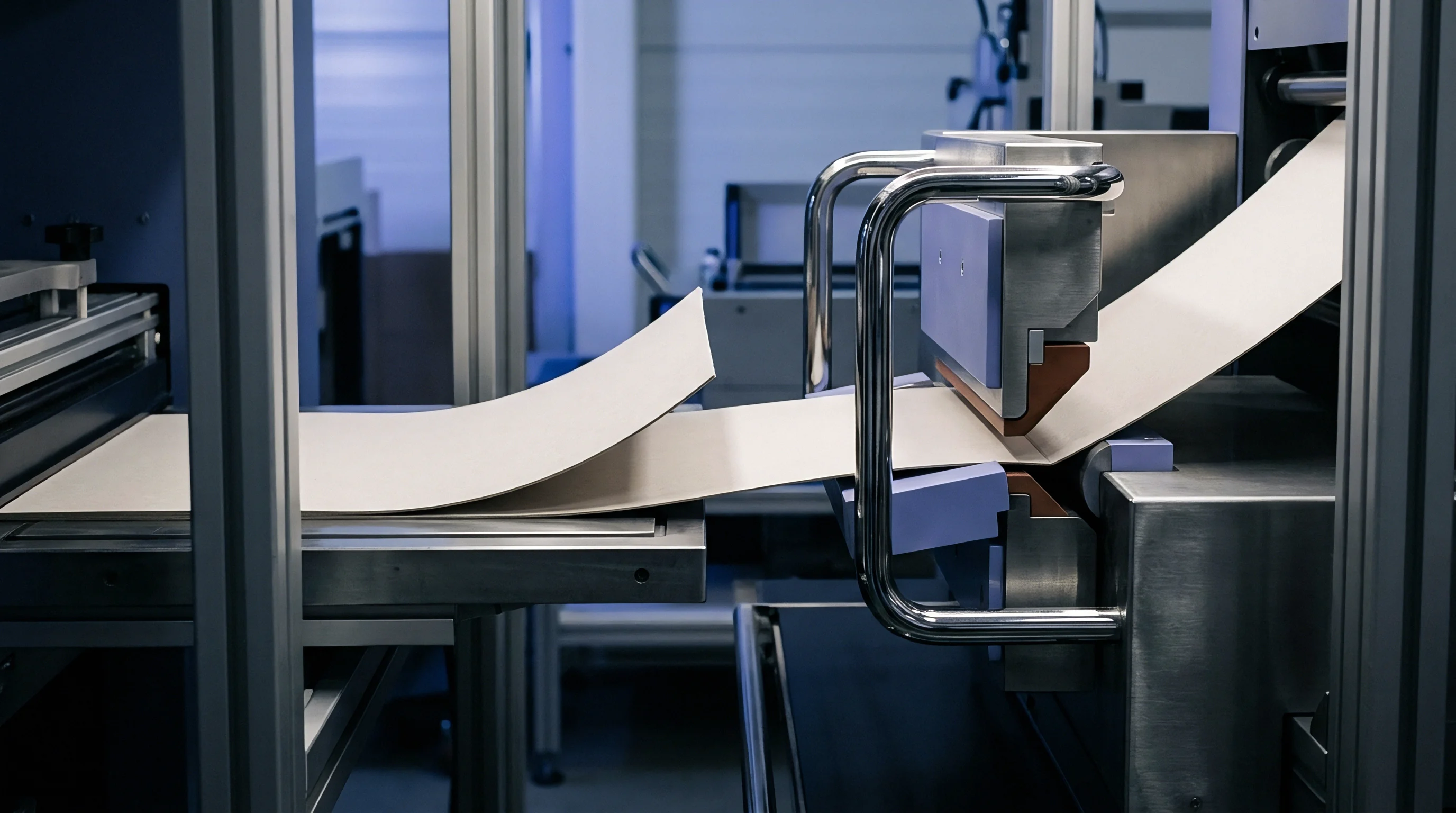
Acoustics
High-frequency mechanical vibrations pass through fibrous webs by transferring stress from individual cellulose fibrils to neighboring polymer chains. When an ultrasonic transducer excites a sheet of solid bleached sulfate or folding boxboard, sound waves move through the three-dimensional network as longitudinal compression waves and transverse shear waves. The mechanical wave energy decays as it travels through the material.
This amplitude reduction over distance defines wave attenuation, where initial acoustic intensity drops exponentially as a function of path length and the material’s attenuation coefficient.
Cellulose fibers form an anisotropic matrix interspersed with microscopic air voids, mineral fillers, and chemical binders. When a mechanical wave encounters phase boundaries between dense crystalline cellulose and low-density air spaces, acoustic impedance mismatches occur. Solid cellulose has a specific acoustic impedance near 3.2 x 10⁶ kg/(m²·s), compared to roughly 415 kg/(m²·s) for ambient air inside board pores.
That sharp contrast causes significant reflection and scattering of high-frequency acoustic energy at every internal fiber-air interface.
In undamaged paperboard, the baseline attenuation coefficient depends on basis weight, density, moisture content, and inter-fiber bonding degree; sound moves faster along fibers, while air gaps scatter high frequencies. When a crease enters the sheet, mechanical stress reconfigures this microscopic structure. The scoring rule compresses the outer liners and deforms the middle fiber layers in shear, creating a localized delamination zone.
Ultrasonic wave propagation through this creased area changes immediately, turning acoustic signal loss into a direct probe of internal structural damage.
Viscoelastic dissipation in paperboard at 2 MHz accounts for approximately 62 percent of total acoustic energy attenuation under standard ISO 187 conditioning of 23°C and 50 percent relative humidity.
Total acoustic wave attenuation inside paperboard webs stems from two physical mechanisms: absorption and scattering. Absorption converts acoustic energy into heat through viscoelastic dissipation within amorphous hemicellulose and lignin polymer matrices, where cellulose molecules undergo rapid strain relaxation under high-frequency stress cycles. Scattering instead redirects acoustic wave vectors away from the receiver transducer without thermal conversion.
Micro-cracks, fiber debonding, and z-directional delamination created during score matrix impact act as macro-scale barriers to acoustic transmission.
During non-contact testing, acoustic amplitude decays across the creased channel. The total attenuation coefficient inside paperboard combines frequency-dependent absorption and structural scattering terms, represented mathematically by a power-law relationship:
α(f) = α0 + a · fb
Here α(f) represents the total attenuation coefficient in decibels per millimeter at frequency f, α0 accounts for static structural scattering losses, and parameters a and b represent viscoelastic material properties. Operating frequencies between 500 kHz and 5 MHz provide the spatial resolution needed to detect micro-structural changes without losing the acoustic signal across standard cartonboard calipers ranging from 300 to 800 micrometers.
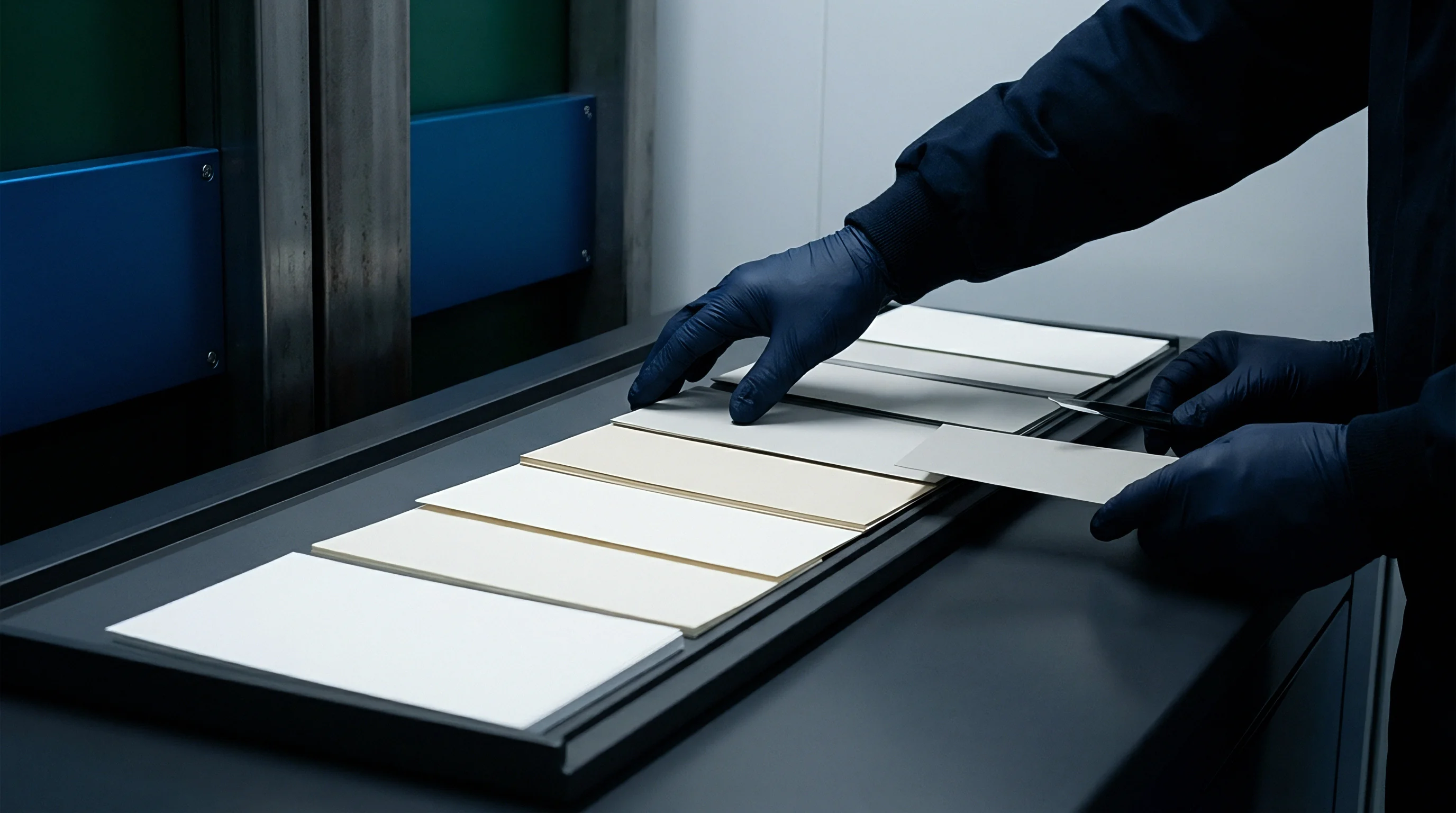
Wave Mechanics in Fibrous Media
Ultrasonic testing sends short acoustic pulses into the paperboard and records the transmitted or backscattered wave packet. Phase velocity and group velocity diverge inside anisotropic paper webs. Because fibers align heavily along the machine motion direction, longitudinal wave velocity there ranges from 3,000 to 4,500 meters per second.
Cross-direction wave velocity drops to roughly 1,500 to 2,200 meters per second, while Z-direction velocity ~ perpendicular to the sheet surface ~ hovers between 400 and 900 meters per second due to the layered orientation of refined cellulose fibers.
Mechanical creasing disrupts this anisotropic equilibrium by introducing internal air voids. When a male steel rule forces paperboard into a female matrix channel, high shear stress initiates intra-ply and inter-ply delamination. Microscopic air gaps form within the core layers of multi-ply board, creating sharp acoustic impedance breaks that scatter ultrasonic waves passing through the Z-direction or across the score width.
Measuring the increase in acoustic attenuation across the score line reveals whether creasing induced internal ply separation or destructively fractured outer surface fibers.
The total energy loss experienced by an ultrasonic wave traversing a paperboard score channel derives from several distinct structural features:
- Viscoelastic Hysteresis loss occurs as high-frequency strain cycles deform amorphous hemicellulose and lignin, converting acoustic energy to heat.
- Rayleigh Scattering dominates when ultrasonic wavelengths exceed the average cellulose fiber diameter, causing diffuse wave reflections off individual fibers.
- Mie Scattering emerges when internal delamination pockets and micro-voids approach dimensions comparable to the acoustic wavelength.
- Interfacial Friction generates thermal energy dissipation as unbonded fiber ends slide past each other inside the creased shear zone.
- Mode Conversion alters incident longitudinal waves into transverse shear waves at oblique fiber interfaces, reducing directional signal energy.
Understanding these acoustic loss mechanisms enables precise calibration of non-destructive testing equipment. Measuring ultrasonic amplitude decay across a creased channel tracks internal bond disruption without tearing the cartonboard sample apart. The main practical difficulty lies in distinguishing acoustic loss caused by target internal shear delamination from acoustic loss caused by destructive surface liner cracking.
Whether specific high-frequency spectral shifts can isolate micro-fractures in outer coated clay layers from internal core delamination across varying furnish blends remains an open subject in acoustic converting research.

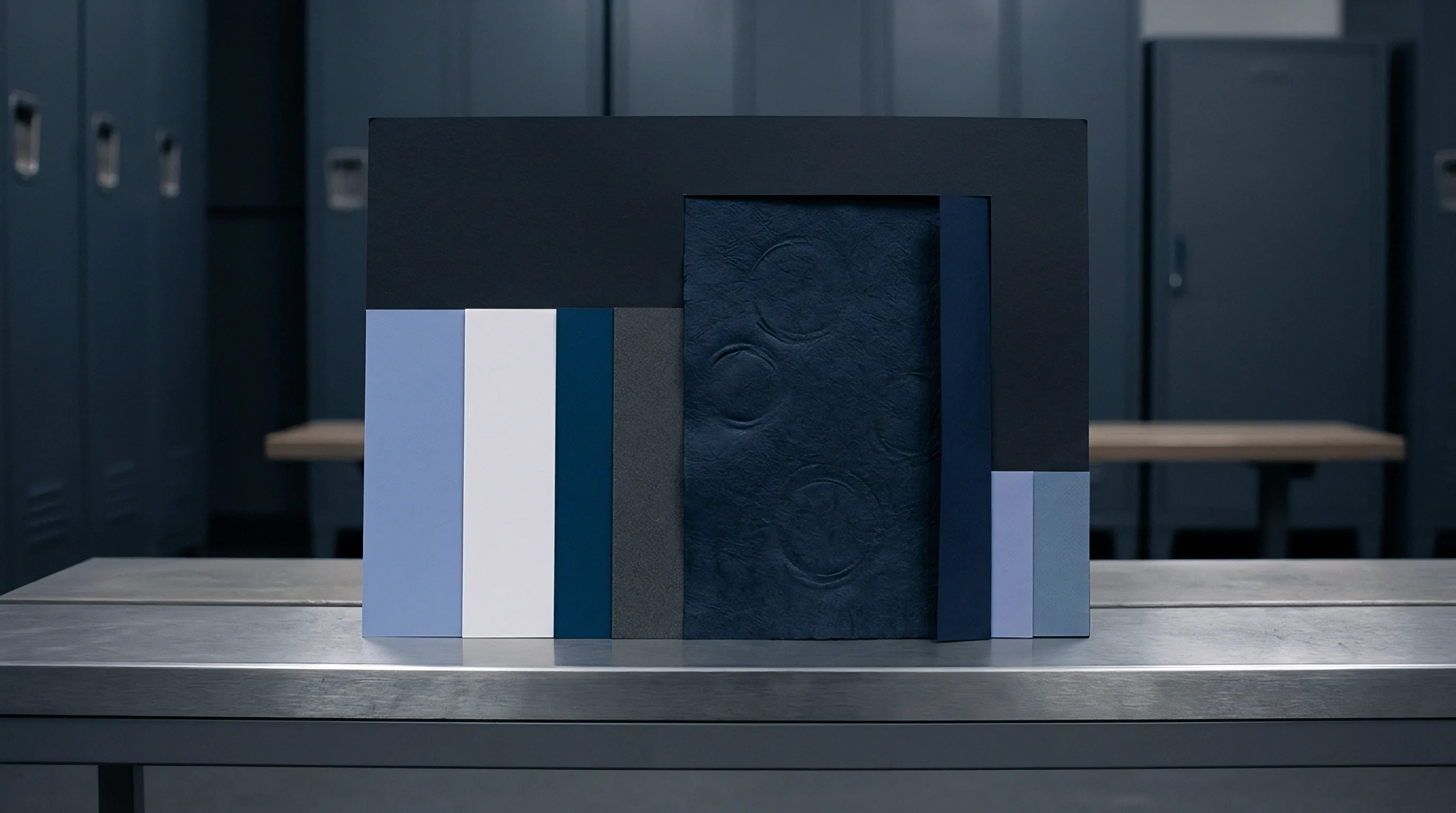
Board
Multi-ply cellulosic sheets display distinct physical properties along three orthogonal axes because machine wire alignment orientates fibers during wet formation. Solid bleached sulfate, folding boxboard, white lined chipboard, and coated recycled board respond differently to creasing stress. Each board grade uses specific furnish compositions that dictate acoustic impedance and sound transmission.
Solid bleached sulfate features uniform chemical pulp throughout all plies, producing high inter-fiber bond strength and predictable acoustic velocity. Folding boxboard pairs chemical pulp outer layers with a thick mechanical pulp core, creating a sharp step-change in density and sound speed across its cross-section.
Density profiles govern Z-direction acoustic wave transmission. Mechanical pulp cores in folding boxboard contain short, stiff, unrefined fibers interspaced with high void volumes. Sound travels slowly through mechanical pulp cores, exhibiting high baseline attenuation.
Chemical pulp plies on solid bleached sulfate present dense, tightly bonded fiber networks that conduct sound rapidly with minimal baseline loss. When a creasing matrix compresses these substrates, mechanical pulp cores fracture and shear easily, forming soft internal delamination planes that scatter acoustic energy broadly across frequencies above 1 MHz.
| Board Grade | Caliper (µm) | Density (g/cm³) | ZD Velocity (m/s) | Baseline Attenuation @ 1 MHz (dB/mm) | Post-Crease Attenuation @ 1 MHz (dB/mm) |
|---|---|---|---|---|---|
| Solid Bleached Sulfate (SBS) | 400 | 0.82 | 820 | 12.4 | 28.6 |
| Folding Boxboard (FBB) | 450 | 0.65 | 580 | 18.1 | 42.3 |
| Coated Recycled Board (CRB) | 480 | 0.74 | 640 | 21.5 | 49.8 |
| White Lined Chipboard (WLC) | 500 | 0.71 | 610 | 23.0 | 54.1 |
Moisture content significantly alters paperboard acoustics. Water molecules act as plasticizers within cellulose networks, disrupting hydrogen bonds and swelling the fiber wall structure. As relative humidity increases from 20 percent to 80 percent, Z-direction sound velocity drops while acoustic attenuation rises.
Moisture softens hemicellulose polymers, increasing viscoelastic energy dissipation. Ultrasonic creasing quality measurements taken in an unconditioned converting plant fluctuate throughout the day if ambient moisture shifts alter the baseline attenuation of uncreased board stock.
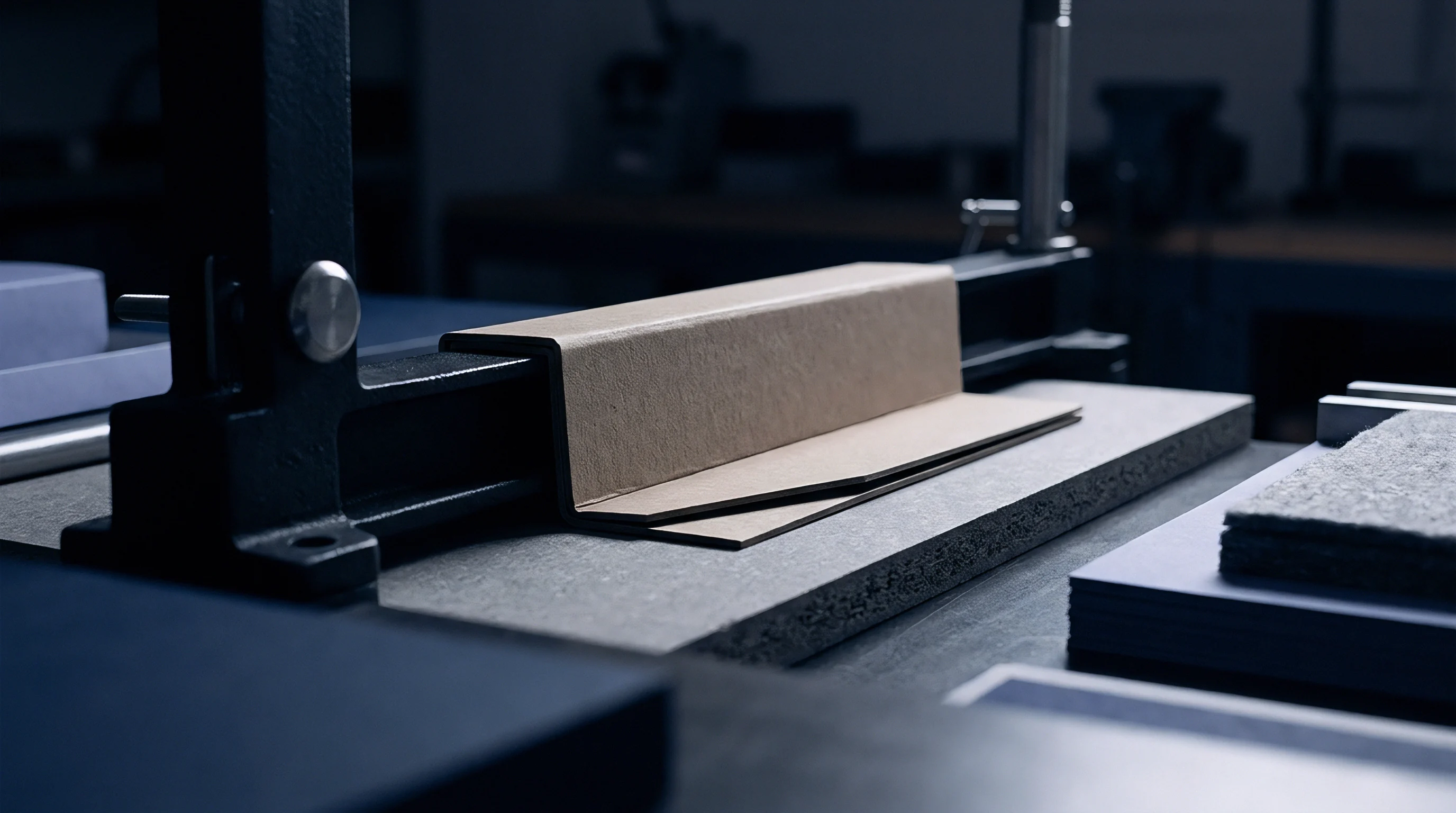
Anisotropic Wave Propagation
Cellulose fibers align predominantly parallel to the machine motion direction on the paper machine wire. This structural orientation creates directional anisotropy in both mechanical modulus and acoustic wave propagation speed. Sound travels fastest along the machine direction because acoustic waves propagate directly down the longitudinal axes of aligned cellulose fibers.
Cross-direction wave propagation requires energy transfer across inter-fiber bond nodes, slowing wave speed and increasing scattering loss. Z-direction transmission, perpendicular to the sheet surface, encounters hundreds of individual fiber-to-fiber layer interfaces, yielding the highest attenuation rates.
Because thicker boards demand wider matrix channels, creasing performance depends directly on matching scoring rule geometry to sheet caliper and directional anisotropy. Creasing across the machine direction forces bending stress along aligned fibers, requiring deeper rule penetration to force shear delamination within inner core layers. Creasing along the machine direction bends the sheet between aligned fibers, requiring narrower female matrix channels to prevent loose, wide crease profiles.
Acoustic wave monitoring across cross-direction scores shows higher post-crease attenuation spikes than machine-direction scores due to extensive fiber debonding across transverse alignment planes.
Coated surface layers add acoustic complexity. High-density mineral coatings containing calcium carbonate or kaolin clay display high acoustic impedance compared to underlying raw cellulose fibers. Sound waves traveling through a coated sheet encounter a sudden impedance shift at the coating-pulp interface.
If creasing stress forces clay coating flaking or top liner rupture, the continuous coating layer breaks. This mechanical break creates localized acoustic scattering points that register as extreme high-frequency attenuation anomalies during ultrasonic scanning.
In multi-ply paperboard, moisture absorption weakens inter-fiber bonding and lowers overall acoustic velocity.


Matrix
Tooling design for platen die-cutting relies on exact geometric alignment between the steel scoring blade and the bottom counter-channel. Mechanical creasing goes beyond surface indentation: as the male rule forces the sheet into the matrix channel, the board experiences simultaneous shear, tensile, and compressive stresses. Outer liner layers undergo high tensile strain, middle plies experience inter-ply shear stress, and bottom liner layers compress into the channel cavity.
Correct creasing establishes controlled internal shear delamination without severing surface fibers.
Internal shear delamination softens the paperboard along the score line, dramatically lowering its bending resistance. When the carton blank reaches the high-speed folder-gluer, the board folds along the pre-damaged delamination line with minimal force. If creasing rule penetration remains too shallow, internal delamination fails to form.
The un-delaminated sheet retains high bending stiffness, causing outer liner cracking, panel bowing, and carton spring-back upon folding. Conversely, excessive rule penetration causes deep fiber rupture, crushing the core and destroying fold integrity.
| Rule Thickness (pt) | Matrix Channel Width (mm) | Matrix Depth (mm) | Penetration Depth (%) | Crease Quality Assessment | Acoustic Attenuation Delta (dB) |
|---|---|---|---|---|---|
| 2.0 | 1.4 | 0.5 | 35 | Under-creased (No delamination) | + 3.2 |
| 2.0 | 1.5 | 0.5 | 55 | Optimal (Controlled shear zone) | + 16.8 |
| 2.0 | 1.6 | 0.5 | 70 | Optimal (Deep delamination) | + 22.4 |
| 2.0 | 1.5 | 0.4 | 85 | Over-creased (Core fiber rupture) | + 38.9 |
| 3.0 | 1.8 | 0.6 | 95 | Liner split (Surface destruction) | + 54.1 |
Acoustic wave attenuation offers direct, real-time insight into this internal structural transformation. Un-creased board exhibits baseline attenuation driven purely by its virgin fiber density and thickness. Optimal creasing introduces controlled air micro-voids throughout the middle core layers, causing a distinct, repeatable rise in acoustic attenuation.
Over-creasing, accompanied by fiber tearing and surface cracking, causes massive acoustic signal decay due to complete structural disruption along the crease line.
A balanced score line produces a clear jump in acoustic wave attenuation without collapsing the main high-frequency signal spectrum.
While excessive attenuation signals fiber rupture, a well-formed crease exhibits moderate attenuation, and tool wear gradually shifts the peak response frequency. Make-ready foremen must balance rule penetration depth against female channel width to achieve consistent scoring performance across full shift runs. As creasing rules wear down over tens of thousands of die-cutting impressions, penetration depth decreases.
Acoustic attenuation monitoring tracks this gradual tooling degradation, alerting operators when score line attenuation drops below critical quality limits.

Die-Cutter Make-Ready Alignment
Aligning air-coupled ultrasonic transducer arrays across a flatbed die-cutter score channel follows a precise operational bring-up sequence:
- Mount the non-contact ultrasonic transmitter probe precisely 10 millimeters above the score line channel on the die-cutter discharge section.
- Position the matching receiver probe directly beneath the sheet path in complete axial alignment with the transmitter probe.
- Run a series of uncreased control sheets through the press to establish baseline acoustic amplitude and time-of-flight values for the target caliper.
- Pass first-off creased sheets through the sensor gap at slow make-ready press speeds to capture initial score line attenuation deltas.
- Adjust die-cutting impression pressure until the acoustic attenuation across all score channels lands within the target quality window.
- Lock the platen impression setting and engage automated continuous attenuation logging for the production run.
Misaligned creasing rules create asymmetrical shear forces across the female matrix channel. One side of the score undergoes excessive compression while the opposite side experiences insufficient strain. This imbalance causes carton blanks to twist during folding, resulting in crooked boxes and folder-gluer jams.
Ultrasonic scanning across asymmetrical creases reveals uneven attenuation profiles, with one score shoulder showing high scattering loss and the other remaining near uncreased baseline values. Catching rule misalignment during make-ready prevents thousands of off-spec cartons from reaching the finishing department.
Selecting incorrect creasing matrix dimensions damages paperboard fibers permanently, forcing complete job re-runs when folded cartons split open on automated packing lines.


Metrics
Quantifying acoustic signal degradation across a score channel requires capturing changes in peak amplitude, pulse propagation time, and spectral energy distribution. Systems deploy either pitch-catch transmission mode or pulse-echo reflection mode. Pitch-catch setups mount a transmitting transducer on one side of the paperboard sheet and a receiving transducer on the opposite side.
Pulse-echo setups use a single transducer that emits acoustic waves and catches reflected echoes from internal interfaces. Pitch-catch air-coupled ultrasonic testing serves as the primary methodology for high-speed inline creasing inspection because it eliminates physical contact with moving webs.
Contact ultrasonic testing relies on liquid couplants like gel or oil to eliminate the air gap between transducer faces and the test specimen. Liquid couplants match acoustic impedance, maximizing energy transfer into the board. Wet contact testing remains completely unsuitable for inline packaging inspection because water or oil destroys paperboard surface finishes and ruins print coatings.
Dry-coupled rolling transducers featuring high-density elastomeric tires offer contact testing without liquid contamination, but mechanical friction limits their operating speed to under 50 meters per minute.

How Does Wave Frequency Choice Affect Resolution?
Selecting transducer frequency involves a trade-off between spatial wave resolution and penetration depth. Acoustic wavelengths shorten as frequency increases. High-frequency ultrasonic waves at 5 MHz offer wavelength dimensions near 150 micrometers in Z-direction paperboard, providing high sensitivity to micro-cracks and sub-millimeter delamination zones.
However, high frequencies undergo severe structural scattering and viscoelastic absorption within porous cellulose networks, attenuating so rapidly that receiver electronics struggle to maintain acceptable signal-to-noise ratios across thick calipers.
Lower frequencies near 500 kHz penetrate heavy multi-ply board easily with minimal absorption loss. The longer wavelength, measuring nearly 1.5 millimeters, passes straight through micro-delamination pockets without scattering, failing to detect early stage shear delamination inside thin folding carton substrates. Ultrasonic creasing inspection systems generally operate between 1 MHz and 2 MHz.
This frequency window provides sufficient spatial resolution to evaluate score line width and depth while maintaining strong signal transmission through board calipers between 300 and 800 micrometers.
Abnormal ultrasonic attenuation profiles captured during score line inspection highlight specific structural failure modes:
- Zero Attenuation Delta indicates complete failure of the scoring rule to induce internal shear delamination, leaving score stiffness dangerously high.
- Localized Attenuation Spikes point to discrete surface liner splitting or clay coating rupture along the primary crease shoulder.
- Asymmetrical Amplitude Decay signals improper male-to-female tool alignment, causing unbalanced strain across the score channel.
- Broadband High-Frequency Blackout reveals extensive core fiber crushing and internal density collapse due to excessive impression depth.
- Periodic Attenuation Oscillations demonstrate die-cutter platen bounce or impression cylinder eccentricity across the production deck.
Calculating the z-direction velocity gradient with dry-coupled transducers during laboratory validation trials provides additional context. Combining wave velocity measurements with attenuation values yields a comprehensive profile of internal score quality. Signal processing software applies Fast Fourier Transform algorithms to convert raw time-domain acoustic signals into frequency spectra.
Analyzing shifts in spectral energy peak frequencies provides immediate detection of fiber bond degradation, as damaged paperboard webs act as low-pass filters that selectively damp high-frequency acoustic components.
Acoustic sensors can inspect score quality accurately across variations in sheet speed, web flutter, or ambient humidity swings.


Discrepancy
Laboratory testing of score stiffness frequently fails to predict carton performance on automatic packaging machinery. Standard off-line score quality testing methods, such as ISO 5628 and TAPPI T 829, rely on benchtop score bend testers. These instruments clamp a creased sample, bend it slowly to a 90-degree angle at controlled angular velocities, and measure the maximum bending force required.
The ratio of creased bending force to un-creased sheet bending stiffness defines the score quality percentage. Benchtop testing evaluates static bending resistance over several seconds, failing to capture high-speed dynamic folding forces.
Automatic folder-gluers fold carton blanks at web speeds exceeding 400 meters per minute. At these velocity levels, folding occurs in under five milliseconds. Viscoelastic cellulose networks respond to high-rate strain differently than to slow laboratory bending.
Fiber bonds that yield smoothly during slow 90-degree benchtop bends act rigid during dynamic impact, forcing tensile strain onto the outer surface liners and causing severe score cracking. Offline static score testers regularly give passing quality grades to board samples that burst open on high-speed gluer lines.
Standard benchtop score bend testing measures slow static resistance, failing to detect dynamic fiber rate-sensitivity that triggers score cracking on high-speed folder-gluers.
Air-coupled ultrasonic wave attenuation bridges this measurement gap by probing internal fiber structure directly without bending the sheet. Acoustic attenuation testing measures microscopic damage, fiber debonding degree, and delamination density inside the crease channel immediately after die-cutting. Because attenuation measurements depend on internal structural geometry rather than strain rate, they correlate directly with both static bending stiffness and high-speed dynamic folding behavior.
Comparing acoustic signal loss against laboratory score bend measurements during quality audits highlights these differences. Samples showing identical static score quality numbers on benchtop testers frequently exhibit vastly different acoustic attenuation values. Samples with low acoustic attenuation contain incomplete internal delamination networks.
These under-delaminated samples generate high spring-back forces and score cracking during dynamic gluer operation, proving that static score bend tests miss critical structural deficiencies.

Standard Compliance and Specifications
Incorporating non-destructive ultrasonic testing requirements into formal paperboard purchase contracts establishes clear performance parameters for converters and board mills alike. Standard quality control specifications rely heavily on physical strength metrics like Mullen burst strength or Taber stiffness, which offer poor indication of creasing suitability. Adding acoustic attenuation tolerances ensures incoming board stock maintains consistent Z-direction shear performance.
A standard quality assurance clause for scoring performance specifies that all delivered folding boxboard lots must demonstrate a minimum acoustic attenuation increase of 12 decibels across a standard test crease applied under ISO 187 conditioning, ensuring internal delamination occurs without liner splitting.

Economics
Financial returns in folding carton conversion depend on minimizing make-ready waste and preventing jam-induced downtime during high-speed gluer runs. High-speed packaging lines running at 50,000 cartons per hour incur massive cost penalties when defective score lines cause feed jams or glue flange misalignment. A single jam on an automated pharmaceutical packing line can cost thousands of dollars in lost throughput, ruined product, and line clearance labor.
Installing non-destructive inline acoustic monitoring systems on flatbed die-cutters catches bad creases before defective blanks reach downstream converting passes.
Make-ready waste represents another significant cost driver. Press operators traditionally adjust creasing impression depth by running test sheets, stopping the press, cutting score cross-sections manually with razor blades, and inspecting delamination under hand lenses. This iterative trial-and-error process consumes 30 to 45 minutes per job bring-up and wastes hundreds of sheets of expensive coated board.
Real-time acoustic sensors provide instantaneous feedforward data during impression setting, cutting make-ready time by over 60 percent and eliminating hundreds of sheets of startup scrap.
| Operating Metric | Manual Sampling Baseline | Inline Ultrasonic Audit System | Annual Economic Variance ($ USD) |
|---|---|---|---|
| Make-Ready Time per Job (min) | 42 | 15 | + $ 64,800 (Press Hours Recovered) |
| Make-Ready Board Scrap (sheets/job) | 350 | 110 | + $ 38,400 (Material Saved) |
| Folder-Gluer Jam Downtime (hrs/yr) | 85 | 12 | + $ 109,500 (Downtime Avoided) |
| Customer Quality Returns (%) | 0.85 % | 0.08 % | + $ 142,000 (Claims Avoided) |
| System Capital Cost & Installation | $ 0 | $ 78,000 | – $ 78,000 (One-Time Outlay) |
Extended Producer Responsibility regulations and eco-modulation fee structures across Europe and North America add compelling financial reasons to optimize mechanical creasing. Modern packaging legislation penalizes multi-material laminates, heavy plastic film coatings, and non-recyclable structural add-ons. Brand owners actively eliminate polyethylene film laminates that were historically used to bridge cracked paperboard scores.
Without protective plastic films, folding cartons must rely entirely on precise mechanical creasing to prevent surface score cracking and fiber exposure.
Evaluating the landed cost of inline acoustic sensors on high-speed platen die-cutters against waste reduction thresholds demonstrates clear payback. Optimizing scoring rule parameters through real-time wave attenuation analysis allows converters to process lower-cost, highly recycled board grades without triggering score cracking claims. Recycled fibers possess shorter fiber lengths and lower intrinsic bond strength, making them prone to erratic creasing performance.
Continuous acoustic attenuation feedback compensates for stock density variations across recycled board reels by dynamically flagging needed impression adjustments.
Tooling ROI and Scrap Reduction
Steel creasing rules undergo continuous mechanical wear during long production runs. A typical flatbed die-cutting die running at 6,000 sheets per hour completes over 100,000 impressions on a two-shift run. As rule edges dull and impression surfaces compress, the force applied to the board shifts, causing crease depth to drift out of specification.
Without continuous monitoring, operators only discover die wear during post-run manual benchtop testing, resulting in full pallet rejections.
Inline acoustic attenuation arrays monitor every single sheet passing through the press delivery. When wave attenuation across key score channels trends toward baseline uncreased values, control software triggers automatic impression pressure compensation or flags specific die positions for rule replacement. Automated tooling monitoring eliminates large scrap events, protects brand integrity, and ensures delivered folding cartons meet strict automated packing performance thresholds consistently.