Paperboard Crease Creasing and Coating Splitting Mechanics
Forcing internal z-directional shear delamination during creasing creates an internal hinge that relieves outer coat tensile strain when folding.


Ply
Creasing paperboard creates a controlled internal rupture across the thickness profile without breaking the top coating or backliner. Mechanical compression forces the fibrous structure into a female groove, subjecting the board to high z-directional shear stresses. Board plies must yield internally under this force.
Internal delamination forms a localized pocket of separated fiber layers that buckle inward, creating an internal hinge. This internal hinge accommodates the geometric compression on the inside of the bend and relieves tensile elongation forces on the outer printed surface during carton erecting.
Shear forces dominate.
When internal delamination fails to initiate during die impact, the paperboard behaves as a solid, monolithic beam. Bending a monolithic sheet forces the outermost fibers and coating layers to absorb total tensile strain. The outer layer stretches beyond its ultimate strain limit, causing coating splitting, liner cracking, and unsightly fiber flaking along the fold line.
Board architecture determines whether internal plies split smoothly under shear or resist displacement until the surface fractures.
Paperboard plies delaminate.
- The male creasing rule strikes the board web, displacing the upper liner downward and establishing high localized compression directly under the rule tip.
- Transverse shear stresses propagate diagonally through the middle plies toward the shoulders of the female matrix groove.
- Low z-tensile fiber bonds yield within the central furnish, forming multiple horizontal micro-delaminations along weak fiber-to-fiber interfaces.
- The delaminated middle plies bulge downward into the female channel, forming a permanent internal bead that functions as a structural hinge.
Conditioning paperboard at 23 degrees Celsius and 50 percent relative humidity maintains the 7 percent equilibrium moisture needed for interior shear delamination.

Internal Shear Failure and Delamination Dynamics
In-plane shear strength and out-of-plane z-directional tensile strength dictate where internal shear failure occurs. The Scott Bond energy test, governed by TAPPI T 541, measures the energy required to delaminate a sheet section under rapid impact loading. High-performance folding boxboard utilizes mechanical pulp or chemithermomechanical pulp CTMP in its center plies.
These bulky middle layers exhibit Scott Bond values between 120 J/m² and 180 J/m², providing ideal internal weakness for clean horizontal shearing.
Solid Bleached Sulfate SBS grades consist entirely of dense chemical pulp fibers with extensive hydrogen bonding. Chemical pulp furnish exhibits Scott Bond values between 250 J/m² and 350 J/m². A Scott Bond value of 150 J/m² for CTMP middle plies rests on TAPPI T 541 testing at 23 degrees Celsius and 50 percent relative humidity using a 0.25-second impact velocity; increasing internal starch sizing to over 4 kg per tonne elevates this figure past 210 J/m², suppressing interior delamination.
Solid bleached chemical boards demand deeper male rule penetration to initiate internal shear because the dense fiber matrix resists internal layer separation.
| Substrate Grade | Furnish Construction | Scott Bond (J/m²) | Crease Depth Range (% Caliper) | Failure Mode Without Delamination |
|---|---|---|---|---|
| Folding Boxboard GC1 | Bleached chemical outer plies, CTMP middle ply | 120 – 170 | 30 – 40 | Clean internal bead, minimal outer stress |
| Solid Bleached Sulfate GZ | 100% bleached chemical pulp plies | 240 – 340 | 40 – 50 | Outer coat splitting, liner micro-cracking |
| White Lined Chipboard GD2 | Recycled fiber layers with starch binder | 140 – 220 | 35 – 45 | Erratic shear, top coat flaking, delamination spread |
| Uncoated Kraft Back SUB | Unbleached softwood chemical kraft base | 220 – 300 | 35 – 45 | High springback force, surface fiber fracture |
Furnish Structure and Fiber Layer Strain
Layering strategies during web formation establish the specific planes where delamination develops. Multi-ply paperboard machines deposit distinct furnish layers onto separate wires before pressing them together while wet. Softwood fibers in the outer plies supply high tensile resistance, whereas short hardwood fibers or stiff mechanical fibers in the core promote localized shear yielding.
Mechanical pulps compress cleanly.
When wet-end pressing forces excessive inter-ply bonding, the board loses its internal shear planes. Converting lines operating on over-bonded recycled paperboard grades report severe coating splitting along longitudinal fold lines. Unrelieved outer strain breaks the coating film.
Omitting internal shear delamination during the creasing step causes immediate rejection of finished cartons due to surface fiber splitting and cracked print graphics.

Rule
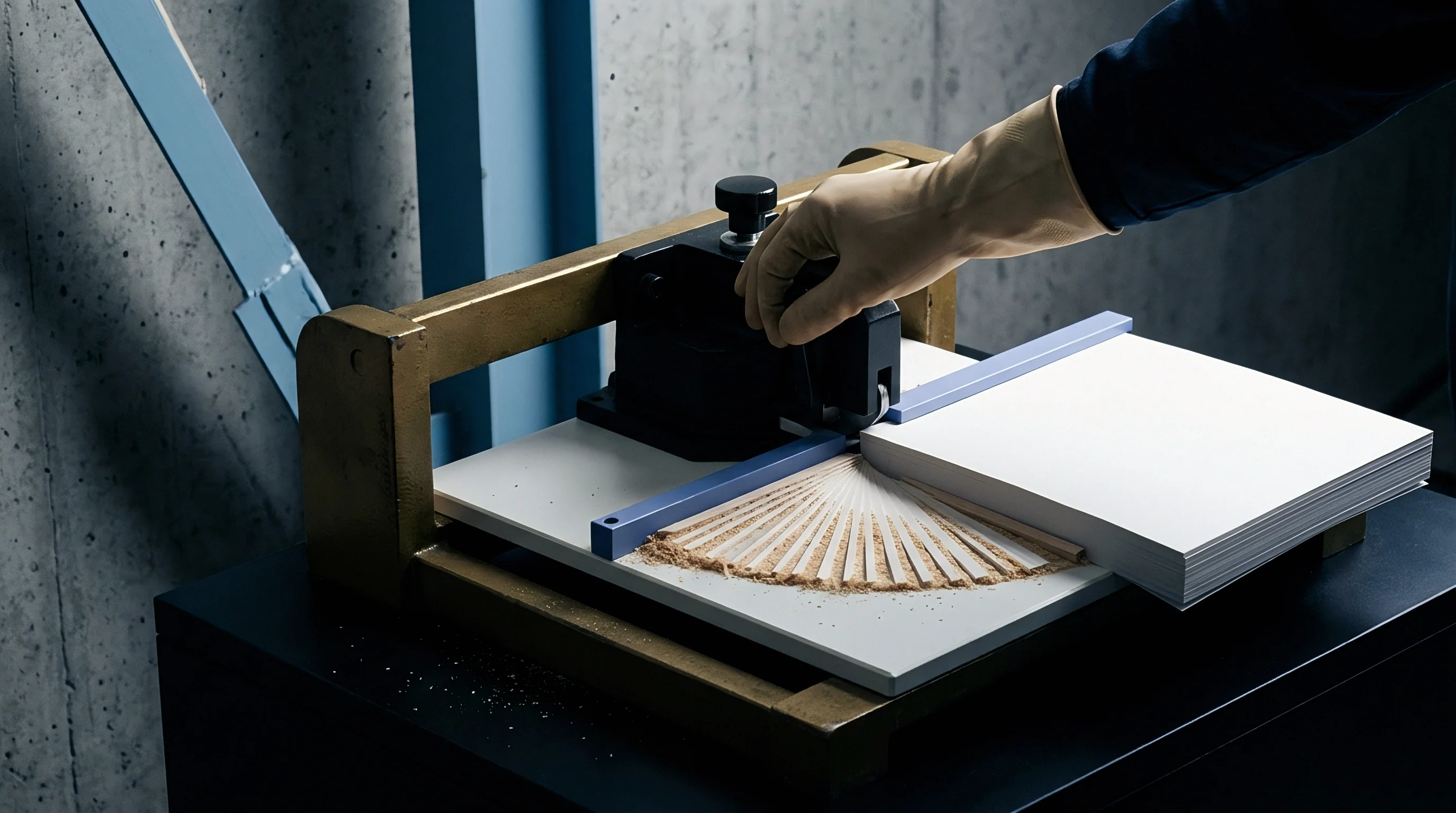
Die-cutting tooling geometry governs the physical deformation applied to the paperboard web. The creasing assembly consists of a steel male rule mounted in a dieboard, pushing paperboard into a precise channel cut into a counterplate or matrix strip. The width and depth of this channel dictate the clearance available for the board plies as they are displaced downwards.
Matrix width dictates clearance.
Incorrect clearance calculations alter the shear stress angle. A female matrix channel that is too narrow prevents the board from entering the groove, crushing the web between the steel rule and the matrix shoulder. Conversely, an overly wide female matrix channel spreads the bending forces across too wide an area, failing to generate sufficient z-directional shear stress directly beneath the rule tip.
Female channel width scales directly with sheet caliper to ensure clear side clearance for female rule penetration.
Matrix Geometry and Clearance Calculations
Calculating proper creasing dimensions requires referencing paperboard caliper and male rule thickness. Standard steel creasing rules feature rounded tops with fixed thickness designations, such as 2-point (0.71 mm) or 3-point (1.07 mm). Female matrix channel width wm depends on board thickness tb and male rule width tr.
For folding boxboard GC grades, the empirical standard formula sets channel width to wm = 1.5 tb + tr. For dense solid bleached sulfate GZ grades, the formula shifts to wm = 1.3 tb + tr to force tighter shear planes.
Female matrix depth hm corresponds directly to nominal board caliper. Pushing a 400-micrometer sheet into a female matrix channel of 400-micrometer depth yields an effective penetration clearance that accounts for ply compression. Adjusting male rule penetration depth fine-tunes the crease bead formation.
Penetration depth remains critical.
Machine setup technicians evaluate creasing tooling using specific failure indicators:
- Roll-over Crease Defect happens when an excessively wide female groove allows the board to form an asymmetric bend rather than a defined internal double-hinge.
- Liner Rupture Mode occurs when an overly narrow female groove pinches the board against steel edges, shearing the backliner before folding starts.
- Double Crease Ridge arises when male rule penetration depth is insufficient, leaving an unformed central ridge flanked by two partial indentations.
- Coating Fracture Line indicates insufficient male rule width for high-caliper board, forcing extreme local stretch over a sharp bend radius.
Tooling Misalignment and Mechanical Score Defects
Precision registration between the dieboard and the channel matrix plate prevents asymmetrical score profiles. Off-center alignment by as little as 0.05 mm shifts shear forces disproportionately to one side of the channel. The board plies on the misaligned shoulder experience excess compression, while the opposite side suffers insufficient deformation.
Wrong matrix dimensions crush the fold line.
Tooling vendors often claim that modern synthetic matrix materials eliminate the need to adjust channel dimensions for variations in substrate moisture or density. Mill-floor experience shows that fixed synthetic matrix dimensions fail when switching between high-bulk mechanical board and dense recycled stock, forcing press operator intervention to prevent surface cracking. Tooling adjustments must adapt to substrate properties rather than relying on material claims.
Film
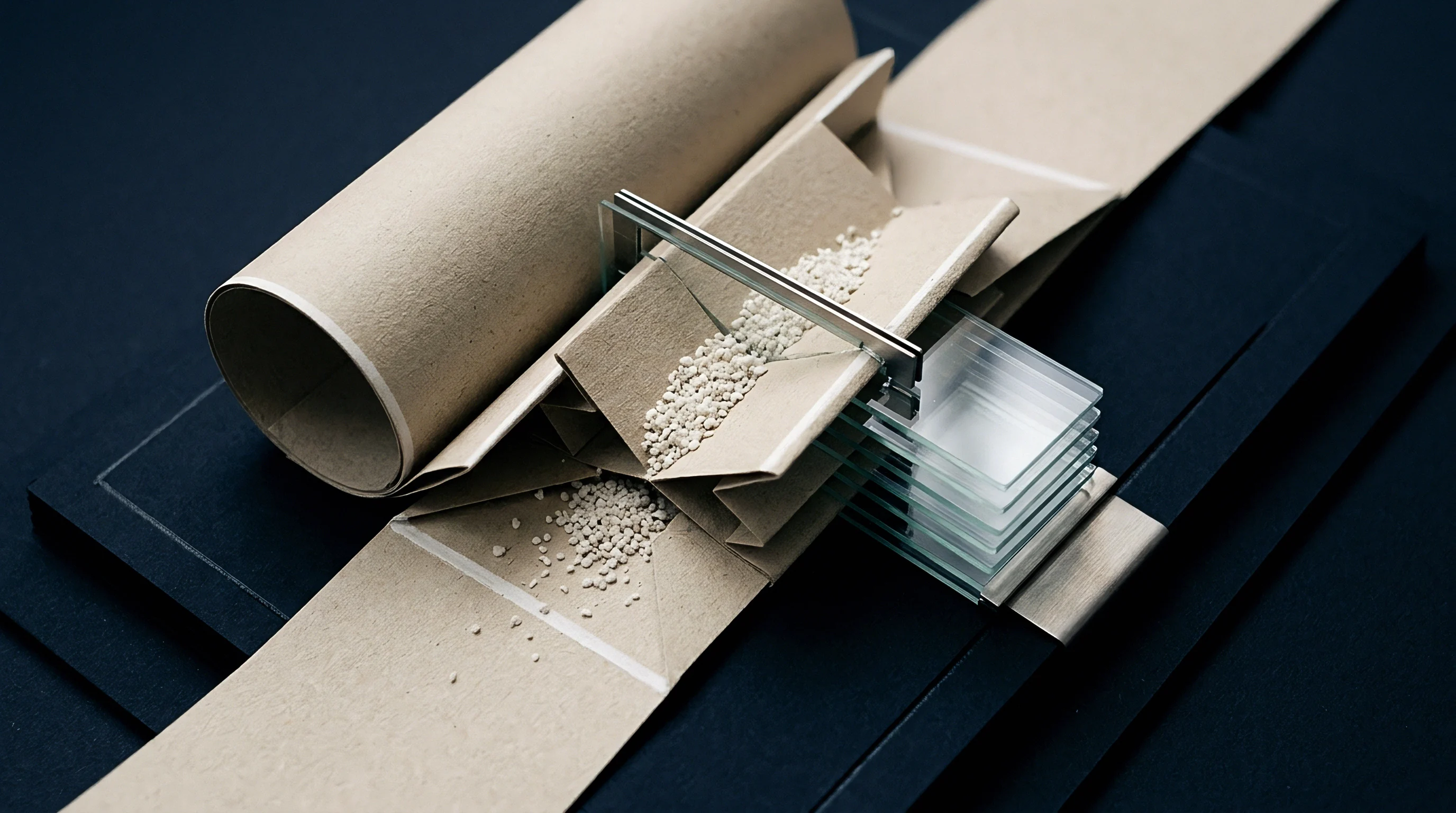
Coating formulation integrity governs surface cracking behavior when paperboard undergoes 180-degree folding. Mineral coating layers contain inorganic pigments bound together by synthetic polymer latices and natural co-binders. The mineral phase provides opacity, brightness, and ink holdout, but lacks intrinsic elasticity.
Polymer binders create a coherent film capable of elongating under tensile strain.
Coating films stretch.
Bending the outer surface of a paperboard carton subjects the top coating layer to tensile elongation proportional to board thickness divided by the fold radius. When tensile elongation exceeds the strain-at-break threshold of the dried coating film, microscopic fractures initiate at pigment boundaries. These micro-cracks coalesce into visible split lines, exposing the underlying dark fibers or breaking the print film.
Latex glass transition temperature dictates binder ductility during high-speed female die penetration.
Pigment Latex Ratios and Stretch Mechanics
The binder level in a coating formulation, expressed as parts per hundred resin phr relative to total pigment weight, directly dictates film elasticity. Standard coat formulations utilize 11 to 15 phr of styrene-butadiene SB or styrene-acrylic SA latex. Lowering binder levels below 10 phr increases pigment packing density and brightness but severely reduces film elongation at break below 1.0 percent.
Polymer glass transition behavior governs performance across unrelated industries, from asphalt paving resistance in freeze-thaw climates to synthetic shoe sole flexibility in alpine footwear. In paperboard coating layers, that same glass transition dictates whether a pigment binder yields or fractures under high-speed folding dies. Latex glass transition temperature Tg controls binder ductility at press ambient operating temperatures.
A latex binder Tg of 12 degrees Celsius in calcium carbonate coating formulations rests on dry film DMA tensile testing at 10 Hz loading frequency; dropping ambient pressroom temperature below 16 degrees Celsius shifts the latex into its glassy state, cutting elongation at break from 4.5 percent down to 0.8 percent.
Which Latex Formulations Prevent Outer Layer Splitting?
Synthetic latex chemistry selection balances binder Tg against printing ink drying performance. Low-Tg latices (below 5 degrees Celsius) provide excellent room-temperature ductility and crack resistance but can cause web blocking in reel winders and slow offset ink drying times. High-Tg latices (above 20 degrees Celsius) generate firm coating surfaces with superior offset ink transfer, but prove brittle during creasing operations.
| Pigment System | Binder Type | Binder Level (phr) | Latex Tg (°C) | Elongation at Break (%) | Fold Crack Index |
|---|---|---|---|---|---|
| 100% Fine Ground CaCO3 | Styrene-Butadiene | 10 | 18 | 1.1 | 4.2 (Severe) |
| 70% CaCO3 / 30% Fine Clay | Styrene-Butadiene | 13 | 8 | 3.4 | 1.8 (Slight) |
| 60% CaCO3 / 40% Gloss Clay | Styrene-Acrylic | 14 | 2 | 4.8 | 1.1 (None) |
| 100% Ultrafine Kaolin Clay | Styrene-Acrylic | 11 | 22 | 0.9 | 4.8 (Failure) |
Platy kaolin clay pigments improve coating film flexibility compared to rhombohedral ground calcium carbonate GCC. The flat, leaf-like shape of clay particles permits sliding alignment during strain deformation, redistributing stress across the binder network. Formulations blending 30 to 40 percent fine clay with GCC display enhanced resistance to coating splitting under severe 180-degree folding operations.
Increasing latex binder content improves coat film elongation without requiring changes to underlying paperboard furnish properties.
Gauge
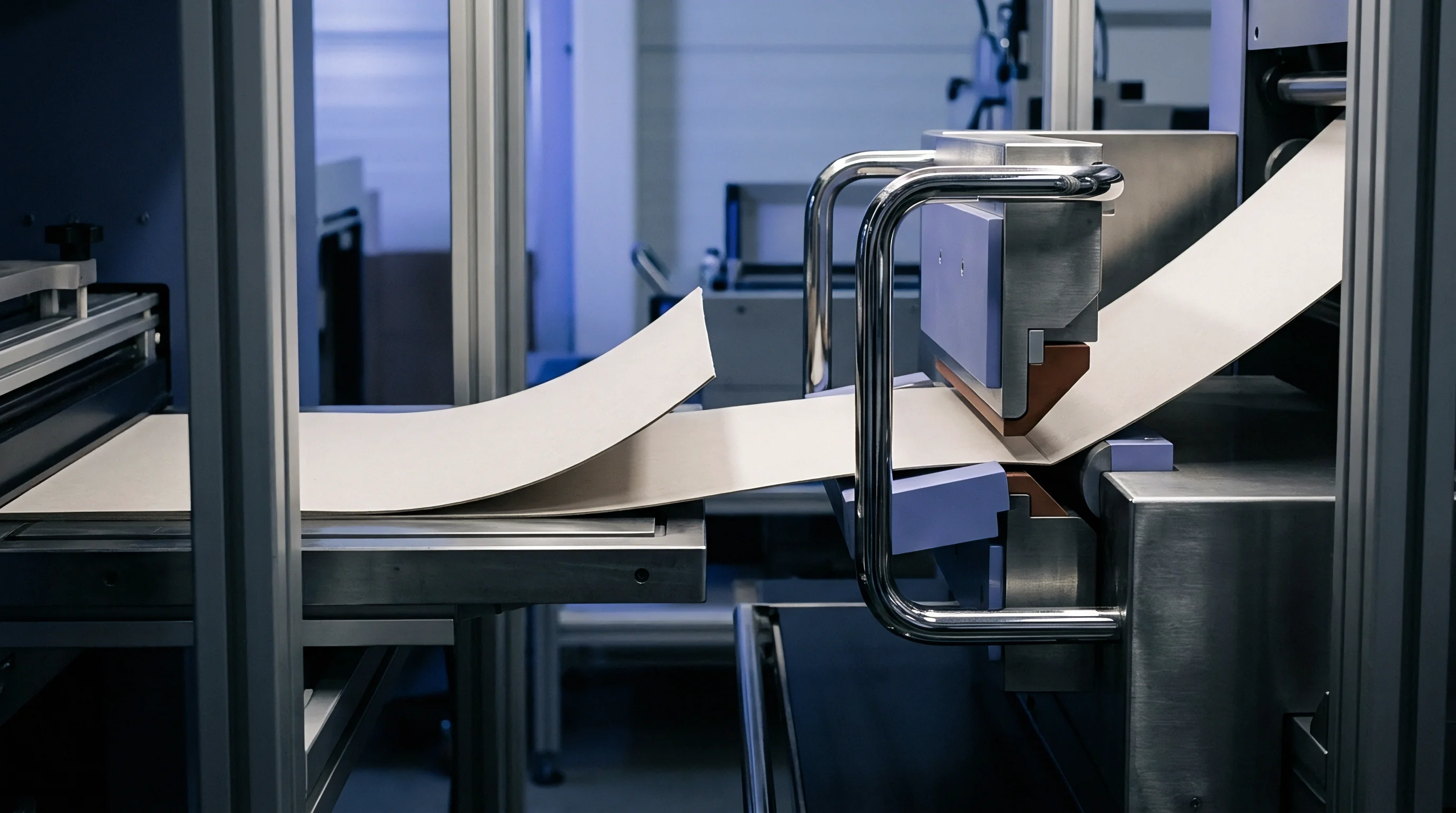
Laboratory quantification of creasing performance relies on standardized bending moment measurements of creased versus uncreased board samples. The Lorentzen & Wettre L&W Crease Tester, operating under ISO 2493 and TAPPI T 556 standards, measures the peak force required to deflect a creased specimen through a 15-degree bending angle. Score quality evaluations convert raw bending force data into non-dimensional ratios.
Score ratio determines foldability.
The Crease Resistance Ratio CR represents creased bending moment Mc expressed as a percentage of uncreased board bending moment M0, defined by CR = (Mc / M0) × 100. An uncreased sheet exhibits high initial bending resistance. Effective internal shear delamination dramatically drops the force needed to fold the board along the creased line.
Optimal CR values cluster between 35 percent and 50 percent for stable cartoning performance.
ISO 2493 compliance demands testing bending resistance at a 15-degree deflection angle on creased specimens.
Bending Moment Ratios and Springback Force
Score ratios above 65 percent indicate incomplete internal delamination, leaving high bending stiffness along the creased line. High crease stiffness generates excessive springback force during carton erecting, causing glue seam pop-open failures on automatic packaging lines. Excessive score resistance stops the cartoner.
A published conversion threshold claiming that a crease resistance ratio above 58 percent guarantees coating rupture across all recycled white-lined chipboard grades rests on inconsistent mill sampling that fails to isolate board moisture drift; packaging engineers protect orders by running press-side 180-degree manual fold audits under 10x optical magnification on every incoming pallet batch. Low CR values below 25 percent signal internal ply crush, where excessive creasing pressure destroys structural stiffness, causing cartoning machine jam-ups due to floppy fold lines.
Quality assurance protocols require strict verification items before approving board lots for high-speed packaging runs:
- Equilibrium Moisture Verification checking that board moisture levels remain within 6.0 to 7.5 percent prior to die-cutting operations.
- Cross-Direction Score Assessment evaluating Crease Resistance Ratios across both machine direction MD and cross direction CD sample strips.
- Magnified Surface Inspection inspecting 180-degree folded scores under 10x optical magnification for micro-cracks along outer pigment coating films.
- Springback Torque Tracking measuring residual recovery force 30 seconds post-folding to verify glue line holding capabilities.
Standardized Atmospheric Conditioning and Score Assessment
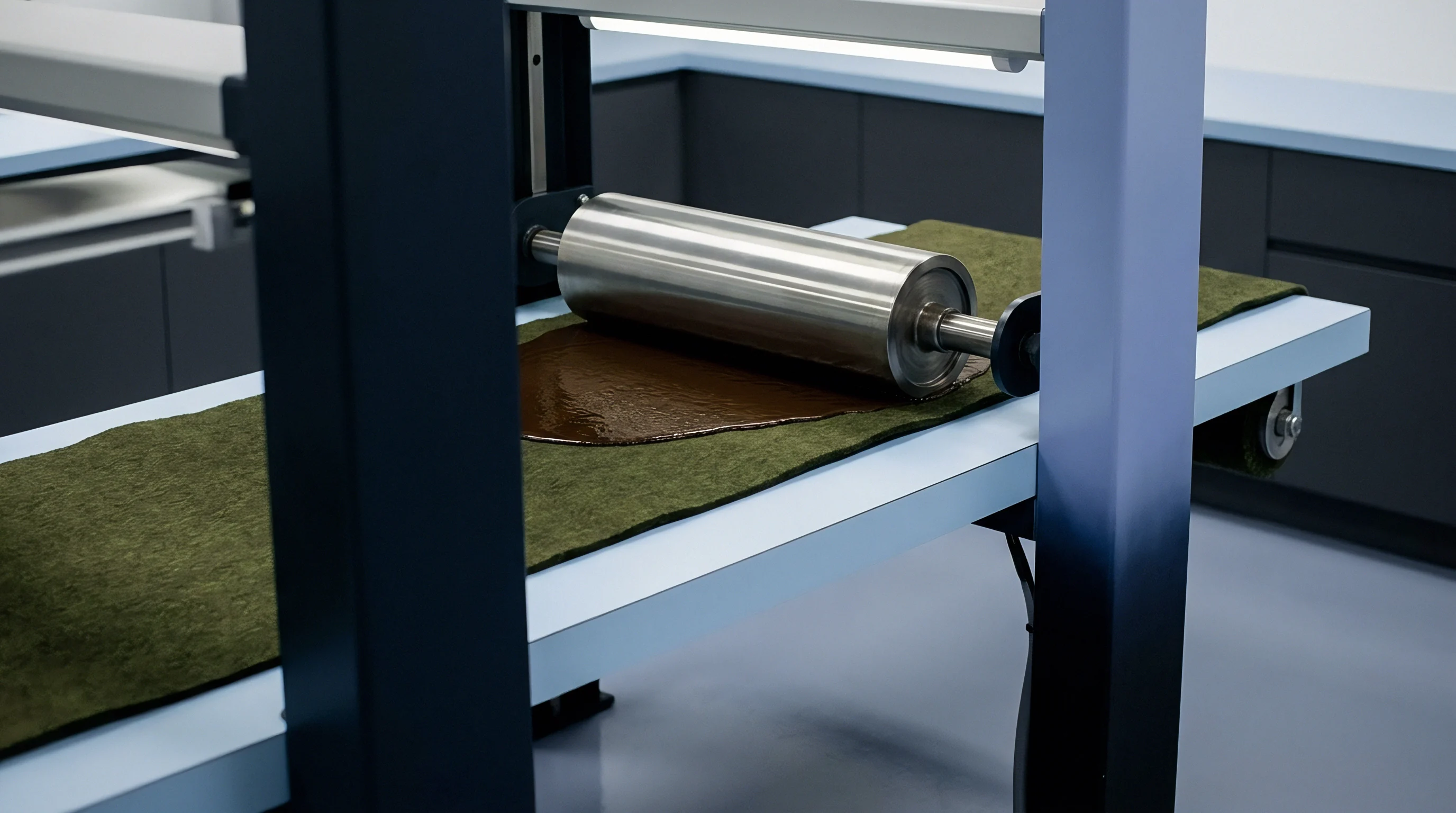
Board testing requires strict atmospheric control. Standard conditioning under ISO 187 specifies maintaining 23 degrees Celsius and 50 percent relative humidity for a minimum of 24 hours. Paperboard moisture content drops rapidly in dry room conditions, losing up to 2 percent moisture within hours.
Moisture loss reduces fiber flexibility, elevating Scott Bond resistance and causing severe coating splitting on lines that executed cleanly under standard lab ambient conditions.
Unconditioned board fractures easily.
Contractual supply specifications must explicitly state that failure rates for coating splitting are assessed exclusively on samples conditioned per ISO 187 prior to die-cutting, transferring financial liability back to the converting plant if unconditioned dry board is run on production dies.
Margin
Substrate selection and creasing execution directly impact finished package manufacturing economics. Converting line stoppages, coating crack spoilage, and glue seam failures incur immediate financial costs through wasted board, lost press hours, and customer claims. Balancing substrate purchase prices against runnability margins requires precise yield arithmetic.
Yield loss drives cost.
Solid Bleached Sulfate SBS commands a price premium over Folding Boxboard FBB and Recycled Board WLC. SBS offers excellent surface smoothness and tear strength, but its dense chemical pulp matrix increases susceptibility to coating splitting when matrix depth is miscalculated. FBB yields higher bulk per unit grammage, allowing downgauging while providing superior internal shear delamination through its mechanical pulp core.

Carton Line Spoilage and Yield Arithmetic
Converting operational efficiency metrics illustrate the landed cost differences between substrate choices. Evaluating a production run of 1,000,000 folding cartons highlights the commercial consequences of board behavior during creasing and folding operations. Converting speeds demand consistency.
Poor creasing generates dust.
Assume a job requires 50 tonnes of Folding Boxboard GC1 at a caliper of 350 micrometers (basis weight 230 g/m²) priced at $1,400 per tonne. The total board material investment equals $70,000. Under optimal creasing matrix tooling, converting spoilage remains at 2.0 percent, yielding 980,000 saleable cartons at a substrate cost of $71.43 per thousand cartons.
Substituting a lower-cost Recycled White Lined Chipboard GD2 at $1,050 per tonne drops raw material outlay to $52,500 for 50 tonnes. However, variable internal bond strength and high starch content in recycled furnish induce frequent coating splitting along cross-direction fold lines. Line spoilage escalates to 8.5 percent due to carton ejection at optical inspection stations and frequent machine stoppages from high springback force.
Net saleable carton yield drops to 915,000 units.
| Board Grade | Caliper (µm) | Tonnage Price ($/t) | Sheet Yield (Cartons/t) | Converting Spoilage (%) | Landed Cost ($/1k Cartons) |
|---|---|---|---|---|---|
| Folding Boxboard GC1 | 350 | 1,400 | 20,000 | 2.0 | 71.43 |
| Solid Bleached Sulfate GZ | 330 | 1,750 | 19,200 | 2.5 | 93.43 |
| Recycled Board GD2 | 380 | 1,050 | 18,400 | 8.5 | 62.40 |
| Uncoated Kraft SUB | 340 | 1,300 | 20,500 | 3.0 | 65.38 |

Substrate Grade Selection and Financial Exposure
Press Downtime costs average $450 per hour on high-speed die-cutting equipment. A run experiencing six line stoppages per shift to clean matrix channels filled with flaked coating dust accumulates 4 hours of unbilled downtime per day, adding $1,800 in direct operational losses per shift. The financial savings achieved through lower raw material tonnage prices are quickly eliminated by converting spoilage and press downtime.
Specifying substrate grades with tailored internal delamination profiles protects converting margins. Selecting FBB substrates with bulky CTMP core plies provides stable creasing headroom across variable atmospheric conditions, minimizing coating split risks and delivering lower net landed costs per thousand finished cartons.