Quantifying Primary Creep Kinetics in Corrugated Packaging Board under Static Relative Humidity Exposure
Primary creep kinetics dictate corrugated box stacking life under static relative humidity, requiring empirical power-law modeling for safety margins.

Swell
Cellulosic fibers within paperboard absorb ambient moisture through capillary condensation and hydrogen binding sites along amorphous hemicellulose regions. Atmospheric water vapor engages with the hydroxyl groups of amorphous cellulose, expanding inter-fiber spacing and weakening the hydrogen-bonded network that gives containerboard its structural stiffness. In controlled environments, moisture equilibrium governs the baseline mechanical resistance of both the outer facings and the internal corrugated medium.

Fiber Wall Hydration and Equilibrium Moisture Content
Water sorption forces adjacent polymer chains apart within the cell wall matrix, swelling the fibers. At fifty percent relative humidity and twenty-three degrees Celsius, standard containerboard reaches an equilibrium moisture content between seven and eight percent by dry weight. Raising the atmospheric humidity to eighty-five percent elevates this equilibrium moisture content past thirteen percent.
The relationship between atmospheric relative humidity and equilibrium moisture content follows a sigmoidal Guggenheim-Anderson-de Boer sorption isotherm, defined by monolayer, multilayer, and capillary condensation regimes. As moisture fills the capillary pores within the fiber wall, the matrix softens, reducing the elastic shear modulus of individual pulp fibers.
| Substrate Grade | Grammage (g/m²) | 50% RH EMC (%) | 65% RH EMC (%) | 85% RH EMC (%) | 85% RH SCT Index (Nm/g) |
|---|---|---|---|---|---|
| Unbleached Kraftliner | 175 | 7.2 | 9.4 | 13.8 | 21.5 |
| High-Performance Testliner | 160 | 7.8 | 10.1 | 14.6 | 17.2 |
| Semi-Chemical Fluting | 127 | 7.1 | 9.2 | 13.5 | 23.1 |
| Recycled Medium (Wellenstoff) | 120 | 8.1 | 10.6 | 15.2 | 14.8 |

Hydrogen Bond Disruption under Static Isotherms
Structural integrity across paperboard depends on direct physical interactions between amorphous cellulose chains. Water molecules act as a plasticizer within the cellulosic network, penetrating the fiber infrastructure and replacing direct cellulose-to-cellulose hydrogen bonds with cellulose-water-cellulose bridges. This transition depresses the glass transition temperature of hemicellulose from roughly one hundred degrees Celsius in dry conditions to below room temperature at high relative humidity levels.
Under static relative humidity exposure, the equilibrium moisture content remains stable over time, but the continuous presence of bound water reduces the resistance of the cell wall to sustained mechanical force.
Cellulosic fibers lose structural stiffness as absorbed water molecules break inter-fiber hydrogen bonds within the amorphous matrix.
The extent of plasticization correlates with the proportion of amorphous hemicellulose and lignin present in the pulp furnish. Recycled fibers, having undergone repeated wetting, drying, and refining cycles, possess higher concentrations of hornified microfibrils and accessible sorption sites, increasing moisture uptake relative to virgin unbleached softwood kraft fibers. Higher equilibrium moisture content accelerates the internal disruption of inter-fiber bonds under sustained load.


Modulus
Viscoelastic materials under sustained compression deform through an initial elastic response, a transient primary phase, and eventual steady-state shear. Corrugated containerboard under static vertical loading exhibits pronounced viscoelastic behavior, accumulating mechanical strain as a function of load magnitude, temperature, and ambient moisture. Primary creep marks the early stage of this deformation, opening with a high initial strain rate that steadily decelerates under constant environmental exposure.
Viscoelastic Strain Phases and Primary Stage Kinetics
Initial deformation following top load application begins with rapid chain uncoiling and instantaneous elastic strain, after which strain rates decay logarithmically. Primary creep follows immediately as internal stresses undergo localized micro-relaxation, slowing strain accumulation while internal hydrogen bonds reform in stress-relieved positions. If the applied load remains below the critical non-linear threshold, primary creep transitions smoothly into secondary steady-state creep, where the strain rate reaches a stable minimum value.
Excessive static loads break this equilibrium, driving the board directly from primary creep into tertiary creep and structural wall collapse.
- Microfibrillar Slip occurs when sustained compressive stresses exceed local intermolecular friction, causing adjacent cellulose microfibrils to slide past one another within the primary cell wall.
- Delamination of Plies develops inside multi-ply linerboards as shear stresses weaken the starch adhesive line separating individual web layers under load.
- Fluting Shear Buckling emerges along the crests of the corrugated medium, where out-of-plane bending moments concentrate stress on the glue line under top compression.
- Kink Band Formation initiates within the crystalline regions of the wood fibers, creating localized plastic hinges that reduce total axial load capacity.
Which Rheological Model Accurately Predicts Initial Deformations?
Empirical representation relies on modified constitutive equations that capture time-dependent compliance under static relative humidity exposure. The classic Andrade power law models primary creep kinetics reliably across static moisture conditions:
Strain(t) = Strain_elastic + A t^m
In this relationship, Strain(t) represents total strain at time t, Strain_elastic is the instantaneous initial strain, A is the creep scale parameter governed by relative humidity and stress level, and m is the time exponent governing primary creep deceleration, typically falling between 0.25 and 0.35 for paperboard materials. At elevated static relative humidity, the magnitude of parameter A increases exponentially, while exponent m remains relatively stable, confirming that moisture amplifies the scale of deformation without fundamentally altering the primary decay mechanism.
The Burgers four-element viscoelastic model offers additional mechanistic detail by placing a Maxwell element and a Kelvin-Voigt element in series. The primary creep phase corresponds to the response of the Kelvin-Voigt retarder circuit, where the parallel combination of a spring element and a viscous dashpot governs transient strain accumulation. Moisture absorption lowers dashpot viscosity, reducing internal resistance and accelerating initial deformation.
Whether micro-fracturing within the fluting core contributes more to primary compliance than molecular slip in the linerboard faces remains an active inquiry among paper physicists.

Fixture
Laboratory evaluation of compressive performance under continuous load relies on rigid mechanical frames equipped with non-contact displacement sensors and precision environmental enclosures. Quantifying primary creep kinetics requires specialized bench configurations capable of applying a constant static load while eliminating structural compliance, thermal expansion drift, and vibration interference. Standard edge compression test apparatuses designed for instantaneous collapse testing lack the spatial resolution and temporal stability needed for continuous primary strain recording.
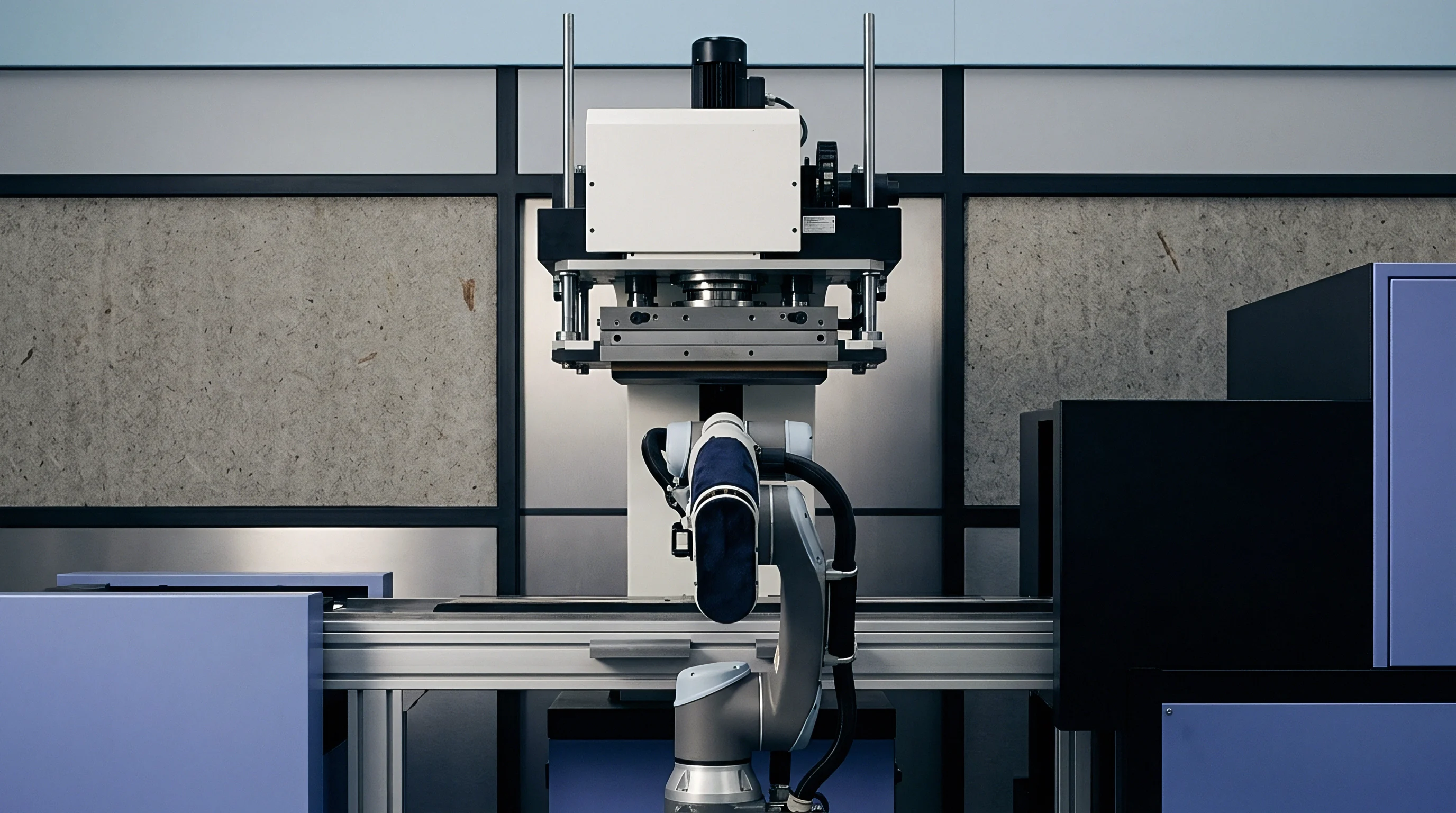
Short Span Compressive Test Apparatus Setup
Clamping assemblies for short span testing hold paperboard specimens under axial compression while providing lateral support to prevent early global buckling. Test specimens measuring 15 millimeters in width are clamped between ground steel jaws with a free span distance of exactly 0.70 millimeters, following specifications derived from ISO 9895 and adapted for long-term load application. Dead-weight mechanisms or electro-mechanical servo systems apply a constant compressive force representing a specified fraction of the material’s nominal Short-span Compressive Strength (SCT).
High-precision Linear Variable Differential Transformers (LVDTs) or laser Doppler vibrometers track micro-scale displacement across the free span at sampling frequencies up to 100 Hertz during the first minute of loading to capture rapid primary kinetics.
| Standard Designation | Test Type | Conditioning Standard | Applied Load (% SCT / BCT) | Primary Duration |
|---|---|---|---|---|
| ISO 2233 / ISO 12048 | Full Box Compressive Creep | 23°C / 50% RH to 85% RH | 40% to 60% of peak BCT | 24 to 72 Hours |
| TAPPI T 818 | Ring Crush Creep Resistance | 23°C / 50% RH | 30% to 50% of peak RCT | 12 to 24 Hours |
| FEFCO Standard No. 50 | Edge Compressive Creep (ECT) | 23°C / 85% RH Static | 40% of ambient ECT | 48 Hours |
| ASTM D7030 | Short-Span Compressive Creep | 23°C / 65% RH to 90% RH | 25% to 55% of peak SCT | 1 to 12 Hours |
Climate Chamber Controls and Environmental Tolerances
Conditioning enclosures maintain tight atmospheric bounds to prevent test variance. Temperature control operates within a tolerance of plus or minus 0.5 degrees Celsius, while relative humidity remains locked within plus or minus 2.0 percent across the full testing timeframe. Thermal expansion drift inside mechanical loading fixtures mimics creep strain, introducing severe measurement error if climate chambers fluctuate during the primary creep phase.
A relative humidity spike of five percent at twenty-three degrees Celsius accelerates initial creep strain rates in containerboard by twenty-eight percent.
- Atmospheric Homogeneity requires continuous laminar airflow across test specimens inside the climate chamber at velocities below 0.3 meters per second to prevent localized evaporative cooling.
- Specimen Pre-conditioning dictates drying test samples in an atmosphere below thirty percent relative humidity at forty degrees Celsius prior to final equilibrium exposure, eliminating sorption hysteresis variance.
- Load Application Velocity specifies reaching peak static stress within less than two seconds without mechanical shock or overshoot, isolating instantaneous strain from time-dependent primary creep.
- Data Acquisition Rate enforces high-density sampling during the initial 600 seconds of static load application to capture exponential primary deceleration kinetics accurately.
Field box wall failures are often traced to unexpected atmospheric spikes in distribution facilities rather than deficient short-span creep performance on the test bench.

Calculus
Predicting structural retention under static top loads requires converting short-term laboratory creep data into duration-of-load factors. Box compression requirements rely heavily on empirical reductions calculated from primary creep rate constants. Without accurate integration of primary creep kinetics, containerboard safety factors derived from static compression tests drastically overestimate warehouse stacking performance under humid conditions.
Empirical Kinetic Equation and Parameter Fitting
Deriving long-term failure thresholds involves fitting curve parameters to deformation points recorded during short-term creep experiments. Primary creep kinetics follow a power-law differential equation governing strain rate behavior over time:
d(Strain)/dt = A m t^(m – 1)
Integrating this equation yields total strain accumulation over a designated storage duration. Consider a technical scenario involving a double-wall corrugated containerboard sheet (175 Kraftliner / 127 Semi-Chemical Fluting / 175 Kraftliner) subjected to a continuous static load equivalent to 40 percent of its ultimate short-term Edge Crush Test (ECT) value at 85 percent relative humidity and 23 degrees Celsius. Laboratory bench testing under these conditions yields the following fitted power-law parameters:
- Instantaneous Elastic Strain equals 0.0028 mm/mm immediately upon applying the static load.
- Scale Parameter A evaluates to 0.00095 mm/mm/hour^m under 85 percent static relative humidity conditions.
- Time Exponent m measures 0.285 for the specific virgin softwood kraftliner face combinations.
- Critical Collapse Strain defines total failure at 0.0180 mm/mm for this double-wall profile.
Stacking Life Prediction Worked Example
Calculate total creep strain after 90 days (2,160 hours) of continuous warehouse storage under steady 85 percent relative humidity.
Primary Creep Strain = A t^m
Primary Creep Strain = 0.00095 (2160)^0.285
Primary Creep Strain = 0.00095 8.948 = 0.00850 mm/mm
Total Accumulated Strain = Instantaneous Elastic Strain + Primary Creep Strain
Total Accumulated Strain = 0.00280 + 0.00850 = 0.01130 mm/mm
Because the total strain after 90 days (0.01130 mm/mm) remains below the critical collapse strain threshold (0.0180 mm/mm), the packaging structure maintains global stability. However, if ambient humidity shifts from 85 percent to 90 percent RH, scale parameter A increases to 0.00185 mm/mm/hour^m due to enhanced cell wall plasticization.
Re-evaluating total strain under 90 percent relative humidity exposure:
Primary Creep Strain = 0.00185 (2160)^0.285 = 0.00185 8.948 = 0.01655 mm/mm
Total Accumulated Strain = 0.00280 + 0.01655 = 0.01935 mm/mm
Failure to specify short-span compressive creep retention parameters in supply agreements voids box performance guarantees during humid storage.
In this second scenario, total strain exceeds the critical failure threshold of 0.0180 mm/mm within 2,160 hours, inducing tertiary creep collapse before the target 90-day storage duration elapses. Errors in primary strain extrapolation result in undersized paper grammages, premature pallet collapse, and total loss of warehouse contents.
Dispute
Discrepancies between short-term crushing values and actual warehouse stacking endurance create operational friction between paper mills, packaging converters, and corporate buyers. Standard laboratory compression tests evaluate ultimate force over a period of fifteen to thirty seconds, while real distribution channels subject loaded boxes to continuous top pressures for months under unconditioned relative humidity environments. The resulting disconnect between certified Box Compression Test (BCT) figures and field retention rates exposes brand owners to uncompensated inventory damages.
Static Compression Standards versus Real Stacking Life
Standard crushing tests deliver instantaneous load capacity measurements in controlled laboratory air. Testing according to ISO 12048 applies a constant deformation rate of 12.5 millimeters per minute until structural failure occurs. This instantaneous measurement captures ultimate structural strength, but completely ignores time-dependent viscoelastic creep deformation.
Standard safety factors applied across the packaging industry assume predictable strength loss over time, multiplying baseline top load needs by factors ranging from 1.5 to 3.0. These generalized factors fail when applied to high-recycled containerboard grades exposed to static relative humidity above seventy-five percent, where primary creep compliance increases non-linearly.
| Furnish Blend Composition | 50% RH Creep Exponent (m) | 85% RH Creep Scale Parameter (A) | 90-Day BCT Retention Factor (50% RH) | 90-Day BCT Retention Factor (85% RH) |
|---|---|---|---|---|
| 100% Virgin Kraftliner | 0.28 | 0.00082 | 0.72 | 0.48 |
| 70% Virgin / 30% Testliner | 0.29 | 0.00115 | 0.68 | 0.41 |
| 100% Recycled Testliner | 0.31 | 0.00168 | 0.61 | 0.31 |
| High-Performance Recycled Medium | 0.32 | 0.00195 | 0.58 | 0.26 |

Virgin Kraft versus Recycled Fiber Creep Penalties
Raw material selection exerts profound influence over time-dependent structural deformation. Fiber recycling shortens average chain lengths, degrades internal fibrillar structure, and increases total hemicellulose surface exposure through hornification. Consequently, recycled testliners exhibit significantly higher primary creep rates than virgin softwood kraftliners of equivalent basic grammage.
Under static 85 percent relative humidity exposure, hundred percent recycled containerboard combinations require safety factors approaching 4.0 to guarantee structural stability over 90 days, whereas virgin kraft combinations achieve equivalent retention with safety factors near 2.1.
Virgin softwood kraft liners exhibit forty percent lower primary creep compliance than hundred percent recycled testliners under identical static moisture loads.

Contractual Risk Allocation and Conformity Files
Procurement documents frequently specify top-load compression parameters while omitting time-dependent metrics. When pallet stacks collapse in humid distribution hubs, disputes center on whether the failure stems from improper box specification, manufacturing defect, or supply chain misapplication. Under the Packaging and Packaging Waste Regulation (PPWR) framework in the European Union, manufacturers face strict obligations to minimize packaging weight while proving structural fitness for use.
Over-designing packaging to compensate for unquantified creep risks violates weight-minimization mandates, while under-designing leads to product destruction.
Defensible compliance files link raw material Short-span Compressive Creep (SCT-Creep) parameters directly to finished box performance profiles. Procurement contracts must embed explicit environmental conditioning parameters alongside minimum duration-of-load standards. Relying solely on standard FSC or PEFC chain-of-custody documentation proves raw material origin, but offers zero assurance regarding mechanical performance under sustained moisture exposure.
Incorporating FEFCO Standard No. 50 creep compliance limits directly into purchase specifications shifts financial liability for moisture-induced stacking failure back to the packaging manufacturer.