Evaluation of Mechano-Sorptive Creep Failure in Recycled Containerboard under Cyclic Ambient Humidity
Dynamic ambient humidity accelerates creep failure in recycled containerboard, requiring increased structural safety factors and dynamic testing to prevent stack collapse.

Mechanics
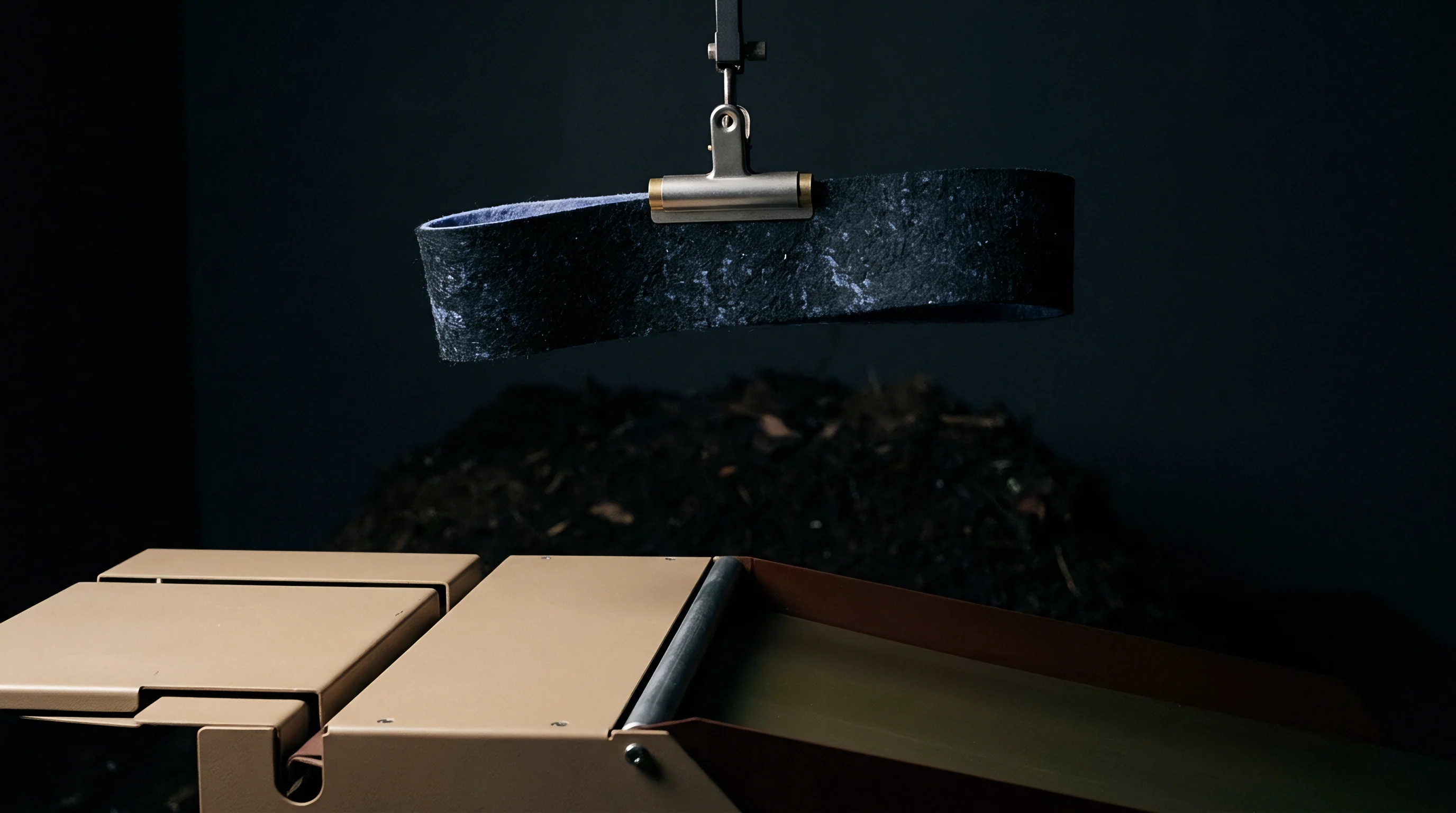
Cellulosic containerboard under static load fails significantly faster when ambient humidity cycles. Known as mechano-sorptive creep, this effect drives deformation rates during active moisture adsorption or desorption well past those observed under constant high humidity. As water moves into or out of the fiber network, it plasticizes the amorphous regions, accelerating strain under load.
The root of this instability lies in the architecture of the wood fiber wall and its interfiber bonding network.
Inside the secondary cell wall, cellulose microfibrils align at specific fibril angles within an amorphous matrix of hemicellulose and lignin. Hydrogen bonds cross-link adjacent cellulosic chains, providing dry fiber with its stiffness. When ambient humidity climbs, incoming water molecules penetrate these amorphous zones and disrupt hydrogen bonds, forming transient water bridges.
Under external load, local shear stresses force the unbonded chains to slip past one another before reforming hydrogen bonds in shifted positions.
Relative humidity cycling between 50 percent and 85 percent at 23 degrees Celsius increases the creep strain rate of 100 percent recycled testliner by a factor of four relative to continuous exposure at 85 percent relative humidity.
Desorption accelerates strain through a related mechanism. As humidity drops and moisture leaves the fiber wall, internal capillary forces generate steep, transient stress gradients across the sheet thickness. When these bonds break and reform during dynamic moisture exchange, the sheet develops irreversible plastic deformation ~ mechano-sorptive strain ~ with overall deflection outpacing static predictions.
Recycled containerboard displays higher susceptibility to mechano-sorptive failure than virgin kraftliner. Industrial repulping, refining, pressing, and drying alter fiber morphology through hornification. Repeated cycles through alkaline washing and drying cylinders collapse pores within the cell wall, lower the specific surface area, and strip away hemicellulose.
The resulting web consists of shorter, stiffer, less conformable fibers with limited swelling capacity and reduced contact area for interfiber bonding.
Micro-Mechanical Stress Distribution in Secondary Fiber Networks
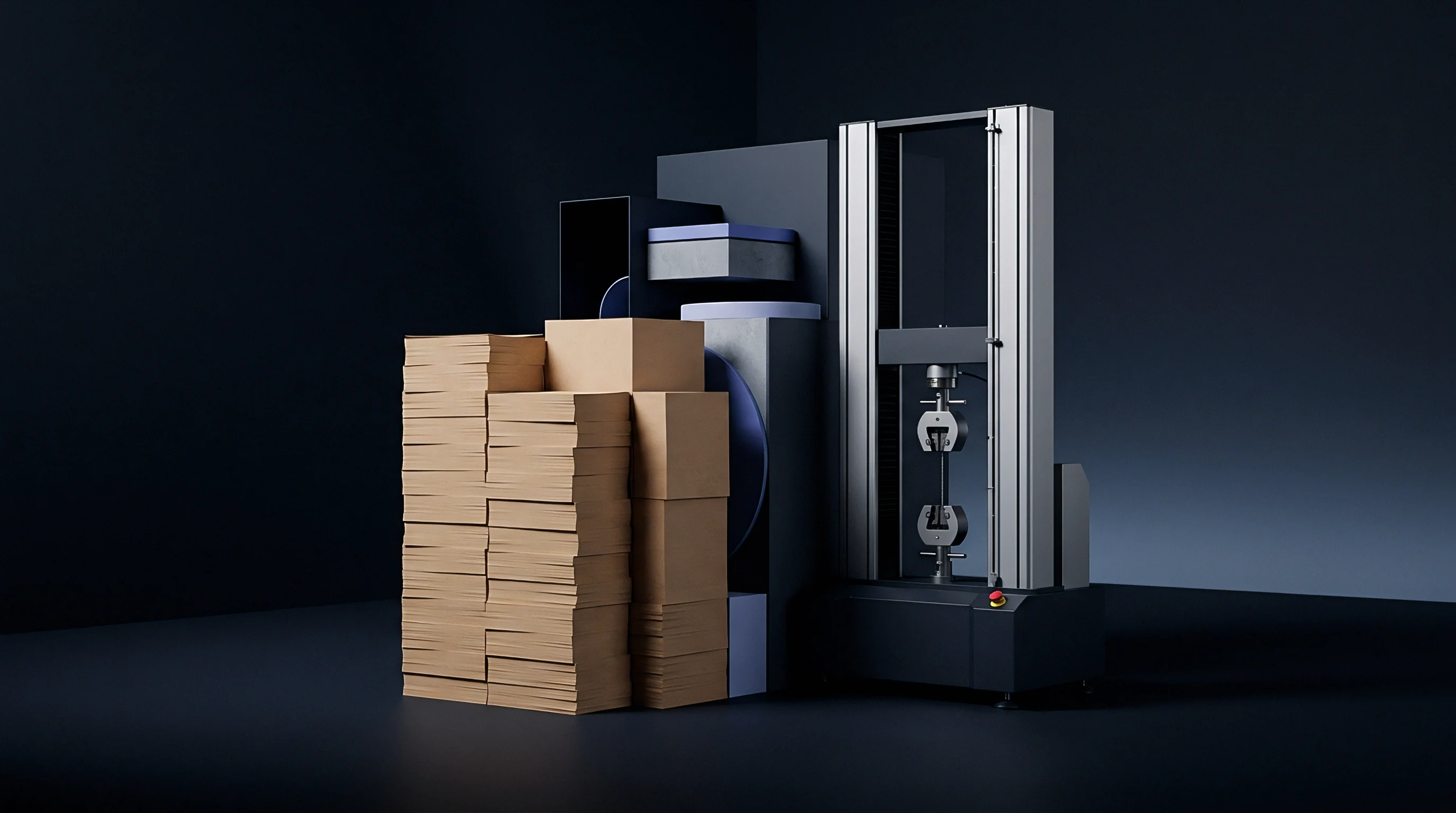
Stress distribution across loaded recycled containerboard is inherently uneven. Hornified secondary fibers resist bending, which concentrates applied compressive or tensile forces across fewer interfiber bonds. During humidity cycles, transient moisture gradients drive differential through-thickness swelling: the surface plies equilibrate almost immediately with ambient air while the core lags behind, creating steep moisture profiles along the z-direction.
These temporary gradients induce internal shear stresses that compound external stacking loads. Because secondary fiber networks possess lower bond density and weaker individual joints than virgin pulp matrices, the combined shear stresses breach the critical yield point at lower overall loads. Micro-delamination consequently begins inside the web well before the board approaches its static ultimate compressive strength.
The accumulation rate of mechano-sorptive strain depends on the frequency and amplitude of relative humidity shifts alongside the moisture transport properties of the grade. High-density recycled testliners and waste-based medium grades, often treated with surface starches or hydrophobic sizing to restore dry strength, produce complex vapor diffusion profiles. Sizing slows liquid penetration but does not halt water vapor diffusion into the amorphous cellulose.
Continued vapor movement through the sheet maintains mechanical instability throughout the fiber network.
Current rheological models fail to capture the molecular threshold where transient moisture flux overtakes the static creep strain rate in ultra-high recycled content fluting medium.
Swell
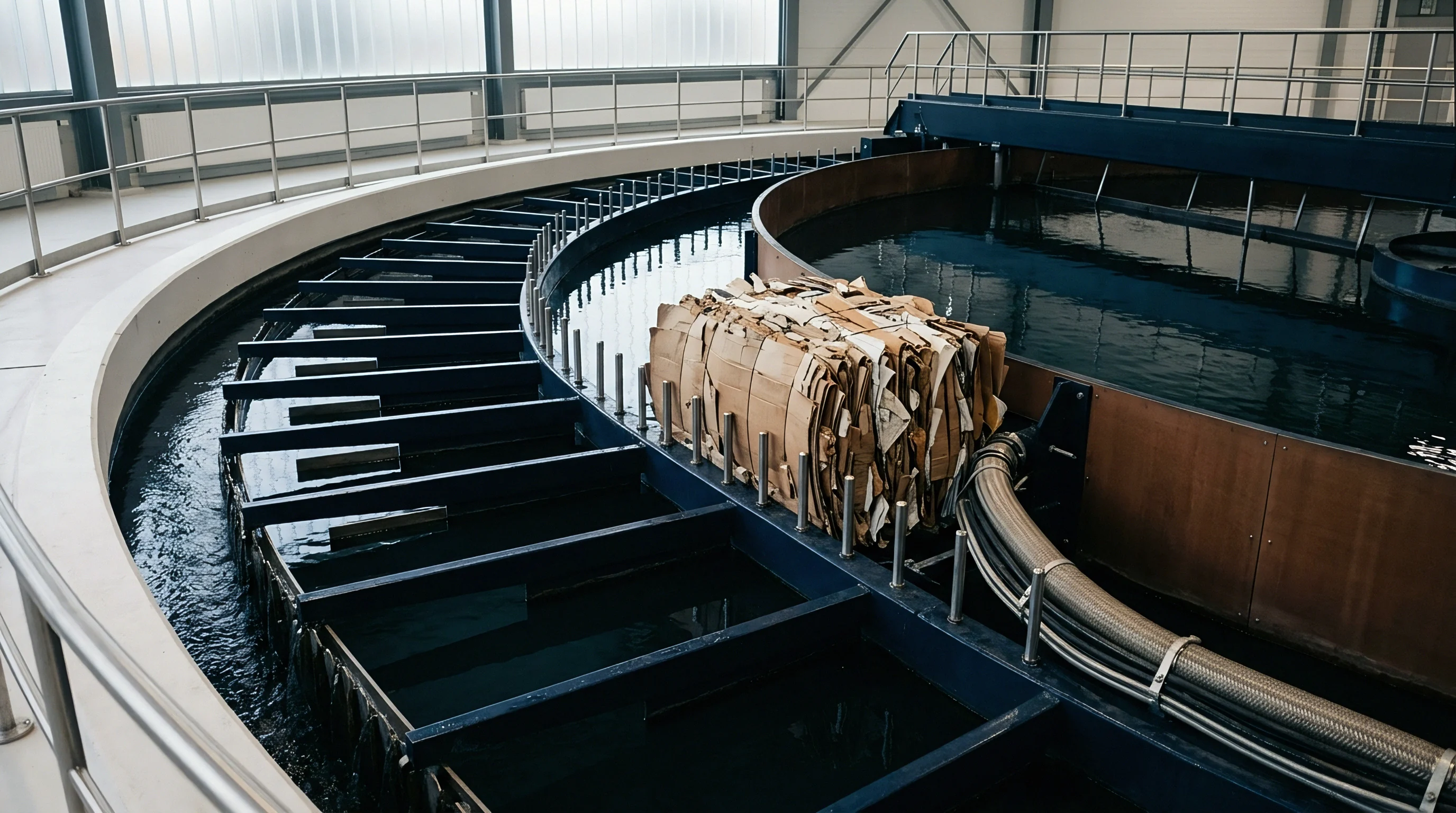
Water vapor sorption disrupts the dimensional stability of individual cellulosic fibers and the web they form. Hygroexpansivity quantifies this fractional dimensional change relative to shifts in moisture content. Absorbed water causes fibers to expand anisotropically, showing minimal expansion along the longitudinal axis but substantial dilation in radial and tangential directions.
Because standard machine-made containerboard aligns fibers predominantly along the machine direction, cross-direction hygroexpansivity exceeds machine-direction hygroexpansivity by a factor of three to five.
Moisture sorption isotherms for recycled containerboard follow the sigmoidal profile typical of Type II physical sorption models. At low relative humidity, water forms a monolayer on accessible hydroxyl groups across cellulosic surfaces. Above 50 percent relative humidity, multilayer sorption begins, leading to capillary condensation within cell wall micropores once humidity exceeds 80 percent.
While hornification lowers the number of amorphous sorption sites ~ yielding a lower absolute moisture sorption capacity in recycled grades than in virgin kraftliner at equivalent humidity ~ the dimensional strain per unit of absorbed water runs higher in recycled sheets due to rigid fiber alignment and constrained internal stress relaxation.
Hygroexpansivity Coefficients across Fiber Orientations
In-plane dimensional shifts remain heavily anisotropic between machine and cross directions. The table below lists measured hygroexpansivity coefficients, moisture uptake rates, and equilibrium moisture content values for virgin kraftliner and 100 percent recycled testliner subjected to cyclic humidity steps between 50 percent and 90 percent relative humidity at 23 degrees Celsius.
| Grade Specification | Fibre Composition | Equilibrium Moisture at 50 Percent RH (Percent) | Equilibrium Moisture at 90 Percent RH (Percent) | MD Hygroexpansivity Coefficient (Percent Delta L per Percent Delta M) | CD Hygroexpansivity Coefficient (Percent Delta L per Percent Delta M) |
|---|---|---|---|---|---|
| Unbleached Kraftliner 175 gsm | 100 Percent Virgin Unbleached Kraft | 6.8 | 14.2 | 0.06 | 0.22 |
| Recycled Testliner 1 160 gsm | 100 Percent Mixed Secondary Fibre | 6.2 | 12.8 | 0.08 | 0.28 |
| Recycled Fluting Medium 120 gsm | 100 Percent Waste-based Medium | 5.9 | 12.3 | 0.09 | 0.31 |
| High-Performance Testliner 140 gsm | 80 Percent Recycled / 20 Percent Virgin | 6.4 | 13.3 | 0.07 | 0.25 |
Humidity cycling produces fluctuating strain fields that repeatedly stress the glue lines joining fluting to linerboard. As moisture enters the structure, the liners and corrugated medium expand at different rates, promoting out-of-plane flexural buckling across panel faces. Static compression figures offer poor guidance here: during subsequent drying and contraction, permanent structural damage prevents the board from regaining its initial geometry, leaving residual strain after every cycle.
Out-of-plane swelling in thickness (the z-direction) introduces an additional failure path. Absorbed moisture disrupts inter-ply bonding in multi-ply testliners. These boards are formed by couching multiple thin plies on a multi-fourdrinier or former to achieve nominal grammage and burst strength, relying on surface starch and fiber entanglement across the interfaces.
Dynamic moisture transport creates differential expansion between plies, prompting localized micro-delamination along the bond lines.
Board webs that absorb moisture rapidly during humidity spikes suffer greater cumulative strain than less vapor-diffusive sheets under the exact same load.
Strength
Short-span axial compression strength governs corrugated panel capacity under stacking loads. Standard testing methods like Short-Span Compressive Strength (SCT), defined in ISO 9895 or TAPPI T 826, measure ultimate resistance over a 0.70 millimeter clamping span. This short span suppresses macro-buckling, isolating compressive shear failure within the fiber matrix.
At a constant 23 degrees Celsius and 50 percent relative humidity, SCT values correlate closely with Box Compression Test (BCT) capacities calculated through empirical models like the McKee formula.
Dynamic humidity breaks this correlation. A recycled testliner that meets structural targets during static testing at 50 percent relative humidity loses compressive resistance over time when stored in unconditioned spaces subjected to moisture cycles. Mechano-sorptive action reduces the tangent modulus of the fiber web, triggering micro-buckling inside individual cell walls at loads well below the static SCT threshold.
This local creep destabilizes the fluting geometry, hastening global panel collapse.

Does Recycled Processing Exaggerate Mechano-Sorptive Strain?
Repeated repulping and refining permanently collapse internal pores in secondary cellulosic fibers. Once hornified, these fibers have lower intrinsic wall strength and lose flexural rigidity when re-wetted. Consequently, recycled containerboards lose a greater share of their compressive load capacity during moisture cycles than virgin kraftliner under identical load ratios.
As humidity climbs and recycled fibers take on water, softened cell walls yield under localized compressive forces. This micro-buckling propagates across structural scales through a predictable sequence:
- Interfiber Bond Shear Yielding occurs as transient moisture transport weakens hydrogen bonds while the matrix remains under sustained compressive shear.
- Fluting Crest Micro-Buckling develops along glue lines where stress concentrations coincide with peak moisture diffusion rates.
- Panel Creep Facet Indentation forms on outer box faces when local shear deformation degrades out-of-plane flexural stiffness.
- Global Stacking Collapse follows once cumulative cross-direction creep strain surpasses the stability limit of the vertical corner posts.
The McKee formula estimates box compression strength from short-span compressive strength, board bending stiffness, and box perimeter, assuming baseline properties determined under standard ISO 187 conditioning:
BCT = 2.028 SCT^0.746 (D_x D_y)^0.127 Z^0.492
where SCT is cross-direction short-span compressive strength, D_x and D_y are bending stiffnesses in the machine and cross directions, and Z is the box perimeter. In fluctuating environments, this formula overestimates the actual stacking capacity of recycled containerboard packaging by 30 to 50 percent.
Incorporating a dynamic mechano-sorptive reduction factor into standard BCT equations reduces the predicted stacking capacity of recycled containerboard boxes operating in ambient relative humidity cycling between 50 percent and 90 percent by 42 percent relative to static testing predictions.
Compressive strength loss does not follow a linear path. Creep strain accumulates most rapidly during the first three moisture adsorption-desorption cycles. Thereafter, irreversible strain builds at a lower, quasi-steady rate until micro-cracking across the recycled web triggers tertiary creep and final structural failure.
Ignoring dynamic mechano-sorptive degradation causes warehouse stacks to collapse, triggering total inventory write-downs and heavy freight rejection penalties at distribution hubs.

Appraisal
Assessing long-term box performance requires test protocols that replicate dynamic ambient shifts rather than steady-state laboratory conditions. Mill technical sheets cite values established strictly under ISO 187 parameters (23 degrees Celsius and 50 percent relative humidity). While these metrics reflect optimal baseline performance, they cannot predict mechano-sorptive fatigue in working supply chains.
Meaningful qualification of recycled containerboard depends on accelerated creep testing across cyclic humidity profiles.
ISO 22314 details procedures for evaluating creep behavior in filled, loaded packages under fluctuating atmospheric conditions. At the material level, specialized test equipment evaluates accelerated creep by subjecting board specimens to constant tensile or compressive deadweights inside humidity-controlled environmental chambers. A standard cycle alternates relative humidity between 50 percent and 90 percent at scheduled intervals (typically 6 or 12 hours per phase) while displacement sensors record strain accumulation.
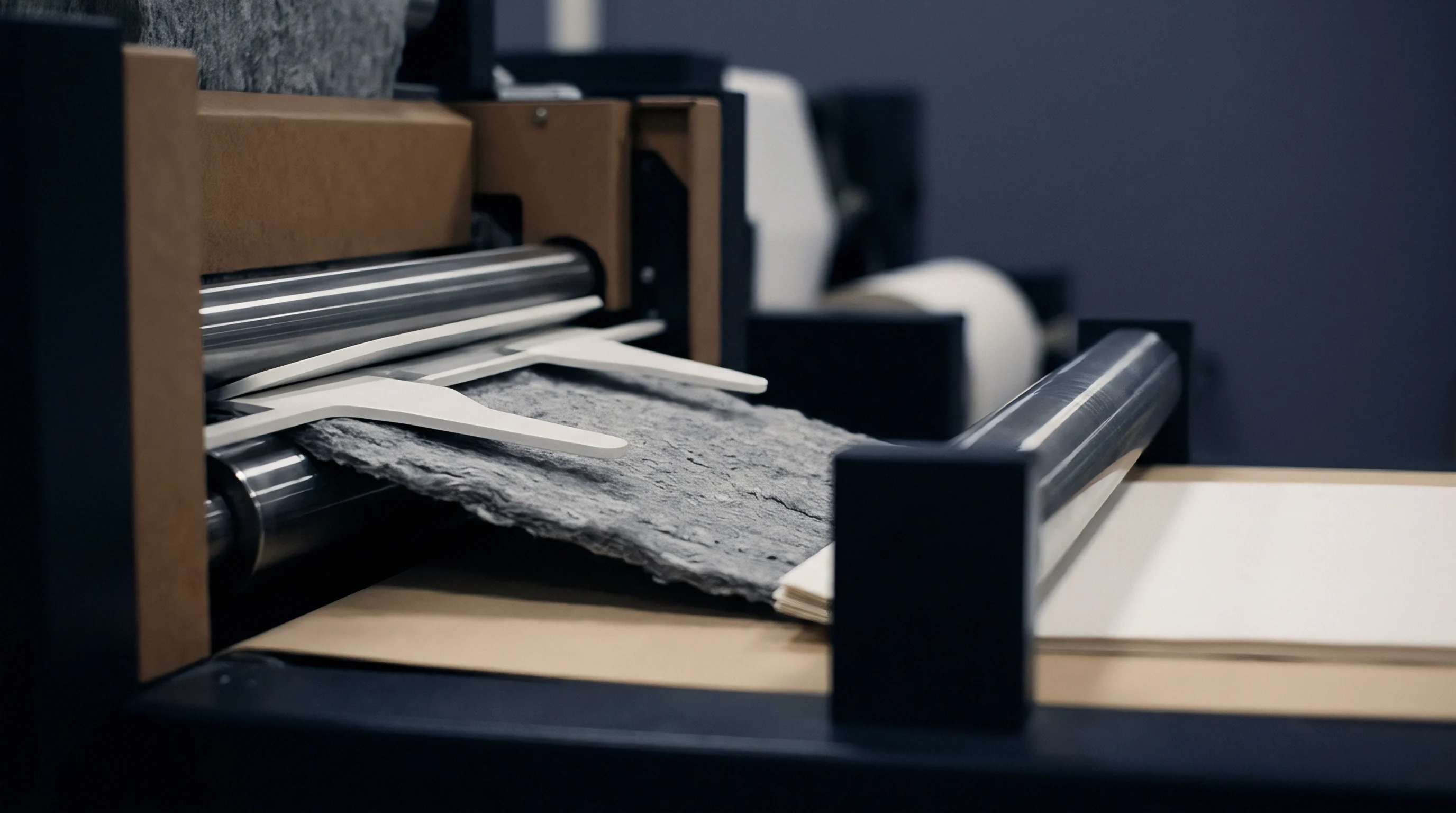
Comparative Analysis of Static and Dynamic Testing Conditions
Static laboratory conditioning ignores the internal stresses generated by moisture transport. The table below contrasts traditional testing regimes with the dynamic accelerated creep protocols required for secondary fiber packaging.
| Test Protocol Standard | Environmental Regime | Relative Humidity Cycle Range | Temperature Profile | Measured Physical Parameter | Relevance to Mechano-Sorptive Failure |
|---|---|---|---|---|---|
| ISO 187 / TAPPI T 402 | Static Controlled | 50 Percent Constant (+/- 2 Percent) | 23 Degrees Celsius Constant | Static SCT / Ring Crush Test (RCT) | Zero (Establishes baseline dry material properties) |
| ISO 22314 Method A | Dynamic Cyclic RH | 50 Percent to 85 Percent (12 h cycles) | 23 Degrees Celsius Constant | Package Creep Deflection Rate | High (Evaluates full pack creep response) |
| Accelerated Material Creep | Dynamic Cyclic RH Ramps | 40 Percent to 90 Percent (6 h cycles) | 23 to 40 Degrees Celsius Variable | Specimen Mechano-Sorptive Strain Rate | Direct (Isolates matrix-level fiber creep response) |
| ISO 12048 Stacking Test | Static High RH | 85 Percent Constant (+/- 3 Percent) | 23 Degrees Celsius Constant | Time to Static Failure under Load | Moderate (Captures plasticization, misses transient flux) |
Auditing recycled containerboard technical files requires scrutiny of test records. Verification of mill certificates must confirm the atmospheric conditions maintained during short-span compression testing. High dry SCT values on a mill certificate offer no protection against failure claims if the material was never evaluated under cycling moisture.
A material declaration specifying 100 percent recycled content remains incomplete without attached dynamic creep strain test data verified across a minimum of five humidity adsorption-desorption cycles.
Certifications such as FSC Recycled (FSC-STD-40-004) or PEFC Recycled (PEFC ST 2002) confirm chain of custody and environmental accounting, but carry no mechanical performance guarantee. Chain of custody verifies origin, not structural endurance. While converters occasionally introduce uncertified virgin furnish to reach static BCT targets without increasing sheet grammage, this circumvents fiber origin rules while leaving mechano-sorptive vulnerabilities unaddressed.
A rigorous intake audit for secondary containerboard follows four distinct steps:
- Certificate Scope Verification involves checking that the scope explicitly covers the exact converting mill, machine line, and grade name stated on delivery notes.
- Equilibrium Conditioning Validation requires confirming that test reports document a full 24-hour pre-conditioning at 23 degrees Celsius and 50 percent relative humidity before strength testing.
- SCT Retention Ratio Calculation entails comparing wet or high-humidity SCT values against dry baseline figures to determine water sensitivity indices.
- Cyclic Creep Response Verification demands reviewing dynamic chamber logs to ensure specimen strain rates stay within specified limits during transient absorption phases.
Standard compression testing under constant conditions satisfies nominal data sheet criteria, yet leaves performance under fluctuating ambient moisture unmeasured.

Allowance
Packaging engineers calculate stacking margins by applying empirical derating factors to dry box compression values. The ultimate strength of a fresh corrugated carton, measured under standard laboratory conditions, must be discounted to account for humidity swings, pallet patterns, load duration, and progressive material fatigue. The structural safety factor (Fs) sets the maximum safe load per carton:
Safe Load = BCT_standard / Fs
Safety margins developed for virgin kraftliner prove inadequate for recycled containerboard exposed to cycling ambient moisture. Virgin unbleached kraftliner in climate-controlled storage generally uses safety factors between 1.8 and 2.2. Standard testing models omit transient moisture states, which can only be evaluated inside dynamic humidity chambers.
Because unconditioned storage triggers rapid structural loss, recycled grades demand substantially higher derating factors.
Engineering Derating Multipliers for Dynamic Ambient Environments
Preventing mechano-sorptive failure across unconditioned supply chains requires composite multipliers that reflect fiber composition, humidity fluctuations, and planned storage duration. The overall safety factor is calculated as:
Fs = F_base k_mat k_hum k_duration k_pallet
where F_base is the baseline factor (typically 1.5), k_mat adjusts for secondary fiber hornification, k_hum covers dynamic humidity cycling, k_duration accounts for prolonged creep, and k_pallet corrects for pallet overhang and misalignment.
| Supply Chain Risk Profile | Containerboard Grade Selection | Relative Humidity Range (Percent) | Material Factor (k_mat) | Humidity Derating Factor (k_hum) | Recommended Composite Safety Factor (Fs) |
|---|---|---|---|---|---|
| Controlled Cold Chain / Indoor Storage | 100 Percent Virgin Kraftliner | 45 to 55 (Controlled) | 1.00 | 1.10 | 1.8 to 2.2 |
| Standard Ambient Domestic Logistics | Mixed Testliner / Recycled Medium | 40 to 75 (Ambient) | 1.25 | 1.45 | 2.8 to 3.2 |
| Unconditioned Marine / Tropical Shipping Lanes | 100 Percent Recycled Testliner | 50 to 95 (Dynamic Cyclic) | 1.40 | 2.10 | 4.2 to 5.0 |
| High-Humidity Agricultural Storage | Heavyweight Recycled Testliner + Wet Strength | 60 to 90 (High RH Cyclic) | 1.30 | 1.85 | 3.6 to 4.2 |
Engineering reviews of box specifications apply load duration factors that reflect dynamic humidity cycles, establishing safety factors above 4.0 for recycled packaging bound for tropical maritime routes. Stacking heights must be derated accordingly. Relying on virgin-grade safety factors for 100 percent recycled boxes in unconditioned supply chains almost guarantees failure once relative humidity cycles above 80 percent.
Recycled content mandates under the EU Packaging and Packaging Waste Regulation (PPWR) are speeding up the replacement of virgin kraftliner with recycled containerboard. Importers, brand owners, and converters must satisfy these targets without compromising transit integrity. Meeting both requirements usually requires raising sheet grammage or altering flute profiles to preserve top-to-bottom compression strength under cyclic moisture stress.
Worked Stacking Load Sensitivity Analysis for Export Packaging
Consider an export packaging application where a master carton must sustain a static load of 350 kilograms (3,433 Newtons) for 90 days in an unconditioned warehouse, with relative humidity cycling daily between 50 percent and 85 percent at 25 degrees Celsius.
Scenario A evaluates a standard RSC box made from virgin kraftliner (175 gsm Kraftliner / 120 gsm Semi-Chemical Fluting / 175 gsm Kraftliner). Static lab testing gives a baseline dry BCT of 8,200 Newtons. Applying a virgin safety factor Fs of 2.2 yields a safe load of 3,727 Newtons, safely exceeding the required 3,433 Newtons.
Scenario B evaluates an eco-redesigned box meeting PPWR targets, built from 100 percent recycled board (160 gsm Testliner 1 / 120 gsm Waste-based Medium / 160 gsm Testliner 1). ISO 187 lab testing gives a dry baseline BCT of 7,800 Newtons. If a buyer incorrectly applies the virgin safety factor of 2.2, the calculated allowable load appears to be 3,545 Newtons, giving a false sense of security.
Under real humidity cycles, mechano-sorptive creep drastically reduces effective load capacity. Applying the correct composite safety factor Fs of 4.2 (combining secondary fiber hornification k_mat = 1.40 and dynamic moisture flux k_hum = 2.10) gives a realistic limit:
Safe Load_recycled = 7,800 N / 4.2 = 1,857 Newtons
The actual stack load of 3,433 Newtons exceeds this safe threshold by 85 percent. In fluctuating humidity, these recycled boxes suffer severe creep within 14 days, leading to leaning pallets and warehouse stack collapse. To safely carry 3,433 Newtons using 100 percent recycled content, the engineer must specify heavier grades (like 220 gsm Testliner) or change the flute profile (moving from Single-Wall C-Flute to Double-Wall BC-Flute), pushing the required baseline dry BCT to at least 14,420 Newtons.
Specifying secondary fiber containerboard requires balancing commercial and engineering demands across several criteria:
- Ambient Humidity Profiling maps peak relative humidity and daily temperature shifts along the full logistics corridor.
- Duration Risk Mapping establishes total expected storage time, accounting for seasonal delays at transit hubs.
- Grammage Compensatory Scaling calculates the weight increases needed to offset strength loss from dynamic creep.
- Flute Profile Optimization selects corrugated geometries that maximize flexural stiffness and panel stability per gram of fiber.
A packaging specification that fails to scale structural safety factors when transitioning from virgin kraftliner to secondary containerboard exposes the buyer to total liability for humidity-induced stack collapse.
Packaging engineers evaluate whether datasheets declare creep resistance under dynamic humidity profiles before approving recycled grade substitutions in export specifications. Mandating recycled content without budgeting for necessary flute redesign or higher grammage forces converters to produce under-engineered boxes, passing latent collapse risks down the logistics chain.
Writing DIN EN ISO 12048 Annex B derating coefficients directly into supply contracts places financial liability for humidity failures on converters who fail to deliver verified load capacity margins.
Settlement
Allocating financial liability for transit stack collapses depends on the exact language of the supply agreement. When cartons collapse in storage, disputes turn on whether ambient conditions were uncharacteristically severe or the packaging was materially deficient. If recycled boxes fail during ordinary humidity cycles, buyers bear immediate costs: destroyed stock, clean-up operations, rejected shipments, and distributor chargebacks.
Purchase orders relying solely on baseline BCT metrics or ISO 187 dry tests leave buyers unprotected. Converters routinely counter claims by showing their packaging satisfied all static laboratory targets at dispatch. If the contract omits dynamic mechano-sorptive creep limits or defined operating environments, arbitrators frequently categorize humidity spikes as improper storage or force majeure, leaving buyers to absorb the loss.
Including explicit dynamic humidity creep performance parameters within packaging supply agreements transforms decorative environmental declarations into legally enforceable structural warranties.
Protecting commercial recovery requires procurement contracts that link structural guarantees to environmental conditions. Incorporating standard derating factors into cross-border supply agreements establishes enforceable thresholds. Agreements must define the expected relative humidity range, mandatory load duration factors, and the required dynamic creep testing standards.
Border inspections introduce additional risk when shipping secondary fiber packaging into territories with strict circular economy rules. Regulators inspect cargo for recycled content documentation, heavy metal limits, and overall handling stability. Damaged or leaning pallets caused by box failure trigger demurrage, restacking fees, or outright rejection at import terminals.
Importers and packaging buyers protect themselves by embedding dynamic creep specs into purchase orders, ensuring claims hold up when environmental logs show warehouse humidity cycled beyond static testing limits.