Mechano Sorptive Creep and Transverse Delamination Mechanics in Multi Ply Recycled Paperboard Grades
Mechano-sorptive cycling accelerates transverse delamination in recycled multi-ply board, collapsing stacked cartons when interlaminar shear exceeds ZD tensile bond.

Stack
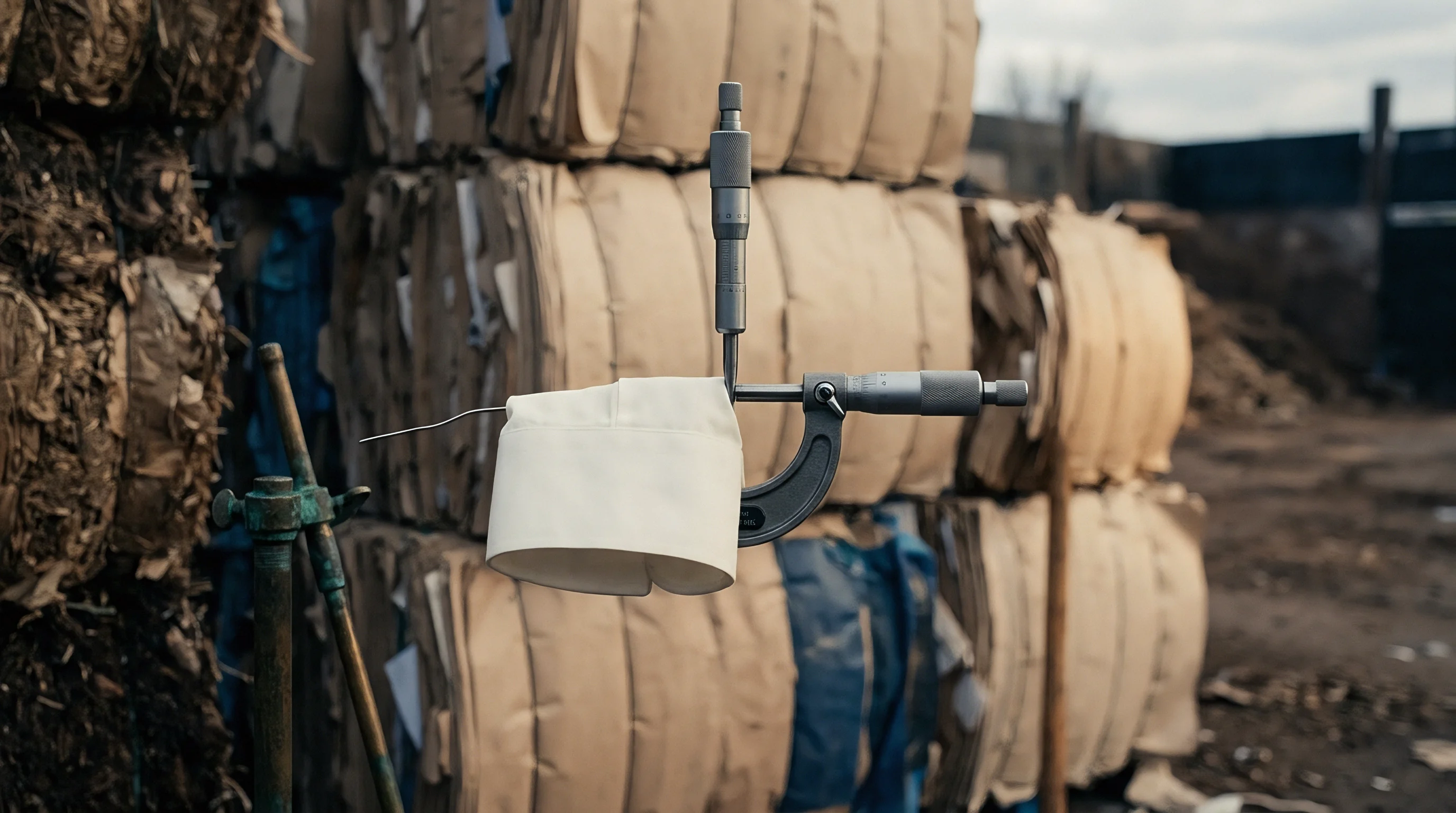
Delivered pallets of coated recycled board stand twenty-four tiers high in a container depot, carrying static loads under steady ambient temperatures. A dual-head micrometre registers the target thickness of four hundred fifty micrometres across every carton wall. The compression tester records six hundred Newtons of box compression strength under ISO 12048 standard conditions at twenty-three degrees Celsius and fifty percent relative humidity.
Three weeks later, inside a marine transit container traversing equatorial routes, forty percent of the bottom cartons buckle along their horizontal creases. The structural failure occurs without any increase in pallet mass or direct water ingress.
Moisture cycling drives the collapse. Relative humidity fluctuates between fifty-five percent during heated daytime transit and ninety-two percent during unventilated night cooling. Under constant mechanical compression, cyclical adsorption and desorption of moisture molecules across the cellulose network accelerates strain rates by four to ten times the rate observed at steady-state high humidity.
This phenomenon, known as mechano-sorptive creep, weakens multi-ply recycled grades far faster than virgin kraft compositions. Secondary fibres, having undergone multiple industrial drying loops, exhibit irreversible hornification, collapsed lumen geometries, and shortened average fibre lengths below 1.2 millimetres. The internal network accommodates the moisture flux through transient disruption of inter-fibre hydrogen bonds.
Cartons engineered with safety factors calculated exclusively for static storage collapse under dynamic atmospheric exposure.
Multi-ply recycled board softens rapidly whenever storage relative humidity swings across the daily dew threshold.
Packaging buyers frequently evaluate compression capacity using static short-span compression tests according to ISO 9895. That metric ignores the out-of-plane stress states generated when score lines roll outward under compressive loads. As the vertical walls bulge, shear stresses develop between the outer chemical pulp liner and the interior recycled filler plies.
The paperboard structure ceases to function as a unified solid beam. Internal plies separate, the cross-sectional moment of inertia collapses, and the compressive load shifts entirely onto thin, unbacked outer plies. The converter rejects the consignment.
Mill technical sales representatives describe the compressed pallet failure as an unpredictable force majeure event caused by rough logistics handling rather than a predictable material deficiency of the furnish.
Vapour
Relative humidity shifts destabilize the internal equilibrium of paperboard through molecular moisture sorption. Liquid sorption expands the cellulose matrix, but sorption from ambient water vapour activates specific hydrogen bond reallocation along the amorphous regions of hemicellulose and cellulose fibrils. Virgin chemical pulps expand uniformly because their long, flexible fibres retain intact fibrils capable of accommodating swelling.
Secondary fibres from recycled paper streams possess stiff, hornified cell walls that cannot swell internally. Water vapour enters the fibre network, breaking inter-fibre hydrogen bonds while the external compressive load simultaneously displaces the micro-fibrils into irreversible plastic strain.
Sorption Dynamics in Secondary Fibres
Desorption cycles do not restore the board to its original mechanical state. When moisture desorbs during temperature increases, reformed hydrogen bonds solidify within the newly deformed micro-fibril configuration. Each humidity cycle ratchets the cumulative deformation forward.
In multi-ply recycled grades such as white lined chipboard, the middle plies consist predominantly of mixed unsorted waste or old corrugated containers. These plies carry high concentrations of residual lignin, short hardwood fractions, mineral fillers, and degraded starch. The resulting network responds unevenly to vapour concentration gradients across the sheet thickness.
The moisture sorption isotherms of recycled multi-ply paperboard show pronounced hysteresis loops between adsorption and desorption branches. When the ambient relative humidity cycles between forty and eighty-five percent, the moisture ratio inside the recycled interior plies swings across a four percent moisture content band. The outer virgin plies, often surface-sized and coated with mineral pigment binders, exchange vapour at half the rate of the unsorted middle furnish.
This rate mismatch produces transient moisture gradients across the board thickness, developing steep internal stress concentrations.
Dynamic cyclic relative humidity between fifty and ninety percent at twenty-three degrees Celsius accelerates creep displacement by a factor of four compared to constant ninety percent exposure.
The failure cascade within the furnish follows a predictable progression:
- Interfacial Shear Delamination develops when differential hygroexpansion between the coated top ply and the recycled middle plies exceeds the shear strength of the inter-ply starch bond.
- Micro-Compressive Kinking occurs along the cross-machine direction as recycled fibres buckle under localized hygro-mechanical compressive forces.
- Starch Bond Plasticization takes place when localized moisture content exceeds twelve percent, dissolving brittle spray-starch bridges between adjacent plies.
- Asymmetric Creep Deflection warps the carton profile because the top liner and back liner possess different elastic moduli and hygroexpansion coefficients.
The table below summarizes the mechanical and hygroscopic divergence between individual plies within a typical four-ply white lined chipboard of three hundred fifty grams per square metre.
| Ply Position | Furnish Composition | Grammage (g/m²) | Elastic Modulus (GPa) | Hygroexpansion Coefficient (β, %/% RH) | Scott Bond Energy (J/m²) |
|---|---|---|---|---|---|
| Top Liner | Bleached chemical birch and pine | 65 | 5.8 | 0.014 | 280 |
| Under-Top | Deinked pulp and mechanical fines | 45 | 3.2 | 0.021 | 175 |
| Middle Filler | Mixed waste paper and mineral filler | 180 | 1.9 | 0.038 | 95 |
| Back Liner | Unbleached kraft and recycled corrugated | 60 | 3.6 | 0.026 | 190 |
Pallets tip within forty-eight hours. The moisture front penetrates the porous edges of the cut carton blanks faster than it passes through the coated face. Edge sorption drives rapid local swelling along the cut boundaries, initiating delamination cracks at the score beads before the carton body absorbs substantial vapour.
Paperboard stored under swinging ambient humidity loses stacking life twice as fast as paperboard kept in saturated damp air.


Split
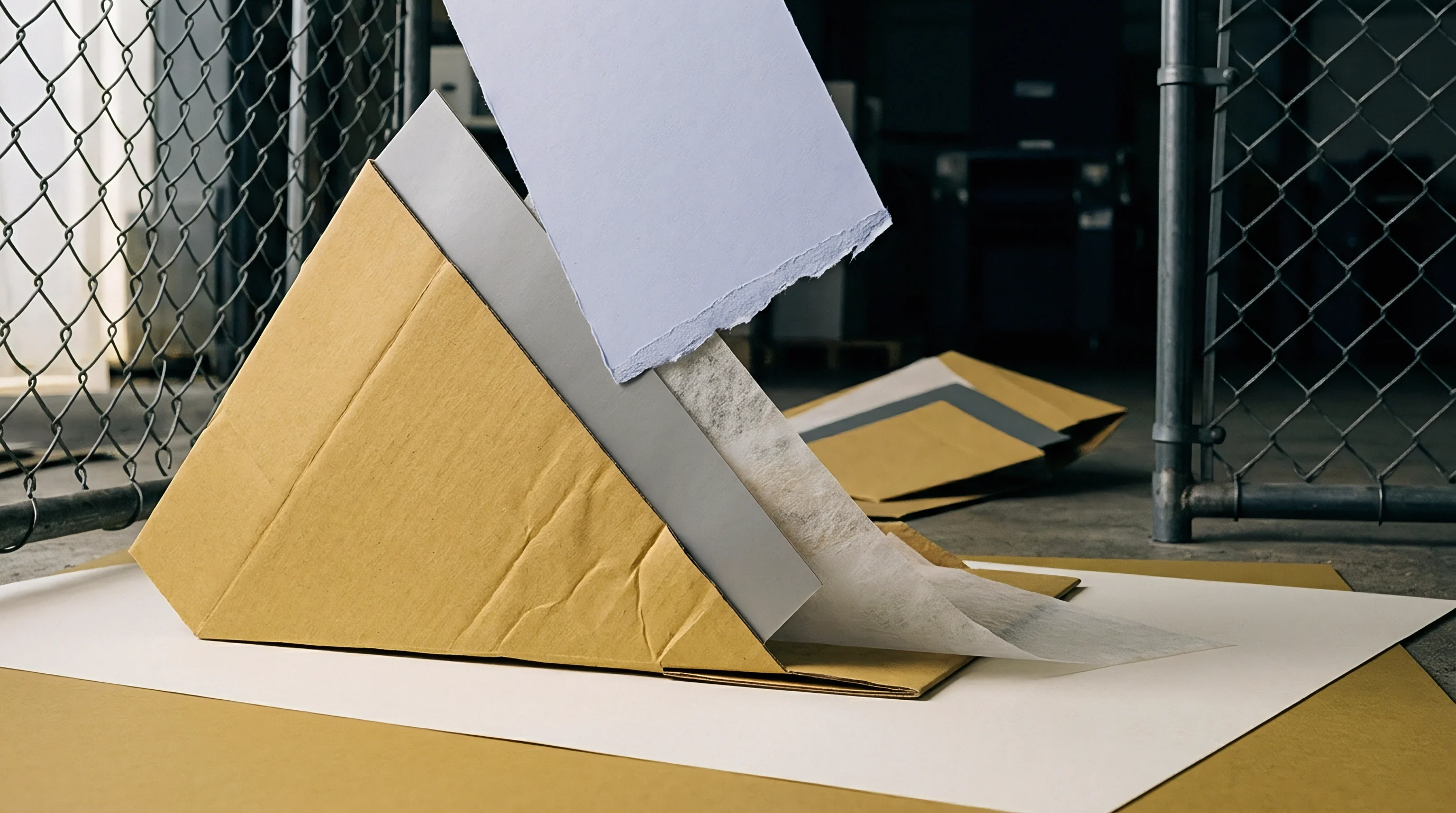
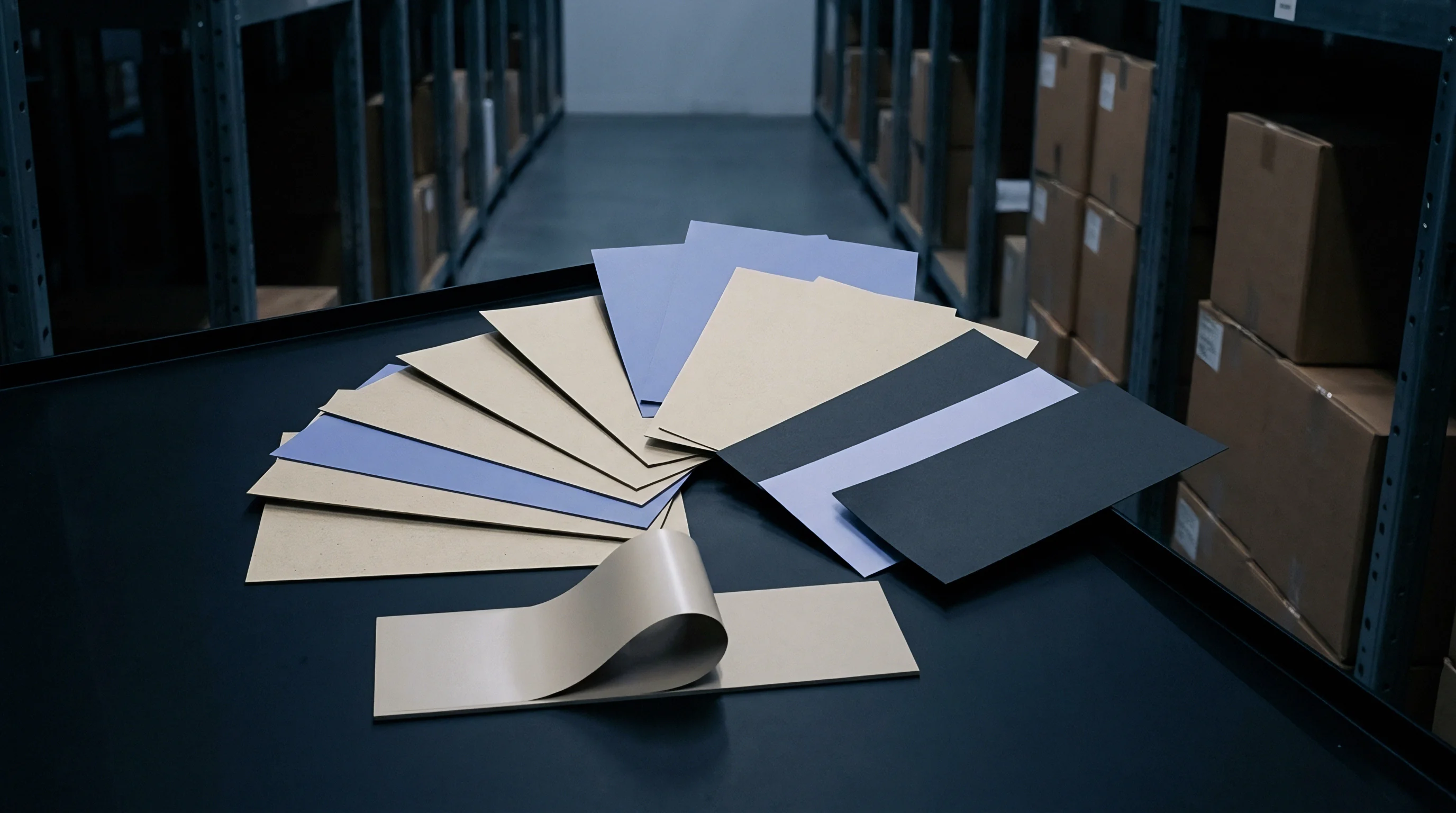
Transverse delamination destroys the out-of-plane integrity of multi-ply recycled boards through crack propagation along low-density interfaces. When folding cartons undergo creasing, cutting, and warehouse stacking, shear forces resolve in the out-of-plane direction. The out-of-plane tensile strength, characterized through ISO 15754, quantifies the force required to pull plies apart perpendicularly.
In premium solid bleached sulphate grades, out-of-plane tensile strength regularly exceeds three hundred kilopascals. In multi-ply recycled board, the value frequently drops below one hundred thirty kilopascals. The middle plies lack the chemical bonding sites and fibrillar entanglement required to resist transverse shear.
Where Do Interlaminar Shear Stresses Reach Peak Intensity?
Bending loads impose severe transverse shear stresses directly at the neutral axis of the paperboard sheet. In an asymmetrical four-ply sheet, the neutral axis lies squarely within the weak middle filler layer. The outer plies carry the primary compressive and tensile bending stresses, while the middle plies must transfer shear between these opposing faces.
When humidity cycles induce mechano-sorptive creep, the elastic modulus of the middle ply deteriorates at three times the rate of the outer chemical liners. This stiffness loss shifts shear stresses toward the interface between the under-top ply and the recycled middle ply.
Out-of-plane strength plummets past forty kilopascals. The interface holds spray starch applied during the wet forming process on the multi-cylinder paper machine. If the drainage rate on the forming wire was too rapid, the applied starch slurry washes out into the white-water circuit.
If drying cylinder temperatures rise too abruptly, the starch skins over without penetrating the fibrous web. The resulting dry interface presents a fragile, two-dimensional boundary. Moisture cycling dissolves the remaining physical interlocks along this boundary, allowing shear micro-cracks to coalesce into continuous delamination planes.
Differential transverse swelling between bleached virgin liner and recycled filler plies concentrates peak shear stress directly at the interface zone.
Creep displacement exceeds four millimeters. Carton walls buckle along horizontal scores. Creasing machines deform the board locally to create hinges for carton folding.
The creasing rule pushes the board into a grooved matrix, deliberately creating a controlled internal delamination pattern. This controlled split permits the board to fold ninety degrees without cracking the exterior coated surface. In virgin boards, the delamination remains localized within the crease channel.
In recycled board subject to moisture cycling, the crease delamination unzips outward into the main carton panel.
The qualification sequence for evaluating delamination vulnerability follows four distinct stages:
- Specimen Conditioning stabilizes the uncreased board blanks at twenty-three degrees Celsius and fifty percent relative humidity for twenty-four hours in conformance with ISO 187.
- Cyclic Exposure transfers the samples to an environmental chamber cycling between thirty percent and ninety percent relative humidity on four-hour intervals across five full cycles.
- Z-Directional Tensile Verification pulls the conditioned specimens apart perpendicularly at a constant displacement rate of two millimetres per minute under ISO 15754 parameters.
- Score Bend Energy Recording bends the crease to ninety degrees on a mechanical creasing tester to determine if residual internal bond strength prevents panel delamination.
Scott energy values plummet below ninety. The caliper swells fifteen micrometers. The board structure separates into discrete layers, reducing flexural rigidity to the sum of the individual plies rather than the cube of the overall caliper.
Uncontrolled panel buckling and premature structural failure in commercial pallet stacks follow immediately when interior plies detach during cyclic ocean transit.


Rig
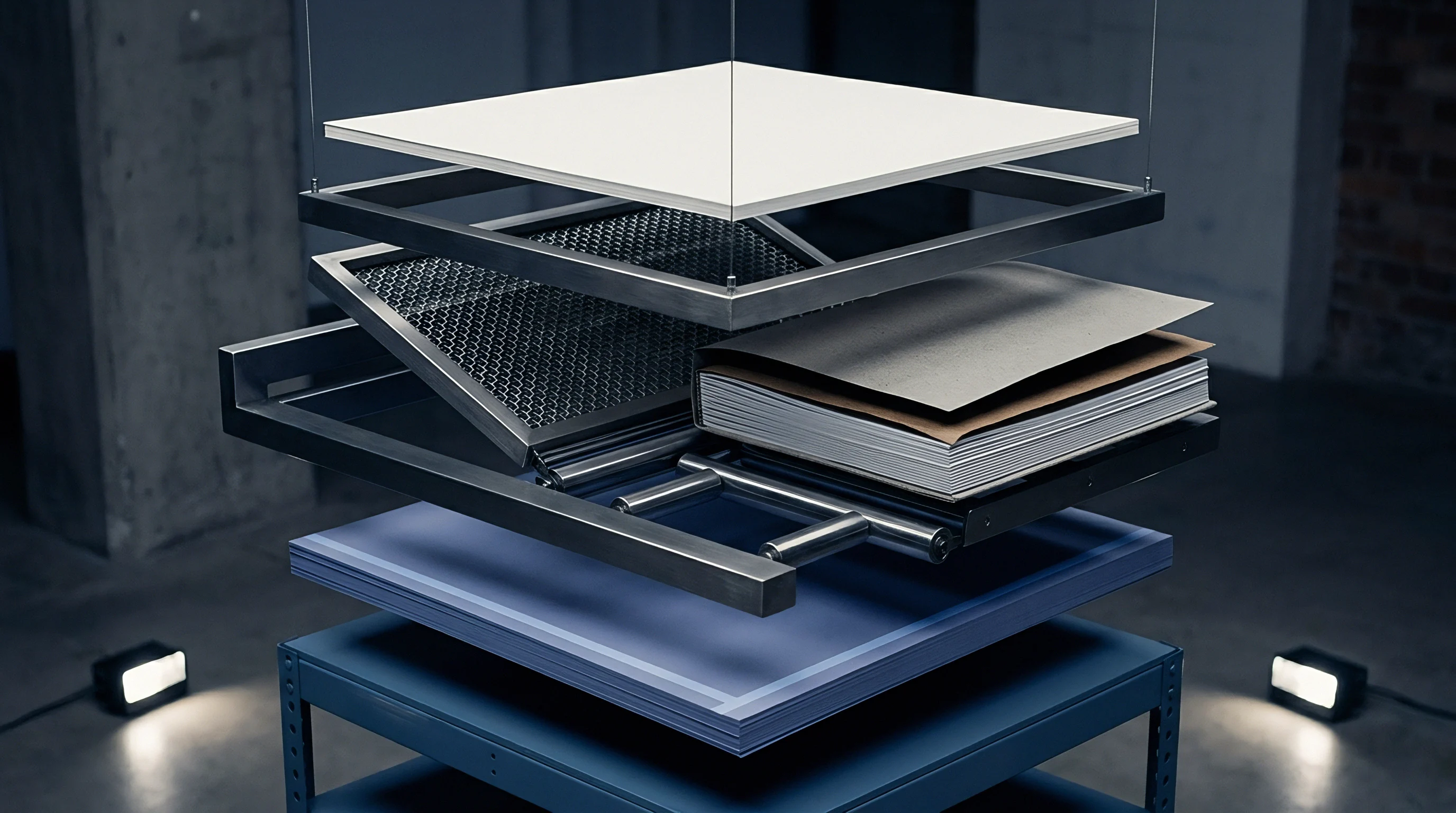
Laboratory evaluation of mechano-sorptive delamination demands physical test rigs capable of applying sustained mechanical loads during rapid atmospheric transitions. Standard testing laboratories condition specimens under static atmospheric equilibrium, completely missing dynamic creep failures. The tester mounts the paperboard specimen between metal clamping plates, applying dead-weight or pneumatic compressive stresses while enclosed inside a small-volume climatic chamber.
Relative humidity cycles between forty and ninety percent across sixty-minute periods, matching rapid container condensation cycles.

Will Calender Densification Suppress Delamination under Sorption?
Hard-nip calenders smooth the sheet and build uniform caliper across the reel. Machine calenders apply extreme compressive pressure across the multi-ply web, crushing bulky secondary fibres to achieve smooth printing surfaces. While calender densification temporarily raises initial Scott bond energy, it breaks fragile hornified fibres within the middle plies.
The mechanical damage creates micro-voids around mineral filler clusters. During humidity cycling, these micro-voids serve as condensation nuclei, drawing water vapour into the internal structure and speeding mechano-sorptive bond failure.
Bending stiffness drops thirty percent. Moisture cycling accelerates bond rupture. The laboratory records creep compliance curves over seventy-two hours.
At constant fifty percent relative humidity, a standard recycled carton board specimen deforms elastically, reaching a steady creep rate of less than 0.02 percent strain per hour under a sustained load equal to forty percent of its compressive failure load. When the chamber cycles humidity, the strain rate surges during each adsorption phase, producing a staircase compliance curve that terminates in catastrophic compressive fracture.
Specification clauses enforcing ISO 15754 out-of-plane tensile minimums of one hundred sixty kilopascals eliminate unbonded recycled lots before warehouse stacking begins.
The following parameters define dynamic structural performance during laboratory environmental screening across commercial packaging substrates.
| Board Classification | Standard Caliper (µm) | Initial ZDT (kPa) | Scott Bond (J/m²) | Static Creep Rate (%/hr at 50% RH) | Cyclic Mechano-Sorptive Creep Rate (%/hr) |
|---|---|---|---|---|---|
| Folding Boxboard (GC2) | 450 | 210 | 195 | 0.012 | 0.048 |
| Solid Bleached Board (GZ) | 400 | 340 | 310 | 0.008 | 0.022 |
| Coated Recycled Board (GD2) | 450 | 135 | 110 | 0.024 | 0.145 |
| Lined Chipboard (GT2) | 480 | 155 | 130 | 0.019 | 0.118 |
Lignin inhibits secondary bond formation. Recycled furnish contains lignin remnants that repel water-soluble starches while retaining hygroscopic sensitivity. Starch penetration depth governs ply retention.
Sourcing specifications that lack dynamic creep verification expose the supply chain to sudden pallet collapses during seasonal monsoon shipping routes.
Section 8 of standard trade contracts for industrial packaging supply stipulates that board lots displaying internal bond degradation exceeding thirty-five percent under cyclic humidity testing forfeit standard warranty protections and trigger mandatory credit settlements.
Settlement
Purchasing specifications for folding boxboard balance sheet grammage against cost per thousand finished units. Multi-ply recycled board trades at a discount of fifteen to twenty-five percent per metric tonne compared to virgin folding boxboard. A buyer running one million pharmaceutical or food cartons calculates an immediate material saving by switching from a three hundred gram virgin folding boxboard to a three hundred twenty gram coated recycled grade.
That calculation ignores yield loss, calender density differences, and stacking safety factors under variable climate conditions.
The virgin sheet provides a bulk of 1.6 cubic centimetres per gram, whereas the recycled alternative delivers only 1.35 cubic centimetres per gram. To match the bending stiffness of the virgin sheet, the buyer increases the grammage of the recycled board to three hundred sixty grams per square metre. The initial price advantage per tonne narrows instantly when calculated per thousand delivered cartons.
Container transit takes twenty-one days. The warehouse air reaches saturation. The secondary fibre network absorbs moisture, activating mechano-sorptive creep across the bottom tiers of palletized freight.
Stacking safety factors designed for virgin grades fail entirely in multi-ply recycled packaging.
Static safety factors of 1.8 to 2.2 protect cartons in climate-controlled warehouses. Shipments moving through unconditioned marine containers require dynamic safety factors between 3.5 and 4.5 when utilizing recycled filler plies. The additional paperboard mass required to survive dynamic humidity sweeps erodes the initial purchase savings.
Sourcing directors face freight claims, customer chargebacks, and emergency airfreight costs when bottom cartons split and production lines shut down.
Whether paperboard mills can engineer cost-effective wet-end enzymatic treatments and starch cross-linkers capable of arresting mechano-sorptive delamination in heavily recycled furnishes remains an active debate across the packaging conversion sector.