Modeling Hygral Stress Profiles and Edge Waving in High-Bulk Recycled Cartonboard Skids
Modeling transient moisture gradients and hygral stress in high-bulk recycled cartonboard skids establishes barrier wrap limits to prevent press edge waving

Pulp
Multi-ply cartonboard combines recycled paper fibers in its middle plies with chemical thermo-mechanical pulp in the top liner to maximize bending stiffness at a target grammage. Recycled grades like White Lined Chipboard ~ designated GD2 and GT2 across Europe ~ draw secondary fiber from sorted office waste, old corrugated containers, and boxboard cuttings. Successive repulping cycles shorten these cellulose fibers, generate fines, and compromise internal hydrogen bonding.
To offset the resulting loss in tensile strength, board mills engineer high-bulk sheets by curtailing mechanical refining and incorporating bulk-enhancing additives or mechanical pulp into the center plies. Pushing the outer liners further apart leverages the cubic relationship between sheet thickness and flexural rigidity to recover bending resistance.
This secondary furnish fundamentally alters hygroexpansion. Mechanical stock preparation chops fibers and increases specific surface area through micro-fibrillation, while fines ~ packed with accessible hydroxyl groups ~ take on atmospheric moisture far faster than intact, long chemical tracheids. As relative humidity fluctuates, recycled middle plies undergo substantially larger dimensional swings than virgin chemical liners.
Furthermore, web forming aligns most fibers along the machine direction. This longitudinal alignment restrains expansion along the web length, redirecting the bulk of moisture-driven swelling into the cross direction. With machine-direction elastic moduli running two to three point five times higher than cross-direction values, the resulting anisotropic stiffness matrix governs internal stress development.

Anisotropy and Elastic Moduli in Recycled Layers
Fiber alignment established at the Fourdrinier or multi-vat cylinder wet end governs directional stiffness through every layer of the board. Elastic properties are resolved along three orthogonal axes: machine direction, cross direction, and through-thickness. Standard ISO 1924-2 testing (23 degrees Celsius and 50 percent relative humidity) highlights the tensile stiffness contrast across the sheet’s cross-section.
Bleached chemical pulp top liners routinely exceed 8.5 GPa in machine-direction modulus, whereas deinked secondary core plies span 3.2 GPa to 4.8 GPa. Cross-direction core moduli drop further, typically measuring between 1.5 GPa and 2.2 GPa.
In-plane shear moduli and Poisson ratios directly dictate how internal stresses distribute as moisture penetrates the stack. Bound water plasticizes the amorphous cellulose and hemicellulose within fiber cell walls, breaking and reforming hydrogen bonds under load while depressing the elastic modulus. High-bulk recycled core layers exhibit cross-direction hygroexpansion coefficients between 0.025 and 0.038 percent strain per percent moisture content, against 0.006 to 0.012 percent strain in the machine direction.
Across palletized sheets exposed to ambient air, this expansion mismatch generates severe in-plane shear forces.

Ply Configuration and Bulk Densities
GD2 and GT2 recipes concentrate high-yield secondary fibers in the center plies to build caliper without adding unnecessary weight. Bulk densities in these grades reach 1.35 cm³/g to 1.60 cm³/g, notably higher than conventional folding boxboards at 1.15 cm³/g to 1.30 cm³/g. Mills preserve this open network by backing off wet press pressures on the board machine.
While this open void structure improves out-of-plane compliance and facilitates vapor migration, it lowers the z-direction shear strength. Under localized hygral expansion stresses along constrained sheet edges, the weakened z-axis bond leaves the board susceptible to delamination and interlaminar shear failure.
Internal and surface sizing agents regulate liquid water uptake rates without altering the ultimate equilibrium expansion limit. Wet-end sizing with alkenyl succinic anhydride or alkyl ketene dimer elevates contact angles, measured via Cobb 60 tests under ISO 535. Surface sizing with modified starches seals surface pores against liquid penetration while remaining open to water vapor diffusion.
In GD2 grades, the mineral coating ~ a blend of calcium carbonate and kaolin clay bound with styrene-butadiene latex ~ creates an asymmetric moisture barrier. Water vapor enters exposed cut edges far faster than it permeates the coated face, concentrating dimensional expansion along the perimeter of the skid.
| Grade Nomenclature | Grammage (g/m²) ISO 536 | Caliper (µm) ISO 534 | Bulk Density (cm³/g) | MD Modulus E_MD (GPa) | CD Modulus E_CD (GPa) | Beta CD (% strain / % MC) | Cobb 60 Top (g/m²) ISO 535 |
|---|---|---|---|---|---|---|---|
| Recycled GD2 High-Bulk | 350 | 525 | 1.50 | 5.4 | 2.1 | 0.032 | 32 |
| Recycled GD2 High-Bulk | 450 | 700 | 1.55 | 4.8 | 1.8 | 0.035 | 34 |
| Recycled GT2 Triplex | 400 | 580 | 1.45 | 5.8 | 2.3 | 0.029 | 28 |
| Virgin FBB Benchmark | 350 | 455 | 1.30 | 7.2 | 3.1 | 0.021 | 25 |
Edge waving is often attributed entirely to seasonal ambient humidity, overlooking how furnish composition and internal ply mechanics govern the sheet’s underlying response.
Sorption
Water vapor sorbs into cellulose and hemicellulose through hydrogen bonding at unoccupied hydroxyl sites within amorphous cell-wall domains. This sorption behavior produces a characteristic sigmoidal curve, accurately captured by the Guggenheim-Anderson-de Boer isotherm model. Between 20 percent and 80 percent relative humidity, board moisture tracks atmospheric vapor pressure while exhibiting distinct hysteresis: board desorbing from a saturated state retains more water than board adsorbing moisture under identical ambient conditions.
For high-bulk recycled grades conditioned to ISO 187, this hysteresis gap accounts for 0.8 percent to 1.5 percent absolute moisture content at 50 percent relative humidity.
Tightly strapped parent sheet skids contain minimal interstitial air volume. When barrier film is compromised, vapor ingress occurs almost exclusively across the exposed cut edges. Moisture migrates into the stack through vapor diffusion in inter-fiber voids and bound-water diffusion within the solid fiber network.
In-plane diffusion coefficients outpace through-plane transport by orders of magnitude due to fiber orientation and sheet lamination. Consequently, warehouse humidity swings alter moisture content along the perimeter of the skid while the center remains at its initial production moisture for weeks.
Equilibrium Moisture Content and Isotherm Hysteresis
The separation between absorption and desorption isotherms reflects differing free energy states during water uptake and loss. Recycled fibers exhibit higher equilibrium moisture levels than virgin chemical pulp because structural damage from repulping exposes additional internal micro-fibrils. Below 30 percent relative humidity, water molecules bind as an immobile monolayer directly onto primary hydroxyl groups.
Between 30 percent and 70 percent relative humidity, multilayer sorption swells the fiber walls. Above 70 percent, capillary condensation fills micro-voids throughout the sheet, accelerating moisture intake and softening the hemicellulose matrix.
Hysteresis directly influences stack moisture equilibration. A pallet produced at 7.5 percent moisture content under 55 percent relative humidity drops toward 5.8 percent moisture if held in dry winter air at 35 percent relative humidity. Returning that same pallet to 55 percent relative humidity yields a re-adsorption equilibrium of only 6.9 percent.
When uneven environmental exposure hits a skid during transport, this hysteresis locks in permanent moisture differentials across the sheet area. Per Clausius-Clapeyron relations, elevated temperatures lower the equilibrium moisture content for any specified relative humidity.
Relative humidity shifts distort sheet edges long before moisture ever reaches the middle of a pallet.
Directional Diffusion Coefficients across Stack Dimensions
Moisture transport through consolidated paperboard stacks involves simultaneous movement through pore networks, capillaries, and cell walls. In orthotropic media, this follows Fick’s second law with concentration-dependent transport coefficients. At 23 degrees Celsius, high-bulk recycled board shows an effective cross-direction diffusion coefficient (DCD) of 1.2 × 10⁻¹⁰ m2/s to 3.5 × 10⁻¹⁰ m2/s.
Machine-direction diffusion (DMD) is 1.5 to 2.0 times faster along aligned pore pathways. Conversely, through-plane diffusion (DZD) remains restricted between 0.8 × 10⁻¹² m2/s and 2.1 × 10⁻¹² m2/s, severely limiting moisture transfer across stacked sheet faces.
Stack boundary constraints heavily influence diffusion rates. Dead weight and strapping tension compress sheet surfaces together, closing air gaps and suppressing boundary permeability. Near cut edges, moisture moves inward along the sheet plane, advancing 50 mm to 150 mm within 48 hours under a 20 percent relative humidity gradient.
Over standard logistics timelines, the interior core of a 1000 mm by 1400 mm pallet experiences no moisture shift, isolating dimensional strain strictly to the outer borders.
- Edge moisture pickup happens when humid air slips past poor stretch wrap, expanding sheet perimeters while the dry core holds firm.
- Center moisture loss occurs when unwrapped pallets sit in dry rooms, shrinking edge material against a damp, rigid core.
- Corner stress concentrations build where vapor enters from two sides at sheet corners, multiplying local strain.
- Asymmetric ply expansion develops as coated top liners take on moisture slower than uncoated recycled backs, curling sheet edges.
Stored in unconditioned space, paperboard always picks up perimeter moisture long before humidity shifts touch the core of the stack.
Transients
As ambient moisture penetrates a pallet, steep concentration gradients develop inward from the perimeter. Modeling the resulting internal stresses requires coupling transient diffusion with mechanical equilibrium conditions. When perimeter fibers absorb moisture, they attempt to expand against an unaffected, dry center.
The rigid core restrains this expansion, placing the perimeter into compression while driving the core into tension. Peak internal stresses coincide with the steepest point in the moisture gradient between edge and center.
Viscoelastic relaxation works against these internal stress peaks over time. Paperboard behaves as a non-linear viscoelastic-plastic material, especially under elevated moisture. When compressive stress builds along an expanding edge, stress relaxation dissipates part of that load into permanent deformation.
Gradual moisture uptake allows sufficient time for this relaxation to moderate peak compressive forces and reduce buckling risks. In contrast, sharp humidity spikes generate steep moisture fronts that outpace the fiber network’s relaxation capacity, driving edge compression past critical instability limits.

Transient Moisture Gradients in Stacked Sheets
Fickian diffusion models capture the sharp moisture front separating sheet edges from the dry core during transport. Finite element simulations of a 450 g/m² high-bulk GD2 pallet exposed to a step change from 50 percent to 75 percent relative humidity indicate that edge moisture rises from 7.2 percent to 9.8 percent within 12 hours. This front advances proportionally to the square root of time, penetrating 100 mm inward by 24 hours to generate sharp localized strain gradients.
Vertical stacking pressure alters these diffusion dynamics. Sheets near the base of a 1.5-meter pallet experience vertical compressive loads up to 15 kPa, which close interlayer gaps and slow edge transport. Unconstrained top sheets allow greater interlaminar slip and faster vapor penetration; acoustic wave resonance testing confirms they build hygral stress faster and distort more severely than sheets in the lower third of the skid under identical ambient conditions.
A 450 g/m² GD2 recycled skid stored at 72 percent relative humidity for 36 hours develops an edge wave height of 3.8 mm.
Why Do Edge Stress Peaks Explode in Winter Transport?
Cold winter air carries low absolute moisture, causing sharp relative humidity drops when cold skids enter heated converting plants. Board equilibrated at 2 degrees Celsius and 80 percent relative humidity carries roughly 8.5 percent moisture content. Bringing that cold board onto a 22 degree Celsius plant floor instantly exposes sheet edges to localized effective humidity near 25 percent.
The perimeter desorbs rapidly and contracts against the moist core, putting the outer borders into severe tension while the core is forced into compression, resulting in tight edges and dished center panels.
Thermal and moisture gradients interact continuously during winter transport. Thermal conduction through the pallet faces outpaces moisture diffusion along the edges. As a cold pallet warms in a heated facility, internal temperature differences establish internal humidity gradients even within sealed packaging.
Air in the warmer outer regions expands and holds more vapor, extracting moisture from the adjacent board and generating transient hygral stresses without external air exchange.

Mathematical Formulation of In-Plane Hygral Stresses
Constitutive formulations for hygromechanical behavior combine orthotropic linear elasticity with swelling coefficients derived from single-fiber expansion. Under a two-dimensional plane stress state, total strain rate resolves into elastic, hygral, and viscoelastic creep components:
σij = Cijkl left( varεkl – βkl Δ M right)
where σij represents the in-plane stress tensor, Cijkl is the fourth-order orthotropic stiffness tensor, varεkl is total strain, βkl is the hygroexpansion tensor, and Δ M is the moisture differential from baseline. Resolving this formulation into machine-direction (σMD) and cross-direction (σCD) terms yields:
σMD = fracEMD1 – νMD,CDνCD,MD left
σCD = fracECD1 – νMD,CDνCD,MD left
where EMD and ECD denote Young’s moduli, and νMD,CD and νCD,MD are the respective Poisson ratios. Unconstrained boundaries permit free displacement normal to the edge, but the interior core constrains displacement along the edge axis, focusing compressive stresses parallel to the perimeter.
Over extended periods, viscoelastic stress relaxation follows a generalized Maxwell formulation, where time-dependent relaxation modulus E(t) is expressed through a Prony series:
E(t) = Einfty + sumk=1N Ek expleft(-fractτkright)
where Einfty is the long-term equilibrium modulus, Ek represents discrete relaxation strength components, and τk is the relaxation time constant. High-bulk recycled cartonboard exhibits short relaxation constants ~ ranging from 15 minutes to 4 hours when moist ~ which dissipate a portion of the compressive load. However, whenever moisture ingress outpaces relaxation rates, cross-direction edge compression exceeds the critical plate buckling threshold, forcing the sheet out of plane.
| Exposure Time (Hours) | Edge Moisture Content (%) | Core Moisture Content (%) | MD Edge Stress (MPa) | CD Edge Stress (MPa) | Net In-Plane Strain Differential (mm/m) |
|---|---|---|---|---|---|
| 0 | 7.0 | 7.0 | 0.00 | 0.00 | 0.00 |
| 6 | 8.4 | 7.0 | -1.85 | -3.42 | 0.48 |
| 12 | 9.2 | 7.0 | -2.90 | -5.60 | 0.77 |
| 24 | 9.8 | 7.1 | -3.45 | -6.85 | 0.95 |
| 48 | 10.2 | 7.2 | -3.10 | -6.10 | 1.05 |
| 72 | 10.4 | 7.5 | -2.65 | -5.20 | 1.02 |
Whether non-linear viscoelastic relaxation can prevent edge waves during multi-week ocean transit remains an open question in packaging research.

Warp
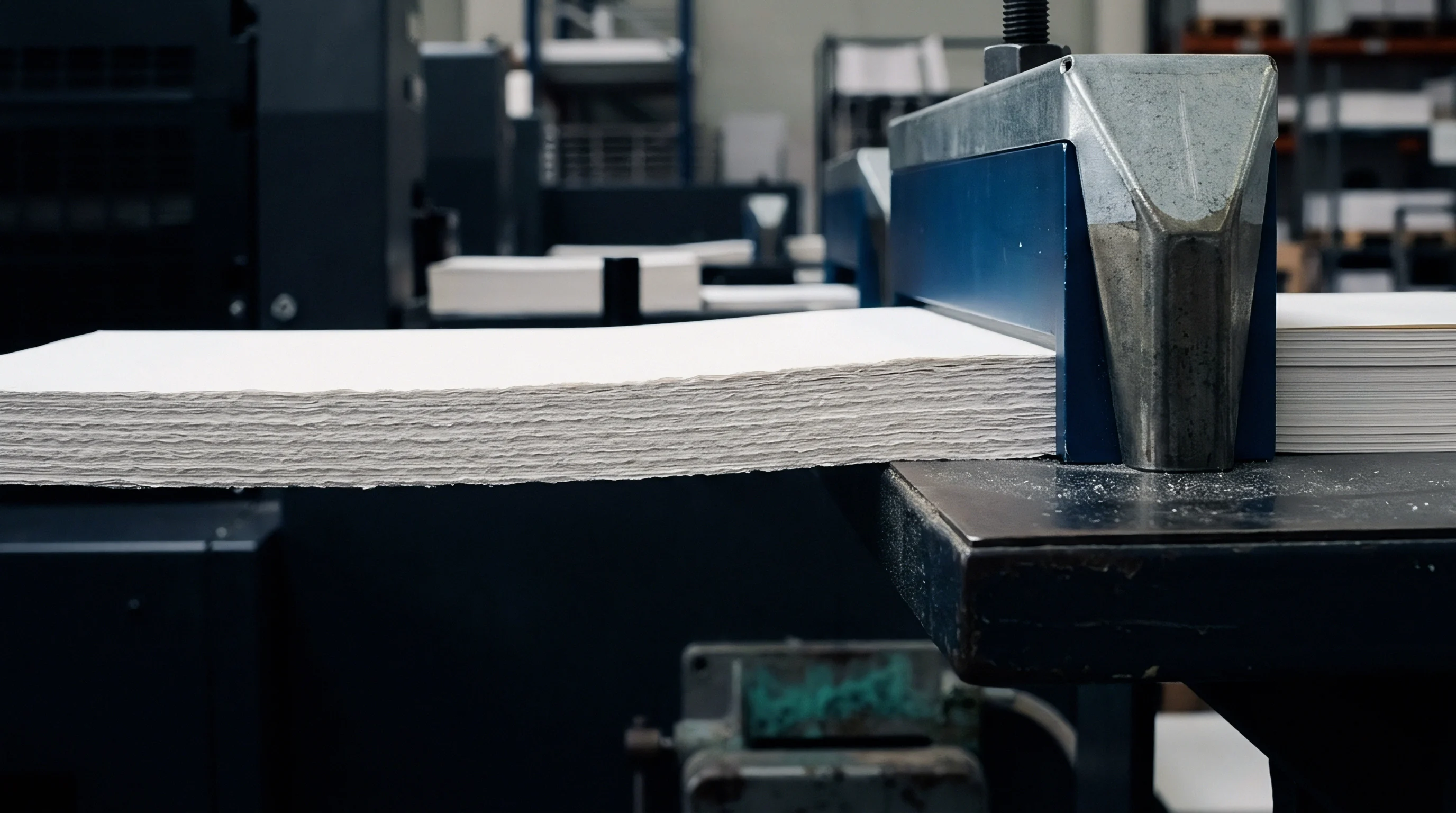
Out-of-plane distortion occurs when compressive stress along the sheet perimeter surpasses the elastic stability limit. Edge waving ~ frequently termed edge cockle ~ manifests as periodic ripples along the sheet margins. Mechanically, this corresponds to classical Euler column buckling applied to thin plate strips under non-uniform edge compression.
High-bulk recycled board provides lower cross-direction bending stiffness per unit thickness than virgin grades, reducing its resistance to out-of-plane deflection. When moisture uptake induces compressive stress along a cross-direction edge, the border buckles vertically to relieve accumulated strain energy.
Buckling geometry is defined by wave amplitude and characteristic wavelength, both determined by caliper, flexural rigidity, and moisture penetration depth. In high-bulk recycled grades (500 µm to 750 µm caliper), typical warehouse humidity shifts generate wave amplitudes between 2 mm and 12 mm. Deformations of this magnitude disrupt sheet-fed press feeders, flatbed die-cutters, and folder-gluers.
Suction suckers struggle to seal against corrugated edges, causing double-sheet feeds, misregistration, optical sensor errors, and press trips.

Plate Buckling Mechanics of Hygrally Constrained Edges
Kirchhoff-Love thin-plate theory governs out-of-plane deflection under edge loading. Treating the swollen edge strip as an elastic rectangular plate of thickness h, width b, and flexural rigidity D, the governing differential equation for out-of-plane displacement w(x,y) is:
D left( fracpartial4 wpartial x4 + 2fracpartial4 wpartial x2 partial y2 + fracpartial4 wpartial y4 right) + σx(y) h fracpartial2 wpartial x2 = 0
where flexural rigidity D is defined by elastic modulus E and Poisson ratio ν:
D = fracE h312 (1 – ν2)
The critical compressive buckling stress σcr for a simply supported boundary is defined by:
σcr = kb fracπ2 Db2 h = kb fracπ2 E12 (1 – ν2) left( frachb right)2
where kb is a non-dimensional buckling factor determined by edge aspect ratios and internal stress distributions across penetration width b. While high bulk increases caliper h ~ scaling flexural rigidity D with h3 ~ it simultaneously reduces elastic modulus E. The resulting critical buckling stress σcr for high-bulk recycled board remains lower than that of denser virgin substrates, leaving it prone to edge cockle under minor humidity increases.
Wave Amplitude and Frequency Derivations
The periodic wave pattern along the edge represents the primary buckling mode dictated by caliper, directional stiffness, and edge boundary length. Post-buckling analysis uses non-linear strain energy minimization to define wave amplitude A when edge strain exceeds critical buckling strain varεcr:
A = frac2 λπ sqrt varεedge – varεcr
where λ is the fundamental wavelength along the border, and varεedge = βCD Δ M is unconstrained hygral strain. Wavelength λ scales directly with penetration depth b and directional rigidity ratios:
λ = 2 π b left( fracDMDDCD right)1/4
Because cross-direction bending stiffness DCD is substantially lower than machine-direction stiffness DMD in recycled cartonboard, cross-direction borders buckle into shorter, more frequent waves. Empirical testing confirms that cross-direction edges develop shorter wavelengths (λ ≈ 80 mm to 150 mm) and greater wave amplitudes than machine-direction edges (λ ≈ 200 mm to 350 mm).
- Position a calibrated digital dial indicator gauge on a granite surface plate on an offline sampling table.
- Pull top, middle, and bottom test sheets from the delivered skid immediately after removing protective wrap.
- Lay the test sheet flat and unconstrained on the surface plate under standard ISO 187 conditioning.
- Run the digital probe along the full cross-direction perimeter, taking peak-to-valley readings every 10 mm.
- Calculate average wave amplitude, maximum wave height, and wavelength across all four cut edges.
- Compare measured peak wave heights against maximum feeder entry gate clearance for the target press.
Failing DIN 54370 dimensional stability criteria automatically voids substrate performance warranties on high-speed sheet-fed offset presses.
| Board Caliper (µm) | Critical Buckling Stress σ_cr (MPa) | Characteristic Wavelength λ (mm) | Measured Wave Height at 75% RH (mm) | High-Speed Feeder Tolerance Limit (mm) | Press Runnability Status |
|---|---|---|---|---|---|
| 400 | 4.85 | 95 | 2.1 | 3.0 | Acceptable |
| 500 | 3.90 | 120 | 3.8 | 3.0 | Marginal Risk |
| 600 | 3.10 | 145 | 5.9 | 3.5 | High Failure Risk |
| 700 | 2.45 | 170 | 8.4 | 4.0 | Unrunnable |
Ignoring critical buckling thresholds leads directly to feeder double-sheet jams, damaged gripper bars, and hundreds of spoiled sheets per shift.
Wrap
Protective packaging around palletized board provides the primary barrier against ambient humidity swings. Packaging lines rely on multi-layer stretch wrapping, polyethylene top caps, and corrugated tier sheets to seal cut sheet stacks. Water vapor transmission rate (WVTR) through the wrapping film dictates moisture flux into the edges.
Standard low-density polyethylene stretch film applied at production pre-stretch levels exhibits a WVTR of 5.0 g/m²/24h to 12.0 g/m²/24h under ISO 15106-2 conditions (38 degrees Celsius and 90 percent relative humidity). An unbroken wrap restricts vapor ingress, delaying edge swelling through normal transit windows.
Breaches in film coverage compromise this protection. Forklift punctures, torn seams, inadequate wrap overlap, and loose top caps create localized entry paths for ambient moisture. Vapor entering these localized gaps generates non-uniform swelling zones, creating asymmetric stress profiles that distort sheets more aggressively than uniform exposure.
In unconditioned transit hubs, temperature fluctuations cause water to condense on the interior surface of the stretch wrap; liquid droplets contacting exposed sheet edges cause severe localized swelling and fiber disruption.

Barrier Film Performance and Water Vapor Transmission
Polyethylene stretch wraps and aluminum-barrier caps govern vapor flux into palletized cartonboard. Standard 23-micron blown polyethylene film applied with a 50 percent overlap offers adequate protection in climate-controlled warehouses. Upgrading to high-barrier films containing ethylene vinyl alcohol copolymer or cast polypropylene reduces transmission rates below 1.5 g/m²/24h to preserve sheet flatness in high-humidity environments.
Wrapping tension during automated pallet packaging compresses stack corners, introducing localized pre-stress along sheet edges. Excessive tension deforms corner fibers and increases out-of-plane flexibility, while insufficient tension allows film layers to slide and form air channels along vertical corners. Maintaining proper packaging integrity requires balancing film containment force with edge protection, using rigid v-board corner posts to distribute winding tension across the vertical corners of the stack.
Stretch wrap with a water vapor transmission rate above 8.0 g/m²/24h fails to prevent edge waving during 72 hours of transit in humid conditions.

Thermal and Hygral Equilibration Protocols
Skids must reach thermal equilibrium with ambient pressroom conditions before protective wrapping is stripped. Cold paperboard stacks moved into warm, humid converting areas function as thermal sinks. Premature unwrapping exposes cold sheet edges directly to warm ambient air, driving immediate condensation and rapid moisture absorption.
Equilibration time depends on total stack mass and the starting temperature differential.
Thermal equilibration data indicates that a 900 kg skid of high-bulk recycled cartonboard transferred from 5 degrees Celsius storage into a 22 degree Celsius plant floor requires at least 48 hours of unopened staging. Unwrapping within 12 hours of delivery induces pronounced edge waving, as thermal imaging confirms internal core temperatures lag surface temperatures by up to 36 hours. Stripping barrier wrap before the stack equalizes exposes cold board edges to ambient moisture, inducing rapid edge cockle.
- Verify film integrity on receiving docks, checking for punctures, tears, or loose top cap seals.
- Measure ambient plant air temperature and relative humidity with calibrated psychrometers near storage bays.
- Stage wrapped skids in pressroom acclimation zones for at least 48 hours of thermal stabilization before unwrapping.
- Apply top load press boards to open skids between printing passes to keep mechanical restraint on the edges.
- Reseal partial pallets immediately with barrier stretch film whenever press runs are paused or delayed.
Delivery contracts that require ISO 187 conditioning compliance before wrapper removal transfer financial liability for hygral edge waving from the board mill to the converter.

Margin
Converting margins in folding carton production depend on press runnability, net yields, and minimal scrap. High-bulk recycled cartonboard offers immediate material savings over virgin folding boxboard: running a 450 g/m² GD2 board instead of a 380 g/m² virgin FBB delivers equivalent caliper and bending stiffness at lower cost per metric ton. However, this initial raw material advantage is quickly erased if edge waving causes press stoppages, feeder trips, and high make-ready waste.
Converting inefficiencies compound through successive process steps. On sheet-fed offset presses, edge cockle forces operators to reduce run speeds from 18,000 to 11,000 sheets per hour to prevent feeder misfeeds. Distorted edges can strike offset blankets, causing hickeys, blanket indentation, and unplanned press stops for wash-ups or blanket changes.
Downstream at flatbed die-cutting, wavy borders induce stripper misalignments and side-guide register variation, pushing job waste from a baseline 1.5 percent to over 4.8 percent.
Financial Impact of Press Feeder Misfeeds
Unplanned press downtime rapidly erodes converting profitability. Quantifying the real cost of edge waving requires evaluating lost machine hours, discarded substrate, auxiliary labor, and schedule delays. A six-color sheet-fed offset press running a 1000 mm x 1400 mm sheet size carries an hourly operating rate between 350 and 550 USD.
Feeder tripping triggered by 5 mm edge waves on 450 g/m² GD2 board causes an average of 1.8 hours of cumulative downtime per 10,000 sheets.
Material waste adds direct financial losses. Feeder register trips discard partially printed sheets into the waste bin. Replacing a damaged printing blanket costs approximately 450 USD per occurrence when factoring in replacement materials, wash-up labor, and lost production time.
When edge waves drive side-guide registration variation past 0.5 mm, entire production lots fail downstream die-cutting tolerances, risking total skid rejection. Operating risk scales non-linearly with increasing caliper and wave amplitude.
Substrate Substitution and Grammage Optimization
Converting engineers evaluating recycled substrates must weigh raw material savings against humidity sensitivity during transit and storage. Reducing basis weight while sustaining caliper through high-bulk furnish reduces total tonnage purchased and lowers freight costs. However, high-bulk recycled sheets exhibit lower elastic moduli and higher hygroexpansion coefficients, widening the operational window where hygral stress induces plate buckling.
Optimizing substrate specifications requires tracking net landed cost per thousand converted cartons rather than raw board price per metric ton. Factoring barrier wrap upgrades, staging protocols, and realistic press speeds into operational models reveals true production yields. Upgrading skid barrier film adds roughly 3.20 USD per pallet while avoiding thousands in press downtime.
Matching board hygral stability to plant environmental control capabilities protects target margins across the converting line.
| Substrate Grade & Metric | Baseline Landed Substrate Cost (USD/ton) | Barrier Wrap Upgrade Cost (USD/skid) | Press Speed Reduction Loss (USD/10k sheets) | Spoilage Waste Penalty (%) | Net Landed Cost per 1k Finished Sheets (USD) |
|---|---|---|---|---|---|
| Virgin FBB 350 g/m² (Standard Barrier) | 1,420 | 0.00 | 0.00 | 1.2 | 504.10 |
| Recycled GD2 450 g/m² (Standard Barrier) | 1,080 | 0.00 | 185.00 | 4.6 | 528.40 |
| Recycled GD2 450 g/m² (Upgraded EVOH Wrap) | 1,080 | 3.50 | 25.00 | 1.5 | 492.30 |
| Recycled GT2 400 g/m² (Upgraded EVOH Wrap) | 1,190 | 3.50 | 10.00 | 1.3 | 518.20 |
Balancing stretch-wrap barrier specs against warehouse acclimation times ensures that high-bulk recycled cartonboard delivers its expected yield without causing press downtime.