Constitutive Multiscale Modeling of Moisture Induced Fracture Energy Thresholds in Secondary Fibre Plies
Moisture plasticizes secondary fibre bonds, reducing Mode I and II fracture energy thresholds and causing delamination during thermal finishing and creasing.

Bond
Delamination in recycled cartonboard begins at the hydrogen bridge between individual beaten fibres. When secondary pulp undergoes repeated drying and rewetting cycles during paper recycling, the cellulose fibrils experience irreversible hornification. Internal fibrillar surfaces collapse, reducing the specific water-retention value by twenty to forty percent compared to virgin kraft pulp.
In secondary fibre plies, this physical compaction decreases the density of accessible hydroxyl groups across the fiber-fiber contact area. Water molecules entering the porous ply dislodge these contact points through competitive sorption. At four percent equilibrium moisture content, secondary fibre plies maintain cohesive shear strength because moisture acts primarily as a localized lubricant within the disordered amorphous regions of the hemicellulose.
Once moisture exceeds nine percent, free water condensates within the intra-fiber pores, driving the cohesive separation of fibre contact zones under minimal mechanical peel stress.
Secondary stock carries shorter filaments.
Multiscale numerical formulations capture this degradation by linking the molecular potential of hydrogen bonding to a mesoscale cohesive zone model. The microscale representative volume element models the single recycled fibre as an anisotropic cylinder with transverse isotropic elastic properties. Cellulose microfibril angles in secondary furnish typically display high angular scatter between fifteen and thirty-five degrees relative to the fibre axis.
This dispersion induces non-uniform transverse swelling when ambient relative humidity climbs from fifty percent to eighty-five percent. As the single fibre swells radially by up to twenty percent while extending longitudinally by less than two percent, shear strains build at the cross-over bond joints.
Plies conditioned below six percent moisture resist transverse shear but tear during folding.
The constitutive traction-separation formulation assigns the damage variable to the interface between overlapping recycled fibres. The bilinear traction-separation law specifies an initial elastic penalty stiffness, a peak traction representing initiation of micro-cleavage, and a critical separation displacement where fracture occurs. In virgin sulphate furnish, the critical displacement broadens due to fibril pull-out and plastic necking of the cell wall.
Secondary furnish displays sudden brittle detachment. Lignin residues in unbleached testliner fractions block uniform re-hydration, concentrating moisture within patchy inter-fibre pockets. Consequently, the local Mode I fracture energy exhibits extreme stochastic variability across the ply thickness.
Hornified pulp resists internal swelling.
When converting lines apply heavy downstream surface finishes, this moisture-dependent interface dictates structural survival. An aqueous dispersion varnish applied on an offline coater floods the top ply with unbound liquid, driving a steep moisture gradient through the cross-direction caliper. Uncoated recycled middles beneath the bleached top liner rapidly absorb this moisture front.
If the local moisture volume fraction pushes the cohesive traction below the transverse tensile stresses induced by sheet transport tension, subsurface delamination initiates before the sheet ever reaches the drying tunnel. Dry fibres snap while saturated fibres slip.
Lattice
Homogenization across secondary fibre arrays links the discrete inter-fibre contact forces to continuum orthotropic stress tensors. Computational homogenization treats the paperboard ply as an irregular three-dimensional structural lattice where individual segments represent segmented fibre lengths joined at bonded nodes. Network orientation tensors derived from automated image analysis define the mechanical anisotropy, producing distinct machine-direction and cross-direction stiffness ratios.
In typical multi-ply white lined chipboard, the secondary fibre core exhibits an orientation ratio between 1.8 and 2.5. Moisture ingress diminishes the out-of-plane stiffness component drastically faster than the in-plane components, reducing out-of-plane elastic modulus by over sixty percent when relative humidity rises from fifty to ninety percent.
The continuum representation models each board ply through an elasto-plastic constitutive law coupled with moisture sorption isotherms. Moisture transport obeys Fickian diffusion modified by swelling-induced porosity shifts. As moisture concentration rises, the effective yield surface contracts.
Continuum damage variables track the loss of load-bearing area through micro-void coalescence along the fibre boundaries. Fracture energy thresholds, defined as the path-independent J-integral values at crack initiation, drop sharply along the out-of-plane direction under Mode I tensile opening and Mode II forward shear.
| Equilibrium Relative Humidity | Ply Moisture Fraction | Out-of-Plane Modulus (MPa) | Mode I Fracture Energy JIc (J/m²) | Mode II Fracture Energy JIIc (J/m²) | Z-Direction Tensile Strength (kPa) |
|---|---|---|---|---|---|
| 30 percent | 0.048 | 48.2 | 88 | 195 | 385 |
| 50 percent | 0.071 | 36.5 | 64 | 142 | 290 |
| 65 percent | 0.092 | 24.1 | 42 | 98 | 195 |
| 80 percent | 0.124 | 13.8 | 21 | 54 | 110 |
| 90 percent | 0.165 | 6.4 | 11 | 26 | 45 |
Finite element implementations deploy these homogenized properties within cohesive interface elements placed between adjacent plies. Multi-ply secondary boards depend heavily on starch spray applied at the paper machine wet end to compensate for lost hydrogen bonding. That starch layer creates a thin interphase with mechanical properties distinct from both the recycled liner and the recycled filler plies.
Moisture diffuses preferentially through this starch-rich interphase. When moisture swells the retrograded starch molecules, the adhesive bond undergoes a plasticization transition, dropping the shear retention capacity of the entire board composite.
Plies shear along weak interfaces.
Laboratory validation of these multiscale models relies on double cantilever beam testing for Mode I and end-notched flexure testing for Mode II crack growth. Applying standard ASTM D5528 methods to fibrous paperboard requires environmental chamber control within plus or minus one percent relative humidity. Secondary plies frequently produce unstable stick-slip crack propagation rather than steady crack growth.
The stick-slip events correspond to local clusters of intact long fibres bridging the crack wake before snapping under tension. At higher moisture fractions, these bridging fibres pull out intact from the softened matrix without snapping, yielding lower peak load values yet prolonging the ultimate crack displacement tail.
Standard ISO 187 conditioning guarantees repeatable laboratory data without capturing high-speed converting shocks.
Computational tools must determine whether an explicit microstructural network or an equivalent homogenized continuum best captures the catastrophic shear banding observed during rapid converting operations.
Delamination
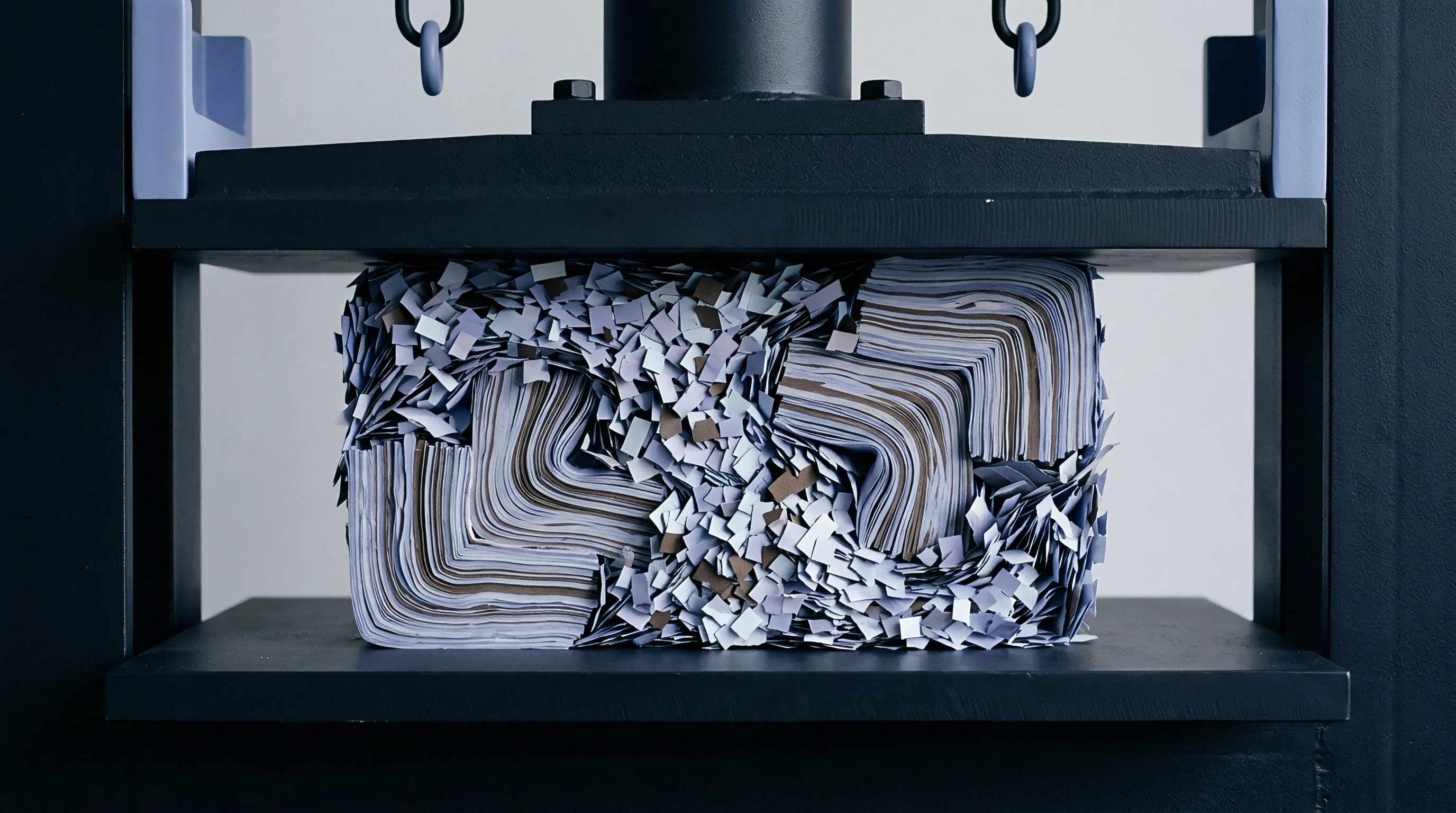
Die-cutting platens subject recycled board to severe out-of-plane dynamic stress concentrations. When a steel rule embeds into the paperboard, the local material directly beneath the knife experiences intense hydrostatic compression accompanied by high transverse shear at the rule flanks. In virgin boards, long kraft fibres distribute this shear stress across several ply thicknesses.
Secondary plies fail through localized internal splitting. The presence of brittle, mineral-loaded secondary fibres prevents stress dissipation, causing the crack to turn ninety degrees from the indentation vector and propagate horizontally along the weakest inter-ply boundary.
Hydrogen bonds break under vapor pressure.
Creasing rule mechanics demonstrate this fracture mode clearly. A proper crease must delaminate the inner core delamination zone cleanly to create an internal shear hinge, preventing the exterior liner from cracking when folded ninety or one hundred and eighty degrees. If the recycled filler plies contain excessive moisture, the fracture energy threshold falls too low, causing uncontrolled widespread delamination that extends centimeters away from the crease groove.
Conversely, if the secondary plies dry below five percent moisture, the fracture energy threshold climbs too high. The board resists internal delamination, forcing the tensioned outer liner to stretch beyond its ultimate strain capacity, resulting in visible cosmetic splits along the printed carton corner.
Does Relative Humidity Depress Delamination Resistance?
Elevated moisture reduces the cohesive force governing inter-fibre contact, directly undermining delamination resistance. When carton converters run secondary board delivered during humid summer conditions, the lower threshold for Mode II shear failure accelerates delamination during creasing. Tooling setups must adjust clearance tolerances to prevent full ply crushing.
- Channel depth verification ensures the matrix channel matches the compressed caliper of the damp recycled furnish, avoiding fiber cutting along the crease shoulder.
- Rule width reduction restricts the volume of displaced board, lowering hydrostatic pressure peaks within the recycled filler plies.
- Crease speed derating extends the mechanical dwell time, allowing softened amorphous hemicellulose polymers to relax without brittle interface tearing.
- Moisture audit confirms the incoming pallet equilibrium relative humidity falls strictly between forty-eight and fifty-five percent before makeready commences.
Delamination halts high speed carton gluers.
The supplier will state that the board complies with standard Cobb sizing specifications and that running failures stem from incorrect knife penetration depths rather than furnish inconsistencies.
Blister
Thermal finishing processes introduce severe thermo-mechanical shock to secondary plies. Hot foil stamping drives heated metal dies into the sheet surface at temperatures ranging from 105 to 145 degrees Celsius under pressures exceeding twenty megapascals. Thermal film lamination similarly runs the web through heated steel nips at 95 to 120 degrees Celsius.
When these hot surfaces contact secondary fibre board containing seven to ten percent moisture, the pore water vaporizes almost instantaneously. Trapped beneath impermeable surface coatings or metallic foils, this water vapor generates localized gas pressures exceeding two hundred kilopascals.
Uncoated middles absorb damp air.
If the internal Mode I fracture energy threshold of the recycled core has fallen due to moisture plasticization, the expanding steam splits the board internally. The outward symptom appears as raised blisters, surface waviness, or complete release of the stamped foil together with a thin veneer of attached fibre. Secondary fibre furnish is exceptionally vulnerable to this mechanism because hornified fibres exhibit poor internal micro-porosity, restricting lateral steam escape along the sheet plane.
Steam pressure remains concentrated directly beneath the heated die face until the weakest inter-fibre joint ruptures.
Heated brass dies convert trapped moisture into localized steam pockets within twenty milliseconds of platen contact.
| Finishing Pass | Tool Temperature (°C) | Nip Dwell Time (ms) | Safe Moisture Range (percent) | Primary Failure Mode Under Excess Moisture |
|---|---|---|---|---|
| Thermal BOPP Gloss Lamination | 105 | 45 | 5.0 to 6.5 | Inter-ply micro-blistering and post-nip web curl |
| Thermal BOPP Matt Lamination | 115 | 45 | 4.8 to 6.2 | Core delamination and optical hazing from steam vents |
| Flatbed Hot Foil Stamping | 130 | 85 | 4.5 to 5.8 | Liner lift-off and patchy foil flake detachment |
| Rotary Hot Foil Stamping | 155 | 18 | 4.5 to 6.0 | Fibre pull tearing beneath stamped typography borders |
| Cast and Cure Micro-Embossing | 90 | 60 | 5.5 to 7.0 | Varnish pinholing and substrate blistering |
Multiscale numerical simulations of this thermal blistering process require coupled pore-pressure thermal-stress finite element models. The constitutive model incorporates temperature-dependent water vapor generation rates defined by the Clausius-Clapeyron equation alongside moisture-dependent traction-separation laws. As the heat front moves downward through the top liner into the recycled filler, the local fracture energy threshold plummets precisely as the pore pressure spikes.
When the local traction demand exceeds the degraded interface strength, failure occurs automatically.
The laminator nip crushes voids.
Purchasing agreements governing high-grade packaging board stipulate under ISO 287 that delivered secondary board moisture must not deviate past 6.0 percent plus or minus 0.5 percent on arrival, voiding claims if moisture deviations occur after converter storage seal breach.
Score
Adding functional coatings alters the mechanical boundary conditions governing score line integrity. Film lamination deposits an impermeable polymeric layer, typically biaxially oriented polypropylene or polyethylene terephthalate, over the printed board. This film exhibits a high tensile elongation capability, frequently exceeding one hundred percent before failure.
However, adding this surface reinforcement alters the neutral bending axis during scoring and subsequent carton folding. The tensioned plastic skin prevents outer surface relaxation, transmitting intensified shear stresses directly into the underlying recycled paperboard plies.
Foil dies demand stable caliper.
If the secondary board core possesses low internal fracture energy due to poor fibre bonding or elevated moisture content, the intense shear force induced by the laminated film drives extensive internal delamination. The folded edge swells, forming a rounded, spongy hinge rather than a crisp, square carton corner. On automated cartoning lines running at five hundred cartons per minute, spongy score lines produce misfeeds, jams, and irregular glue flap compression.
If the moisture is too low, the stiff secondary plies resist internal cleavage, transferring all tensile stress directly to the film-substrate adhesive interface, causing film peel or unsightly white stress whitening along the crease.
Will Film Lamination Suppress Score Cracking?
Applying an exterior film laminate prevents outward surface cracking across brittle recycled plies while shifting failure modes into the subsurface layers. The high tensile strength of the oriented polymer film restrains surface fibril breakage, but internal delamination mechanisms still operate.
- Hingeline rolling occurs when weakened secondary filler plies separate prematurely, producing an off-center fold that distorts carton squareness.
- Shoulder rupture emerges where excessive creasing pressure shears through the bleached top liner, leaving only the plastic film intact to bridge the structural gap.
- Adhesive cleavage develops along the ink-primer interface when trapped volatile moisture evaporates under friction during high-speed folding belts.
- Blistering at scores manifests during subsequent hot-melt gluing passes as heat from adhesive nozzles activates residual moisture along crushed hinge channels.
Scored hinges stiffen during drying.
When converters bypass structural verification of moisture-dependent fracture energy in secondary plies, folding carton runs face systematic rejection due to carton warp, failed glue seams, and catastrophic line jamming in automated pharmaceutical or food filling facilities.
Scrap
Sourcing multi-ply secondary board requires balancing base sheet pricing against downstream converting yield. Recycled white lined chipboard trades at a discount of two hundred to three hundred and fifty dollars per metric ton relative to virgin solid bleached sulphate or folding boxboard. That raw material saving erodes rapidly if the moisture sensitivity of the secondary plies induces high scrap rates across multiple added passes.
Each finishing pass adds compounding makeready waste and line spoilage. In a typical luxury folding carton run requiring four-color offset printing, offline spot UV varnish, flatbed hot foil stamping, and die-cutting, overall job yield depends on board dimensional stability and ply cohesion.
Assume an order of one hundred thousand folding cartons produced from 350 gsm white lined chipboard at 1.10 dollars per kilogram, with virgin folding boxboard priced at 1.45 dollars per kilogram. Each carton sheet measures 720 by 1020 millimeters, yielding six cartons per sheet. The net production requires 16,667 good sheets, representing approximately 4.29 metric tons of board.
Printing makeready consumes 250 sheets, running waste averages 1.5 percent. Applying the offline spot UV varnish adds 200 sheets makeready and 1.0 percent waste. Hot foil stamping introduces 350 sheets makeready and 2.5 percent running waste on stable virgin board.
On secondary fibre board with fluctuating moisture-induced delamination thresholds, foil waste routinely spikes to 6.5 percent due to blister defects and patchy transfer.
Die-cutting secondary board with unstable fracture energy thresholds consumes an extra 400 makeready sheets to tune creasing rule depths, alongside running scrap climbing from 1.0 percent to 3.5 percent due to score splitting and carton flaking. The secondary board run wastes an additional 920 sheets, representing 237 kilograms of stock, plus lost machine hours priced at two hundred and fifty dollars per hour across foil stamping and die-cutting lines. The material cost advantage of 1,500 dollars narrows to less than 400 dollars before factoring in extended lead times and customer rejection exposure.
Polymer films retard moisture escape.
European Packaging and Packaging Waste Regulation mandates further complicate this ledger. Under modulated Extended Producer Responsibility schemes, packaging materials face eco-modulation penalties based on recyclability grading. Laminating secondary board with non-separable BOPP or PET film to mask surface brittleness downgrades carton recyclability under standard PTS or CEPI recyclability assessment methods.
The plastic laminate drops the paper yield during repulping below the eighty-five percent threshold, pushing the packaging into penalty fee bands that add sixty to one hundred and twenty euros per metric ton of placed packaging.
Tool wear accelerates on recycled liners.
- Furnish specification must require secondary board mills to guarantee minimum internal bond strength via Scott Bond testing above 130 J/m² under standard ISO 187 conditioning.
- Barrier coating evaluation assesses water-based dispersion barriers over plastic lamination to maintain recyclability certification under EN 13430 while controlling moisture migration.
- Moisture meter tracking enforces incoming pallet verification using sword probes to ensure core relative humidity matches converting hall equilibrium within five percent.
- Finishing sequence discipline schedules thermal foil stamping passes prior to water-based varnishing to prevent steam blistering across saturated recycled cores.
The run stops immediately.
A rigorous converter calculates the total cost of finished, delivered cartons by incorporating furnish-dependent running speeds, die-cutting yield losses, and regulatory recycling tariffs. Virgin board frequently secures lower total landed packaging costs on heavily embellished luxury cartons despite higher initial ton rates. When secondary furnish is mandated by brand sustainability policies, maintaining absolute control over ply moisture content and interface fracture energy thresholds remains the sole operational method to prevent catastrophic converting scrap.