Measuring Specular Gloss Changes during Standard Paperboard Rub Tests
Measuring specular gloss changes before and after standard rub tests quantifies surface coating durability using exact optical angle decay metrics.

Grit
Container transport friction can turn smooth paperboard finishes dull and abraded. As printed surfaces rub together inside an outer carton, microscopic crests on the ink layer or overprint coating shear off. Specular reflection requires a flat plane where light reflects at an angle equal and opposite to the surface normal, but physical abrasion scatters that light diffusely.
Measuring this shift means isolating mechanical wear from optical breakdown.
Mechanical Shearing across Print Interfaces
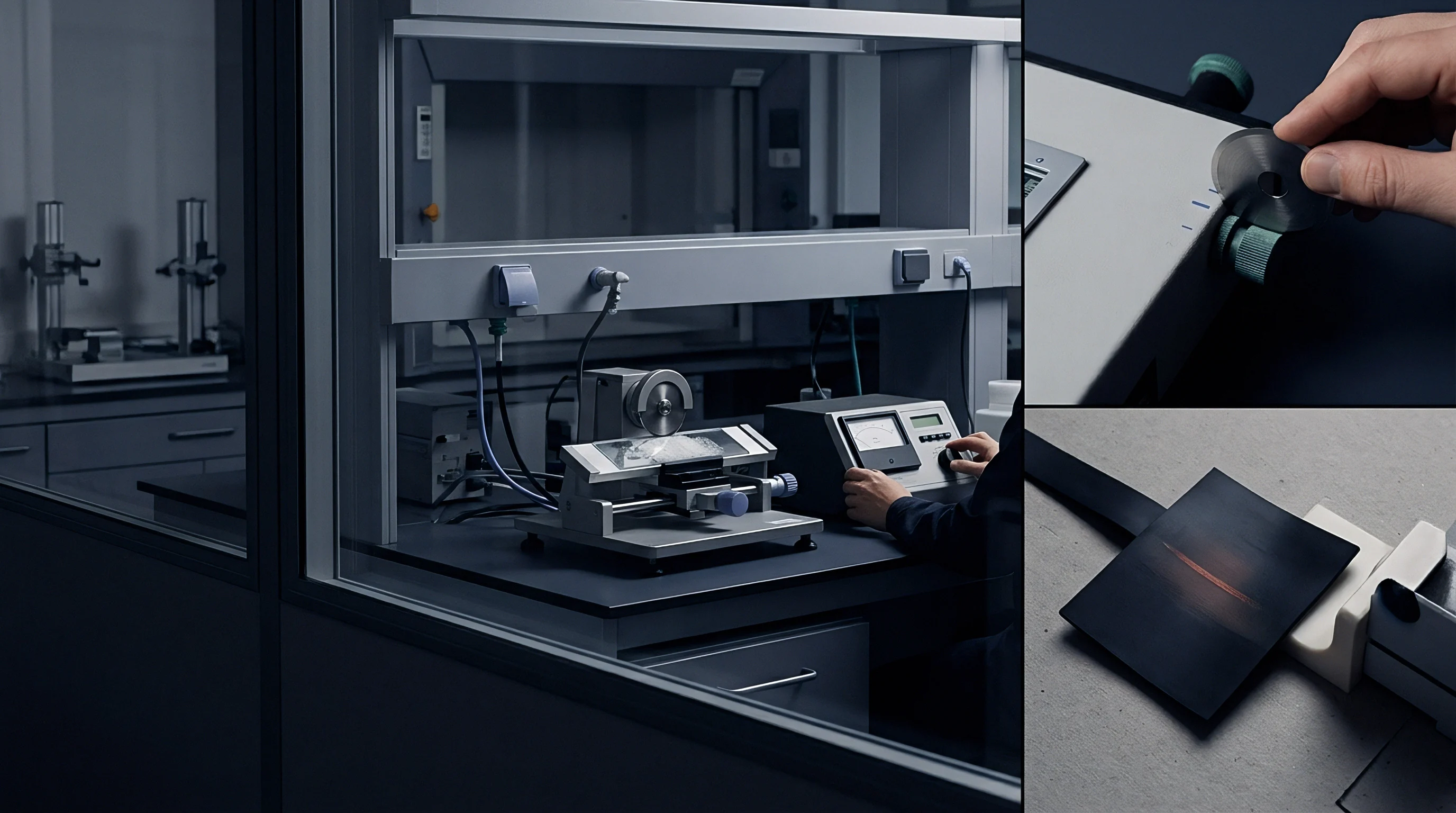
Standard rub test fixtures, like Sutherland rub testers or TAPPI T 830 units, apply a set receptor weight over a fixed stroke count. As the receptor block moves linearly across the specimen at constant speed, shear concentrates at elevated paperboard fibers. High contact pressure collapses surface coatings, forcing polymer chains to yield under repeated friction.
Dry ink films hold up through initial passes until frictional heat softens the binder resins.
Initial strokes burnish minor surface irregularities, which can briefly raise gloss readings on semi-matt coatings. Continued rubbing gouges channels into the ink vehicle, dislodging pigment particles that act as secondary abrasives under the receptor block. Trapped beneath the rub shoe, this loose debris accelerates wear with every back-and-forth stroke.
Frictional heat generated during extended rub testing alters binder ductility and shifts baseline gloss degradation rates.

Asperities and Surface Fracture Modes
Topological irregularities dictate how friction degrades optical smoothness across paperboard. Heavy clay coatings yield high initial gloss on smooth profiles, yet micro-fractures develop quickly when rubbed against unprinted kraft liner. Uncoated board exhibits a higher coefficient of friction, exerting greater tangential force against the printed face.
- Asperity Shear occurs when microscopic surface peaks strike receptor fibers, snapping brittle overprint varnish away from the underlying ink.
- Abrasive Gouging arises when detached pigment clusters drag across soft polymer coatings, carving parallel sub-micron troughs.
- Polymer Smearing develops under high local temperatures, redistributing wax slip additives into dull patches along the rub path.
- Substrate Delamination begins when repeated shear stress ruptures internal fiber bonds beneath the ink layer.
Quantifying these failure patterns requires consistent test conditions. Fluctuations in stroke speed create thermal spikes at contact points, altering physical surface properties before optical readings can even be taken, leaving mechanical wear unresolved when test speeds differ across labs.
Atmosphere
Paperboard fibers continuously exchange moisture with the surrounding air, altering stiffness and surface friction. Environmental conditioning under ISO 187 calls for 23 degrees Celsius and 50 percent relative humidity. Any drift in humidity changes substrate compressibility and alters the true contact area under the rub tester shoe.
Dry board stiffens, concentrating pressure on high peaks, while humid board softens, letting the receptor shoe sink deeper into the coating.
Humidity Equilibrium and Fiber Swell Dynamics
Moisture absorption causes cellulose fibers to expand laterally, raising microscopic surface roughness across coated board and scattering light before physical rubbing even begins. When abraded under humid conditions, soft coatings shear off in thick flakes rather than micro-fine powder.
Standard conditioning schedules require at least 24 hours on suspended sheets to reach moisture equilibrium. Testing unconditioned samples straight off a converting line introduces heavy error, as residual moisture trapped in freshly cured water-based coatings acts like an internal plasticizer and accelerates gloss loss during rub trials.
- Precondition paperboard samples in a low-humidity atmosphere below 35 percent relative humidity for four hours to clear historical moisture memory.
- Transfer specimens to an ISO 187 compliant chamber held at 23 degrees Celsius and 50 percent relative humidity.
- Suspend individual test sheets vertically to allow uniform air movement across both wire and felt sides.
- Maintain environmental conditioning for 24 hours prior to cutting rub test swatches and receptor strips.
- Execute specular gloss measurements immediately upon removing specimens from the controlled conditioning space.
Temperature Effects during Rub Cycles
Continuous rubbing at 42 strokes per minute elevates local temperatures at the sample interface. Polyolefin laminates and UV-cured acrylic coatings exhibit temperature-dependent mechanical yield points; as the polymer matrix warms, it undergoes plastic deformation under lighter loads, reducing scuff resistance.
Conditioning paperboard at standard equilibrium prevents moisture-induced stiffness changes from biasing rub test outcomes.
| Paperboard Moisture Content (%) | Pre-Rub Gloss at 60 Degrees (GU) | Post-100 Rub Gloss at 60 Degrees (GU) | Gloss Loss (%) | Dominant Surface Failure |
|---|---|---|---|---|
| 4.5 | 84.2 | 76.1 | 9.62 | Brittle micro-fracture |
| 6.0 | 83.8 | 71.5 | 14.68 | Uniform abrasive scuffing |
| 7.5 | 82.1 | 61.4 | 25.21 | Coating smear and gouging |
| 9.0 | 79.4 | 48.2 | 39.29 | Substrate fiber plucking |
Testing environments without precise climate control produce erratic friction coefficients. A dry winter lab will yield drastically different rub endurance figures than a humid summer plant using the exact same board.

Geometry
Optical measurement configurations dictate sensitivity to surface degradation. ISO 2813 and TAPPI T 480 define standard specular gloss geometries at 20, 60, and 85 degrees relative to the perpendicular axis. High-gloss finishes require narrow acceptance angles to capture mirror reflection, whereas low-gloss matt finishes demand wider angles to isolate minor specular highlights from diffuse background bounce.

Which Angle Detects Micro-Scuffing First?
Measuring high-gloss coated board at 60 degrees often obscures early abrasion because overall reflected intensity stays high. A 20-degree optical geometry isolates small specular variations across high-gloss surfaces above 70 Gloss Units. Micro-scratches scatter light away from the tight 20-degree aperture, revealing degradation long before a 60-degree meter registers a shift.
Matt surfaces present the opposite problem. Low-gloss overprint varnishes measuring under 10 Gloss Units at 60 degrees register no meaningful change at 20 degrees. Testing matt finishes at 85 degrees captures subtle burnishing where friction flattens coarse surface particles into reflective planes.
A 20-degree aperture detects early scuffing on high-gloss board that remains invisible under standard 60-degree illumination.
Reflection Distribution and Scatter Profiles
Specular gloss meters calculate the ratio of specularly reflected light against a polished black glass reference. Rubbing alters the bidirectional reflectance distribution function of the coating as scratches scatter light unevenly across the grain. Aligning the light beam parallel to rub strokes yields higher gloss numbers than measuring perpendicularly across scratch channels.
| Finish Type | Measurement Angle | Initial Value (GU) | Post-Rub Value (GU) | Absolute Loss (GU) |
|---|---|---|---|---|
| UV Gloss Varnish | 20 Degrees | 78.5 | 42.1 | 36.4 |
| UV Gloss Varnish | 60 Degrees | 89.2 | 71.4 | 17.8 |
| Water-based Matt Varnish | 60 Degrees | 12.4 | 15.8 | -3.4 |
| Water-based Matt Varnish | 85 Degrees | 28.6 | 44.2 | -15.6 |
Evaluating abraded samples with the wrong aperture geometry leads to false material approvals. Choosing a 60-degree angle for ultra-gloss coatings masks severe micro-scuffing, letting underperforming packaging pass into high-friction shipping environments where visual defects show up on retail shelves.

Coating
Finishing chemistry determines mechanical durability across printed cartonboard. Overprint varnishes, film laminates, and functional barrier coatings protect ink layers through distinct physical mechanisms. Slip additives, like micronized polyethylene or synthetic siloxane waxes, migrate to the surface during drying or curing.
These additives reduce the surface coefficient of friction, allowing receptor blocks to slide over the paperboard without shearing the polymer matrix.
Film Laminates versus Overprint Varnishes
Biaxially oriented polypropylene film laminates offer far greater rub resistance than inline water-based coatings. The continuous crosslinked polymer structure absorbs frictional energy, deforming elastically before tearing or scratching. Film lamination maintains gloss levels under heavy stroke counts that would strip liquid varnishes down to raw fiber.
Water-based acrylic coatings depend heavily on wax emulsion concentration. Excessive wax lowers surface energy and disrupts glue flap adhesion during carton converting, while insufficient wax leaves acrylic resins vulnerable to dry scuffing. Striking the right balance requires precise dosing during press make-ready.
- Polyethylene Wax Additives migrate rapidly to create a sacrificial slip layer that protects underlying ink layers from light rub forces.
- PTFE Fine Powders provide maximum scratch resistance under heavy load weights but increase unit coating formula costs significantly.
- Silicone Fluids lower kinetic friction instantly while introducing severe risk of pinholing and poor recoatability during multi-pass finishing.
- Colloidal Silica Suspensions increase surface traction on matt finishes to prevent burnishing without compromising recyclability scheme grades.
Polymer Crosslinking and Slip Additive Migration
Ultraviolet-cured overprint varnishes form dense three-dimensional acrylate networks that resist physical gouging. Incomplete UV curing leaves unreacted monomers trapped within the matrix, drastically reducing scratch hardness and initial specular gloss.
Consider a folding carton line producing 50,000 sheets using a standard water-based gloss overprint varnish. Assuming a basic varnish application cost of 1.20 USD per thousand square meters, adding a high-grade micronized wax dispersion increases fluid cost by 0.35 USD per unit area. On a 50,000-sheet run using 1020 x 1420 mm board format, total coating material spend increases from 86.90 USD to 112.24 USD.
Skipping this additive saves 25.34 USD up front, but leaves the print vulnerable to a 30 percent specular gloss drop during transit that can cause rejection at the destination warehouse.
While higher wax additions prevent surface scuffing, excess slip additives bleed into adhesive seams, causing carton side-seam bond failures under cold-storage conditions.
Dispute
Clearance thresholds for rub resistance routinely spark friction between brand buyers and packaging converters. Visual inspection of rub samples remains subjective when lighting conditions vary, but implementing instrument-based specular gloss drop limits establishes clear pass-or-fail metrics in supply contracts.
Threshold Acceptance Limits in Quality Contracts
Contract specifications define maximum allowable percentage drops in specular gloss after a fixed rub count. A typical spec permits up to a 15 percent gloss reduction at 60 degrees following 100 double rubs with a two-pound weight. Exceeding this threshold triggers lot rejection or mandatory secondary sorting.
Variations in receptor block foam padding alter load distribution across test specimens. Aged rubber hardens over time, concentrating weight along pad edges and carving false scuff marks into test samples. Standard calibration requires replacing rub shoe padding every six months to maintain baseline accuracy.
Statistical Verification across Production Lots
Verification testing requires sampling three sheets per pallet across a converting run. Measuring gloss at five distinct points per sheet accounts for cross-direction coating weight variations introduced on press.
Standard quality agreements incorporate explicit sampling protocols detailing measurement alignment, pre-conditioning duration, and maximum allowable gloss variance across production batches. A contract clause reading Gloss retention shall be evaluated under ASTM D5264 using a 4-pound weight for 200 cycles, requiring post-test specular gloss measured under ISO 2813 at 20 degrees to retain a minimum of 80 percent of original unrubbed values turns subjective visual debates into definitive numeric criteria.