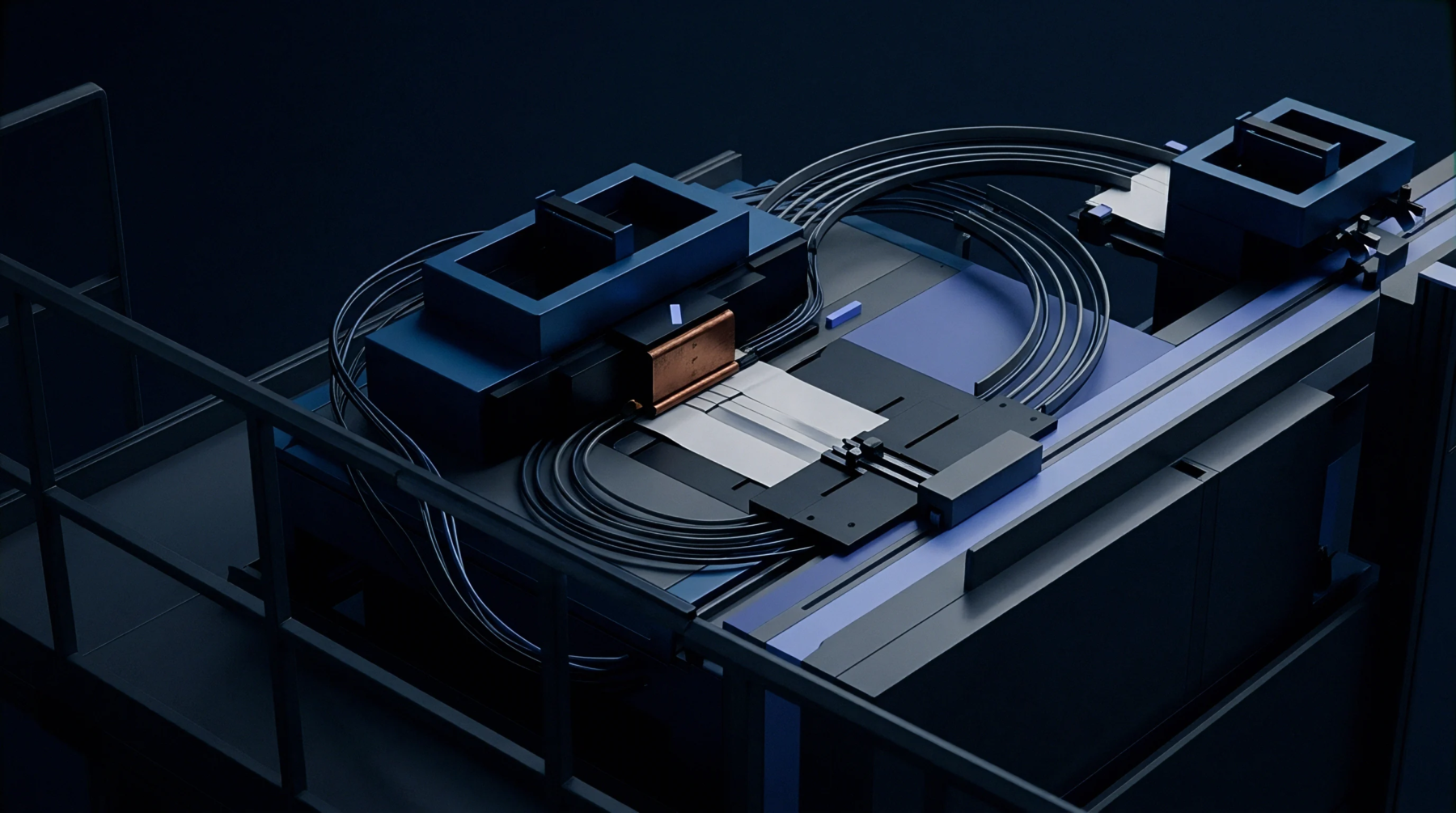
Frictional Instability
Intermittent kinetic resistance occurs when opposing paper webs or converting cylinders transition from static adhesion to sliding motion during high-speed production runs. Stick slip mechanics governs this discontinuous velocity profile across rotary presses and laminators where web tension fluctuates unpredictably. Surface roughness parameters on calendered paper substrates directly influence the magnitude of these acceleration peaks.
Shear stress builds steadily until elastic deformation overcomes static friction, releasing energy instantaneously. High-friction coatings compound this behavior by increasing the differential between static and kinetic resistance values. Web breakages and register errors multiply when mechanical dampening fails to absorb the sudden kinetic release.
Tension Variation
Fluctuating pulling forces propagate along the printing path whenever unstable sliding friction alters the speed of the travelling stock. Substrate elongation properties dictate how severely paper webs absorb or transmit these cyclic velocity shocks. Converting lines running at high speeds require precise torque regulation to counteract periodic drag variations.
Unwind stands equipped with closed-loop pneumatic brakes minimize the amplitude of transitional force spikes. Adhesive lamination units suffer from coating thickness irregularities whenever speed oscillations interrupt smooth nip roll transfer.
Kinetic Transition
Periodic velocity drops degrade final print quality by causing dot gain distortion and misregister across multi-color cylinder decks. Operational parameters must account for thermal expansion within heated drying tunnels because temperature changes alter rubber roller compliance. Preventive maintenance protocols specify exact durometer ratings for nip rollers to stabilize friction coefficients during continuous extrusion.
Substrate conditioning chambers adjust ambient humidity levels to prevent electrostatic charging from exacerbating surface friction anomalies. Engineering controls eliminate destructive harmonic frequencies by matching drive motor inertia to the specific weight of the running paper grade.