Spectrophotometric Sensor
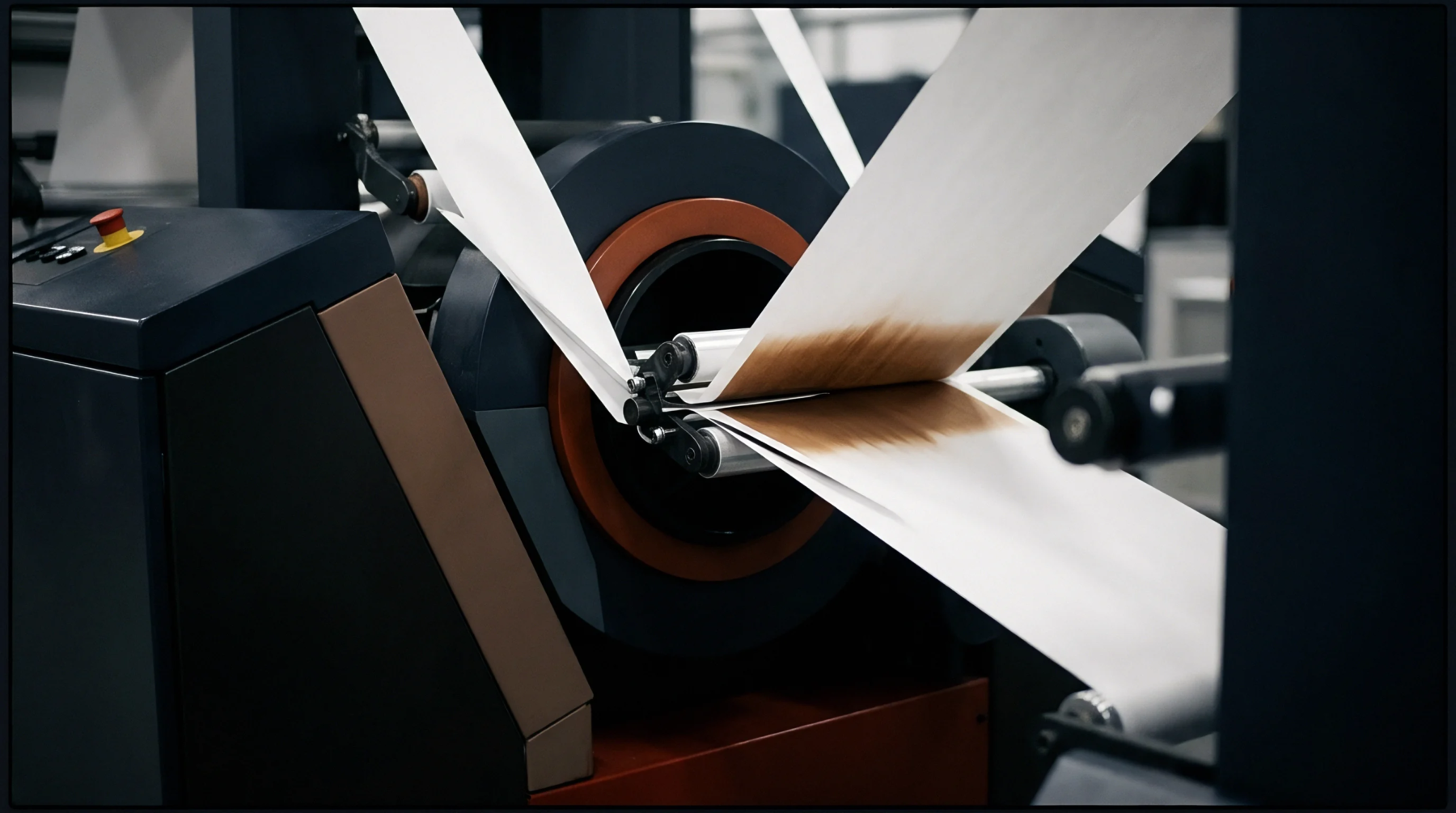
Non-contact optical instrumentation measures selective absorption bands of reflected or transmitted light to determine real-time moisture, coat weight, and polymer film thickness on moving paper webs. A near-infrared gauge evaluates molecular vibrations, specifically overtone and combination bands of hydroxyl, hydrocarbon, and amine bonds across the eight hundred to twenty-five hundred nanometer spectral band. Optical filters isolate reference wavelengths where the substrate absorbs minimal light and measurement wavelengths where water or binder functional groups absorb strongly.
Comparing the attenuation ratios between reference and measurement beams yields instant quantitative readings without touching the moving sheet. Gauge accuracy degrades when optical scattering fluctuates due to uncalibrated base sheet opacity, extreme web temperature shifts, or heavy mineral pigments like titanium dioxide.
Optical Attenuation Dynamics
Halogen or solid-state light emitters project narrow-band infrared energy onto the running web, where photon interaction reflects or transmits toward high-speed lead sulfide or indium gallium arsenide detectors. Inside the near-infrared gauge, beam splitters divide received light across optical filters tuned precisely to one point nine four microns for moisture, two point three microns for latex binders, and three point four microns for synthetic barrier coatings. Electronic processing converts radiant attenuation values into linear basis weight or percentage metrics using baseline calibration curves derived from oven-dry gravimetric standards.
Modern traversing scanners sweep these gauges back and forth across the paper machine reel, assembling real-time cross-direction profile arrays at continuous production speeds. High-speed signal sampling filters out mechanical web flutter, ensuring steady signal acquisition even on high-speed slitter rewinders running at two thousand meters per minute.
Process Regulation
Converting operations depend on on-line optical measurement to minimize cross-direction moisture variance and maintain specified coat weight uniformity on silicone release liners and barrier boards. Drift in moisture percentage destabilizes downstream corrugator operations, inducing irreversible warp, flute curl, and mechanical jam-ups during box slotting. Applying barrier latexes requires strict mass control, where under-application breaches greaseproof thresholds and over-application causes blocking inside wound reels.
Scanners hosting a near-infrared gauge tie directly into closed-loop slice-lip actuators and steam shower regulators, holding coat weight tolerances within zero point one grams per square meter across master rolls.