Aerodynamic Clearance
Fluid mechanics dictates the distance by which an external stream of moving gas or vapor is forced away from a solid substrate by the outward bulk flux of mass originating at the material plane. Boundary layer displacement governs the thickness of the stagnant laminar film that separates the wet paper web from drying air or convective hood flows inside multi-cylinder and flotation dryers. High drying rates induce strong counter-diffusion of evaporated moisture, shifting the viscous boundary layer outward into the turbulent crossflow.
Evaporative cooling at the sheet surface moderates as mass ejection forces the thermal boundary condition to expand. Above critical evaporation thresholds, external convective heat transfer coefficients decay because the thickened boundary layer limits direct turbulent energy exchange with the sheet surface.
Drying Mechanics
Rapid phase change drives moisture vapour through the fibrous network, forming an advective velocity vector normal to the moving paper plane. Boundary layer displacement alters the local Nusselt and Sherwood numbers that dictate simultaneous thermal transfer and mass transfer during impingement drying. Higher web speeds drag a boundary layer of entrained air along the converting line, while high-velocity air nozzles attempt to puncture this laminar cushion to deliver thermal energy.
If the outward mass flux of steam from the drying paper matches or exceeds nozzle kinetic energy, the thermal envelope thickens, depressing overall heat transfer efficiency. Caliper variations across the machine direction exacerbate displacement differences, producing cross-directional streaks in drying rates and uneven residual moisture profiles.
Converting Impact
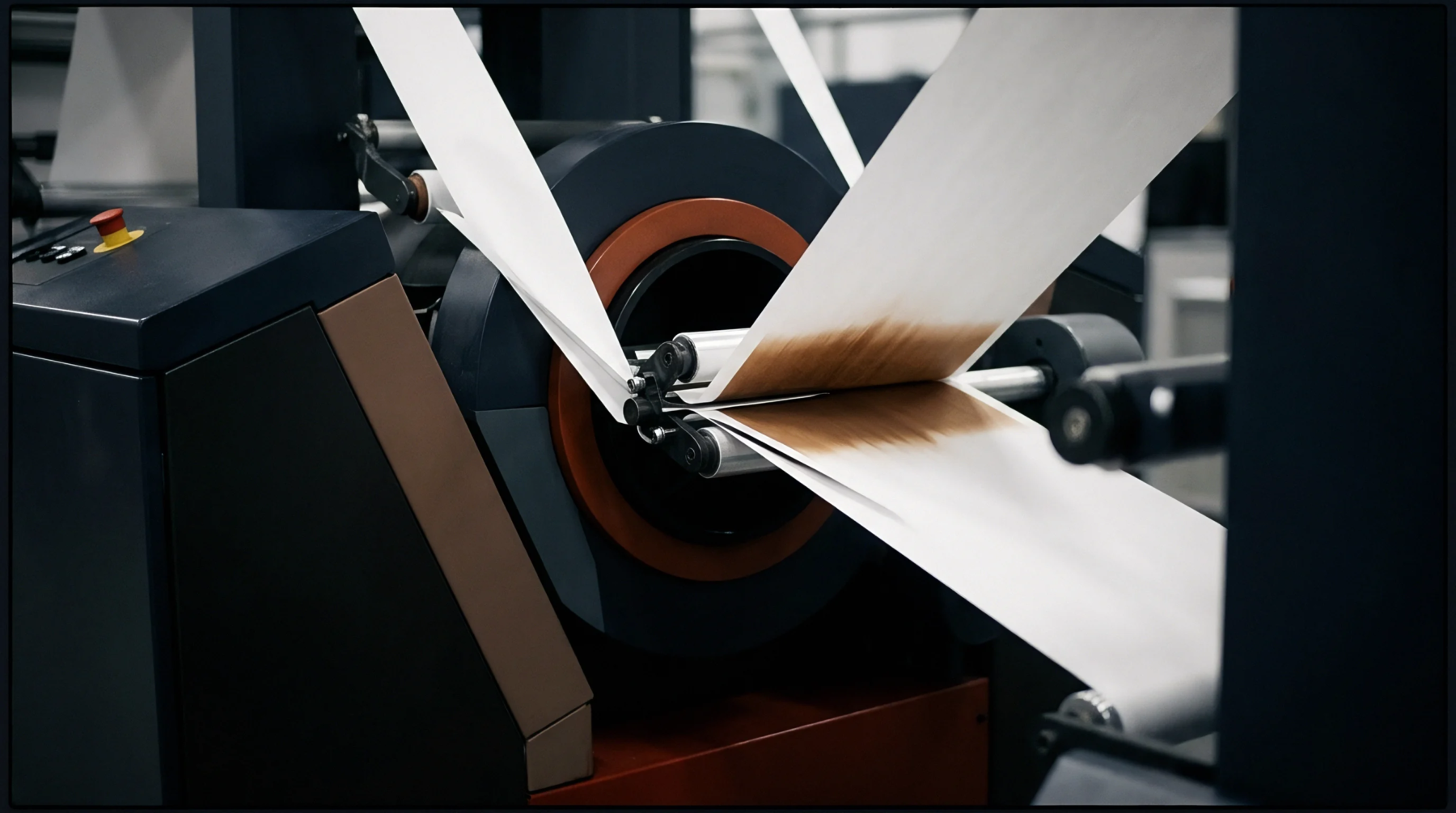
Dimensional stability during rotary offset and high-speed flexographic printing relies on continuous boundary layer management over heated chill rolls and drying tunnels. Excessive boundary layer displacement prevents hot impingement air from scouring the evaporating solvent film from printed ink films, prolonging drying cycles and risking web flutter or ink setoff. Stabilizing the boundary layer demands mechanical air foils or tuned exhaust plenums capable of maintaining laminar shear without stripping unevaporated coating solids.
When web transport rates decouple from the local boundary displacement thickness, air entrapment inside nip rollers triggers tracking instability and web wrinkles.