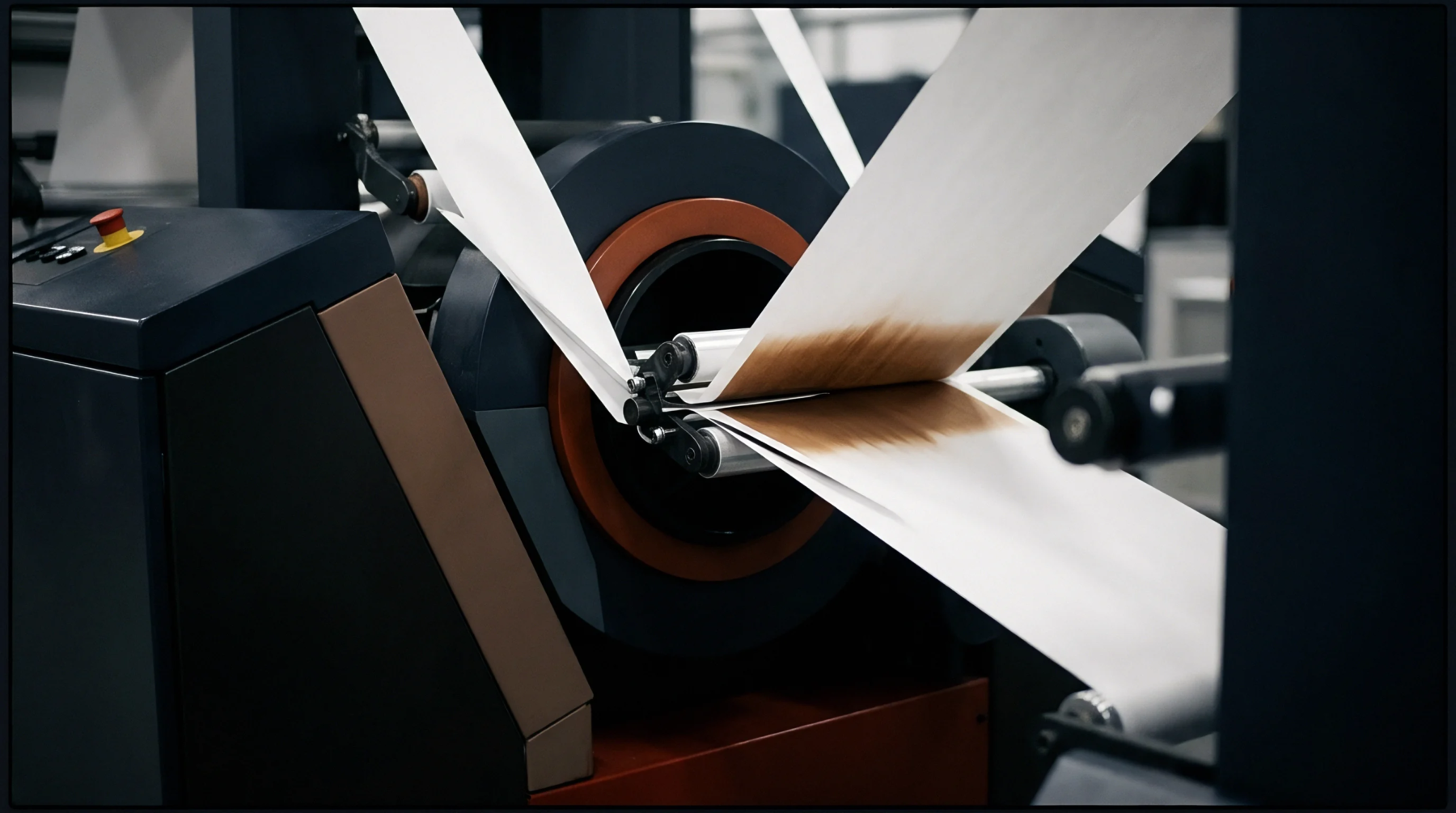
Internal Diffusion
Dynamic capillary and vapour transport of water molecules through the cross-sectional thickness of paperboard redistributes moisture between internal sheet strata. Termed z-direction moisture migration, this mass transfer mechanism occurs in response to through-thickness temperature and moisture differentials generated during drying, calendering, coating and storage. It governs planar curl stability, surface sizing penetration and internal ply-bond durability across multi-ply packaging grades.
The boundary of this transport phenomenon sits strictly within the through-thickness dimension, distinct from lateral planar water dispersion across machine and cross directions.
Diffusion Physics
Thermal gradients across drying cylinders drive liquid water and vapour away from hot contact surfaces toward cooler sheet interiors or unconstrained outer surfaces. In multi-ply boards, differing fibre properties and refining levels establish varied pore geometries, which create localized capillary pressure differentials across the z-axis. Starch layers applied at the size press momentarily swell outer cellulose networks, inducing water diffusion toward dry internal plies through transient moisture gradients.
As paper dries, non-uniform shrinkage between the upper and lower sheet surfaces generates internal residual stress states. Reversible diffusion continues after packaging is wound into reels, with ambient moisture penetrating outer reel wraps and creeping inward through open fiber capillaries.
Structural Instability
Packaging converters encounter severe processing difficulties when through-thickness water distribution becomes asymmetrical. Non-uniform moisture content through the sheet thickness causes immediate curl and twist, causing feed jams in high-speed blanking presses and automated carton gluers. During extrusion coating with molten polyethylene, sudden z-direction moisture migration toward the hot polymer interface flashes into steam, forming microscopic blisters that ruin barrier integrity.
Multi-ply solid bleached sulphate board can suffer internal delamination if water migrates unevenly into weakly consolidated inner plies during scoring and folding. Sourcing specifications demand conditioned boards held at controlled equilibrium moisture to prevent through-thickness migration from distorting carton geometry on filling lines.