Anisotropic Thermal Strain Mapping across Large Format Heated Platen Brass Die Chases
Pre-scaling brass die vector artwork based on directional thermal strain maps eliminates press registration drift across large format heated platens.

Strain
Mechanics of Directional Thermal Expansion in Engraved Brass
Metallurgical rolling texture imparts distinct directional physical behavior to cold-finished brass plate stock during thermal elevation. When a large format brass die carrier operates at temperatures between 130 degrees Celsius and 160 degrees Celsius, dimensional growth along the rolling axis routinely exceeds lateral growth along the transverse axis. This anisotropic behavior stems from grain elongation during mill processing, creating preferential thermal expansion coefficients along distinct crystallographic orientations.
In a standard 1060 millimeter by 1450 millimeter platen area, uniform heating generates non-uniform distortion when cold-rolled CuZn37 or CuZn39Pb3 brass plate stock serves as the image-bearing tool.
Heat drives dimensional movement.
Platen steel expands at a linear coefficient of approximately 11.5 multiplied by 10 to the negative sixth power per Kelvin. Engraved brass expands at coefficients ranging from 18.2 to 20.5 multiplied by 10 to the negative sixth power per Kelvin depending on grain alignment. This thermodynamic mismatch generates differential displacement across the interface between the heated platen bed and the lockup chase.
Unconstrained brass expanding against fixed steel stops generates mechanical stress that warps the plate surface, altering impressional depth and damaging fine-line foil stamping detailing.
Brass expands faster than steel.
| Material Grade | Mean CTE 20 to 150 C (10^-6 / K) | Rolling Grain Alignment Factor | Thermal Conductivity (W / m K) | Elastic Modulus (GPa) |
|---|---|---|---|---|
| Cold-Rolled CuZn37 (C27200) | 19.8 Longitudinal / 18.1 Transverse | 1.094 | 121 | 110 |
| Free-Cutting CuZn39Pb3 (C36000) | 20.5 Longitudinal / 18.9 Transverse | 1.085 | 115 | 105 |
| Cast Brass Tooling Plate | 18.4 Isotropic | 1.002 | 108 | 96 |
| Platen Structural Steel (S355) | 11.7 Isotropic | 1.000 | 52 | 210 |

Coefficient Asymmetry across Alloy Formations and Rolling Directions
Thermal response curves measured across perpendicular axes demonstrate substantial divergence between extrusion-cast and cold-rolled brass alloys. Cold-finished plate stock contains stretched grain boundary networks that store internal strain energy. Elevating temperature releases residual mechanical strain, adding a secondary dimensional shift atop the linear coefficient of thermal expansion.
Extruded cast brass exhibits near-isotropic behavior, reducing directional variation to less than one percent, whereas rolled plate exhibits up to nine percent directional variance between longitudinal and transverse axes.
Differential thermal growth between brass tooling and steel platens introduces systematic spatial offset across large format hot stamping runs.
When temperature management drops below required precision thresholds, lateral registration failure destroys foil registration accuracy across the outer yield matrix, forfeiting thousands of finished folding cartons per shift.

Chase

Mechanical Constraints and Boundary Conditions of Large Format Lockup
Rigid clamping assemblies hold heavy metal carrier frames against heating platens under high hydraulic toggle forces. Boundary conditions imposed by edge clamps restrict free thermal movement, forcing thermal strain into interior shear and out-of-plane distortion. As the plate attempts to expand against immovable steel perimeter borders, compressive forces inside the brass plate build rapidly, resulting in localized buckling or arching at the center of the platen area.
Clamps resist outward growth.
Thermal equilibrium takes time.
In large format hot foil stamping and embossing presses, mechanical lockup systems convert linear expansion into complex localized strain fields through specific failure modes:
- Corner Pinching occurs when perimeter clamps prevent orthogonal expansion, forcing brass material inward and pinching fine-line foil relief geometry near sheet margins.
- Center Arching develops when lateral expansion constraints exceed the buckling limit of the brass plate, causing the center of the die to lift off the platen surface by up to 0.15 millimeters.
- Toggle Slippage manifests when thermal expansion forces exceed the holding friction of lockup toggles, causing sudden register jumps during continuous production runs.
- Foil Shearing results from uneven thermal growth between adjacent die units, tearing delicate metallic foil carriers during high-speed web advancing passes.
Where Does Platen Zone Temperature Variance Induce Spatial Shear?
Heating element layout configurations in multi-zone heating banks frequently exhibit thermal valleys measuring up to twelve degrees Celsius near exterior edges. Central zones maintain higher temperatures due to heat accumulation from surrounding elements, while edge zones lose thermal energy to ambient air through conduction and radiation. This thermal gradient creates differential expansion rates across a single chase plate, causing complex shear stresses that twist multi-up artwork matrices out of square alignment.
Standard contractual agreements for high-speed hot foiling require heated tool carriers to remain within plus or minus two degrees Celsius across all active heating zones.
Equipment vendors frequently claim that spatial registration drift stems entirely from stock hygroscopic dimensional instability rather than uneven platen heating dynamics.

Grid
Digital Image Correlation and Infrared Strain Mapping Protocols
Surface tracking using high-contrast ceramic speckle coatings allows multi-axis cameras to calculate full-field displacement tensors under elevated temperatures. Non-contact optical metrology captures continuous thermal strain maps without applying mechanical loads that distort measurement results. By pairing stereoscopic digital camera arrays with calibrated infrared thermography, engineers observe the exact spatial progression of thermal strain across large format heated plates during bring-up cycles.
Cold corners pull inward.
Registration shifts across sheets.
| Measurement Technique | Spatial Resolution | Strain Sensitivity | Operating Thermal Window | Primary Limitation |
|---|---|---|---|---|
| 3D Digital Image Correlation | 0.05 mm / pixel | 50 microstrain | 20 C to 300 C | Requires high-temperature speckle surface preparation |
| Infrared Thermography | 0.80 mm / pixel | 0.1 C thermal resolution | -20 C to 250 C | Measures surface heat rather than direct mechanical displacement |
| Contact Foil Strain Gauges | Point-wise (1 mm gauge) | 10 microstrain | -50 C to 200 C | Wire routing interferes with press closure and impression nip |
| Laser Speckle Interferometry | 0.01 mm / pixel | 5 microstrain | 20 C to 180 C | Highly sensitive to press ambient vibration and air turbulence |
Empirical Measurement of Localized Deformation Field Networks
Field data gathered across 1020 millimeter by 1420 millimeter heated surfaces reveals non-linear vector distribution heavily weighted toward central heating elements. Strain magnitude scales non-linearly with dwell duration and heating cycle intensity, generating parabolic displacement curves across both major platen axes. Mapping protocols must follow precise sequence steps to yield accurate vector compensation data:
- Clean the polished brass surface using industrial solvent to eliminate residual grease and anti-corrosion oils.
- Apply a thin, uniform base coat of high-temperature matte white ceramic paint to eliminate surface reflection.
- Apply random black ceramic speckles using a fine-nozzle airbrush to create optical tracking targets across the entire surface.
- Mount dual high-resolution optical cameras on a rigid frame parallel to the heated platen bed.
- Capture baseline reference coordinates at ambient temperature prior to powering heating elements.
- Heat the platen to target operating temperature and log displacement vectors at five-minute intervals until reaching thermal equilibrium.
Optical strain testing under ISO 12006 conditions reveals up to 0.42 millimeters of non-linear lateral displacement along the rolling axis of uncompensated CuZn37 brass tooling at 140 degrees Celsius.
Whether non-contact optical strain mapping can be integrated into live production press controls to dynamically adjust zone heating elements remains an active subject of industry investigation.


Drift
Pre-Compensation Algorithms for Thermal Distortion Correction
Direct CAD modifications subtract expected thermal growth vectors from original vector art before tool engraving begins. By applying reverse directional scaling factors, pre-compensated dies expand into correct dimensional target shapes upon reaching target operational temperatures. This algorithmic scaling accounts for both linear thermal expansion coefficients and grain-dependent anisotropic behavior across cold-finished brass alloys.
CAD software applies scaling factors.
Proper scaling saves make-ready time.
Implementing pre-compensation algorithms into large-format packaging tooling workflows requires evaluating specific technical parameters:
- Alloy Certification Verification validates the exact chemical makeup and rolling grain direction of raw brass stock before running toolpaths.
- Platen Mapping Alignment pairs specific engraved dies to calibrated heating zone profiles on designated production presses.
- Substrate Dwell Calculation factors press operating speed and heat transfer losses into target operating temperature targets.
- Zone Heating Calibration adjusts individual heating circuit setpoints to flatten measured thermal gradients across the chase frame.
Die Engraving Scaling Factors along Primary Material Axes
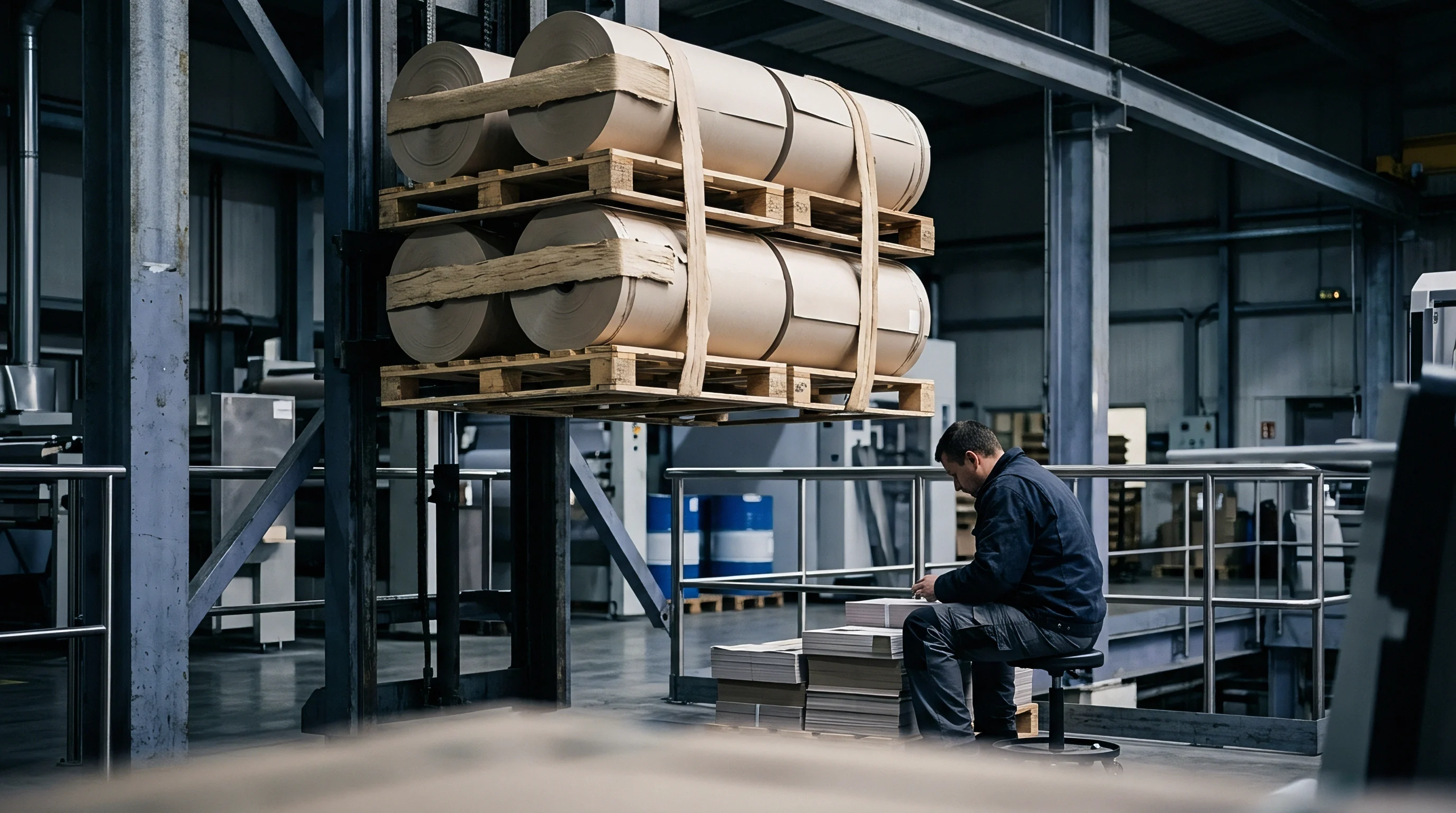
Milling calculations apply differential ratios between longitudinal and transverse directions, typically setting 99.82 percent scale along the grain and 99.86 percent across the grain. When stamping complex multi-up folding boxboard cartons with tight registration tolerances, ignoring grain direction results in accumulated position errors exceeding 0.50 millimeters at sheet edges. Calculating scaling factors using thermal strain maps eliminates manual press-side modifications and prevents costly die remachining passes.
Pre-scaling tooling art based on thermal mapping eliminates the need for press-side heating adjustments during production bring-up.
A press room that calculates dimensional scaling from measured operating heat rather than standard alloy tables reduces make-ready waste on every large-format job.

Cost
Waste Yield and Spoilage Metrics across High-Volume Shifts
Production accounting tracks sheet loss during thermal bring-up phases, where press stabilization frequently consumes hundreds of printed sheets. Uncompensated thermal distortion forces press operators to adjust register controls repeatedly as platens warm, generating running scrap across initial production hours. In high-value packaging runs utilizing premium solid bleached sulphate boards, foil waste and substrate scrap quickly impair job profitability.
Uncompensated tools generate scrap.
Thermal stabilization consumes stock.
Spoilage eats running margins.
The ledger captures all waste.
| Cost Parameter | Standard Uncompensated Tooling | Strain-Mapped Pre-Compensated Tooling | Variance Impact |
|---|---|---|---|
| Initial Die Fabrication Cost | EUR 2,800 | EUR 3,600 | + EUR 800 (Upfront setup) |
| Make-Ready Waste Stock (Sheets) | 450 sheets per bring-up | 80 sheets per bring-up | – 370 sheets saved |
| Make-Ready Downtime (Hours) | 2.5 hours stabilization | 0.75 hours stabilization | – 1.75 press hours saved |
| Run Spoilage Rate (100k Run) | 2.2 percent offset error | 0.3 percent offset error | – 1.9 percentage points scrap |
| Net Landed Job Cost (100k Units) | EUR 18,450 | EUR 16,100 | Net Savings: EUR 2,350 |

Commercial Thresholds for CNC Pre-Compensation against Remachining Costs
Tooling expenditure analysis balances the upfront investment of high-precision strain mapping against potential press downtime and scrap costs. For production runs under twenty thousand sheets, standard uncompensated brass dies modified via press zone adjustments often meet budget constraints. When job volume exceeds fifty thousand sheets or involves complex multi-pass foil embossing combinations, pre-compensated tooling amortizes its initial measurement cost within the first operating shift.
Including explicit thermal stability tolerances under ISO 12647-2 in purchase specifications shifts financial liability for registration failure from the converter to the tooling vendor when dies exceed defined strain thresholds.