Gas Chromatography Mass Spectrometry Screening for Photoinitiators in Laminate Films
Gas chromatography mass spectrometry screening isolates residual photoinitiators in laminate films, verifying compliance with food contact migration limits.


Extraction
Multilayer flexible packaging structures combine oriented polypropylene, polyethylene terephthalate, and aliphatic polyolefins through polyurethane laminating adhesives. Ultraviolet curable inks and overprint varnishes applied to outer film layers contain photoinitiators that do not fully consume during high-speed crosslinking. Unreacted photoinitiators remain embedded in the ink film, free to diffuse through inner substrate layers into packed dry or fatty foodstuffs.
Evaluating these migrant molecules requires liberating them from the complex polymer film matrix without generating sample preparation artifacts or causing polymer degradation.
Matrix Disruption and Solvent Selection
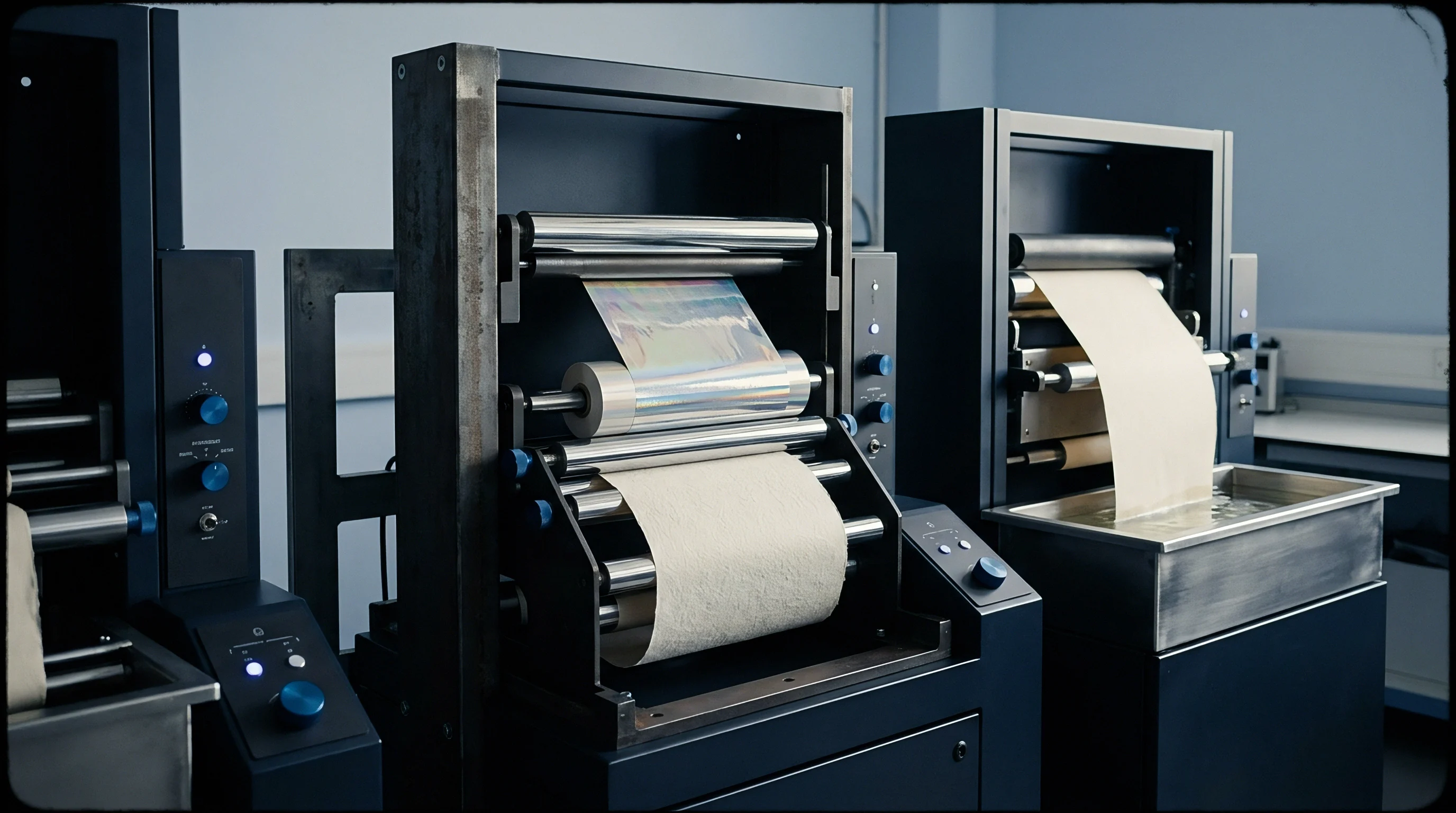
Organic liquids penetrating printed film matrices dissolve unreacted photochemical agents while swelling polyolefin sealing layers. Standard liquid-solid extraction protocols rely on targeted organic solvents selected for their polarity, boiling point, and structural compatibility with target photoinitiator chemistries. Dichloromethane provides comprehensive dissolution of low molecular weight compounds, though aggressive swelling of low-density polyethylene layers releases interfering low molecular weight wax oligomers.
Acetonitrile and ethyl acetate present selective extraction profiles that isolate target analytes while limiting total wax co-extraction. Solvent swelling breaks laminate bonds. Incomplete extraction underestimates toxicological risk.
The choice of solvent dictates both analytical recovery rates and downstream chromatographic cleanliness.
Temperature during solvent contact accelerates diffusion rates out of the film structure. Maintaining extraction baths at forty degrees Celsius for twenty-four hours maximizes recovery of volatile species such as benzophenone and 2-hydroxy-2-methylpropiophenone. Higher temperatures risk evaporative loss of low-boiling photoinitiators and cause thermal degradation of sensitive amine co-initiators.
Room temperature extraction over forty-eight hours protects volatile analytes, though extended lead times delay quality assurance decisions during commercial packaging runs.
Solvent extraction using dichloromethane at 40 degrees Celsius for 24 hours yields a 98 percent recovery rate for benzophenone in 65-micron PE laminates.

Thermal Desorption Direct Sampling Mechanics
Direct heating of film fragments volatilizes residual organic compounds directly into a helium carrier stream without fluid handling. Automated thermal desorption bypasses liquid solvent preparation entirely, eliminating hazardous solvent waste and reducing make-ready times for laboratory testing. Laminate film samples are cut into precise surface area strips and inserted into glass desorption tubes.
Programmed thermal ramps heat the tube to temperatures between one hundred twenty and two hundred degrees Celsius. Thermal desorption eliminates extraction waste. Polypropylene films exhibit minimal swelling.
Liberated vapors pass directly onto a cryogenically cooled focus trap before rapid ballistic heating injects the concentrated analyte band onto the gas chromatography column.
Direct thermal desorption targets volatile and semi-volatile photoinitiators efficiently. Highly non-volatile polymeric photoinitiators and high molecular weight photoinitiator oligomers resist thermal evacuation at safe temperatures, remaining trapped within the film substrate. Thermal desorption acts as a rapid, high-throughput screening tool for incoming packaging lots, while solvent extraction remains the standard for comprehensive compliance dossier preparation.
| Target Photoinitiator | CAS Registry Number | Solvent System | Extraction Temperature | Recovery Rate Percentage |
|---|---|---|---|---|
| Benzophenone | 119-61-9 | Dichloromethane | 40 °C | 98.2% |
| 1-Hydroxycyclohexyl phenyl ketone | 947-19-3 | Acetonitrile | 40 °C | 94.5% |
| 2-Isopropylthioxanthone | 5495-84-1 | Ethyl Acetate | 50 °C | 91.8% |
| Ethyl 4-(dimethylamino)benzoate | 10287-53-3 | Dichloromethane | 40 °C | 96.1% |
| 2-Methyl-1- -2-morpholinopropan-1-one | 71868-10-5 | Acetonitrile | 50 °C | 89.3% |
Extract clean-up steps prevent instrument fouling when analyzing aggressive solvent extracts. Solid-phase extraction cartridges containing silica or C18 sorbents isolate target photoinitiators from co-extracted polyurethane adhesive oligomers. Concentrating purified extracts under a gentle stream of nitrogen gas increases analytical sensitivity, lowering effective limits of detection for trace contamination screening.
The choice between total immersion extraction and single-sided migration cell extraction dictates which chemical species reach the analytical vessel. Total immersion exposes cut film edges, allowing solvents direct access to internal adhesive layers and inner polyolefin substrates. Single-sided cells expose only the food-contact surface to the extraction medium, mimicking real-world packaging contact dynamics.
- Adhesive layer dissolution releases synthetic polyurethane oligomers that clog injection liners and obscure target analyte chromatography peaks.
- Polyolefin polymer swelling alters matrix permeability, releasing internal slip agents and antistatic additives into the extract liquid.
- Incomplete photoinitiator recovery occurs when high molecular weight initiators remain physically bound within crosslinked acrylic ink networks.
- Non-volatile oligomer contamination causes rapid baseline drift and reduces capillary column operational lifespan during routine testing.
Film suppliers frequently attribute detected benzophenone traces to background environmental contamination within the converting hall rather than print formulation migration.


Separation
Gas chromatography resolves volatile organic molecules based on their thermodynamic distribution between a stationary capillary phase and a mobile gas phase. Analyzing complex packaging film extracts containing dozens of functional additives, slip agents, and unreacted photoinitiators demands narrow chromatographic peak bands and broad thermal selectivity. Achieving complete resolution prevents co-elution, ensuring accurate quantitative detection of trace migrants.

Capillary Column Phase Chemistry
Cross-linked 5% phenyl methylpolysiloxane wall-coated open tubular columns deliver balanced selectivity for aromatic photochemical agents and aliphatic additives. Non-polar capillary columns separate target molecules primarily by boiling point, while low-bleed mid-polar stationary phases provide additional retention for polar functional groups like hydroxyl and amine co-initiators. Standard dimensions incorporate a thirty-meter column length, a zero point two five millimeter internal diameter, and a zero point two five micrometer stationary phase film thickness.
Co-elution skews quantification accuracy.
High-temperature capillary columns featuring polyimide or aluminum outer cladding extend operational limits up to three hundred fifty degrees Celsius. Extended thermal limits enable complete elution of heavy photoinitiators like ethyl 4-(dimethylamino)benzoate and polymeric cleavage agents without column bleed interference. Carrier gas selection influences separation efficiency and analysis time.
Hydrogen carrier gas offers flat van Deemter curves at high linear velocities, accelerating run times compared to helium carrier gas, though safety considerations on commercial converting floors favor helium.
Method validation under CEN TS 13130 20 mandates recovery rates between seventy and one hundred twenty percent across all target migrants.

Inlet Vaporization and Injection Parameters
Splitless injection transfers high-boiling compounds from the hot injection port into the analytical column with minimal mass discrimination. The injection port temperature maintained at two hundred eighty degrees Celsius ensures rapid vaporization of low-volatility photoinitiators without thermally decomposing sensitive cleavage compounds. Programmable temperature vaporization inlets cool during liquid injection before heating rapidly, sweeping analytes cleanly onto the capillary column without subjecting delicate photoinitiators to flash vaporization stress.
Cold splitless injection concentrates volatile analytes.
Oven temperature programming dictates peak capacity and total runtime. A typical temperature program starts at fifty degrees Celsius to focus volatile compounds, holds for two minutes, and then ramps at ten degrees Celsius per minute to three hundred twenty degrees Celsius. A final thermal hold at three hundred twenty degrees Celsius for ten minutes sweeps high-boiling wax residues and adhesive oligomers from the column, preserving baseline stability for subsequent analytical injections.
- Cut the laminate film into five-millimeter square fragments using solvent-cleaned stainless steel shears.
- Weigh precisely one hundred milligrams of the prepared film sample into a glass thermal desorption tube.
- Insert the loaded tube into the automated desorption unit connected directly to the gas chromatograph inlet.
- Heat the sample tube to one hundred eighty degrees Celsius for twenty minutes under a helium sweep gas flow rate of fifty milliliters per minute.
- Cryo-trap the desorbed volatile compounds at minus thirty degrees Celsius on a tenax trapping column before ballistic heating injection.
Inlet liners packed with silanized glass wool catch non-volatile resin droplets and particulate debris present in packaging extracts. Deactivated glass wool prevents thermal degradation of active photoinitiator functional groups on raw quartz surfaces. Regular liner replacement maintains peak symmetry and prevents retention time drift during long sequence runs.
Thicker stationary phases improve low-boiling initiator separation while increasing total run duration and thermal stress on heavy polymeric additives.

Ionization
Mass spectrometers transform eluting neutral vapor molecules into charged gas-phase fragments to facilitate mass-to-charge sorting. Generating reproducible ion fragments allows unambiguous identification of unknown compounds against standardized spectral reference libraries. The choice of ionization technique establishes the balance between molecular ion preservation and structural fragmentation.

Electron Impact Mass Spectral Fragmentation Patterns
Bombarding organic vapors with seventy electronvolt kinetic energy breaks specific covalent bonds into highly predictable fragment clusters. Standard electron ionization yields extensive structural information, producing mass spectra that match commercial NIST and Wiley spectral libraries. Molecular ions for low molecular weight photoinitiators like benzophenone at mass-to-charge ratio 182 remain prominent, facilitating simple structural identification.
Fragmentation patterns identify structural isomers. Benzophenone migrates through polyethylene layers. Mass spectra confirm molecular identities.
Type I cleavage photoinitiators split at alpha-carbon positions during electron impact, generating dominant acylium ion peaks. For example, 2-hydroxy-2-methylpropiophenone forms a dominant fragment at mass-to-charge ratio 105, corresponding to the benzoyl cation. Type II hydrogen abstraction initiators like 2-isopropylthioxanthone form stable fused aromatic ring fragments at mass-to-charge ratio 254.
Identifying these characteristic fragmentation pathways enables target compound identification even within complex multi-peak chromatograms.
Selected ion monitoring increases signal clarity by filtering background matrix noise in heavily printed laminates.
Which Photoinitiator Structures Present the Highest Analytical Interference during Electron Ionization?
Benzophenone derivatives and substituted thioxanthones generate isobaric tropylium and benzoyl cations that overlap with adhesive plasticizer residues. Positive chemical ionization uses reagent gases like methane or isobutane to soft-ionize volatile compounds through proton transfer. Soft ionization preserves the protonated molecular ion, giving a clear mass peak without extensive fragmentation.
Chemical ionization clarifies ambiguous mass spectra when electron impact fragmentation completely destroys fragile molecular ions.
Acquisitions operate in either Full Scan mode or Selected Ion Monitoring mode. Full Scan mode monitors a wide mass range from mass-to-charge ratio 35 to 500, capturing complete spectral fingerprints essential for screening Non-Intentionally Added Substances. Selected Ion Monitoring focuses mass filter fields on specific target ion masses, increasing sensitivity by two orders of magnitude to quantify trace photoinitiators at sub-parts-per-billion levels.
- Type One Alpha Hydroxyketones yield prominent benzoyl fragment ions at mass-to-charge ratio 105, serving as standard confirmation markers.
- Type Two Benzophenone Derivatives produce strong molecular ions along with substituted phenyl cation fragments under standard electron impact conditions.
- Thioxanthone Isomer Pairs share identical mass spectra requiring complete chromatographic peak separation for accurate individual quantification.
- Acylphosphine Oxide Compounds undergo extensive fragmentation, forming dominant diphenylphosphine oxide ions at mass-to-charge ratio 201.
The extent to which thermal breakdown products of high molecular weight polymeric photoinitiators mimic monomeric target initiators during 70 electronvolt ionization remains an open analytical debate.


Peak
Chromatographic signals represent the abundance of targeted ions passing through the mass detector as a function of elution time. Processing these raw signals into actionable quantitative numbers requires accurate peak integration, baseline correction, and calibration against known reference standards. Co-extractives from laminate packaging films present matrix effects that shift detector response factors, demanding rigorous internal standardization.

Internal Standard Quantitation Mechanics
Adding stable isotope-labeled reference molecules directly into sample matrices balances analyte losses occurring during extraction. Deuterated internal standards like benzophenone-d10 exhibit identical physical properties, extraction recovery, and chromatographic retention relative to native benzophenone, while mass filters distinguish their ten-atomic-mass-unit mass shift. Deuterated analogs offset ionization drift.
Matrix suppression reduces signal intensity. Detector saturation distorts peak geometry.
Constructing multi-point calibration curves establishes linear dynamic ranges for target photoinitiators. Preparing calibration solutions ranging from zero point zero one to five milligrams per liter yields correlation coefficients exceeding zero point nine nine five. Linear regression equations convert integrated peak area ratios of target ions relative to internal standard ions into exact analyte concentrations within film extracts.
Deuterated analogs offset ionization drift caused by co-extracted laminating adhesive oligomers.

Worked Conversion from Film Surface Mass to Packaging Food Equivalent
Calculating specific migration demands mapping quantified chemical mass from a measured film surface area to a standardized food simulant mass. European regulatory compliance frameworks adopt a conventional packaging ratio of six square decimeters of film contacting one kilogram of food material. Derivatization increases chemical volatility.
Barrier coatings limit mass transfer.
Assume a solvent extraction assay performed on a zero point five square decimeter piece of laminated PET/PE film yields an absolute benzophenone mass of seven point five micrograms. Dividing seven point five micrograms by zero point five square decimeters yields a surface concentration of fifteen micrograms per square decimeter. Multiplying fifteen micrograms per square decimeter by the standard European packaging surface factor of six square decimeters per kilogram of food calculates an equivalent migration concentration of ninety micrograms per kilogram of food.
Convert ninety micrograms per kilogram to milligrams per kilogram by dividing by one thousand, resulting in zero point zero nine milligrams of benzophenone per kilogram of food. Comparing zero point zero nine milligrams per kilogram to the European specific migration limit of zero point six milligrams per kilogram confirms compliance with legal thresholds.
| Compound Name | Target Quantifier Ion (m/z) | Qualifier Ions (m/z) | Method LOD (mg/kg) | Method LOQ (mg/kg) |
|---|---|---|---|---|
| Benzophenone | 182 | 105, 77 | 0.002 | 0.006 |
| 1-Hydroxycyclohexyl phenyl ketone | 105 | 81, 190 | 0.003 | 0.010 |
| 2-Isopropylthioxanthone | 254 | 211, 182 | 0.001 | 0.004 |
| 4-Methylbenzophenone | 196 | 119, 91 | 0.002 | 0.005 |
| Ethyl 4-(dimethylamino)benzoate | 193 | 148, 120 | 0.004 | 0.012 |
| Limits of Detection (LOD) and Limits of Quantification (LOQ) calculated at signal-to-noise ratios of 3:1 and 10:1 respectively, using 100 mg laminate film extracted into 5 mL solvent. | ||||
Misidentifying matrix background peaks as target photoinitiators causes unnecessary commercial lot rejections and costly converting line shutdowns.


Compliance
Food contact safety regulations establish strict maximum limits on chemical migration from flexible packaging materials into dry, aqueous, and fatty foodstuffs. Converters, ink formulations manufacturers, and consumer brand owners bear joint legal responsibility for ensuring finished laminate structures contain zero hazardous non-listed migrants. Documenting compliance requires validated analytical testing dossiers proving that individual chemical components remain below statutory specific migration limits.

European Regulatory Thresholds and Specific Migration Limits
Commission Regulation EU 10 2011 specifies positive substance lists alongside restrictions governing individual chemical species. Benzophenone carries a specific migration limit of zero point six milligrams per kilogram of food. 4-Methylbenzophenone and benzophenone evaluated together must not exceed a combined specific migration limit of zero point six milligrams per kilogram.
Specific migration limits dictate acceptance.
The Swiss Ordinance on Materials and Articles SR 817.023.21 Annex 10 sets specific legal benchmarks for packaging printing inks. Substances evaluated and listed in Part A carry binding migration limits, while non-evaluated substances listed in Part B require non-detectable migration verified at a ten parts per billion screening threshold. Brand guidelines like the Nestlé Guidance Note on Packaging Inks enforce even lower internal compliance thresholds, placing complete bans on volatile Type I initiators in sensitive food packaging applications.

Non Intentionally Added Substances Evaluation Workflow
Unintentional reaction side-products, ink degradation species, and breakdown fragments undergo toxicological threshold screening at ten parts per billion. Screening unknown chromatographic peaks requires matching mass spectra against comprehensive spectral databases followed by toxicological threshold of toxicological concern hazard grading. Structural alerts dictate whether a Non-Intentionally Added Substance requires full synthesis and analytical quantification.
| Photoinitiator Name | Swiss Ordinance Status | EU 10/2011 SML (mg/kg) | Nestlé Guidance Limit (mg/kg) | Toxicological Action Limit |
|---|---|---|---|---|
| Benzophenone | Part A Listed | 0.60 | 0.60 | 0.05 mg/kg target |
| 4-Methylbenzophenone | Part A Listed | 0.60 (Sum) | Not Recommended | 0.01 mg/kg target |
| 2-Isopropylthioxanthone | Part A Listed | 0.05 | Banned | 0.01 mg/kg limit |
| 2-Methyl-1- -2-morpholinopropan-1-one | Part A Listed | 0.01 | Banned | 0.01 mg/kg limit |
| Polymeric Photoinitiator (Omnipol 910) | Part A Listed | 5.00 | Approved | 0.05 mg/kg limit |
- Declaration of compliance statement confirms that all ink additives, monomeric photoinitiators, and laminating adhesives comply with regional packaging regulations.
- Specific migration limit proof provides quantified laboratory test results proving analytes stay below legislative migration boundaries.
- Screening method validation data documents instrument detection limits, extraction recoveries, and calibration linearity across tested film batches.
- Raw material composition disclosures trace ink chemical structures through supply chains to verify absence of banned initiators.
Incorporating Annex 10 compliance clauses from the Swiss Ordinance into conversion contracts shifts financial liability for unlisted photoinitiator contamination directly onto the ink manufacturer.


Execution
Translating laboratory screening techniques into converting plant operations demands rigorous quality control schedules and structured supplier documentation. Converter quality teams test incoming film rolls, monitor print station ink curing efficiency, and verify finished laminate rolls prior to slitting and shipment. Establishing structured testing intervals prevents non-compliant packaging lots from reaching food packing lines.

Quality Assurance Sampling and Verification Frequency
Screening schedules correlate with production volume, substrate changes, and print ink chemistry shifts across converted film lots. Baseline testing demands running full gas chromatography mass spectrometry quantitative solvent extractions on the first converted roll of every new print job setup. High-volume continuous production runs undergo automated thermal desorption fast-screening once per shift to detect shifts in UV curing lamp efficiency.
UV lamp degradation reduces crosslinking efficiency, causing sharp spikes in unreacted monomer and photoinitiator concentrations within printed ink layers. Monitoring residual photoinitiator concentrations provides indirect monitoring of UV lamp output intensity and line speed matching. Detecting elevated photoinitiator levels triggers immediate curing lamp reflector maintenance and line speed adjustments before finished material leaves the converting floor.
A full photoinitiator quantitative dossier costs eight hundred fifty dollars per sample and requires seven business days of laboratory time.

Commercial Testing Cost and Lead Time Economics
Laboratory pricing structures balance rapid thermal screening turnarounds against extensive quantitative solvent extraction reports. Standard gas chromatography mass spectrometry screening for a target panel of twenty common photoinitiators costs between four hundred fifty and nine hundred dollars per sample. Turnaround lead times range from five to ten business days for standard analytical services, while expedited twenty-four-hour testing incurs two hundred percent pricing surcharges.
Commercial packaging buyers offset laboratory testing costs by demanding certified Certificates of Analysis from ink manufacturers and converting suppliers. Validating supplier certificates through random independent laboratory audits ensures supply chain compliance while controlling ongoing analytical testing budgets. Converting operations balance fast thermal desorption screening at two hundred dollars per roll against comprehensive solvent extraction dossiers to minimize operational risk and maximize profit margins.
Integrating fast thermal desorption gas chromatography mass spectrometry screening directly into plant quality workflows gives packaging converters immediate operational control over photoinitiator migration risks. Roll release decisions proceed based on hard analytical data, protecting food brand owners from product recall liabilities while keeping converting lines running at maximum capacity.