Interfacial Peel Mechanics in High Speed Laminated Packaging Converting
High-speed interfacial peel strength relies on dynamic surface wetting and viscoelastic energy dissipation under microsecond strain rates inside the lamination nip.


Tack
First-off rolls exiting the lamination station at four hundred meters per minute exhibit immediate boundary contact dynamics between the molten extrudate and the treated substrate. Mechanical bond strength during the initial millisecond following nip closure relies entirely on physical wetting and short-range van der Waals interactions before long-range polymer chain entanglement takes place. Line speeds exceeding five meters per second reduce the available dwell time inside the nip zone to values under ten milliseconds.
When the fluid adhesive fails to wet the solid web surface within this brief contact window, air micro-voids remain trapped across the interface, creating nucleation sites for premature interfacial debonding under downstream web tension.
Adhesive rheology during initial contact operates under high shear rates ranging from ten thousand to one hundred thousand reciprocal seconds. Solventless polyurethane and extrusion-coated polyethylene formulations exhibit pronounced shear-thinning behavior within the nip entry zone, lowering dynamic viscosity to facilitate micro-cavity filling on rough paperboard or treated film surfaces. The elastic component of the complex shear modulus dominates once the substrate exits the nip pressure zone.
Excessive elastic storage causes immediate interfacial recoil, lifting the film from the substrate surface prior to thermal or chemical crosslinking. Dynamic surface tension measurements under dynamic wetting conditions reveal that surfactant migration rates within water-borne adhesives frequently lag behind the rapid surface creation rates occurring at web speeds above three hundred meters per minute.
Initial green strength formation requires interfacial contact pressures exceeding two bar within a six-millisecond nip residence window.
Polymer chain mobility controls the transition from instantaneous liquid tack to structural green strength. The reptation rate of backbones across the liquid-solid phase boundary dictates how fast thermodynamic adhesion energy builds up before web guidance rollers apply flexural stresses. Low molecular weight fractions within the formulation migrate to the boundary zone first, forming a weak boundary layer if full solubility is missing.
Adding tackifying resins increases initial molecular intimacy but shifts the glass transition temperature upward, altering high-speed peel response when converted rolls undergo cold slitting operations.

Micro-Contact Kinetics
Topological compliance between the laminating web and the fluid adhesive controls real contact area development. Substrate surface roughness profiles, evaluated using three-dimensional optical profilometry, show that surface asperities create local contact pressure variations across the web width.
Flow into sub-micron surface valleys follows modified capillary penetration dynamics where viscous drag opposes capillary driving force under external mechanical loading. High viscosity prevents complete air displacement from surface valleys before pressure drops at the nip exit. Trapped air pockets reduce the effective interfacial bonding surface area by fifteen to thirty-five percent on un-calendered paperboard substrates.
The resulting microscopic void density correlates directly with low peel resistance during immediate post-lamination quality checks on high-speed rewinding equipment.
- Rheological Cavitation Threshold defines the critical negative pressure limit at the nip exit zone where dissolved gases nucleate bubbles within the un-cured adhesive layer.
- Dynamic Wetting Limit establishes the maximum web velocity above which the dynamic contact angle reaches one hundred eighty degrees, preventing physical fluid contact with the substrate.
- Zero-Shear Viscosity Recovery Rate dictates the speed at which the applied polymer regains structural resistance against applied web tension immediately following nip discharge.
Initial bond separation on high-speed lines often stems from localized web temperature drops rather than rheological shear breakdown within the coating head.


Viscoelasticity
High line speeds compress the deformation timescale of polyurethane and acrylic adhesive layers down to sub-millisecond windows. Mechanics governing interfacial peel shifts from steady-state equilibrium detachment to high-strain-rate viscoelastic fracture as converting velocities scale upward. The rate of mechanical force application during high-speed peel testing, conducted at three hundred meters per minute, forces the polymer backbone into a rigid, glass-like state.
High strain rate increases the measured peel force by orders of magnitude compared to standard benchtop measurements conducted at three hundred millimeters per minute under ASTM D903 testing standards. This dynamic stiffening transfers applied peeling stresses directly into the interfacial boundary rather than permitting bulk energy dissipation through viscous flow within the adhesive matrix.
Temperature and strain rate equivalence obeys the Williams-Landel-Ferry relationship within the viscoelastic transition zone of the laminating adhesive. Increasing converting line speed by a factor of one hundred shifts the effective mechanical response of the adhesive along the master curve equivalent to a temperature reduction of twelve to fifteen degrees Celsius. Converting cold rolls stored in unheated warehouse spaces forces the adhesive layer into a brittle fracture regime during inline pouch-forming or roll-slitting processes.
Bulk viscoelastic dissipation vanishes when the local Deborah number, representing the ratio of polymer relaxation time to deformation time, exceeds unity.
| Peel Speed Range (m/min) | Deformation Time (ms) | Dominant Failure Mode | Adhesive Dissipation Energy (J/m²) |
|---|---|---|---|
| 0.1 to 1.0 | 100.0 to 10.0 | Cohesive Viscous Flow | 450 to 620 |
| 1.0 to 50.0 | 10.0 to 0.2 | Viscoelastic Stick-Slip | 280 to 410 |
| 50.0 to 300.0 | 0.2 to 0.03 | Interfacial Brittle Fracture | 45 to 110 |
| 300.0 to 600.0 | 0.03 to 0.01 | Interfacial Micro-Cleavage | 12 to 38 |
Dynamic mechanical thermal analysis establishes the loss factor, defined as the ratio of loss modulus to storage modulus, across a frequency sweep up to ten thousand hertz. A high loss factor peak centered at the deformation frequency corresponding to converting speeds promotes resistance against delamination by absorbing kinetic energy supplied by web tension surges. If the loss factor peak falls outside the mechanical frequency window generated by high-speed slitting blades, the adhesive behaves as a purely elastic solid, promoting catastrophic un-zipping along the interface.
Strain Rate Dependence
Tensile stress concentration at the peel front scales non-linearly with web velocity. Local elongation rates at the root of the peel zone exceed five thousand percent per second during high-speed roll unwinding. Polymer chains lack sufficient time to uncoil and align along the stress vector, leading to localized bond rupture at stress levels far below the bulk ultimate tensile strength of the crosslinked matrix.
Molecular weight distribution plays a direct role in balancing high-speed strength against stress dissipation. High molecular weight tails provide structural integrity and elevated plateau moduli, preventing cohesive shear slip during high-tension winding. Narrow molecular weight distributions reduce tail-end strain hardening, allowing localized energy dissipation without triggering interfacial crack initiation along the primary primer coat.
Contracts specifying laminated flexible barriers must reference high-speed peel test methods ISO 11339 evaluated at line-relevant strain rates rather than quasi-static laboratory standards.
Stiff adhesives demand low web angles to prevent crack tip stress concentrations from exceeding interfacial bond capacity.

Fracture
Cleavage stresses concentrated at the crack tip govern the mechanical separation of flexible packaging laminates. Mechanics of interfacial separation under dynamic converting conditions depend on the total strain energy release rate, which combines adhesive work of adhesion with plastic deformation energy dissipated in the flexible backings. Aluminum foil and biaxially oriented polypropylene films undergo significant elastoplastic bending as they are pulled away from the primary substrate at the lamination interface.
The mechanical energy expended in permanently bending a stiff aluminum foil layer at ninety degrees often exceeds the actual physical work of adhesion by a factor of ten, masking poor chemical bonding when measured via crude hand-peel evaluations.
Energy balance equations developed by Rivlin define the relationship between applied peel force, peel angle, and interfacial fracture toughness. As line speed increases, the curvature radius of the bending flexible substrate at the crack root decreases sharply, increasing local bending stresses beyond the yield point of the metal or polymer film. Thin foil layers suffer localized micro-necking and pinhole generation along the peel front when web tension fluctuations drive the local energy release rate beyond the critical value.
Interfacial crack propagation occurs via three primary micro-mechanical modes: localized cavitation, fingering instability, or clean interfacial cleavage. High-speed video analysis of the debonding zone reveals that high line speeds suppress viscous fingering instabilities and transition the crack growth mode toward planar interfacial cleavage. This shift results in smooth, featureless fracture surfaces visible under scanning electron microscopy, characteristic of brittle adhesive separation.

Energy Release Mechanics
The total energy release rate splits into Mode I tensile opening and Mode II in-plane shear forces based on the structural asymmetry of the laminated layers. Unbalanced web tension during inline converting alters the phase angle of complex mode mixity at the fracture tip. Increasing the Mode II shear contribution shifts the crack path away from the sensitive interfacial boundary layer and drives it into the bulk of the softer sealant layer, artificially elevating the observed peel resistance during continuous rewinding operations.
- Verify that web tension controls maintain total tension variance below two percent across the unsupported web span between the laminator and the inline slitting assembly.
- Measure backing thickness uniformity across five points along the transverse web profile using continuous non-contact capacitive gauges to identify local flexural stiffness variations.
- Calculate the effective plastic dissipation factor using the elastic modulus and yield stress of the specific metallic foil or polymer backing layer under dynamic strain conditions.
- Adjust the unwinding peel-off angle at downstream converting stations to minimize backing plastic work while keeping interfacial stress state within safe limits.
What fundamental molecular interaction threshold determines whether a propagating crack remains anchored within the interfacial layer or transitions into the bulk sealant during high-velocity web transport?

Corona
Dielectric barrier discharge alters the surface energy of non-polar polyolefin films by introducing oxygen-containing functional groups into the outer carbon backbone. High-speed extrusion coating lines rely on continuous inline dielectric treatment to elevate the surface energy of polyethylene and polypropylene films above forty-two dynes per centimeter. Treatment generates polar hydroxyl, carbonyl, and carboxyl sites that interact with polar groups in polyether-based adhesives through hydrogen bonding and dipole-dipole interactions.
Over-treatment of polyolefin webs creates low molecular weight oxidized material on the outer polymer layer. This oxidized material forms a weak boundary layer that lacks structural cohesion with the underlying polymer matrix. High-speed peel failures on over-treated webs demonstrate separation between the oxidized film surface layer and the bulk polyolefin base, leaving high surface energy readings on both sides of the fractured interface despite poor mechanical laminate performance.
| Storage Time at 25°C (Days) | Surface Energy (mN/m) | Water Contact Angle (Degrees) | High-Speed Peel Force at 200 m/min (N/15mm) |
|---|---|---|---|
| 0 (Inline) | 46 | 58 | 3.8 |
| 7 | 42 | 67 | 3.1 |
| 30 | 38 | 76 | 2.2 |
| 90 | 35 | 84 | 1.1 |
Decay of surface activation occurs due to hydrophobic recovery, where low molecular weight chains rotate from the surface back into the bulk polymer matrix to minimize thermodynamic surface energy. High ambient storage temperatures accelerate this chain mobility, reducing effective surface energy rapidly during long roll storage periods before lamination passes. Re-activation via inline atmospheric plasma treatment immediately prior to adhesive application restores polar site density without generating excess loose oxidized fragments.
When Does Surface Degradation Mandate Inline Treatment?
Inline discharge treatment becomes indispensable when converted film roll age exceeds thirty days or when storage humidity drives surface additive migration. Slip additives like erucamide and anti-blocking silica agents migrate to the surface layer, burying polar oxidation sites under an incompatible organic film layer. Dynamic contact angle goniometry shows a dramatic rise in advancing water contact angles when additive concentration reaches saturation coverage at the surface.
Chemical primers based on titanates or polyethyleneimine stabilize surface oxidation sites, providing permanent chemical anchoring that resists additive displacement. Polyethyleneimine primers form covalent complexes with surface carboxyl groups, creating a stable platform for subsequent water-borne acrylic coating passes. Applying primer at dry coat weights below fifty milligrams per square meter maintains high clarity while preventing interfacial slip failure during thermal seal passes.
Standard packaging delivery specifications require certified compliance with EN 13430 material recyclability guidelines without sacrificing minimum cross-directional interfacial bond integrity.


Nip
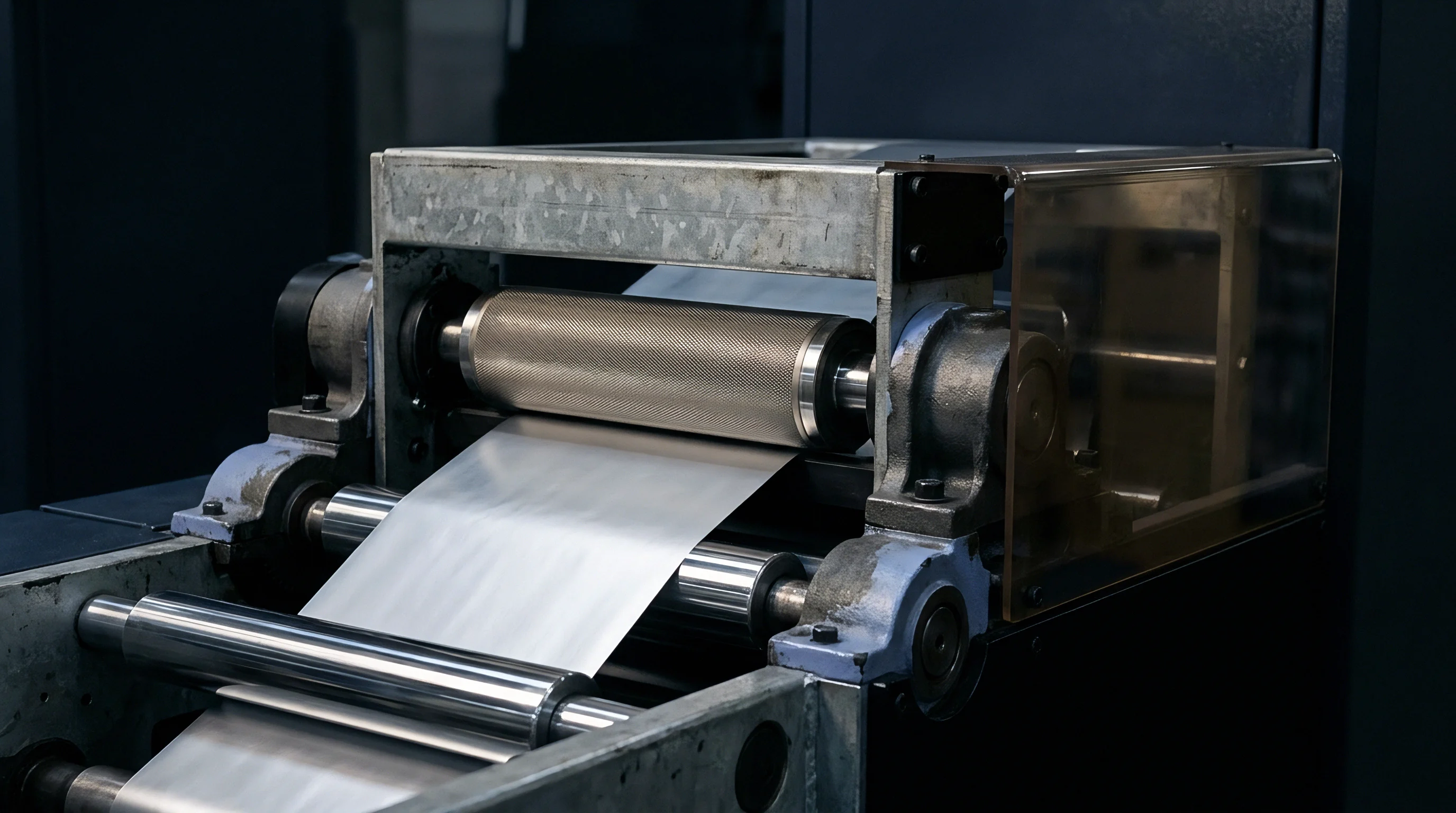
Steel and rubber counter-rolls establish the pressure boundary where heat transfer and molecular intimacy develop. Mechanical loading across the lamination impression area dictates the dynamic pressure distribution experienced by the fluid adhesive and substrate layers. Rubber roll hardness, measured in Shore A durometer, governs footprint width under a given pneumatic or hydraulic cylinder load.
Soft rubber covers deform significantly under load, broadening the footprint to increase residence time while reducing peak contact pressure at a given line velocity.
Heat transfer across the rotating steel shell melts amorphous polymer domains and lowers adhesive viscosity during initial contact. Thermal gradient models reveal that high line speeds limit heat penetration depth into thick paperboard backings, concentrating thermal energy precisely at the interfacial boundary layer where bonding takes place. Steel roll surface temperatures maintained between eighty and one hundred twenty degrees Celsius promote polyolefin flow without triggering structural thermal shrinkage in oriented film backings.
Rubber roll deflection under heavy hydraulic nip loading creates transverse pressure variations across the web width. Higher compression forces at web edges cause non-uniform coat weights and unequal residual strain profiles across the web. Modern lamination stations utilize crown-compensated rolls or variable inflation internal pressure tubes to maintain flat pressure profiles across working widths exceeding one thousand five hundred millimeters.

Pressure Distribution Profiles
Peak pressure inside the deformation zone drives mechanical micro-anchoring of the adhesive into substrate pores. Dynamic pressure sensors embedded in the rubber roll cover demonstrate that the leading edge of the contact zone exhibits a steep pressure gradient, followed by a parabolic drop towards the exit line. Misalignment between counter-rolls creates interfacial micro-shear stresses inside the deformation zone, introducing pre-existing shear strains into the un-cured adhesive layer that lower dynamic peel resistance on finished packaging rolls.
- Dynamic Nip Impression Footprint Width expands proportionally with the square root of roll diameter and applied linear loading force.
- Thermal Penetration Time Constant determines the maximum speed allowable before interfacial temperature drops below the polymer melting threshold.
- Transverse Rubber Micro-Slippage introduces localized shear deformation along the web boundary that weakens initial chemical adhesion network development.
Operating a laminator with uneven nip pressure profiles across the web width results in localized boundary delamination, leading to catastrophic full-width web splices during subsequent high-speed pouch converting passes.


Ledger
Interfacial delamination on commercial slitting lines generates material scrap that directly degrades margin expectations. High-speed flexible packaging converting lines running at five hundred meters per minute consume substantial material quantities every hour. A failure in interfacial peel strength detected after five finished mill rolls yields hundreds of kilograms of unusable printed and laminated substrate.
Material costs account for sixty-five to eighty percent of total unit expenses in high-volume flexible barrier manufacturing, making immediate detection of interfacial failure critical to plant profitability.
Extended make-ready times caused by adhesive wet-out failure or corona generator miscalibration add non-productive machine hour costs that double the quoted finishing cost per thousand packs. Calculating total job profitability demands rigorous tracking of set-up waste, continuous running scrap, and customer return allowances driven by delamination failures at end-user filling plants. The true cost of an interfacial bond failure extends past wasted film and resin to include freight liabilities, customer downtime claims, and full batch replacement costs.
Modulated producer responsibility fees enforced under European Union Packaging and Packaging Waste Regulation frameworks penalize multi-layer laminates that incorporate non-separable dissimilar materials. Laminates utilizing solventless polyurethane adhesives that prevent clean mechanical separation during post-consumer shredding receive lowest-tier recyclability scores, incurring maximum financial levies per tonne placed on the market. Switching to mono-material polyolefin laminates with functional barrier coatings lowers regulatory fee exposure but narrows the operating window for dynamic interfacial peel mechanics during high-speed converting passes.
Waste Arithmetic Mechanics
Financial impact assessment of converted lot rejections hinges on identifying the precise root cause within the added pass sequence. High-speed slitting operations running un-cured solventless polyurethanes risk web telescoping and interfacial slip if slitting web tension exceeds green adhesive shear capacity. Setting roll rewinding profiles requires balancing core pressure, taper tension, and adhesive cure kinetics to prevent costly post-lamination roll defects.
- Calculate the dry adhesive coat weight across three web positions using gravimetric or inline infrared sensor arrays to verify application consistency.
- Record total roll curing time and ambient warehouse environmental conditions before authorizing high-speed secondary slitting passes.
- Determine the landed cost penalty per pack resulting from increased producer responsibility fees under current regional packaging waste regulations.
- Audit line spoilage logs to isolate make-ready waste from steady-state running delamination scrap on high-speed pouch-making equipment.
Unit pricing models for high-barrier laminates must incorporate both the mechanical pass costs and the long-term compliance liability of the selected adhesive system. Converting facilities that validate interfacial peel performance under actual strain rates secure higher operational margins while protecting brand owner clients against costly field failures.