Interfacial Shear Stress Analysis in Coated Board Packaging
Controlling interfacial shear stress balances ply delamination during scoring against surface coating integrity to prevent converting splits and barrier failure.

Score
Board conversion relies on mechanical displacement within a male rule and female matrix geometry to establish permanent hinges. As the creasing rule enters the substrate and impacts the coated surface, compressive force translates into z-directional shear stresses between adjacent fibrous plies and along the coating interface. Multi-ply paperboard grades like folding boxboard and coated unbleached kraft feature layered fiber structures where chemical pulp outer plies sandwich high-bulk mechanical pulp.
As bending forces concentrate along the boundary, these mechanical stresses force the internal fiber network to separate cleanly without rupturing the exterior mineral coating.
During commercial scoring, tensile strain develops along the external coated liner while compressive stress buckles the reverse liner into the matrix groove. Balanced interfacial shear strength permits the plies to slide over one another during bending, keeping outer surface strain below its ultimate tensile elongation limit. If the interfacial shear strength between the mineral coating and the base bleached kraft ply exceeds the cohesive shear strength of the fiber layers, cracks propagate laterally within the sheet.
If the interface instead resists shear displacement, all bending strain is forced directly into the brittle coating layer, producing visible score line fractures.
Creasing performance depends entirely on forcing delamination into the interior fiber network before surface strain reaches the elastic limit of the mineral coating.
Line speed compounds these mechanical demands. Modern rotary and flatbed die-cutters operate at cycle rates exceeding nine thousand sheets per hour, subjecting the board to impact times under ten milliseconds. At these deformation rates, viscoelastic stress relaxation within the board matrix is suppressed.
High-speed video diagnostics show that unoptimized scoring profiles create asymmetric shear distribution across the score shoulder, triggering surface micro-tears before the carton blank enters the folding section.
- Coating flaking failure occurs when localized shear stress exceeds the adhesive bond between the pigment cake and the fibrous substrate, causing small chips of mineral coating to detach during matrix penetration.
- Interior ply cleavage develops when mechanical pulp plies possess insufficient internal shear resistance, leading to uncontrolled delamination that extends well outside the creasing zone.
- Tensile bead split emerges across the outer crease fold whenever female matrix channel dimensions fail to accommodate the displaced caliper volume, exceeding board elongation capacity.
A deeper female matrix groove preserves surface liner continuity whenever mechanical pulp stiffness rises in cold warehouse conditions.

Adhesion
The chemical formulation of the pigment layer governs how tensile and shear stresses transfer across the boundary into bleached kraft fibers. These coatings consist of inorganic pigments, primarily ground calcium carbonate and fine kaolin clay, bound within a synthetic polymer matrix where styrene-butadiene latex and carboxymethyl cellulose anchor the mineral matrix to raw cellulose fibers. Pigment volume concentration dictates coating ductility: high pigment loading increases opacity and ink holdout but reduces elongation at break below one percent, whereas higher latex fractions suppress fiber pull.
Binder migration during the drying sequence establishes the shear resistance gradient through the coating thickness. Rapid infrared or air-flotation drying draws water toward the top surface, pulling soluble binders away from the fiber-coating boundary and leaving a weak layer directly at the cellulose interface. While extrusion coatings resist interfacial separation, water-based barrier coatings and functional polyolefin layers introduce a sharp rheological mismatch because their shear moduli differ significantly from the fibrous base under mechanical deflection.
Styrene-butadiene binder levels below eleven parts per hundred pigment yield interfacial shear failure at less than 1.8 megapascals under standard conditions of 23 degrees Celsius and 50 percent relative humidity.
Can Rapid Creasing Predict High Speed Delamination?
Tooling velocity on folder-gluers reaches eight meters per second, multiplying instantaneous strain rates by two orders of magnitude compared to static bench presses. High shear rates alter the mechanical response of the synthetic binder from ductile yielding to brittle fracture. When folding occurs at production velocity, interfacial shear stress spikes along the boundary between the stiff pre-coat layer and the top chemical pulp liner.
Because substrate moisture acts as an internal plasticizer, relative humidity levels below forty percent stiffen the cellulose wall, elevating peak interfacial shear stress during high-speed scoring passes.
| Formulation Class | Binder Ratio to Pigment | Interfacial Shear Strength (MPa) | Failure Mode at 90-Degree Fold | Limiting Tensile Strain (%) |
|---|---|---|---|---|
| Standard Folding Boxboard Mineral Coating | 10 pph Latex / 2 pph Starch | 1.65 | Micro-flaking along score bead | 1.2 |
| High-Ductility Barrier Pre-Coat | 14 pph Latex / 1 pph Synthetic Co-binder | 2.45 | Cohesive fiber tear without flaking | 2.8 |
| Stiff High-Brightness Print Layer | 8 pph Latex / 4 pph Starch | 1.25 | Delamination peeling and chalking | 0.8 |
| Aqueous Dispersion Barrier Layer | 18 pph Styrene-Acrylate Latex | 3.10 | Pinholing along compression crease | 3.4 |
Board cracking on converting lines during winter production runs is often attributed solely to floor humidity dropping below forty percent.

Fracture
Standardized laboratory instrumentation isolates internal cohesion and z-directional shear resistance through distinct loading modes. The Scott bond test measures dynamic energy absorption during impact delamination, reporting values in joules per square meter under TAPPI T 569 and ISO 16260. The test applies an impulse load through a pendulum striking a metal angle bracket glued to the board face.
While valuable for tracking internal fiber cohesion inside mechanical pulp layers, the Scott bond measurement bundles tensile, peeling, and shear energies into a single scalar value, making it unable to isolate peak interfacial shear stress at the coating boundary.
Because normal stress alters peak shear resistance, z-directional tensile tests executed under TAPPI T 541 and ISO 15754 pull the board apart under pure normal tension, whereas pure shear tests ~ including short-span shear and double-notch shear protocols ~ force failure along a predetermined horizontal plane. When analyzing coated board during creasing, interfacial failure occurs under mixed-mode loading where shear stress couples with out-of-plane compression, and batch variation shifts the location of the fracture plane.
| Test Protocol | Standard Designation | Primary Loading Mode | Reported Metric | Applicability to Coating Interfaces |
|---|---|---|---|---|
| Internal Bond Strength | TAPPI T 569 / ISO 16260 | Dynamic impact peel and shear | J/m² | Measures bulk fibrous energy absorption; insensitive to micro-coating separation |
| Z-Directional Tensile | TAPPI T 541 / ISO 15754 | Static normal uniaxial tension | kPa | Measures minimum planar tensile cohesion; dominated by weakest ply |
| Double Notch Shear | ASTM D3846 adapted | In-plane direct interfacial shear | MPa | Isolates specific horizontal boundary layers; requires precision slot cutting |
| L&W Creasability | DIN 55437 / ISO 2493 | Combined bending and transverse shear | mN·m | Quantifies residual crease stiffness; empirical correlation to line runnability |
| Test specimens conditioned at 23.0°C ± 1.0°C and 50.0% ± 2.0% relative humidity for 24 hours in accordance with ISO 187 prior to mechanical evaluation. | ||||
Are Ultrasonic Transmission Readings Predictive of Delamination?
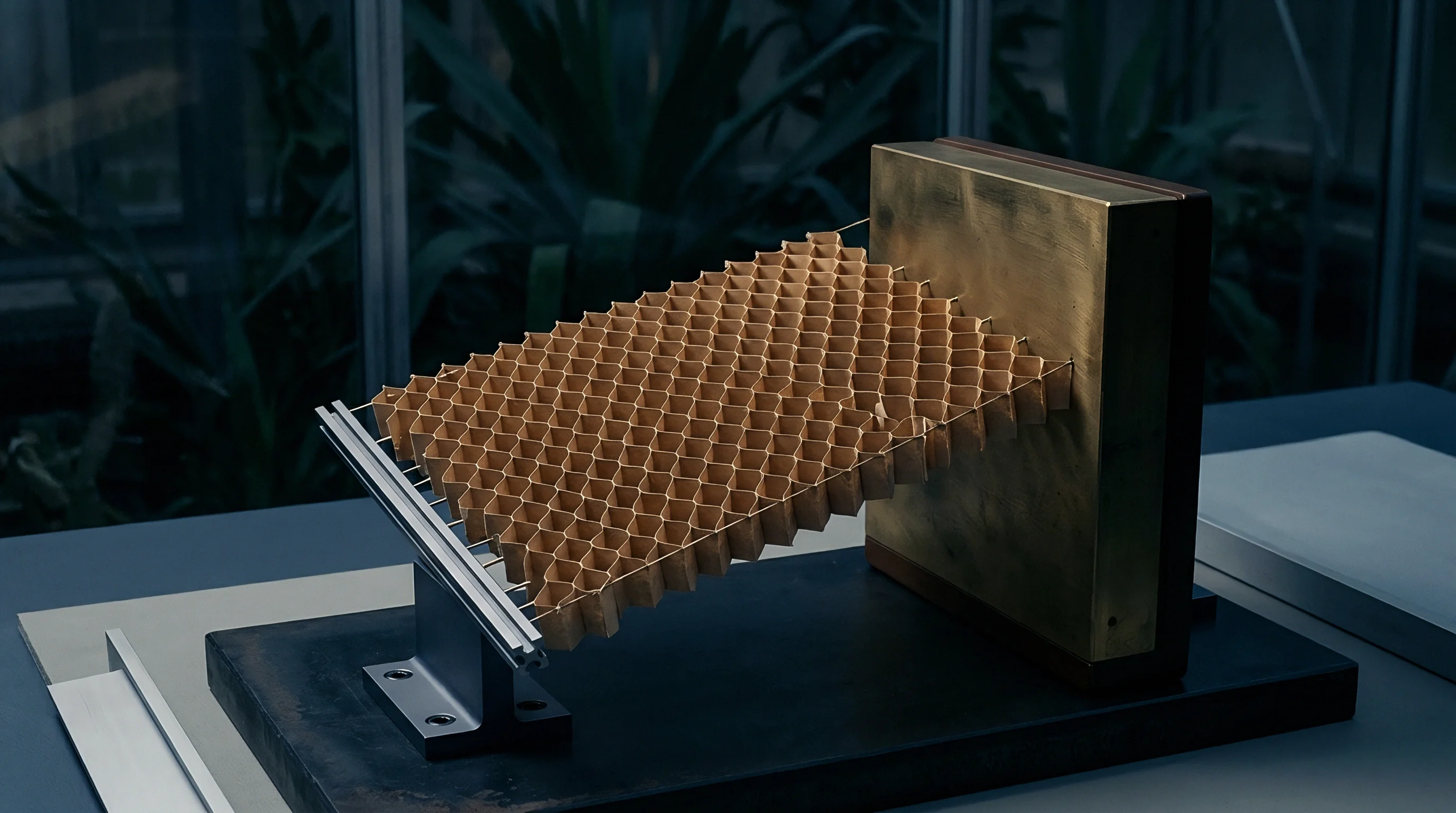
High-frequency acoustic velocity measurements track out-of-plane elastic stiffness parameters without destroying the board specimen. Compressional and shear acoustic waves propagating through the thickness yield polar stiffness diagrams, generating the complete elasticity matrix including out-of-plane shear moduli Gxz and Gyz. These ultrasonic polar measurements reveal weak internal bonding before converting tools touch the board; specifically, when acoustic velocity dips below 850 meters per second through the z-axis, internal delamination resistance drops significantly.
Consider a typical packaging calculation for a 350 gram per square meter folding boxboard sheet having a caliper of 520 micrometers. The board construction comprises a 60-micrometer bleached chemical pulp top liner carrying a 20-micrometer mineral coating layer, a 380-micrometer thermo-mechanical pulp center ply, and a 60-micrometer chemical pulp back liner. A creasing rule of width 0.70 millimeters descends into a matrix channel of width 1.40 millimeters to an indentation depth of 280 micrometers.
Under pure elastic beam deflection, transverse shear stress distributions across the sheet follow the classical parabolic relationship:
Shear stress tau equals the product of transverse shear force V and the first moment of area Q, divided by the product of the gross cross-sectional moment of inertia I and the section width b. At the critical interface between the top bleached chemical pulp liner and the thermo-mechanical center ply, the calculated peak shear stress reaches 2.38 megapascals. Measured cohesive shear strength at that specific inter-ply interface averages 2.10 megapascals under double-notch shear testing.
The induced shear stress exceeds cohesive capacity by thirteen percent, initiating horizontal crack propagation within the center ply. This delamination lowers the section moment of inertia, capping tensile stress along the outer coating at 18.2 megapascals, well below its measured ultimate cracking limit of 24.5 megapascals.
- Calibrate female channel width to 1.5 times board caliper plus rule thickness under DIN 55437.
- Condition test strips at 23 degrees Celsius and 50 percent relative humidity for 24 hours under ISO 187.
- Apply male creasing rule penetration in twenty-micrometer increments until internal delamination initiates.
- Record folding moment at ninety degrees using an automated creasing tester.
- Inspect outer coating under thirty-times optical magnification to record micro-crack initiation.
The industry still lacks an agreed analytical model that translates dynamic mill-floor acoustic stiffness readings directly into predictable high-speed folder-gluer creasing windows.
Recyclability
European packaging mandates under the Packaging and Packaging Waste Regulation link commercial viability directly to repulping efficiency and fiber recovery yields. Because undispersed barrier films, macro stickies, and synthetic coatings complicate hydrapulper separation and degrade recycled pulp quality, hydraulic shear forces within the hydrapulper must detach the coating layer from the substrate without fragmenting synthetic binders into non-removable micro-debris. EN 13430 establishes basic material recyclability, while the CEPI recyclability test method version two provides explicit laboratory protocols for fiber recovery.
High interfacial shear adhesion presents an engineering contradiction. Packaging converting demands elevated interfacial bond strength to prevent flaking and uncontrolled blistering on high-speed lines. Conversely, mill repulping lines require complete boundary release under neutral water agitation at 40 degrees Celsius within ten to twenty minutes.
When barrier coatings utilize highly crosslinked styrene-butadiene or polyurethane dispersions to survive creasing stresses, the water-resistant interface prevents water penetration into adjacent fibers. This failure to disintegrate leaves coarse fiber flakes attached to the coating layer, which reject screens discard into waste streams.
Under the CEPI recyclability test method version two, failure of a dispersion barrier to separate from fibers within twenty minutes of standard disintegration relegates the entire board structure to unrecyclable status.
- Disintegration screening logs confirm fiber recovery yields equal or exceed ninety percent after ten minutes of standard mechanical pulping without elevated chemical additions.
- Screen residue analyses quantify macro-stickies and non-dispersed polymer flakes retained on a slotted plate with 0.15-millimeter apertures, ensuring contaminant levels stay below two-tenths of a square millimeter per kilogram.
- Fiber fraction declarations demonstrate that total non-paper components, including mineral coatings and synthetic barrier binders, do not exceed five percent of total packaging dry weight.
Standard delivery contracts specifying CEPI Version Two compliance force mills to accept financial liability for landfill tipping fees whenever repulping residue exceeds fifteen percent.
Exposure
Commercial contracts across cross-border packaging supply chains shift financial default directly to the entity named on the import declaration. Beyond the immediate risk of border detention or retailer rejection for torn liners and compromised barrier integrity, crease-line failures on high-speed filling lines create shared blame between mill fiber formation, coating formulation chemistry, and converter tooling settings. Importers of record face heightened customs scrutiny under updated European Union circular economy frameworks, where a batch rejected for surface rupture or barrier delamination triggers immediate product holds and inspection charges.
Food contact verification compounds this liability. Regulation 1935/2004 mandates that materials in contact with foodstuffs must not alter the composition or organoleptic properties of food. If high-speed creasing induces micro-fractures through barrier coating layers, mineral oils, adhesives, or printing ink constituents migrate unchecked through the porous paperboard base.
Council of Europe guidelines and BfR Recommendation XXXVI require rigorous verification of barrier continuity. Migration testing under EN 1186 executed on uncreased flat samples yields compliant results. The real exposure emerges on retail shelves, where scored corners have undergone severe interfacial shear stress, fracturing the barrier film and voiding the underlying migration certificate.
A specification that omits relative humidity tolerances transfers environmental failure liability entirely onto the converting plant.
Undetected shear delamination across frozen food packaging releases moisture into outer plies, collapsing pallet stacks inside refrigerated transit hubs and voiding cargo insurance settlements.