Analytical Differential Stress Modelling for Thermal Film Shrinkage and Board Curl Inversion
Analytical differential stress modelling balances thermal film shrinkage against board hygroexpansion to prevent post-converting carton curl inversion.


Strain
Differential shrinkage in film-laminated folding boxboard generates severe out-of-plane distortion during subsequent converting. When a heated polymer film bonds to a paperboard substrate under nip pressure, the laminate cools into a stressed state governed by unequal mechanical and thermal properties. The film contracts as its thermal expansion coefficient exceeds that of the cellulose base by an order of magnitude.
Concurrently, paperboard loses moisture under heated rollers, prompting hygroexpansion changes once sheets re-equilibrate with ambient air. The resulting residual force couple produces curvature that twists carton blanks, jams high-speed folder-gluers, and skews registration on die-cut platens.
Residual stresses accumulate fast.
Accurate prediction of this distortion requires analytical mechanics capable of resolving multi-layer stress profiles across the web thickness. Single-layer approximations fail because paperboard exhibits non-linear viscoelasticity, marked orthotropy, and moisture sensitivity, while polymer films display entropic recovery and temperature-dependent relaxation. The interaction between these dissimilar materials manifests as a continuous redistribution of internal stresses over time.

Analytical Beam Models for Multi-Layer Composites
Classical Timoshenko bi-metal strip equations describe the internal bending moment that develops when two adhered materials possess unequal thermal expansion coefficients. Extending this formulation to paperboard lamination requires incorporating the through-thickness elastic modulus gradient of multi-ply paperboard alongside the viscoelastic relaxation of the adhesive interlayer. Let layer one represent the polymer film of thickness h1 and layer two represent the board substrate of thickness h2.
The differential strain Delta epsilon across the laminate interface drives the curvature kappa:
Delta epsilon = (alpha2 – alpha1) Delta T + beta2 Delta M – epsilon_t
In this expression, alpha1 and alpha2 represent linear thermal expansion coefficients, Delta T defines the temperature change from nip exit to room conditions, beta2 denotes the paperboard hygroexpansion coefficient, Delta M reflects moisture loss during heating, and epsilon_t quantifies mechanical web strain applied to the film prior to bonding. The resulting curvature kappa takes the analytical form:
kappa = (6 Delta epsilon (1 + m)^2) / (h (3 (1 + m)^2 + (1 + m n) (m^2 + 1 / (m n))))
Here, m equals the thickness ratio h1 / h2, n defines the elastic modulus ratio E1 / E2, and h represents the total composite thickness h1 + h2. Because folding carton board typically measures 300 to 600 microns while laminating films range from 12 to 30 microns, m remains small, typically between 0.02 and 0.08. Consequently, the high tensile modulus of oriented films exerts an outsized bending moment on the composite structure.
A 250 gram solid bleached sulphate board laminated with 18-micron oriented polypropylene exhibits a curvature radius below 120 millimetres when film-side residual tension exceeds 14 Newtons per metre.
The neutral axis shifts.

Orthotropic Elastic Moduli and Neutral Axis Position
Cellulose fiber orientation creates directional stiffness ratios ranging between two and three to one between machine and cross directions. The machine direction displays elevated tensile stiffness from fiber alignment, whereas the cross direction exhibits lower modulus and higher hygroexpansion. When biaxially oriented polypropylene or polyethylene terephthalate films bond to this substrate, the isotropic or balanced biaxial film stress acts against an orthotropic base.
Curvature develops unevenly, generating cylindrical curl along the cross direction or complex saddle shapes when principal material axes misalign with the web run.
Asymmetric layer structures alter the neutral axis position within the composite beam. The adhesive layer, while thin at two to four microns, introduces a shear compliance zone that moderates stress transfer between film and board. Finite element calculations and analytical laminating dockets treat this zone as a viscoelastic shear spring.
If the adhesive shear modulus falls below 10 megapascals at room temperature, interfacial slip relieves a fraction of the thermal mismatch stress, reducing instantaneous out-of-plane curvature at the expense of long-term creep stability.
The mechanical consequences of this asymmetric internal stress state manifest during converting passes:
- Feed table skewing occurs when cross-direction curl lifts the leading edge of carton blanks, tripping mechanical sheet detectors on flatbed die-cutters.
- Side-seam glue failure emerges when residual film contraction pulls against setting emulsion adhesives, peeling the carton flap open before full curing.
- Pallet bricking arises from uneven thickness profiles and edge lifting across stacked sheets, causing local pressure concentrations that transfer ink onto raw backings.
- Window patch misregistration develops when localized residual stresses warp cutout apertures, shifting clear polyester film patches off carton margins.
Calculation of curl radius must evaluate the composite flexural rigidity D, expressed as the integral of E(z) z^2 dz across the total thickness, where z measures distance from the transformed neutral axis. Because paperboard plies vary in density, with high-density outer plies sandwiching a bulkier, lower-modulus mechanical pulp core, the transformed cross-section calculation places greater structural resistance in the outer bleached liners. Film applied to the wire side encounters a different surface stiffness than film applied to the top coat, altering the resultant moment arm and dictating the final curl equilibrium.

Shrink
Polymer films undergo significant structural reorganization when passing through heated nip rollers. During extrusion and biaxial stretching, polymer chains lock into non-equilibrium conformations. Heat applied by laminator drums elevates the film near or above its glass transition temperature, supplying thermal energy that enables polymer chains to retract toward higher entropy states.
This entropic contraction generates shrinkage forces that transfer into the substrate as the web cools under nip contact.
Thin films pull harder.
Thermal film behavior varies across chemical classes. Biaxially oriented polypropylene, the dominant choice for folding cartons due to cost and barrier qualities, exhibits significant thermal shrinkage above 80 degrees Celsius. Biaxially oriented polyethylene terephthalate retains greater dimensional stability under thermal load, making it preferable for high-flatness print applications.
Cellulose acetate and oriented polyamide occupy distinct operational niches, displaying elevated moisture uptake or pronounced thermal contraction.
| Film Substrate Grade | Tensile Modulus (GPa) | Thermal Expansion Coefficient (10^-6 / K) | Unrestrained Shrinkage at 120 C (%) | Operating Web Tension (N/m) |
|---|---|---|---|---|
| Biaxially Oriented Polypropylene (18 micron) | 2.1 to 2.6 | 110 to 135 | 2.4 to 4.2 | 25 to 45 |
| Polyethylene Terephthalate (12 micron) | 3.8 to 4.5 | 18 to 25 | 0.8 to 1.5 | 40 to 65 |
| Oriented Polyamide (15 micron) | 2.4 to 3.1 | 30 to 45 | 1.8 to 2.8 | 30 to 50 |
| Cast Polypropylene (25 micron) | 0.7 to 1.1 | 140 to 180 | 4.5 to 7.0 | 15 to 25 |
| Cellulose Acetate (20 micron) | 2.8 to 3.4 | 80 to 105 | 0.5 to 1.1 | 20 to 35 |
Molecular Orientation and Entropic Recovery under Temperature
Biaxially stretched polymer chains reside in a frozen, non-equilibrium conformational state following extrusion. Applying thermal energy in the lamination nip activates molecular mobility within amorphous domains. Oriented chains relax, driving macroscopic shrinkage along both machine and transverse directions.
Thermal shrinkage of 18-micron biaxially oriented polypropylene ranges from 2.4 to 4.2 percent when tested unrestrained at 120 degrees Celsius under ASTM D1204 for fifteen minutes. This standard figure rests on oven dwell times far exceeding converting operations. In high-speed thermal laminators running at 65 meters per minute, film dwell in the heated nip lasts between 25 and 45 milliseconds.
Actual shrinkage stress remains limited by this brief thermal exposure, though high nip temperatures up to 130 degrees Celsius drive the film surface past its softening point, causing localized plastic deformation under compressive nip loads.
Web tension applied before the nip multiplies thermal contraction after cooling.
Tension governs the interface.

Substrate Restraint and Machine Direction Tension Dynamics
Adhesion between the molten adhesive layer and the fibrous board surface prevents unrestrained contraction while the web remains under mechanical load. When the film adheres to the paperboard, the substrate acts as a mechanical restraint. The film cannot shrink freely; instead, it develops internal tensile stress proportional to its restrained strain and elastic modulus.
This locked-in stress remains dormant while the combined web travels under machine direction tension between laminator nip and sheet delivery. Once rotary knives sever the continuous web into individual sheets, the mechanical restraint along the cut edges vanishes. The internal tensile stress contracts the film surface, pulling the sheet into concave curl toward the laminated side.
Film suppliers often claim that adjusting roll brake friction eliminates post-sheeting curl by relaxing incoming web strain. This explanation oversimplifies the physics by conflating mechanical unwinding tension with thermal recovery. Reducing brake tension mitigates elastic stretching, but thermal contraction occurs independently of mechanical brake settings once drum temperatures exceed polymer relaxation thresholds.

Quench
Rapid heat removal at the chilling drum freezes residual elastic deformations into the multi-layer structure. As the composite web leaves the primary heated nip, it wraps around water-cooled chill rolls designed to set the hot-melt or dry-bond adhesive before downstream slitting. Heat transfers outward through both faces, establishing a transient thermal gradient across the thickness.
Because the metallic cooling drum contacts only one face of the laminate, temperature decay across the board section behaves asymmetrically, creating non-uniform thermal contraction rates throughout the fibrous plies and the polymer skin.
Chill rolls lock structure.
Conductive heat transfer across the composite thickness follows Fourier equations governing transient thermal diffusion. Multi-ply cartonboard exhibits low thermal conductivity, measuring between 0.12 and 0.18 Watts per meter-Kelvin, compared to water-cooled chrome rolls exhibiting high heat dissipation. The polymer film, measuring 15 to 25 microns, conducts heat swiftly into the adjacent roll surface, whereas the 400-micron paperboard base acts as a thermal insulator.
The film layer solidifies almost instantaneously while the core plies of the board remain warm. As the board core slowly equilibrates to factory ambient conditions inside the delivery stack, delayed contraction takes place within the cellulose matrix, altering the internal stress equilibrium established on the chill roll.

Will Symmetric Thermal Profiling Prevent Post-Lamination Inversion?
Operating twin chill rolls to balance heat extraction from both faces reduces the immediate curl moment across the lamination nip. Dual chill configurations draw thermal energy simultaneously from the film face and the wire side of the board. This dual-sided heat removal minimizes through-thickness thermal gradients, locking the adhesive interface under lower differential strain.
Symmetrical cooling suppresses instantaneous roll-off curl as sheets leave the delivery belt.
Dwell time changes everything.
Thermal symmetry during cooling fails to eliminate latent hygro-mechanical curl. While chill rolls extract thermal energy, they leave moisture imbalances unresolved. The heated lamination drum drives water from the top liner into the cartonboard core, drying the upper surface plies.
Asymmetrical moisture profiles persist even when thermal equilibrium is achieved. When the sheet subsequently absorbs atmospheric moisture, uneven ply swelling triggers structural distortion regardless of chill roll efficiency.
Glass Transition Hysteresis across the Laminate Cross-Section
Polypropylene cools through its transition temperature near minus ten degrees Celsius, remaining flexible, whereas polyethylene terephthalate locks its glassy state near seventy-eight degrees Celsius. The adhesive layer, typically formulated from ethylene vinyl acetate, polyurethane, or modified acrylic polymers, undergoes glass transition within operating temperature envelopes. When chill rolls depress the adhesive layer below its transition point under active web tension, the polymer locks in shear strains imposed by the laminating nip.
These strains cannot relax until the stack experiences post-converting temperature increases, such as transport inside uninsulated freight containers.
The field remains divided over the extent to which secondary annealing zones on lamination lines relieve frozen interface stresses without degrading gloss. Line operators run secondary heated smoothing rolls at temperatures slightly below adhesive softening to anneal the film, while quality managers report that thermal re-exposure triggers latent entropic shrinkage in biaxially oriented polypropylene, exacerbating curl in low-humidity storage.

Inversion
Post-converting curl behavior frequently reverses sign when palletized blanks move between dry finishing floors and humid storage environments. A sheet exiting the laminator with pronounced concave curl toward the film face can flatten entirely within twelve hours, only to develop aggressive convex curl toward the raw board face two days later. This phenomenon, board curl inversion, represents a dynamic coupling between viscoelastic stress relaxation in the polymer and hygroexpansion in the paperboard substrate.
Water alters fiber dimensions.
Cellulose fibers are naturally hygroscopic, swelling in diameter by fifteen to twenty percent as relative humidity shifts from dry states to fiber saturation. In contrast, polymer films like polypropylene and polyester exhibit near-zero moisture absorption, acting as moisture barriers. The board backing remains exposed to ambient air on the unlaminated reverse face.
Moisture absorption or desorption through the open back liner induces dimensional expansion or contraction of the paperboard while the film layer maintains stable dimensions.
| Conditioning Exposure (RH %) | Board Moisture Content (%) | Curvature Radius (mm) | Observed Curl Direction | Deflection on 300 mm Span (mm) |
|---|---|---|---|---|
| 20 | 3.8 to 4.4 | 110 | Concave toward film | +18.5 |
| 35 | 5.2 to 5.8 | 280 | Concave toward film | +7.8 |
| 50 (Standard ISO 187) | 6.8 to 7.3 | Infinity | Flat plane equilibrium | 0.0 |
| 65 | 8.4 to 9.0 | -310 | Convex toward board | -7.1 |
| 80 | 10.5 to 11.4 | -135 | Convex toward board | -16.2 |
Hygro-Mechanical Expansion versus Frozen Polymer Relaxation
Cellulosic fibers absorb ambient water vapor through moisture diffusion, expanding perpendicularly to their axial alignment. The hygroexpansion coefficient of bleached kraft board ranges between 0.0005 and 0.0008 strain per one percent change in moisture content along the machine direction, rising to 0.0015 to 0.0025 along the cross direction under ISO 5635 testing. These values apply to virgin chemical pulps.
Recycled multi-ply boards exhibit thirty percent lower hygroexpansion due to fiber hornification and inorganic filler loading, altering composite response across grade substitutions.
Heat drives out water.
The heated lamination nip strips moisture from the board, reducing web water content from seven percent down to four percent at the moment of bonding. Once palletized sheets sit in a 50 percent relative humidity converting hall, the board regains water toward equilibrium. The cellulose expands against the rigid film, counteracting initial thermal film contraction.
When moisture regain exceeds the thermal shrinkage strain, the net bending moment flips. The laminate passes through a transient flat state before inverting into severe reverse curl.
DIN 55437 specifies curl testing across defined moisture cycles to exclude lots that flip direction during pallet storage.
Viscoelastic relaxation in the polymer adhesive further complicates inversion mechanics. Adhesive shear stress decays over logarithmic time scales. While the board expands hygroscopically, the polymer layer experiences stress relaxation under persistent tensile strain.
The decay rate of this interfacial stress under cyclic warehouse temperatures cannot be predicted with absolute precision from standard data sheets, as plasticizer migration and resin tacticity vary between chemical batches. Sourcing teams mitigate this uncertainty by specifying a 120-hour quarantine period under standard conditioning before die-cutting operations begin.
Box plants reject curled blanks.
Equilibrium Curvature across Environmental Humidity Cycles
Relative humidity swings between thirty and seventy percent produce a severe reversal from concave film-side curl to convex board-side warp. When converting facilities operate without strict climate controls, seasonal swings from winter heating to summer humidity provoke chronic inversion. During winter, heated indoor air drops ambient humidity below thirty percent, drying cartonboard backings and driving sharp concave curl that wraps blanks around carton-erector feeder belts.
In summer, elevated humidity swells the board base, inverting blanks into convex domes that jam transfer hoppers.
Converting inverted board through packaging lines increases machine downtime and material waste. When folded carton blanks deviate more than six millimeters from the horizontal plane across a three-hundred-millimeter span, automatic cartoning magazines fail to pick blanks cleanly via vacuum suction cups. Jammed cartons trigger emergency line stops, generating high scrap rates, damaged scoring profiles, and lost production capacity across high-speed fulfillment contracts.

Offset
Converting plants implement active mechanical and thermal adjustments during the lamination run to stabilize the finished sheet. Balancing a multi-layer composite against differential stress requires counteracting thermal shrinkage through controlled mechanical deformation, tension adjustments, and thermal management. The converter counteracts the thermal contraction of the film by introducing opposite strain profiles into the paperboard backing prior to bonding, ensuring that post-equilibration forces cancel each other out.
Flatter sheets run faster.
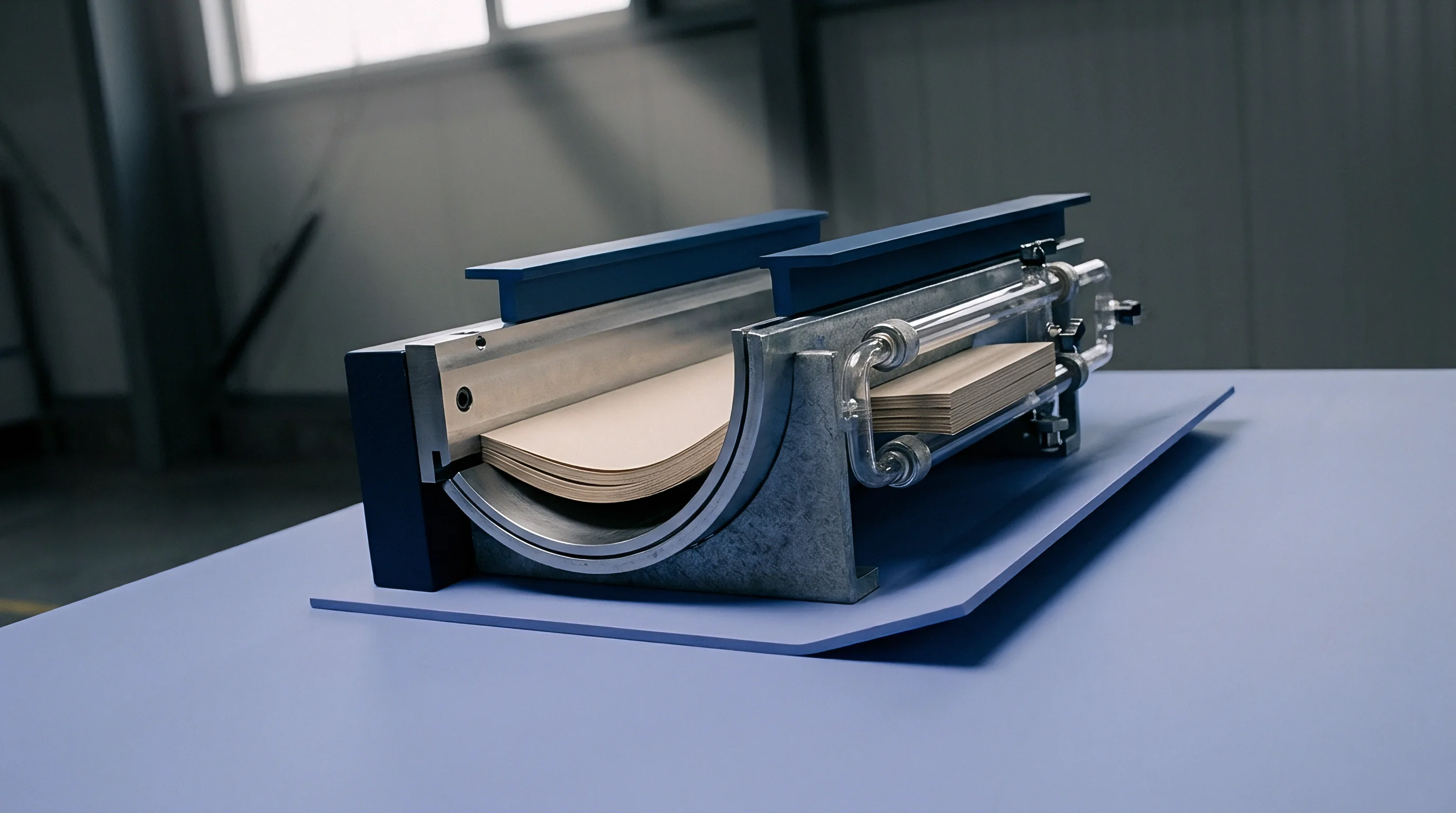
Mechanical decurling systems, positioned downstream of the chilling unit or between lamination and rotary sheeting, apply reverse plastic deformation to the board backing. By pulling the continuous web over adjustable small-radius breaker bars or counter-curved steel rollers, the equipment stretches the fibrous plies on the unlaminated side. This mechanical stretching introduces a permanent elongation into the paperboard, counteracting the tensile shrinkage of the polymer film.
When executed properly, mechanical decurling shifts the composite stress balance into flat equilibrium under ambient humidity.
Rotary decurling mandrels compensate for instantaneous thermal curl but leave latent hygroscopic imbalance untouched.
Moisture equilibrium demands time.

Decurler Geometry and Plastic Deformation Limits
Small-diameter breaker bars introduce localized reverse bending into the board before adhesive application. The diameter of these mandrels directly influences the through-thickness strain gradient. Mandrels measuring between twelve and twenty-five millimeters generate localized strains that exceed the elastic limit of the paperboard outer liners without rupturing surface fibers.
Exceeding plastic strain thresholds induces delamination within inner mechanical pulp plies, degrading overall carton stiffness under DIN 53121 bending resistance protocols.
Process adjustments follow a strict physical progression on industrial lamination lines:
- The operator matches web tension profiles across both unwinds, keeping film tension between twenty-five and thirty-five Newtons per meter to limit elastic pre-stretch.
- Nip temperature is lowered to the minimum activation threshold specified by the adhesive formulation, reducing total thermal contraction energy transferred into the polymer web.
- The decurler bar engages the unlaminated board face, adjusting penetration depth until sheet samples exhibit slight convex back-curl immediately upon rotary knife cutoff.
- Water-cooled chill rolls maintain surface contact at fifteen to eighteen degrees Celsius, preventing premature adhesive crystallization while cooling the composite evenly.
- Finished sheet pallets enter climate-controlled conditioning bays held at twenty-three degrees Celsius and fifty percent relative humidity for seventy-two hours prior to die-cutting.
Commercial Tolerance Specifications and Reject Thresholds
Purchasing contracts for high-speed cartoning operations define maximum allowable sheet lift on an inspection plate under ISO 187 conditioning. Quality standards typically mandate that sheet lift remain below four millimeters on finished blanks measuring four hundred by six hundred millimeters. Meeting these tolerances requires continuous coordination between substrate selection, film specification, and lamination settings.
Supply agreements governing laminated folding carton board incorporate explicit warranty provisions based on ISO 11093-9 dimensional stability criteria, establishing that deliverable lots exhibiting out-of-plane curvature exceeding five percent of total sheet width under specified atmospheric transitions remain subject to full commercial rejection and replacement at the finisher’s expense.