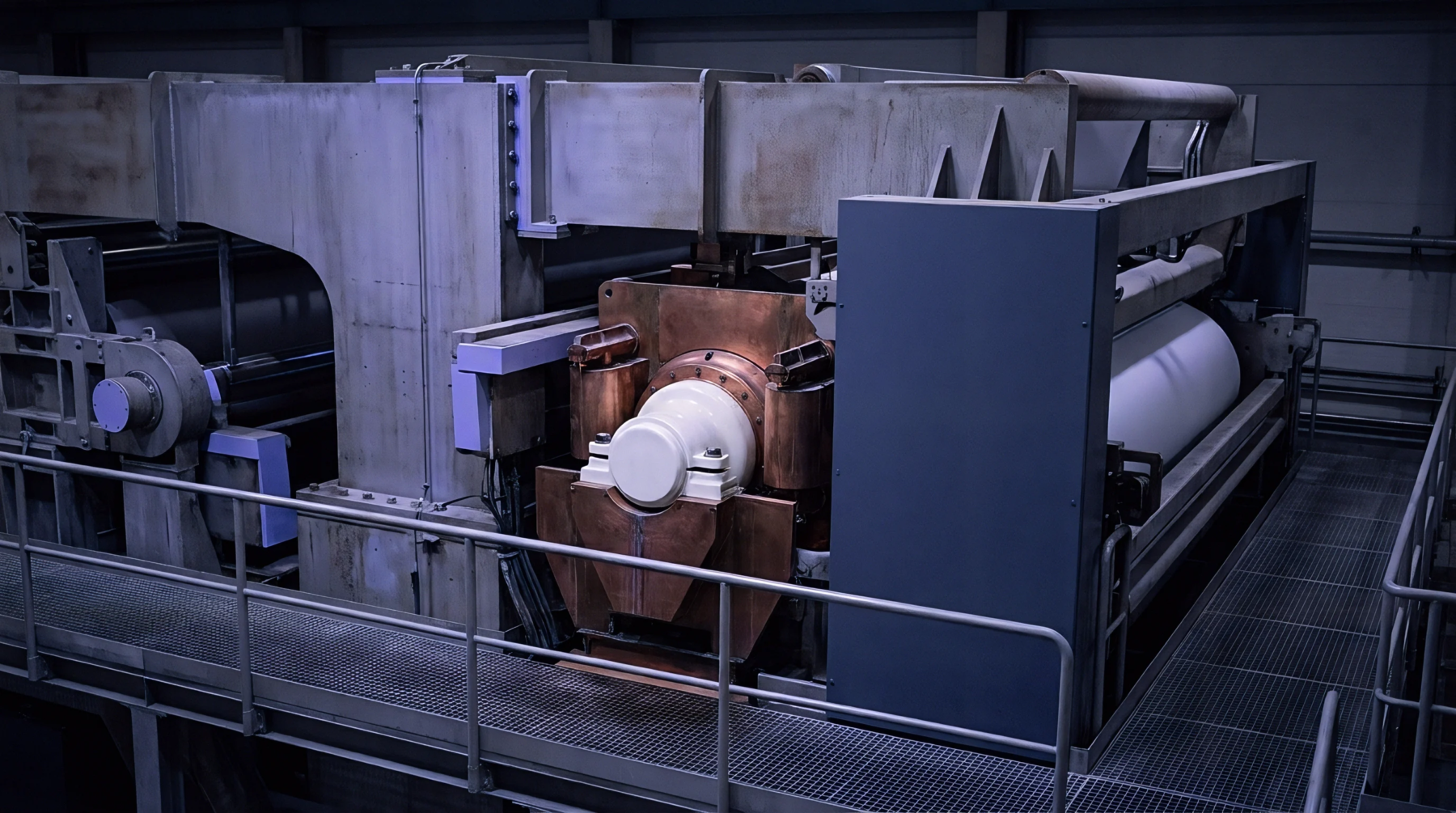
Calender Shell
Centrifugal casting creates an extremely hard, wear-resistant outer layer of white cast iron metallurgically bonded to a tough, grey iron core. Operating as a chilled iron roll within paper machine calender stacks and supercalenders, this cylinder provides the high surface hardness and thermal conductivity necessary to smooth paperboard surfaces under severe linear nip pressures. The chilled outer surface consists of cementite and pearlite, resisting abrasive wear from mineral coatings such as calcium carbonate and clay.
Shell thickness ranges from ten to thirty millimetres of chill depth, beyond which the iron transitions to a ductile grey structure capable of absorbing cyclic flexural stresses.
Thermal Geometry
Controlled induction heating, hot water circulation or peripheral oil drilling allows the cylinder to maintain an even surface temperature profile across wide paper webs. Localized friction and incoming sheet moisture variations generate thermal crowns that alter the nip pressure distribution along the roll face. Peripheral bore designs bring thermal transfer fluids directly beneath the hardened working shell, maximizing heat transfer rates and minimizing thermal lag.
Calender nip pressures exceeding three hundred kilonewtons per metre generate substantial mechanical deflection, demanding variable-crown internal hydraulic supports or precision ground camber. Uniform thermal expansion ensures that surface micro-roughness defects do not imprint thickness variations into coated board grades.
Finish Integrity
Mechanical reliability hinges on maintaining smooth surface topographies over extended operational campaigns between grindings. Roll covers must withstand high-speed web breaks without suffering edge marking, spalling or catastrophic thermal cracking. When doctor blades run against bare chilled iron, precise lubrication and oscillation prevent grooving and localized burn marks.
High surface hardness ratings between 68 and 74 Shore C prevent particle indentations from loose debris passing through the nip. Roll roundness tolerances are held within micrometre thresholds to prevent nip bounce, which otherwise prints recurring bar markings across coated solid bleached sulfate sheets.