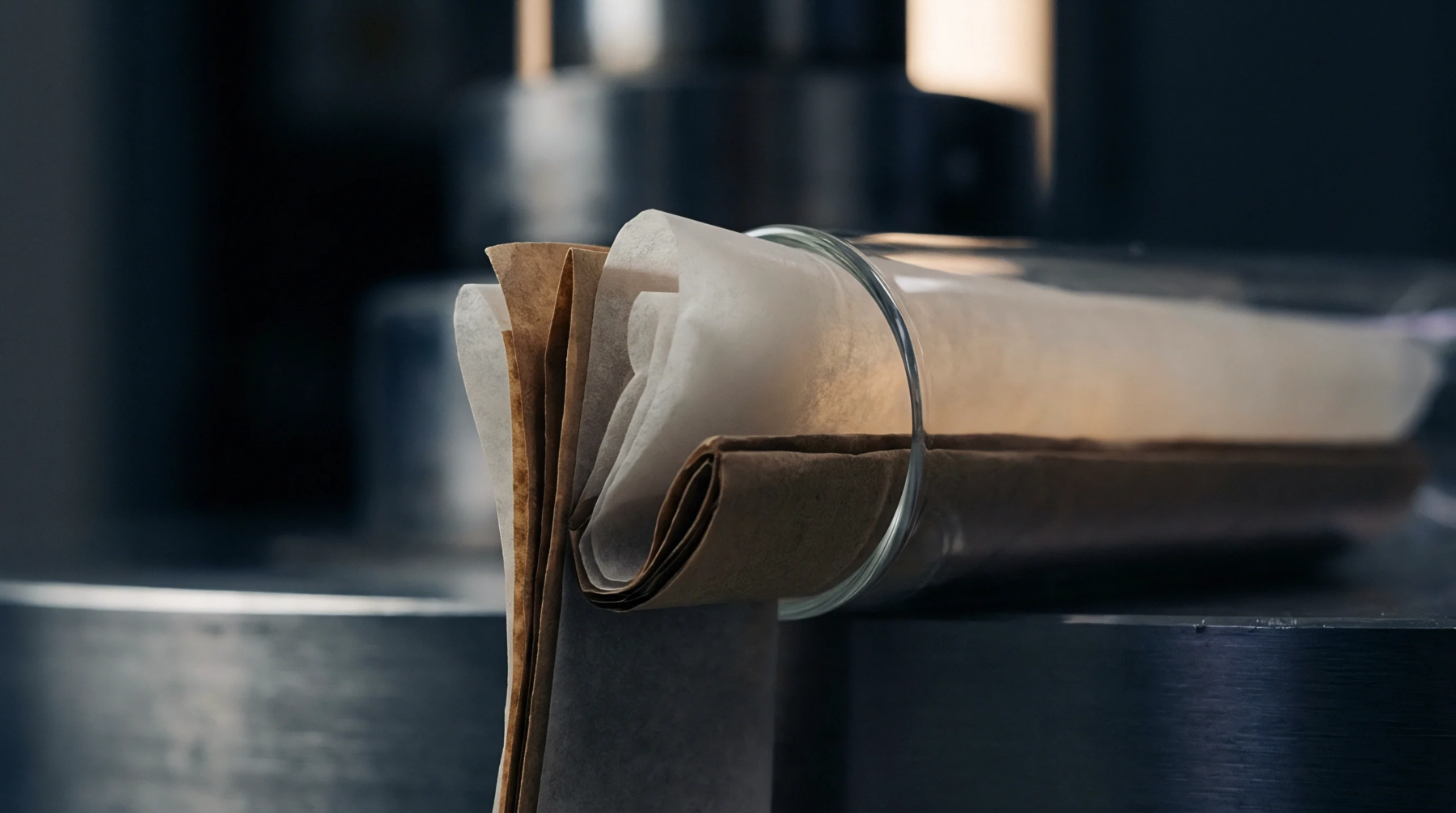
Indentation Resistance
Mechanical resistance of a cured polymeric film to permanent deformation, scratching and surface penetration governs the physical durability of exterior packaging coatings. Surface hardness establishes the structural integrity of overprint varnishes, functional barriers and radiation-cured inks applied to paper or cartonboard packaging. The property ceases to govern product survivability when underlying paper fibres undergo structural crushing under excessive mechanical loads, shifting failure from the film to the substrate core.
Viscoelastic Response
Crosslinked polymer networks distribute applied mechanical loads through a combination of elastic recovery and viscous dissipation. High crosslink density derived from multifunctional acrylate monomers raises hardness values, providing scratch defense during high-speed folding, automated carton erection and pallet transport. Over-curing leads to excessive brittleness, which induces micro-cracking when the coated board undergoes sharp ninety-degree scoring and creasing operations.
Standard testing methodologies evaluate resistance through pencil hardness testing, Koenig pendulum damping, and nano-indentation depth tracking. Variations in baseboard smoothness alter the local coating thickness, producing uneven film hardness profiles across recycled chipboard compared to smooth bleached kraft liners. Porous paper grades absorb varnish resins unevenly, leaving thin surface films that yield low indentation resistance under standard stylus pressures.
Industrial converters must balance curing lamp intensity against coating formulations to produce ductile surfaces that preserve decorative packaging graphics without flaking off during retail handling.
Cure Verification
Mechanical scratch evaluations confirm surface hardness as a shop-floor indicator that an overprint varnish has achieved the required crosslink density across the printed board.