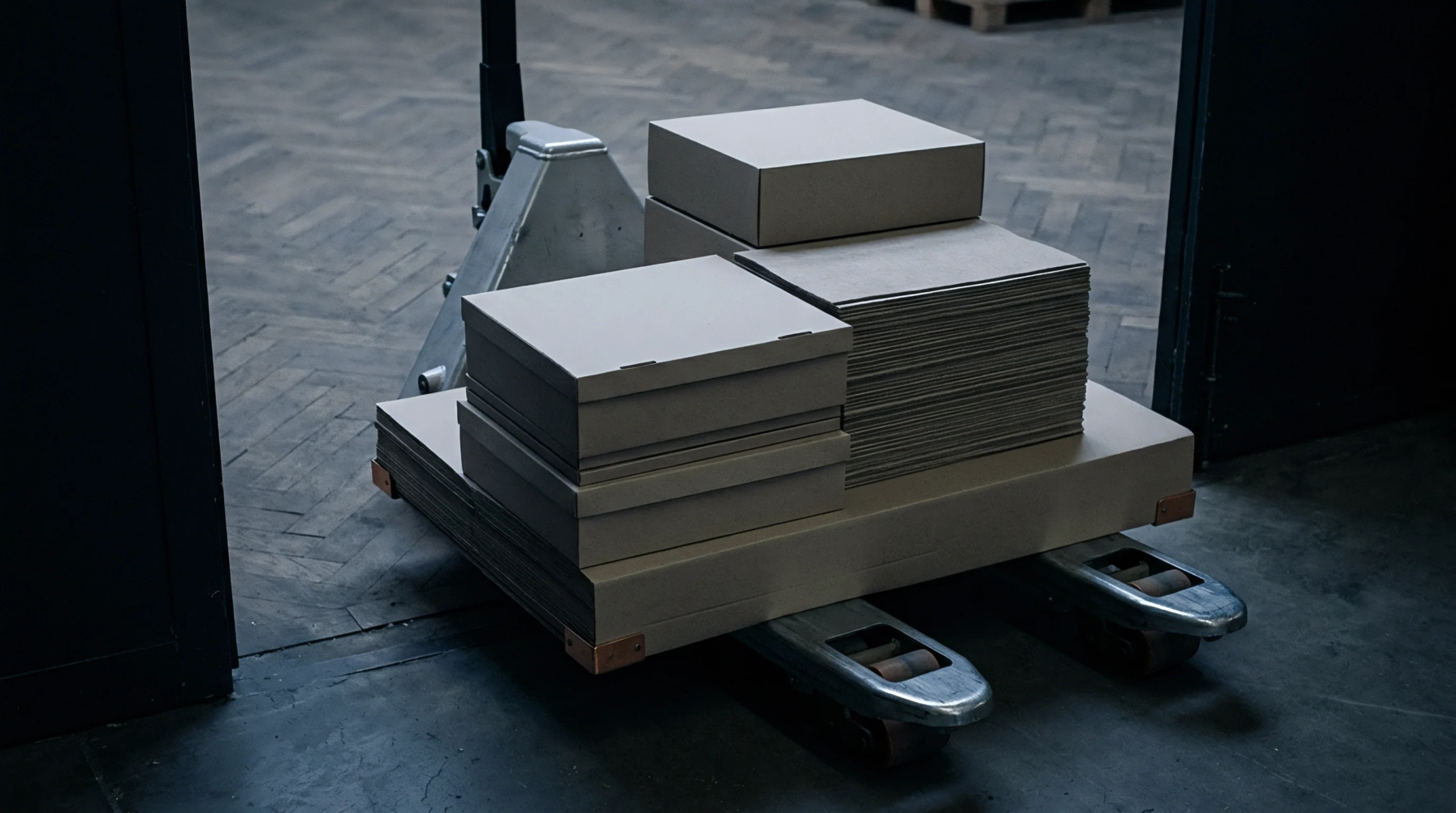
Moisture Baseline
The baseline water content held by recycled paperboard grades under standard atmospheric conditions acts as the primary determinant of converting dimensional stability during high speed printing and gluing operations. Testliner equilibrium moisture dictates how much water a web retains while interacting with ambient humidity on the factory floor, a property set during press section dewatering and dryer section temperature profiling at the paper mill. Converting plants demand a strict tolerance window, usually between six and eight percent by weight, because deviations outside this narrow band cause either web curling during lithographic offset runs or joint failure on high speed folding carton gluing lines.
Mill laboratories verify this percentage by weighing conditioned samples before and after oven drying under standard international testing protocols.
Environmental Conditioning
Atmospheric relative humidity directly drives moisture migration into unbleached and recycled fluting layers, causing the board to expand across the grain direction while remaining largely stable along the machine direction. Air conditioned storage spaces maintain a relative humidity of fifty percent alongside a temperature of twenty three degrees Celsius, which stops excessive moisture absorption prior to corrugated lamination. Excessively dry paper stock loses internal hydrogen bonding flexibility, resulting in brittle scoring cracks along crease lines during die cutting, whereas damp paper loses stiffness and triggers compressive failure during box stacking tests.
Production schedulers monitor these ambient fluctuations because a sudden humidity spike inside the converting warehouse alters the moisture gradient across the caliper of the sheet within hours.
Functional Threshold
Thermal drying stages inside corrugating machinery remove excess water rapidly, but insufficient dwell time leaves internal vapor pressure trapped inside the medium, leading to delamination under flat crush loads. Substrate engineers measure water activity alongside absolute weight percentage to predict how the board will react when sealed inside wax or polymeric coatings that restrict vapor transmission. Print supervisors adjust fountain solution dampening levels on printing presses according to incoming moisture readings to prevent dot gain distortion caused by localized fiber swelling.
High performance packaging specifications require strict control over internal moisture gradients because unequal drying across the top and bottom liners induces permanent warp across large corrugated sheets before palletizing.