Constitutive Rheological Modeling of Transient Moisture Transport Driven Micro Buckling in Recycled Fluting
Viscoelastic transport modeling predicts humidity-driven micro buckling in recycled fluting to protect containerboard compression strength.

Transport
Water vapor moves through recycled containerboard via porous networks and swelling lumens. Compared with virgin semichemical hardwood pulps, secondary fibers in recycled fluting carry higher concentrations of hornified cell walls, micro-fibrillar fragments, and residual fines. These microstructural differences alter physical diffusion.
Moisture moves through both vapor transfer across intra-flute air voids and bound-water diffusion within the disordered cellulose matrix. When relative humidity spikes inside a shipping container, outer plies reach equilibrium well before the core, setting up a sharp moisture gradient across the board’s caliper.
Cellulose fibrils swell transversely as water enters the amorphous regions between microfibrils. In recycled sheets, fiber alignment is often less uniform ~ a side effect of machine speed changes and headbox dilution used to pull acceptable burst strength from lower-grade furnish. Moisture gradients generate localized expansion differences, which drive severe shear forces between adjacent fiber plies.
The board expands unevenly, creating internal instability before any stacking loads hit the box.

Diffusion Kinetics in Short-Fiber Recycled Pulp
Standard Fickian models assume uniform media and a constant mass transfer coefficient. Recycled fluting breaks that assumption: repeated repulping introduces density shifts, convoluted pore paths, and chemical variations. Because secondary fibers absorb water quickly, non-Fickian transport dominates early adsorption.
Bound-water diffusion depends heavily on local moisture levels, accelerating once moisture content exceeds eight percent by weight.
Capillary condensation inside the pores further shifts local transport rates. When relative humidity steps from 50 percent to 85 percent, the diffusion coefficient climbs nonlinearly. Microstructural shifts push moisture through the caliper in uneven waves rather than a uniform front.
How water distributes across these plies determines where and how sharply elastic moduli drop.
Sorption Hysteresis and Gradient Creep Mechanics
Equilibrium moisture content depends on whether the material is gaining or losing moisture. A recycled fluting sample brought up to 80 percent relative humidity holds less bound water than one drying down to 80 percent from saturation. This thermodynamic path-dependence complicates stress calculations under shifting conditions, such as day-to-night temperature changes during ocean transport.
At 85 percent relative humidity and 23 degrees Celsius, cross-direction moisture expansion coefficients for 100 percent recycled fluting exceed 0.18 percent per percentage moisture content increment.
Gradient creep occurs when adjacent plies try to expand at different rates while locked together by inter-fiber hydrogen bonds. High-moisture outer fibers quickly relax stress through viscoelastic dissipation, while dry inner fibers stay stiff and take on a disproportionate share of the tension and compression. This temporary stress imbalance destabilizes the geometry of the fluting arch.
Static equilibrium tests cannot predict how paper behaves under transient transport conditions. As containerboard experiences sudden relative humidity shifts, peak internal stresses occur midway through moisture sorption rather than at final climate equilibrium. Assessing fluting performance requires measuring these temporary strain peaks directly.
- Bound-Water Diffusion Differential Transverse moisture movement across short recycled fibers occurs up to four times faster than axial transport along intact virgin tracheids.
- Hygro-Expansivity Anisotropy Cross-direction expansion rates exceed machine-direction rates by a ratio of three to one due to fiber alignment patterns.
- Pore Tortuosity Shift Repulping collapses primary wall structures, decreasing average pore diameter while increasing local liquid transport resistance.
- Sorptive Energy Dissipation Heat released during initial water molecule binding creates localized micro-thermal gradients that accelerate viscoelastic relaxation rates.
Elevated web tension during corrugation can offset raw material swelling differentials, though underlying moisture-driven strains persist.
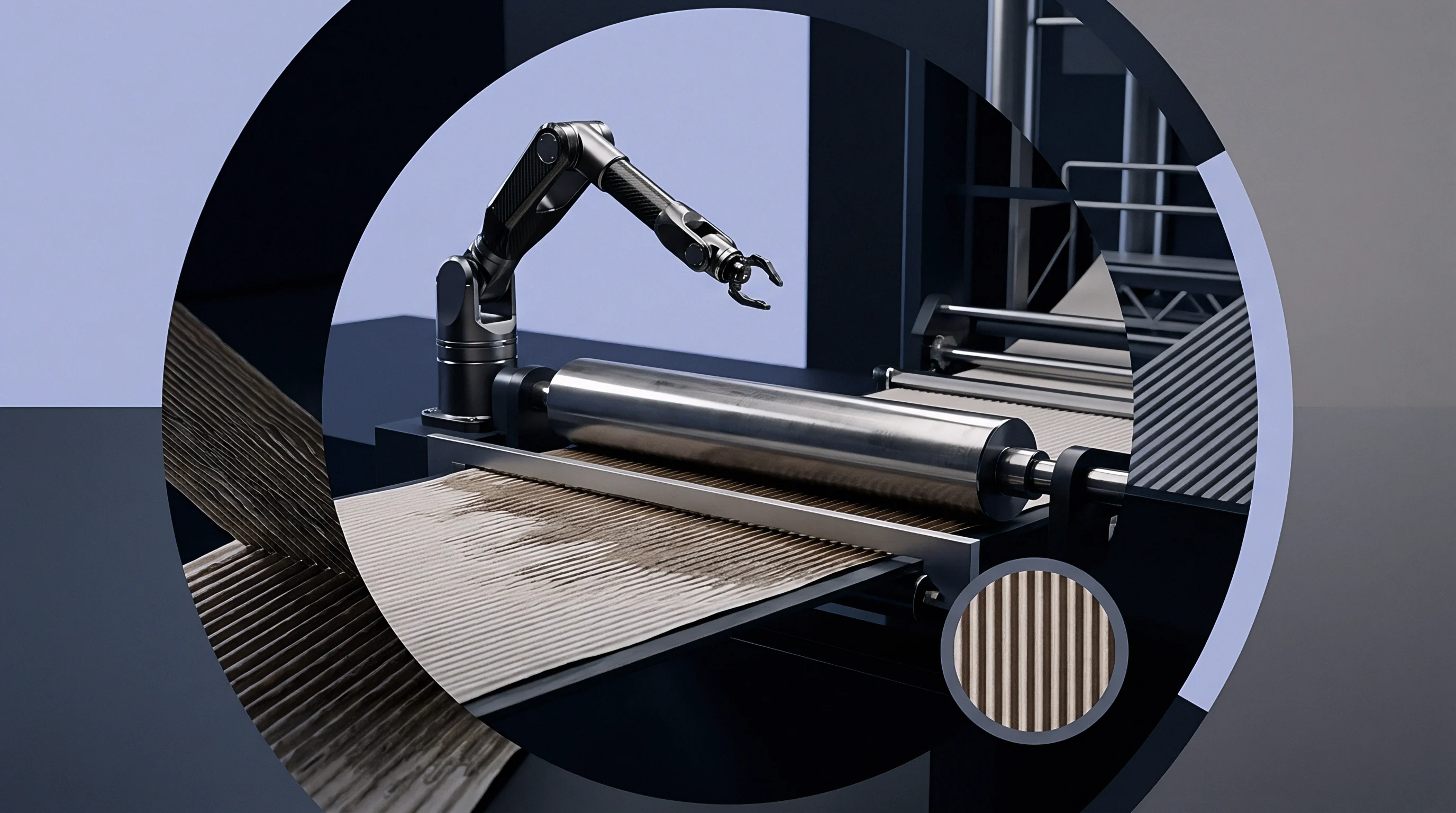

Viscoelasticity
Stress fields in paper sheets depend on time, temperature, and local moisture levels. Cellulose, hemicellulose, and residual lignin form a polymer matrix that combines classical viscoelastic behavior with strong mechanosorptive effects. In 100 percent recycled fluting, repeated drying cycles on previous machine runs shorten the hemicellulose chains, lowering the activation energy needed to break and reform hydrogen bonds under load.
Viscoelastic strain divides into instantaneous elastic deformation, delayed reversible creep, and permanent plastic slip. As moisture rises, water molecules act as plasticizers, dropping the glass transition temperature of hemicellulose below ambient shipping conditions. Because of this, the relaxation modulus of recycled fluting drops sharply once humidity moves past 70 percent relative humidity.

Orthotropic Hygro-Mechanical Constitutive Relations
Containerboard acts as an orthotropic material along three principal axes: machine direction, cross direction, and out-of-plane thickness. Its compliance tensor expands dynamically with instantaneous moisture content, cutting in-plane stiffness parameters by 30 percent to 50 percent as moisture climbs from 6 percent to 14 percent.
| Furnish Grade | Conditioning RH (%) | MD Modulus (GPa) | CD Modulus (GPa) | Mechanosorptive Coeff (MPa^-1) |
|---|---|---|---|---|
| 100% Recycled Fluting (120 gsm) | 50 | 6.2 | 2.8 | 0.0042 |
| 100% Recycled Fluting (120 gsm) | 85 | 3.1 | 1.1 | 0.0118 |
| Semichemical Virgin Medium (120 gsm) | 50 | 8.5 | 4.1 | 0.0019 |
| Semichemical Virgin Medium (120 gsm) | 85 | 5.4 | 2.4 | 0.0045 |
Linear elastic constitutive models fail completely when applied to recycled fluting under moisture transients. Transient diffusion coefficients increase nonlinearly with local stress, creating strong two-way coupling between the moisture transport equations and structural momentum balances. Tensile stress along the fiber axis speeds up water absorption, while compressive stress in the cross direction suppresses moisture uptake in dense networks.
Mechanosorptive Relaxation across Humidity Transients
Deformation accelerates when paper experiences load while moisture content is changing. This mechanosorptive effect produces strain far beyond the combined totals of isolated mechanical creep and free moisture expansion. Under load, inter-fiber hydrogen bonds temporarily break, allowing microfibrils to slip before forming new bonds at adjacent sites.
Recycled fibers carry micro-cracks from past processing that concentrate mechanosorptive strain at fiber junctions. Under fluctuating humidity ~ like damp nights followed by warm, dry days ~ mechanosorptive creep accumulates continuously. The fluting loses its ability to recover, leading to progressive arch flattening under static top-compression stacking loads.
Mechanosorptive strain rates increase exponentially when ambient relative humidity fluctuates across the 70 percent threshold during transport.
Accurate modeling requires defining a stress-dependent mechanosorptive strain tensor tied to the rate of moisture change. Including this term accounts for the severe stiffness loss that occurs during dynamic transport ~ a drop that standard static humidity tests miss entirely.
Fluting mediums with high fines content deform permanently under cyclic ambient exposure regardless of initial dry compression strength.
Instability
Edgewise loading concentrates stress along the crimp lines of corrugated arches. Fluting functions as a series of curved structural elements designed to transfer shear between linerboards while resisting out-of-plane crushing. When moisture gradients create opposing dimensional expansion between the top and bottom surfaces of the fluting profile, out-of-plane displacement causes buckling.
Micro-buckling starts inside the fiber wall before showing up as visible distortion. Repeated repulping and calendering flatten recycled fibers, reducing their cross-sectional moment of inertia compared to tubular virgin fibers. Under compressive loads and moisture softening, these flattened fiber walls collapse inward according to local Euler buckling criteria.
Flute Arch Geometry and Out-of-Plane Buckling Modes
Arch geometry governs structural stability in corrugated board. B-flute and C-flute profiles have different radiuses and crimp angles, altering how sensitive they are to moisture-driven bending moments. As water penetrates the peak of the flute arch, localized cross-direction swelling tries to lengthen the arch while the adhesive holds the flute tips fixed against the linerboard.
| Moisture Step (RH %) | Peak Shear Stress (MPa) | Critical Arch Displacement (mm) | Failure Mode Location |
|---|---|---|---|
| 50 to 75 | 1.15 | 0.04 | Flute Tip Adhesive Line |
| 50 to 85 | 2.45 | 0.12 | Flute Tangent Flank |
| 50 to 95 | 4.10 | 0.31 | Crimp Line Fiber Wall Flattening |
This restraint transforms in-plane expansion forces into severe bending moments along the flute flanks. The curved profile snaps through or bifurcates when internal bending exceeds the reduced flexural rigidity of the wet board. While semichemical virgin fibers resist swelling, recycled fluting ~ with its lower flexural stiffness ~ buckles at much lower moisture differentials.

Liner Delamination and Local Micro Buckling Thresholds
In-plane expansion places heavy shear stress on adhesive bond lines. Starch adhesives absorb moisture from adjacent paper plies, softening the interface. When shear stress from differential expansion exceeds the wet shear strength of the starch, micro-delamination opens at the flute tips.
Losing boundary constraint at the flute tip drastically lowers the critical buckling load of the adjacent arch. The unsupported length doubles, reducing compressive crush resistance by 75 percent under classical beam stability equations. Once micro-buckling takes hold at a single tip, concentrated strain spreads quickly across adjacent flutes, leading to full panel collapse in the cross direction.
Ignoring transient differential swelling in structural containerboard designs yields unexpected pallet collapse during multi-climate oceanic transit.

Grain
Paper machines align cellulose fibers primarily along the direction of web travel. This orientation produces marked differences in physical, mechanical, and transport properties between the machine direction and the cross direction. In recycled containerboard, high headbox shear and secondary refining frequently disrupt alignment consistency and long-term sheet stability.
Anisotropy drives moisture-induced dimensional changes. Absorbing water expands cellulose fibers in diameter while changing their axial length very little. As a result, cross-direction expansion in recycled fluting is five to eight times greater than machine-direction expansion.
Aligning flutes perpendicular to the vertical axis of a box places this principal expansion direction straight along the primary stacking load path.
Anisotropic Fiber Alignment and Machine-Direction Swelling Ratios
Fiber orientation distribution functions describe alignment relative to the machine axis. Recycled paper mills often adjust the jet-to-wire speed ratio to boost cross-direction Ring Crush Test values. But pulling more fibers into cross-direction alignment also increases cross-direction hygro-expansivity, forcing a direct trade-off between dry strength and wet dimensional stability.
As ambient humidity fluctuates during transit, uneven water absorption through the sheet thickness creates internal shear strain between misaligned fiber layers. This inter-ply shear warps and twists the paper web, accelerating micro-buckling across the flute crests.
What Mechanisms Drive Transient Moisture Buckling in Containerboard?
Unequal swelling between machine and cross directions creates internal bending moments within the plies. As water vapor enters from the surface, upper layers expand laterally while drier inner layers hold their original dimensions. This differential curvature produces compression in the wet zone and tension in the dry zone.
- Establish baseline conditioning of recycled fluting samples at 50 percent relative humidity and 23 degrees Celsius in accordance with ISO 187 standard parameters.
- Mount samples in a high-precision biaxial load frame equipped with environmental chamber humidity step controls.
- Apply a constant static compressive edge-wise load set to 40 percent of short-span compressive strength.
- Rapidly step ambient chamber humidity from 50 percent to 85 percent within a 120-second timeframe to initiate dynamic transient diffusion.
- Record real-time laser profilometry surface mapping across flute crests to measure localized out-of-plane displacement profiles continuously.
- Calculate instantaneous strain tensor components by coupling moisture diffusion field data with structural finite element field displacement outputs.
Under ISO 187 conditioning standards, paper strength testing reflects uniform equilibrium moisture states, completely bypassing the damaging transient stress peaks that occur during environmental transitions.
Testing validates constitutive stress predictions. Laboratory evaluations that ignore fiber alignment dynamics miss the localized stress concentrations that cause boxes to fail prematurely in humid supply chains.
The precise threshold where localized micro-buckling transitions into cataclysmic panel collapse remains unquantified for multi-recycled paper fibers.

Formulation
Total strain rate breaks down into elastic, viscoelastic, thermal, and moisture-induced components. Building a full constitutive model requires combining nonlinear Fickian diffusion equations with 3D orthotropic viscoelastic stress-strain relations that include mechanosorptive coupling. The model defines total incremental strain as the sum of elastic strain, linear viscoelastic creep, hygro-expansion, and mechanosorptive strain.
Elastic stiffness parameters drop exponentially with instantaneous moisture content. The linear viscoelastic creep strain rate follows a Generalized Maxwell model with parallel Maxwell elements, where relaxation times shorten as moisture plasticizes the amorphous hemicellulose matrix.

Mathematical Derivation of the Hygro-Viscoelastic Strain Tensor
The mechanosorptive strain rate tensor scales with absolute stress and the rate of moisture change. Mechanosorptive strain accumulates irreversibly whether moisture rises or falls, reflecting the continuous breaking and reforming of hydrogen bonds under mechanical load.
| Parameter Description | Symbol | Calibrated Value | Units |
|---|---|---|---|
| Initial MD Elastic Modulus | E_MD0 | 6.85 | GPa |
| Initial CD Elastic Modulus | E_CD0 | 2.95 | GPa |
| Moisture Softening Coefficient | alpha_m | 0.082 | % MC^-1 |
| CD Hygro-Expansion Coefficient | beta_CD | 0.0019 | % MC^-1 |
| Mechanosorptive Coupling Constant | mu_MS | 0.0084 | MPa^-1 % MC^-1 |
Implementing these nonlinear material equations in finite element subroutines allows coupled heat, moisture, and stress fields to be solved simultaneously across complex 3D corrugated geometries under dynamic climate loads.
Numerical Implementation in Structural Finite Element Solvers
Solvers evaluate spatial moisture distributions before solving for mechanical equilibrium. The material continuum is discretized into eight-node solid brick elements with coupled displacement and pore pressure degrees of freedom. At each step, the transport solver updates local moisture values across every integration point.
Updated moisture values adjust local compliance matrices and calculate free swelling strains. The mechanical solver then evaluates stress states ~ including mechanosorptive strain increments ~ and checks against local stability limits. If local compressive stress exceeds the Euler buckling threshold, element stiffness is degraded to reflect microstructural cell wall collapse.
FEFCO test method 50 specifications define corrugated board compression testing under static room climates, failing to evaluate transient hygro-mechanical degradation.
Standard procurement specifications following DIN 53121 require suppliers to guarantee minimum cross-direction stiffness retention after three standard climate changes.
- Constitutive Material Mapping Input orthotropic stiffness tensors calibrated across moisture increments ranging from 5 percent to 18 percent total moisture content.
- Transient Climate Boundary Boundary Conditions Apply cyclic humidity step functions simulating real-world transport routes from tropical manufacturing hubs to temperate consumer markets.
- Adhesive Shear Boundary Definition Include cohesive zone elements along flute tips to simulate starch layer softening and adhesive delamination kinetics.
- Nonlinear Geometry Tracking Enable large displacement formulations to capture localized snap-through buckling modes across corrugated flanks accurately.
Risk
Financial losses from damaged freight land heavily on packaging buyers who accept uncalibrated fiber specifications. When recycled boxes collapse under stacking loads in humid environments, liability disputes center on whether failure was caused by improper palletizing or bad paper. Without constitutive rheological data showing transient moisture sensitivity, brand owners absorb the costs of ruined inventory, logistics re-routing, and retailer penalties.
Fiber substitution at the mill directly affects supply chain reliability. Mills frequently increase recycled fiber ratios or adjust starch spraying without informing converters. While dry strength may match purchase order specs, performance under dynamic moisture drops sharply.
Packaging engineers need to verify compliance through environmental chamber stress testing rather than relying on dry mill certificates.

Commercial Liability and Packaging Qualification Protocols
Chain-of-custody documentation proves environmental origin but offers no guarantee of structural integrity under climate stress. FSC Recycled certified linerboard and PEFC certified recycled fluting meet sustainability mandates, yet remain just as vulnerable to transient moisture buckling as uncertified secondary fibers. Technical qualifications need to separate raw material sourcing claims from structural performance.
Procurement contracts specifying only basis weight and dry Ring Crush Test values leave buyers exposed to moisture-driven field failures. Adding transient humidity retention clauses to supply agreements forces paper mills to maintain tight fiber furnish standards and refining consistency.
Regulatory Compliance and PPWR Recyclability Thresholds
European packaging standards demand proof of both material recyclability and structural performance under actual transport conditions. The Packaging and Packaging Waste Regulation sets strict recyclability grades based on yield and repulping efficiency. Relying on heavy wet-strength resin additives to offset moisture buckling can disqualify recycled fluting from top recyclability tiers, triggering higher modulated eco-fees.
Balancing structural durability against recyclability targets requires precise constitutive rheological modeling. Optimizing flute profiles and local fiber alignment ~ rather than relying on non-recyclable coatings ~ lets packaging manufacturers meet both stacking strength requirements and European sustainability targets.
Mill test certificates undergo strict reconciliation with environmental performance data prior to finalizing high-volume supply contracts.