Quantification of Dissolved Acrylic Micro-Stickies in Closed Water Loop Papermaking Circuits
Quantifying dissolved acrylic micro-stickies in closed water loops requires 0.45-micron phase separation followed by solvent extraction and total organic carbon verification.

Slurry
Paper recycling mills operating closed water loops face intense accumulation of synthetic polymers released from pressure-sensitive adhesives and coating binders. High temperature accelerates binder detachment. When mills reduce fresh water consumption below five cubic meters per tonne of produced paper, dissolved and colloidal substances build up exponentially within white water circuits.
Pressure-sensitive adhesive fragments, predominantly polyacrylates, styrene-butadiene rubber, and vinyl acetate copolymers, break down under mechanical shear in pulpers. Larger adhesive chunks form macro-stickies that screens remove efficiently. Smaller particles pass through fine screen slots under one hundred microns, entering process water circuits as micro-stickies or dissolved polymers.
Uncontrolled buildup halts machine wires.

Colloidal Acrylic Mechanics
Pressure-sensitive adhesive materials detach from recycled recovered paper fibers during pulping operations conducted between 45 and 65 degrees Celsius. Chemical dispersants, alkaline pH reagents, and mechanical agitation fragment these tacky polymers into microscopic entities. Polyacrylate latex suspensions rely on anionic charge repulsion and steric hindrance to remain suspended in water.
In closed circuits, elevated concentrations of calcium ions, aluminum species, and cationic wet-end additives compress the electrical double layer surrounding acrylic particles. This charge neutralization causes colloidal polymers to aggregate into soft, tacky micro-stickies ranging from 0.1 to 100 microns in diameter. Fractions under 0.45 microns behave as true dissolved polymers, remaining undetected by traditional gravimetric screening procedures.
Temperature shifts shift polymer solubility thresholds.
Dissolved acrylic species comprise uncrosslinked polyacrylic acid, polyacrylamide copolymers, and low molecular weight alkyl acrylate esters. These molecules maintain high thermodynamic solubility in warm, alkaline process water. As process water cools during stock delivery or web dewatering, these dissolved chains undergo phase separation, precipitating as colloidal sticky droplets.
Clean filtrate yields predictable paper strength. Traditional water quality monitoring relying solely on total suspended solids fails to account for this latent tacky potential, exposing converting operations to sudden deposition outbreaks.
Fiber Circuit Phase Boundaries
Contaminants within zero liquid discharge water systems divide into coarse macro particles, colloidal suspensions, and true molecular solutions based on hydrodynamic diameter. Macro-stickies remain on a 0.10 millimeter slotted screen plate, whereas micro-stickies pass through screen openings but deposit onto hydrophobic surfaces under dynamic shear. Dissolved acrylic polymers exist entirely below the filtration threshold of conventional laboratory filter papers, requiring membrane ultrafiltration or chemical precipitation for physical isolation.
Micro-stickies pass through coarse pressure screens.
Accumulation of these dissolved and colloidal acrylic species creates distinct operational bottlenecks across the papermaking line:
- Wire blinding reduces vacuum dewatering efficiency across the forming section, increasing sheet moisture entering the press section.
- Press felt clogging causes uneven moisture distribution across the paper web, forcing operators to increase dryer section steam pressure.
- Dryer cylinder pick-up induces frequent web breaks and increases downtime costs during high-speed paper machine runs.
- Packaging spot defects compromise barrier coating adhesion and printed image quality on finished corrugated boards.
Understanding phase boundaries enables paper mill chemical engineers to target specific contamination fractions. Polymer molecules transitioning between dissolved and colloidal phases represent the primary source of unpredictable pitch deposits on machine clothing. Chemical suppliers frequently attribute persistent wire deposits to uncharacterized pulp batch variation rather than admitting the thermal saturation limit of their dispersant chemistry.
Centrifugation
Separating colloidal polymer particles from aqueous wood pulp suspensions demands rigorous mechanical isolation parameters. Centrifugal force drives particle separation. Standard filtration methods fail because flexible acrylic micro-stickies deform under vacuum pressure, squeezing through porous membranes and skewing analytical results.
High-speed centrifugation establishes a reliable density gradient that separates low-density adhesive polymers from dense wood fibers, inorganic filler clays, and mineral pigments.
Phase Separation Dynamics
Standard gravimetric filtration using coarse paper filters fails to isolate dissolved acrylic polymers because sub-micron particles pass directly through filter media pores. Centrifugation leverages density differences between water, wood cellulose, calcium carbonate, and synthetic polyacrylates. Polyacrylate polymers possess a particle density ranging between 1.02 and 1.08 grams per cubic centimeter, rendering them slightly denser than water but significantly lighter than cellulose fibers or mineral coatings.
Applying ultracentrifugation at gravitational fields exceeding 20,000 times gravity isolates suspended colloidal particles from true dissolved polymer chains.
- Collect a representative two-liter process water sample from the primary fan pump discharge using a pre-cleaned stainless steel sampling vessel.
- Filter the raw sample through a 100-micron wire mesh screen to remove suspended cellulose fibers and macro-stickie fragments.
- Spin the fiber-free filtrate in an ultracentrifuge at 20,000 revolutions per minute for 45 minutes at 55 degrees Celsius.
- Decant the clear supernatant carefully to avoid re-suspending the dense sediment pellet resting at the centrifuge tube bottom.
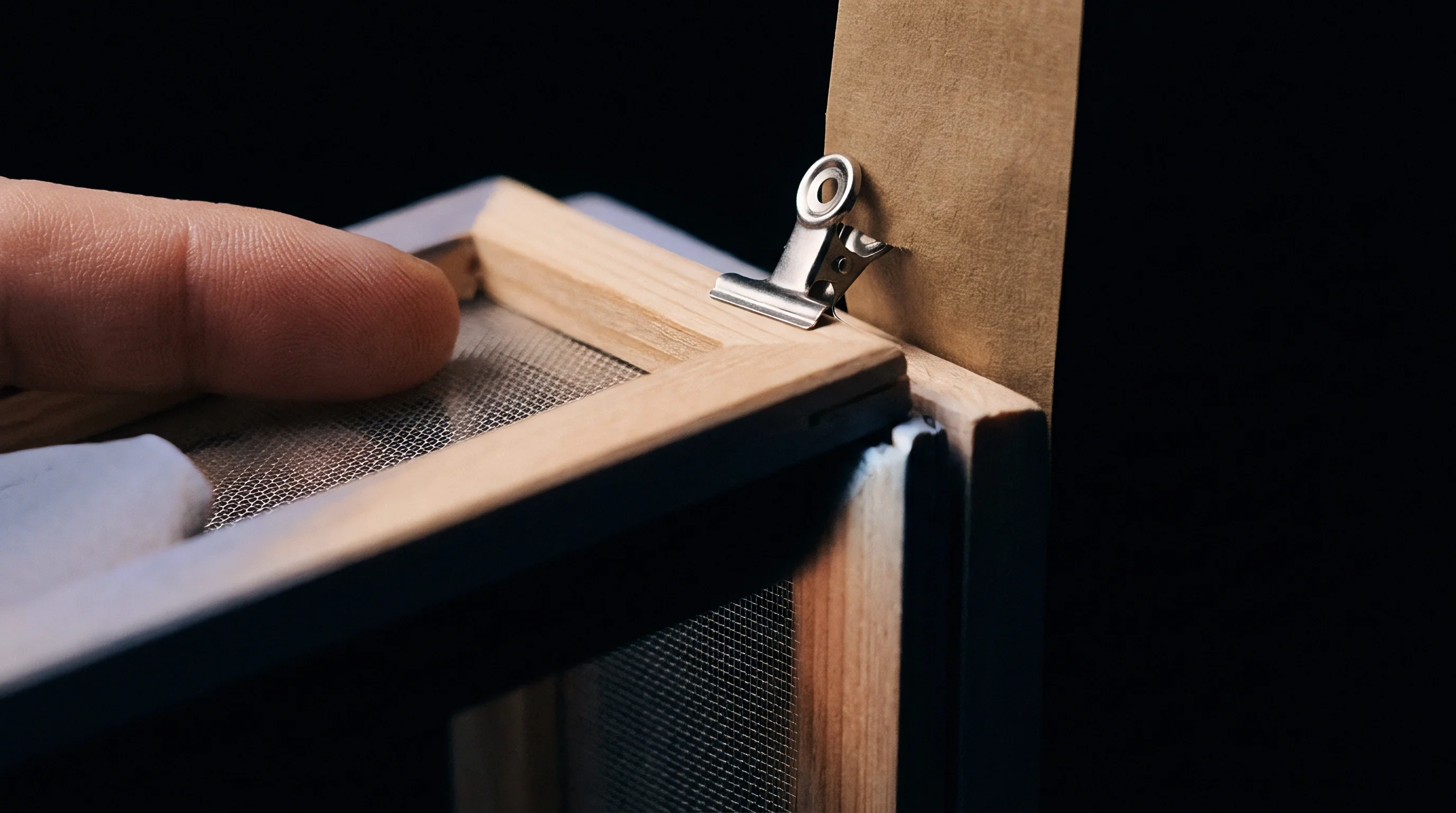
- Pass the decanted supernatant through a 0.45-micron polyethersulfone membrane disk under vacuum pressure to isolate dissolved species.
Mass Balance Worked Example
Assume a packaging paper mill processes 40 tonnes per hour of recycled corrugated container stock while circulating 50 cubic meters of process water per hour in a semi-closed loop. Laboratory testing measures total organic carbon in the raw process water at 850 milligrams of carbon per liter. After passing through a 100-micron screen, the filtrate maintains a carbon concentration of 820 milligrams per liter.
Subsequent ultracentrifugation at 22,000 times gravity for 50 minutes removes suspended colloidal micro-stickies, reducing the supernatant total organic carbon concentration to 410 milligrams per liter. Passing this supernatant through a 0.45-micron polyethersulfone filter yields a final dissolved organic carbon concentration of 280 milligrams per liter.
The mass flow calculations establish the distribution across contaminant phases. Total organic carbon in the process loop equals 42.5 kilograms of carbon per hour. The colloidal micro-stickie fraction, isolated between centrifugation and 0.45-micron membrane filtration, accounts for 6.5 kilograms of carbon per hour.
True dissolved acrylic and organic species account for 14.0 kilograms of carbon per hour. The remaining 22.0 kilograms per hour consists of coarse suspended organic debris removed during initial 100-micron screening. Process water conductivity alters particle charge.
Tracking these exact mass ratios allows mill chemists to determine whether chemical fixation or mechanical clarification provides the most cost-effective yield protection. Clear filtrate after ultracentrifugation indicates effective colloidal trapping before polymer deposits build up on machine wire rolls.
Spectroscopy
Identifying the precise molecular composition of dissolved adhesives requires analytical instruments capable of distinguishing polyacrylates from natural wood resin acids. Advanced spectroscopic and chromatographic tools isolate ester carbonyl stretch vibrations, monomer degradation products, and mass-to-charge fragments specific to synthetic packaging adhesives. Calibration standards establish baseline measurement accuracy.
What Limits Infrared Resolution in Process Water?
Interference from lignin fragments, hemicelluloses, and starch molecules masks characteristic ester carbonyl absorption bands occurring near 1730 inverse centimeters. Raw water samples cannot be analyzed directly by Fourier-Transform Infrared Spectroscopy due to broad water absorption bands masking key chemical signals. Analytical technicians extract dried residues using organic solvents such as dichloromethane or methyl tert-butyl ether to isolate synthetic polymers from water-soluble wood carbohydrates.
Solvent extraction removes hydrophilic interfereing agents, leaving polyacrylates, polyvinyl acetate, and rosin esters in the solvent phase.
Attenuated Total Reflectance spectroscopy performed on evaporated solvent extracts displays distinct absorption peaks. Polybutyl acrylate exhibits strong carbonyl stretching at 1735 inverse centimeters, along with C-O ester stretching multiplets between 1160 and 1250 inverse centimeters. Styrene-acrylic copolymers display additional sharp aromatic ring breathing modes at 700 and 760 inverse centimeters.
Quantification relies on comparing peak area ratios against standardized calibration curves constructed with known concentration ratios of poly(ethyl acrylate-co-methyl methacrylate).
Total organic carbon testing on process water filtered through 0.45-micron membranes yields 340 milligrams of carbon per liter at 55 degrees Celsius.
Pyrolysis Mass Spectrometry Isolation
Thermal degradation of dried aqueous extracts under an inert helium atmosphere yields distinct acrylate monomer fragments that reveal original polymer formulations. Pyrolysis Gas Chromatography-Mass Spectrometry breaks complex crosslinked acrylic matrices down into volatile monomer building blocks at 590 degrees Celsius. Pyrolysis breaks polyacrylates into monomer fragments.
Pyrograms generated from acrylic micro-stickies feature dominant peaks for butyl acrylate, 2-ethylhexyl acrylate, methyl methacrylate, and styrene.
Integrating specific mass spectrometer ion chromatograms allows mill laboratories to quantify acrylic micro-stickies down to part-per-million levels. Target quantitative ions include mass-to-charge ratio 55 for acrylic acid fragments, mass-to-charge ratio 73 for butyl ester fragments, and mass-to-charge ratio 104 for monomeric styrene. Extraction solvents strip volatile organic residues.
This technique differentiates synthetic adhesive polymers from natural wood extractives like fatty acids and resin acids, which pyrolyze into distinctive diterpene and dehydroabietic acid fragments.
| Analytical Method | Target Fraction | Detection Limit (mg/L) | Solvent Requirement | Matrix Interference Sensitivity |
|---|---|---|---|---|
| Pyrolysis GC-MS | Colloidal and Dissolved Acrylics | 0.5 | Dichloromethane / None | Low |
| FTIR-ATR Spectroscopy | Extracted Polyacrylates | 5.0 | Methyl Tert-Butyl Ether | Moderate |
| TOC after 0.45µm Filtration | Total Dissolved Organic Carbon | 1.0 | Aqueous / None | High (Starch / Lignin) |
| Dynamic Light Scattering | Colloidal Micro-Stickie Particles | 10.0 | None | High (Fine Fibers) |
| Methods tested under ISO 15318 water quality guidelines at 25 degrees Celsius conditioning. | ||||
Quantification accuracy depends on complete sample drying and thorough solvent extraction recovery steps. Residual moisture in extracted samples causes hydrolysis of ester linkages during thermal pyrolysis, creating artificial acrylic acid peaks that distort quantitative results. Whether dynamic light scattering can differentiate between synthetic polyacrylate micelles and native wood resin emulsions in high-conductivity process water remains an active area of investigation.
Deposition
Accumulation of synthetic polymers onto papermaking equipment surfaces driven by temperature drops, pH swings, and high shear forces causes catastrophic operating disruptions. Tacky micro-stickies transition from stable colloidal suspensions into macro-scale surface agglomerates when environmental conditions alter their surface energy. Unpassivated polymers adhere to hot dryer surfaces.
Machine Surface Agglomeration
Polymer particles suspended in water loops transition from stable colloidal dispersions to sticky surface agglomerates when environmental conditions alter their zeta potential. As process water recirculates through zero liquid discharge circuits, dissolved salts build up, raising electrical conductivity past 4000 microsiemens per centimeter. High ionic strength compresses the repulsive electrical double layer surrounding colloidal acrylic particles.
Hydrophobic interactions then force individual micro-stickie particles to coalesce upon colliding under high shear forces in pumps and refiners.
Temperature fluctuations across the paper machine further accelerate agglomeration. Polyacrylate pressure-sensitive adhesives possess glass transition temperatures ranging between minus 40 and minus 10 degrees Celsius. Operating process water loops at 55 degrees Celsius maintains these polymers in a highly mobile, tacky fluid state.
When warm process water contacts colder machine rolls or structural framing, local thermal cooling causes sudden polymer phase separation and rapid deposition onto stainless steel, polyurethane roll covers, and synthetic forming wires.
Deposition Monitoring Methods
Quartz crystal microbalance sensors equipped with golden dissipation sensors detect nanogram-scale polymer accumulation in real-time under operational shear rates. Monitoring deposition rates enables paper mill operators to evaluate chemical pacification programs continuously before physical deposits visible on machine clothing cause paper web breaks.
Maintaining optimal wet-end chemical parameters requires strict monitoring across multiple physical control points:
- Zeta potential balance maintains net negative surface charge between minus 15 and minus 25 millivolts to prevent rapid micro-stickie agglomeration.
- Fixative addition rate matches cationic charge demand precisely without over-charging the water system into positive territory.
- Talc mineral purity ensures high specific surface area exceeding 12 square meters per gram for maximum hydrophobic adsorption.
- Process temperature control avoids thermal transitions near the glass transition temperature of synthetic polyacrylates.
Standard EN 1541 specifies cold water extract limits for paper materials, where exceeding 10 milligrams per decimeter square voids food contact certification under European regulations.
| Process Water Condition | Passivation Polymer Type | Addition Rate (kg/tonne) | Deposition Rate (mg/m²·h) | Sheet Defect Rate (ppm) |
|---|---|---|---|---|
| Low Ionic Strength (1200 µS/cm) | Untreated Control | 0.0 | 145.2 | 420 |
| High Ionic Strength (4500 µS/cm) | Untreated Control | 0.0 | 580.6 | 1850 |
| High Ionic Strength (4500 µS/cm) | High Charge PolyDADMAC | 1.5 | 85.4 | 120 |
| High Ionic Strength (4500 µS/cm) | Cationic Polyvinylamine | 1.2 | 32.1 | 35 |
| High Ionic Strength (4500 µS/cm) | Micro-Particle Talc | 5.0 | 110.8 | 210 |
Inaccurate measurement of dissolved adhesive concentrations leads to excessive chemical addition, foaming in headbox channels, and unbudgeted downtime costing thousands of Euros per hour.
Reagent
Chemical additives designed to passivate or fix micro-stickies require selection based on accurate quantitative analytical data rather than trial-and-error chemical additions. Mill chemists select chemical reagents to alter particle surface chemistry, neutralize anionic charges, or enzymatically degrade ester linkages within acrylic polymer backbones. Untreated white water destroys production yield.
Chemical Passivation Efficiency
High charge density cationic polymers neutralize negatively charged acrylic colloids, binding them onto cellulose fibers before agglomeration occurs on machine wires. Low molecular weight polyDADMAC and branched polyethyleneimine act as effective fixatives, capturing colloidal micro-stickies and transferring them into the paper sheet structure where they remain dispersed safely. Excessive cationic fixative addition reverses particle charge, re-dispersing micro-stickies and inducing severe press felt conditioning problems downstream.
Migration compliance requires precise chemical accounting.
Passivation using high-purity talc or bentonite clay relies on detackifying polymer surfaces through hydrophobic adsorption. Delaminated talc particles coat tacky acrylic micro-stickies, creating a non-tacky inorganic outer shell. Enzyme treatments utilizing esterases and lipases cleave alkyl ester side chains from acrylic polymers, converting sticky polyacrylates into water-soluble, non-tacky polyacrylic acid sodium salts.
Chemical treatment programs require balance to prevent regulatory compliance issues on finished packaging products.
High process water conductivity above 3000 microsiemens per centimeter compresses the electrical double layer around synthetic acrylic particles and accelerates deposition.

Food Contact Compliance Boundaries
Paper manufacturers producing packaging materials for direct food contact navigate strict regional regulations regarding residual extractable chemicals. Finished paperboard intended for dry, fatty, or aqueous food contact must comply with BfR Recommendation XXXVI and EU Regulation 1935/2004. Certificate scope determines legal packaging compliance.
Synthetic fixatives, talc additives, and dispersant chemicals applied during papermaking remain in the fiber matrix, contributing to overall migration limits.
| Chemical Strategy | Annual Reagent Cost (€/tonne) | COD Contribution (mg/L) | Food Contact Approval Status | Recyclability Impact |
|---|---|---|---|---|
| PolyDADMAC Fixative | 2.40 | +15 | Approved (BfR XXXVI) | Neutral |
| Cationic Polyvinylamine | 4.10 | +8 | Approved (FDA 176.170) | Positive (Strength) |
| Micro-Talc Dispersion | 1.80 | 0 | Approved (Direct Contact) | Neutral (Ash Increase) |
| Esterase Enzyme Blend | 5.50 | +45 | Approved (Enzymatic List) | Positive (Degradation) |
Clause 4.2 of standard supply contracts for recycled containerboard specifies that total extractable organic halogens and synthetic resins shall not exceed 0.05 percent by weight, transferring chemical compliance liability back to the pulp supplier.