Acoustic Emission Stress Wave Monitoring for Online Micro Delamination Detection along Carton Scores
Online acoustic emission monitoring detects micro delamination along carton scores in real time to prevent line jams and outer liner cracking.

Pulse
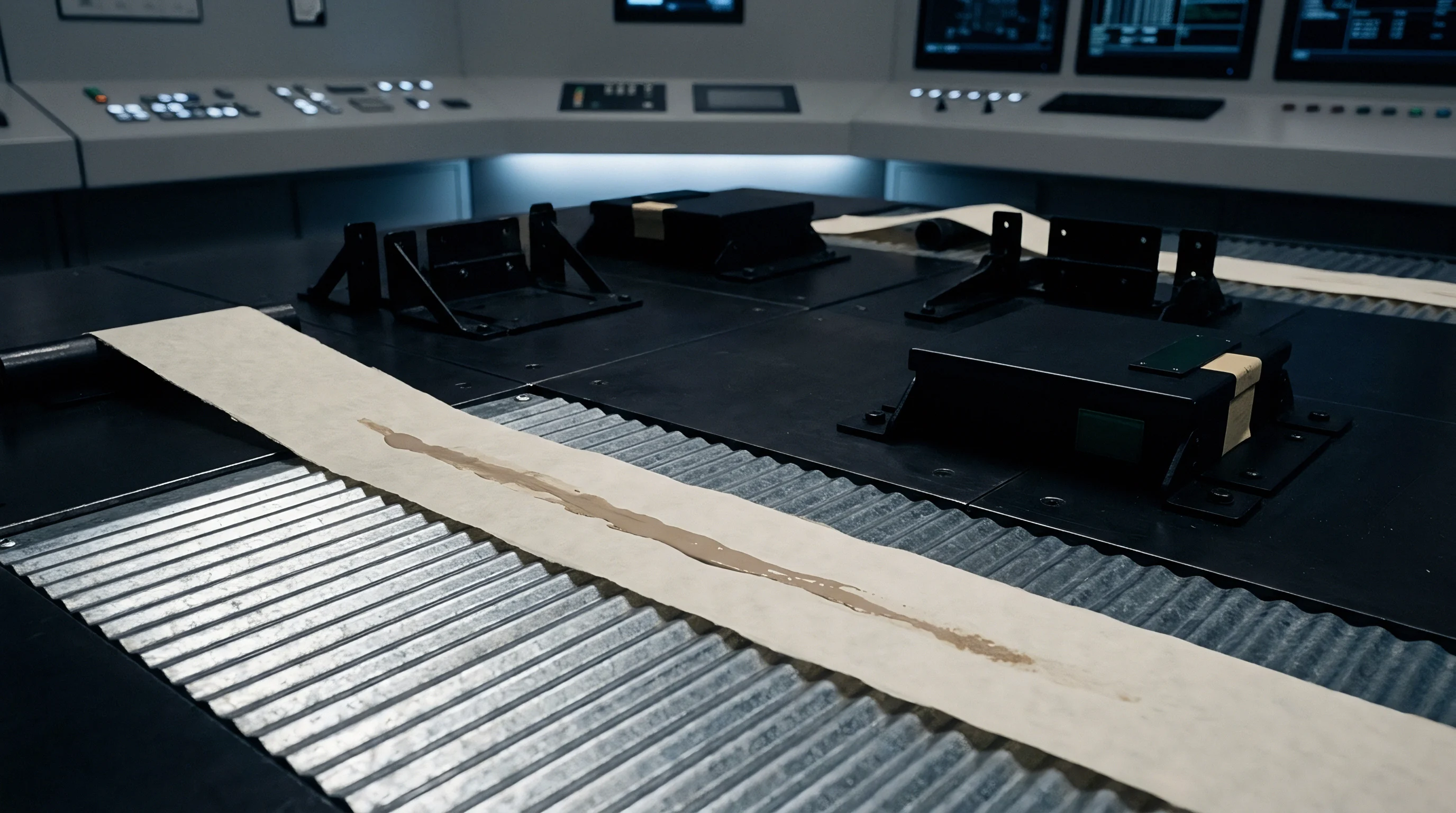
High-speed folding carton convertors running solid bleached sulfate and coated unbleached kraft substrates generate transient stress waves whenever a creasing rule strikes the paperboard sheet. Elastic energy stored during female die penetration releases quickly, sending high-frequency waves through the multi-ply structure. Online acoustic emission monitoring captures these micro-seismic events in real time.
Piezoelectric transducers mounted in the creasing matrix or on the die cylinder pick up mechanical waves in the 50 kHz to 750 kHz range, isolated from lower-frequency plant vibration by bandpass filtering. Controlled micro-delamination along score lines is essential for clean, low-torque carton erection on high-speed lines. Without internal delamination across central plies, folder-gluer operations cause outer liner rupture or excessive bending resistance, throwing cartoner timing out of spec.
Stress wave signatures produced during scoring give an acoustic fingerprint of shear fracturing between paperboard plies. High-amplitude burst signals mark primary shear fracture across the Z-direction fiber network, while attenuation patterns indicate whether internal ply separation reached the intended volume along the score axis or stayed trapped in isolated clusters. Evaluating score acoustic emissions quantitatively depends on transient signal parameters: peak amplitude in decibels relative to one microvolt, signal duration, rise time, ring-down count above a preset threshold voltage, and total spectral energy in attojoules.
Standard ISO 187 conditioning at 23 degrees Celsius and 50 percent relative humidity sets baseline moisture content, but web moisture on an operating line fluctuates between 4.5 percent and 8.0 percent. These moisture shifts change the elastic modulus of internal plies, swinging acoustic wave velocity from 2800 meters per second down to 2100 meters per second and shifting signal amplitude signatures regardless of mechanical scoring depth.
Transient stress wave energy peak shifts directly reflect interlaminar shear failure volumes along carton scores under dynamic impact.
Sensor placement directly dictates acoustic signal fidelity. Mounting wideband piezoelectric sensors on the anvil counter-plate creates mechanical coupling to the scoring zone, while silicone-free acoustic couplant interfaces or hardened tungsten carbide waveguides transmit high-frequency transients without attenuation losses exceeding 0.5 decibels per millimeter. Arrays spaced at 150-millimeter intervals along the scoring cylinder pick up spatial variations in micro-delamination caused by local caliper swings or uneven rule wear.
Modern instrumentation samples acoustic channels at minimum rates of 5 megasamples per second per channel, catching fast-rising transient wave fronts within 2 microseconds of initial rule impact. Fast Fourier transform algorithms then process the raw waveforms to split high-frequency ply-splitting emissions from the low-frequency structural ring-down of the scoring station frame.
During scoring, mechanical press work converts into plastic deformation, heat, and acoustic radiation. Controlled internal delamination absorbs substantial strain energy, dampening subsequent stress wave reflections. By contrast, solid board lacking micro-delamination produces high-amplitude, undamped reflections that bounce between top and bottom liner surfaces.
Online algorithms calculate cumulative signal energy envelope profiles across each scoring stroke, checking real-time energy against calibrated process bounds. Values outside statistical limits point to improper scoring rule depth, worn matrix profiles, or batch variations in Z-directional tensile strength. Acoustic signatures shift detectably when scoring rule clearance drifts by just 15 micrometers, showing sensitivity far beyond visual or manual inspection.
Substrate composition significantly alters how stress waves travel through scored cartonboard. Recycled folding boxboard with high percentages of short mechanical fibers attenuates high-frequency acoustic emissions faster than virgin kraft structures. Synthetic surface coatings, extrusion laminations, and foil finishes introduce acoustic impedance mismatches at material interfaces; high-density polyethylene or polyethylene terephthalate film laminates, for instance, absorb up to 4 decibels of signal strength per millimeter of film thickness.
Calibration routines must establish baseline acoustic signatures for each board grade and lamination stack before production runs begin. Setting these baseline thresholds prevents false defect calls caused by variations in coating density or adhesive film thickness.
Scoring operations on high-speed rotary convertors happen within microsecond windows. At web speeds of 400 meters per minute, a standard scoring rule passes through the paperboard sheet in under 3 milliseconds. Online acoustic detection systems process transient signals quickly enough to trigger real-time sheet rejection or automated die-position adjustments.
Embedded digital signal processors run thresholding algorithms that spot premature outer-liner micro-cracks before total score failure occurs. Catching defects this early prevents thousands of bad folding cartons from reaching high-speed filling lines, where jammed scores cause costly stoppages.
Sensor housings must withstand harsh press environments. Dust, airborne anti-setoff powders, ambient temperature spikes up to 50 degrees Celsius, and continuous mechanical shock easily undermine optical and ultrasonic monitoring options. Piezoelectric ceramic elements sealed inside stainless steel housings hold up reliably across long converting shifts.
Positioning signal conditioning preamplifiers within 300 millimeters of the sensor head maintains high signal-to-noise ratios, suppressing electromagnetic interference from heavy-duty press drives and static discharge bars. The resulting acoustic data streams directly into automated quality control dockets, tying micro-fracture performance back to specific mill rolls.
What specific acoustic threshold separates acceptable micro-delamination from irreversible outer liner rupture across high-density virgin kraft boards?

Resonance
Analyzing transient acoustic emissions during scoring requires isolating the resonant frequencies tied to paperboard delamination. Micro-fracturing of cellulose fiber bonds releases acoustic energy in distinct bands between 120 kHz and 350 kHz. Secondary stress waves from mechanical friction between sliding plies resonate lower, typically between 40 kHz and 90 kHz.
Continuous wavelet transform processing separates structural delamination frequencies from friction noise by mapping acoustic energy across time and frequency simultaneously. This decomposition marks the exact moments internal plies yield under scoring pressure, tracking how fast micro-delamination moves along the crease axis.
Waveform parameters correlate directly with physical score dimensions measured in laboratory bench testing. Short rise times below 5 microseconds paired with high peak amplitudes signal crisp, localized fiber fractures within central board plies. Longer durations with drawn-out decay tails indicate excessive friction or plastic deformation without clean ply separation.
Tracking these waveforms across thousand-sheet runs exposes progressive tool wear: as scoring rule edges dull, peak acoustic amplitude drops while total spectral energy shifts toward lower frequencies. Plant teams track these spectral shifts to schedule die maintenance long before score cracking appears on the converting floor.
| Failure Mode | Peak Amplitude (dB) | Frequency Peak (kHz) | Signal Duration (µs) | Rise Time (µs) |
|---|---|---|---|---|
| Optimal Delamination | 68 – 74 | 180 – 240 | 45 – 65 | 2.1 – 4.2 |
| Outer Liner Rupture | 82 – 90 | 310 – 450 | 15 – 30 | 0.8 – 1.5 |
| Insufficient Delamination | 45 – 55 | 60 – 110 | 85 – 140 | 6.5 – 12.0 |
| Matrix Misalignment | 75 – 84 | 90 – 160 | 110 – 190 | 4.0 – 8.5 |
Signal processing pipelines need robust noise discrimination to run reliably on the production floor. High-speed convertors generate substantial mechanical background noise from gear meshes, pneumatic ejectors, and sheet grippers, though almost all of it concentrates below 35 kHz. Analog high-pass filtering strips out low-frequency machine noise before digital conversion.
Preamplifiers boost acoustic signals by 40 decibels directly at the sensor head to preserve signal fidelity over long cable runs to main processing units. Digital signal processing blocks then use adaptive thresholding, shifting trigger levels dynamically as background noise drifts with machine speed changes or press warming.
Good score quality depends on balanced delamination across the entire score cross-section. Insufficient ply separation leaves the score stiff, creating high bending resistance during carton setup. Too much delamination destroys structural stiffness, causing carton sidewalls to bulge under stack loads.
Acoustic emission monitoring measures delamination volume by integrating energy envelopes across specific frequency channels. Linear regression models then link cumulative acoustic energy to standard TAPPI T 829 score stiffness test figures. Cumulative acoustic energy readings between 450 and 650 attojoules correlate to optimal 90-degree score bending resistance on 450-micrometer solid bleached sulfate board.
Thickness variations across a single paperboard reel alter acoustic resonance. Caliper shifts as small as 8 micrometers change local compression beneath the scoring rule, moving peak acoustic amplitudes by up to 6 decibels. Online systems compensate for caliper drift by feeding real-time thickness data from upstream laser displacement sensors into the processor.
Automated algorithms adjust acoustic threshold parameters on the fly, eliminating false defect calls during reel transitions and maintaining consistent identification despite raw material variations.
Multi-layer barrier coatings complicate acoustic reflections within the scoring zone. Extrusion-coated polyethylene layers absorb high-frequency waves, cutting measured signal amplitudes by 15 percent to 30 percent compared to uncoated paperboard while shifting resonant frequency peaks downward. Signal processing algorithms account for layer architecture using pre-programmed calibration dockets.
When converting barrier packaging for liquid or food products, these dockets define grade-specific acoustic envelopes that prevent false quality alerts while enforcing strict delamination limits.
Cross-directional scoring produces different acoustic characteristics than machine-directional scoring because fibers aligned parallel to the crease yield differently than fibers running perpendicular to it. Machine-direction scores produce sharper acoustic bursts with higher peak frequencies as cross-aligned fibers snap under tensile stress. Cross-direction scores show broader frequency spectra and longer signal durations as parallel fibers slide past one another.
Online monitoring software checks score orientation automatically against sheet imposition layouts, applying direction-specific evaluation criteria across individual transducer channels.
The operational guideline for acoustic system calibration demands recalibrating baseline threshold levels whenever paperboard supply shifts across different paper mills.

Matrix
Die setup precision dictates score quality and the resulting acoustic stress wave profiles. Correctly pairing scoring rule width, counter-matrix channel width, and matrix depth determines whether paperboard undergoes controlled internal delamination or catastrophic shear failure. The theoretical matrix channel width formula calculates optimum clearance from board thickness and rule thickness:
W = t_r + 1.6 t_b
where W represents matrix channel width, t_r indicates scoring rule thickness, and t_b represents paperboard caliper. Deviations from calculated matrix widths shift internal stress distribution, directly altering the acoustic energy profiles generated during scoring.
Proper matrix channel width selection prevents premature outer liner cracking while enabling full internal ply delamination along the score axis.
When matrix channels are too narrow, paperboard experiences severe lateral squeezing that pinches fibers against matrix edges. This pinching generates high-amplitude bursts above 400 kHz, signaling outer liner micro-cracking and fiber shearing rather than smooth delamination. Conversely, matrix channels that are too wide let paperboard bow downward without generating sufficient internal shear stress, producing weak signals below 50 kHz that point to incomplete delamination.
Real-time acoustic analysis catches these matrix setup errors on the first sheet pass, letting operators correct tooling choices before starting a production run.
Scoring rule geometry also affects acoustic signatures. Radiused rule edges create smooth stress distributions that foster progressive shear delamination between internal plies. Sharp or damaged edges concentrate compressive force into narrow lines, causing immediate surface ruptures that register as high-energy spikes.
Real-time analysis flags damaged die tooling by detecting asymmetric acoustic energy across individual scoring strokes. Spotting tool wear early protects expensive counter-die matrices from severe damage caused by compromised rule profiles.
- Tooling Selection match scoring rule width and matrix channel geometry to target paperboard caliper using standard conversion equations.
- Sensor Mounting install piezoelectric acoustic transducers into counter-plate recesses using specified mounting torque and acoustic couplant layers.
- Baseline Calibration record baseline acoustic stress wave profiles using reference paperboard samples verified by laboratory score stiffness testing.
- Threshold Configuration set peak amplitude, signal duration, and energy envelope bounds within online signal processing software.
- Online Verification initiate press runs while monitoring real-time acoustic emission data feeds for structural delamination variance.
Matrix wear during long converting runs gradually alters score formation mechanics. Phenolic, steel, and resin matrices degrade at different rates under continuous impact. As channel edges round off, internal shear stress drops and acoustic signal amplitudes decay steadily.
Online monitoring systems track these long-term amplitude decay trends across thousands of impressions, alerting press operators when cumulative signal degradation exceeds 20 percent so they can replace the counter-matrix before score quality suffers.
Surface treatments alter both score formation and acoustic signal propagation. UV-cured varnishes, film laminations, and heavy clay coatings increase surface brittleness, making outer layers prone to micro-cracking during scoring and generating high-frequency spikes that can mask internal delamination. Signal processing filters out surface crack noise using spatial array processing, comparing data from sensors positioned above and below the web to isolate top-surface micro-cracks from true Z-direction delamination in internal plies.
Converting lines that combine embossing and scoring passes produce overlapping acoustic signatures. Embossing tooling strikes the web simultaneously with scoring rules, generating high-energy emissions that blend with delamination signals. Separating these signals requires precise optical encoder integration: high-resolution rotary encoders track press shaft positions down to sub-millimeter increments, gating data collection to the microsecond windows when scoring rules engage the substrate.
Time-gated acquisition ensures acoustic evaluation focuses strictly on score formation, isolating it from adjacent die operations.
Standard quality control clauses in commercial converting contracts mandate zero tolerance for outer liner cracking alongside strict limits on score bending resistance. Adding online acoustic emission monitoring to quality protocols provides continuous verification for every manufactured carton. Digital data logging replaces manual spot-checking, establishing verifiable proof of structural integrity across entire production runs.
Continuous acoustic monitoring reduced customer carton-jam returns by 85 percent across a six-month evaluation period on automated packaging lines.
According to standard packaging conversion specifications, score bending force must remain within specified upper and lower bounds to prevent cartoner feeding failures.
Outlay
Implementing online acoustic emission monitoring requires balancing initial capital outlay against waste reduction and claim avoidance. System hardware costs scale with press width and scoring complexity: a standard 1420-millimeter sheet-fed die cutter with an eight-channel sensor array, signal conditioning, preamplifiers, and digital signal processing units requires an initial hardware investment between 35,000 and 55,000 USD per machine. Installation, press modification, optical encoder integration, and initial calibration add 8,000 to 12,000 USD in setup costs, while software licensing, algorithm updates, and predictive maintenance modules run roughly 3,500 USD per press annually.
Commercial savings come mostly from reduced setup spoilage and early defect detection at production speeds. Traditional manual inspections force operators to stop the press, pull sheets, perform hand bends, or run benchtop score stiffness tests. These checks take 15 to 20 minutes each, racking up costly downtime on high-speed die cutters running at 9,000 sheets per hour.
Online acoustic monitoring eliminates these delays by giving instant pass-fail feedback on the first sheet pass, cutting make-ready spoilage by up to 60 percent on complex multi-score carton designs.
| Cost / Benefit Category | Year 1 Outlay (USD) | Year 2 Outlay (USD) | Year 3 Outlay (USD) |
|---|---|---|---|
| Hardware and Sensor Integration | 45,000 | 0 | 0 |
| Software Licensing and Calibration | 3,500 | 3,500 | 3,500 |
| Make-Ready Waste Reduction Savings | -28,000 | -32,000 | -34,000 |
| Customer Claim and Jam Penalty Avoidance | -35,000 | -40,000 | -42,000 |
| Net Financial Impact | -14,500 | -68,500 | -141,000 |
Avoiding customer claims and line-jam penalties on high-speed packaging lines is the primary financial argument for acoustic monitoring. Contractual non-performance penalties on automated food and pharmaceutical lines can hit 10,000 USD per hour of customer line downtime. A single pallet of folding cartons with improperly delaminated scores can repeatedly jam packaging equipment, triggering rejected shipments, product recalls, and expensive commercial disputes.
Online acoustic monitoring acts as insurance, verifying that 100 percent of shipped cartons meet structural delamination criteria before leaving the plant.
Scrap reduction savings depend heavily on raw material costs across substrate grades. Premium solid bleached sulfate virgin paperboard runs between 1,400 and 1,800 USD per metric ton, while specialty barrier-coated and foil-laminated stocks frequently top 3,200 USD per metric ton. Waste from scoring bring-up or undetected die misalignment rapidly eats into margins on high-value substrates.
Eliminating 300 to 500 setup sheets per job across several daily changeovers yields direct material savings that can recoup initial hardware investments within six to nine months of continuous operation.
Long-term maintenance costs for acoustic monitoring systems remain minimal compared to optical inspection setups. Cameras struggle with lens contamination, lighting shifts, and frequent recalibrations in dusty converting plants. By contrast, piezoelectric sensors have solid-state construction with no moving parts or optical windows, running reliably across millions of impact cycles.
Preamplifiers and signal cables require only periodic inspection and annual recalibration, keeping yearly maintenance under 1,200 USD per press installation.
Integrating acoustic quality records into enterprise resource planning software streams compliance data directly to job dockets. Automated collection generates customer-facing certificates that prove 100 percent online inspection of score integrity. Converting plants use these verified records to win high-margin contracts with global consumer goods brands that demand zero-defect packaging.
Commercial penalties from a rejected 500,000-carton run demonstrate the cost of unmonitored defects, driving plants to adopt online acoustic monitoring and refine quality protocols.
The standard procurement agreement clause requires suppliers to provide certified electronic quality logs verifying online score inspection across all high-speed carton deliveries.