Harmonized Dry Basis Mass Adjustment Formulas for Cross-Border Recycled Paper Pulp Ledger Disputes
Cross-border recycled pulp disputes clear by adjusting gross container weight to bone-dry fiber mass via ISO 7213 wedge sampling and ISO 2144 ash deductions.

Moisture
Commercial transactions for recycled secondary fiber pulp rely on standard dry-matter conventions that frequently conflict with physical conditions during maritime transit. When deinked pulp or unbleached recycled softwood fiber leaves a mill, invoices reflect an air-dry metric tonnage calculated under laboratory baseline conditions. Containerized ocean transport exposes cargo to humidity and temperature shifts that alter moisture distribution throughout individual bales, leaving substantial weight discrepancies between departure tallies and arrival port weighments.

Standard Atmospheric Equilibrium Mechanics
Test methodologies under ISO 638-1 specify oven-drying pulp samples at 105 degrees Celsius to constant mass. Commercial pulp is not invoiced on pure bone-dry mass; the trade runs on an air-dry standard, defined in ISO 8068 as 90 percent bone-dry cellulosic fiber and 10 percent bound water.
Secondary fiber recovered from post-consumer waste behaves inconsistently under ambient moisture. Unlike virgin bleached kraft, recycled pulp contains fragmented fibers, fines, and residual process chemicals that alter sorption dynamics. Bales packed at 10 percent moisture continuously exchange water vapor with the air inside a shipping container until reaching equilibrium, and relative humidity shifts inside unvented steel boxes drive rapid absorption across the outer bale faces.
Recycled secondary pulp sheets held at 80 percent relative humidity and 23 degrees Celsius absorb up to 2.4 percent additional ambient moisture across a twenty-day shipping transit.

Hysteresis Effects in Secondary Fiber Matrices
Reclaimed cellulosic fibers retain an irregular pore network that responds unevenly to atmospheric moisture. Sorption curves do not track desorption curves: because recycled fiber exhibits hysteresis, a pulp sheet reabsorbing water at a given relative humidity holds less total moisture than a sheet drying down to that same humidity level. Unsealed ocean containers compound this divergence through sharp diurnal thermal swings.
Solar radiation routinely drives daytime container temperatures past 50 degrees Celsius, forcing bound moisture out of the upper bale layers into the internal headspace. Nighttime cooling then condenses that vapor against the container roof and side walls, raining liquid runoff back onto the cargo. The outer bale shell absorbs this water quickly, setting up steep moisture gradients between the exterior and the bale core.
Standard terminal scales simply register the resulting gross gain, inflating reported weights unless systematic dry-basis sampling reconciles the ledger.
Ledger disputes frequently turn on whether moisture pickup occurred during transit or within port storage facilities after customs release.

Wedge
Representative sampling provides the sole technical basis for resolving cross-border recycled pulp claims. Scale weights at an import terminal record gross payload mass but indicate nothing about actual dry fiber content. Establishing an enforceable settlement requires cutting physical specimens from interior bale volumes according to standardized geometric patterns.
Sampling Methodologies under International Standards
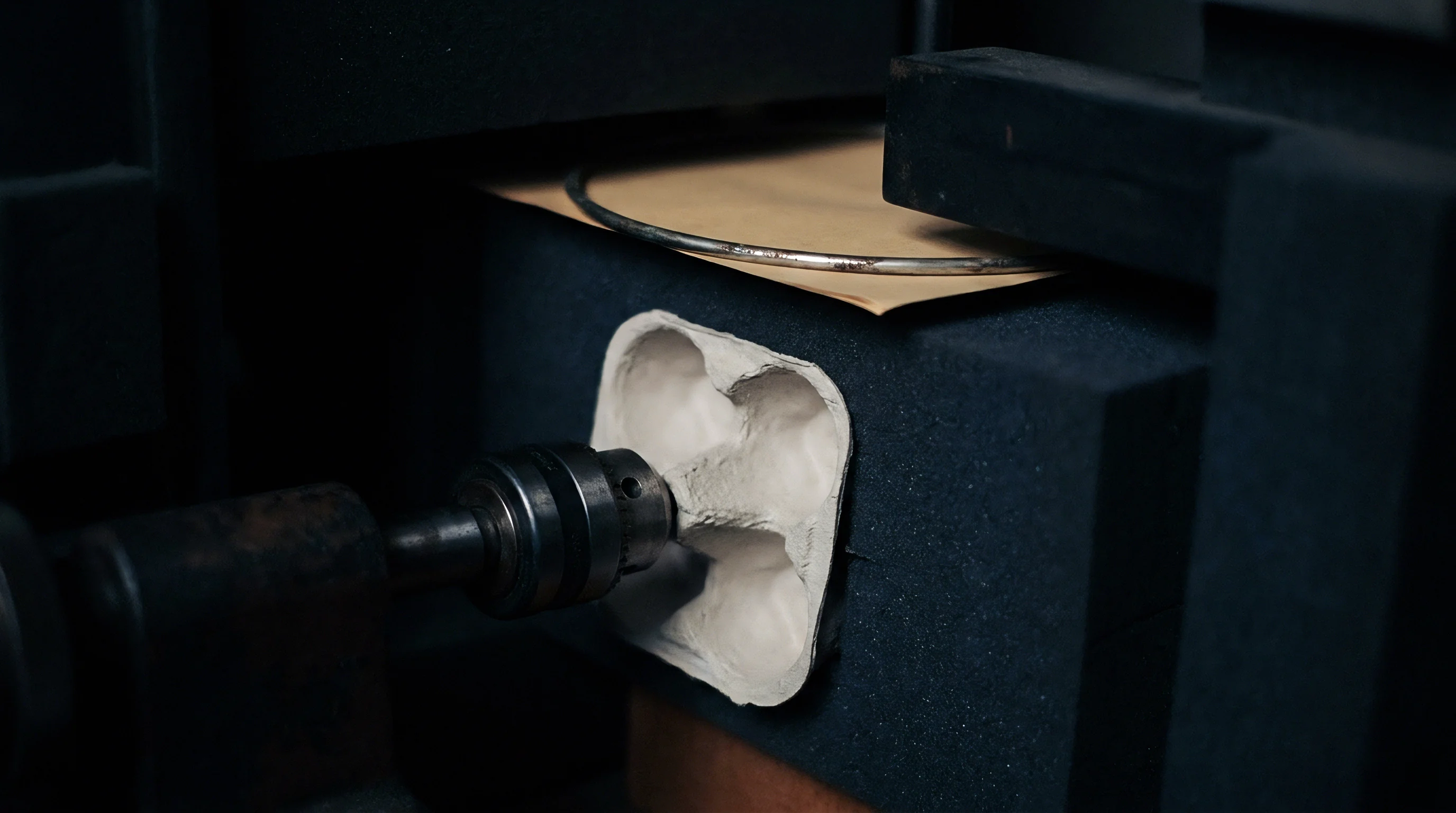
Procedures under ISO 7213 require cutting triangular wedges from designated depths across stacked bales, with each cut running from the outer edge to the exact geometric center of the sheet. This geometry guarantees that exterior moisture pickup and dry interior fiber enter the test sample in direct proportion to the bale’s overall volume. Core drilling under TAPPI T 210 follows an entirely different mechanic.
Core boring drives rotating steel tubes into the dense recycled bale. High-speed bit friction heats the cutting zone enough to drive off bound water before technicians can seal and weigh the core, routinely yielding artificially low moisture figures that favor the seller.
| Method Standard | Sample Geometry | Thermal Gain Risk | Measurement Precision | Applicability |
|---|---|---|---|---|
| ISO 7213 | Triangular radial wedge | Negligible thermal impact | Plus or minus 0.1 percent dry solids | Bale stacks and sheet bundles |
| TAPPI T 210 | Cylindrical drill core | Moderate to high thermal evaporation | Plus or minus 0.4 percent dry solids | High-density compressed bales |
| EN ISO 638-2 | Full sheet section strips | Zero thermal impact | Plus or minus 0.05 percent dry solids | Unbaled reel and sheet stock |
Sampling geometry errors corrupt laboratory results from the outset. Pulling material strictly from bale corners captures transient surface condensation and exaggerates moisture levels, while unthrottled drill bits burn off water before the sample reaches a scale. Sustaining a formal claim requires verifying that extraction adhered strictly to ISO 7213 dimensions.
- Surface core mismatch occurs when test cuts capture only the outer three centimeters of a bale, overestimating water gain from humid container air.
- Frictional thermal evaporation generated during high-speed drill core extraction volatilizes structural moisture before weight recording.
- Inadequate sample sealing allows rapid vapor loss during transport from the port dock to the accredited testing laboratory.
- Non-representative wedge angle distorts the volumetric ratio between exterior bale surfaces and interior core mass.
Deviations from ISO 7213 wedge geometry invalidate moisture contestation claims under standard Baltic and International Paper Trade terms.
Flawed extraction protocols artificially depress declared air-dry tonnage, leaving buyers to absorb unrecoverable customs duties paid on phantom dry mass.
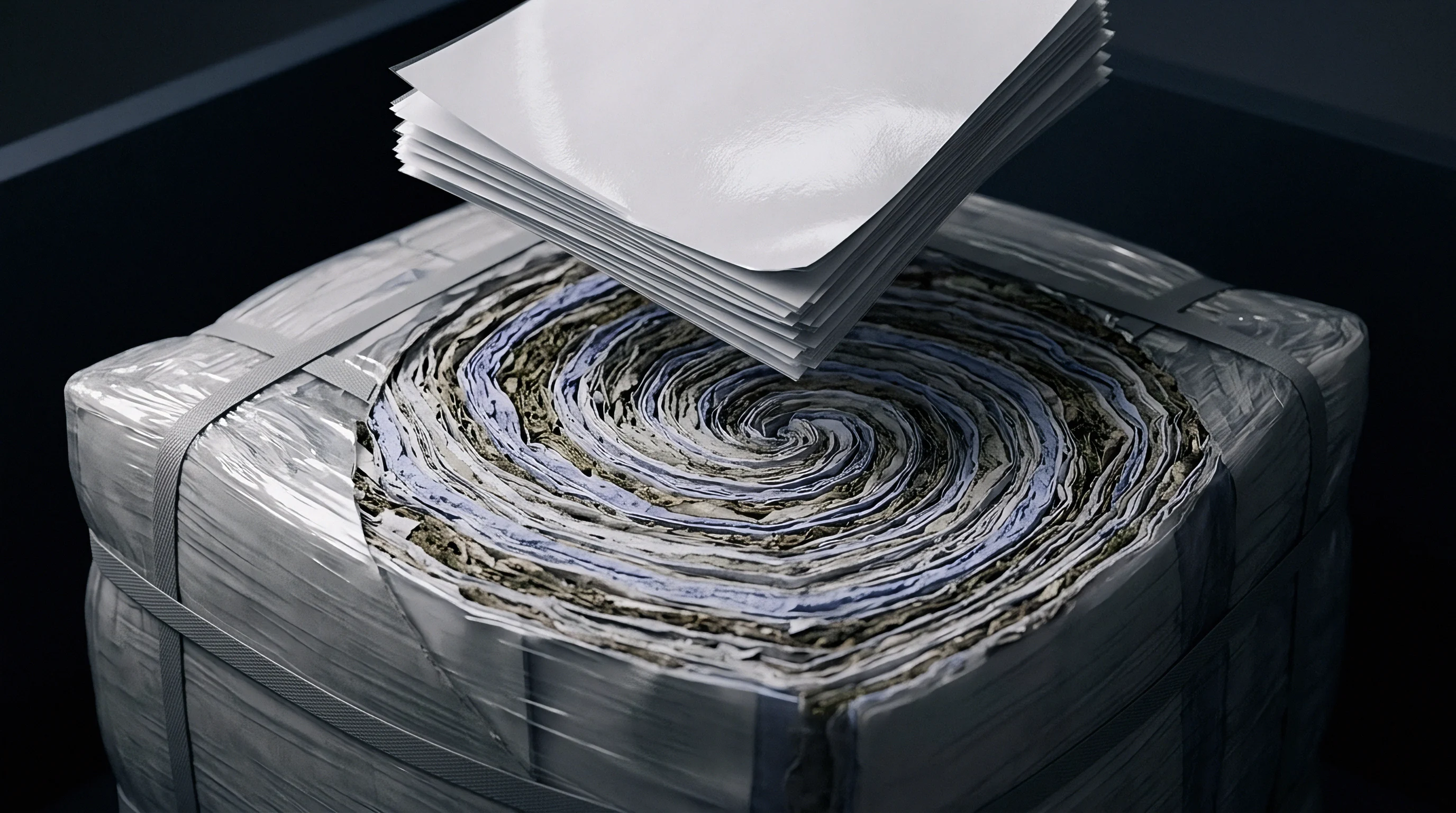
Calculus
Commercial adjustments convert gross landed mass into air-dry metric tons through standardized balance equations. Billing secondary fiber on gross weight forces buyers to pay delivered fiber prices for absorbed rainwater and mineral fillers. Harmonized mass equations isolate net cellulosic yield by calibrating gross scale tickets against certified laboratory findings.
Harmonized Mass Adjustment Equation
Isolating net billable fiber requires separating bone-dry cellulose from ambient moisture and non-cellulosic mineral additives. Standard trade contracts define air-dry mass as bone-dry mass divided by 0.90. The foundational commercial calculation runs as follows:
Air-Dry Mass = Gross Mass × (100 – Measured Moisture Percentage) / 90
Recycled grades ~ especially deinked secondary fibers derived from post-consumer newsprint and office papers ~ carry heavy inorganic filler loads. Residual calcium carbonate, kaolin, and titanium dioxide stay trapped within the reclaimed pulp matrix. ISO 2144 measures this inorganic ash by incinerating specimens at 525 degrees Celsius.
Because non-cellulosic ash displaces usable fiber, purchase agreements specifying filler limits incorporate deductions into the ledger adjustment:
Adjusted Bone-Dry Mass = Gross Mass × (100 – Measured Moisture Percentage – Deductible Ash Percentage) / 100
Commercial Settlement Mass = Adjusted Bone-Dry Mass / 0.90
Take an operational example. A paper mill takes delivery of a 500 gross metric ton consignment of containerized deinked recycled pulp, invoiced at 500 air-dry metric tons based on an origin moisture declaration of 10.0 percent. When containers are unstuffed at the terminal, joint ISO 7213 sampling and ISO 638 oven testing determine actual moisture at 12.5 percent.
ISO 2144 testing reveals inorganic ash at 2.0 percent against a contractual ceiling of 0.5 percent, leaving a 1.5 percent deductible ash excess.
Terminal scales register 508.5 metric tons gross landed weight. Entering these values into the harmonized adjustment establishes the true cellulosic fiber yield:
Adjusted Bone-Dry Mass = 508.5 × (100 – 12.5 – 1.5) / 100 = 508.5 × 0.860 = 437.31 metric tons
Commercial Settlement Mass = 437.31 / 0.90 = 485.90 air-dry metric tons
The mill was invoiced for 500.0 air-dry metric tons. Applying the dry-basis correction establishes a shortfall of 14.10 air-dry metric tons. At an agreed price of 680 USD per air-dry metric ton, the settlement requires issuing a credit note of 9,588.00 USD to the buyer.
| Measured Moisture | Inorganic Ash | Bone-Dry Mass | Settlement Air-Dry Tonnage | Financial Ledger Variance at 680 USD/MT |
|---|---|---|---|---|
| 10.0 percent | 0.5 percent baseline | 89.50 metric tons | 99.44 metric tons | Minus 380.80 USD |
| 11.5 percent | 1.0 percent (0.5 deduct) | 88.00 metric tons | 97.78 metric tons | Minus 1,509.60 USD |
| 13.0 percent | 1.5 percent (1.0 deduct) | 86.00 metric tons | 95.56 metric tons | Minus 3,019.20 USD |
| 14.5 percent | 2.5 percent (2.0 deduct) | 83.50 metric tons | 92.78 metric tons | Minus 4,909.60 USD |
| Methodology note: Calculations assume standard air-dry baseline of 90 percent dry fiber content and ISO 2144 ash determination at 525 degrees Celsius. | ||||

Ash and Contaminant Mass Deduction Rules
Post-consumer pulp slurries retain inorganic residues like calcium carbonate and kaolin clay, which offer zero fiber-bonding capacity in paperboard production. Buyers contract for usable cellulose rather than ground mineral filler, making explicit accounting for non-paper ash essential to prevent paying for dead weight.
Contracts must define whether ash thresholds apply against total sample mass or bone-dry fiber, avoiding conflicting calculations during final accounting. Tackifiers, hot melts, and synthetic latex binders complicate balances further; oven drying evaporates water while leaving synthetic polymers behind in the dry residue, requiring solvent extractives testing under ISO 14453 when handling heavily contaminated lots.
- Measure total gross scale weight of the palletized pulp lot upon container de-vanning.
- Extract test wedges from designated bale positions following ISO 7213 spatial sampling grids.
- Seal individual specimens immediately within vapor-impermeable barrier bags.
- Perform dual-stage thermal desiccation at 105 degrees Celsius until mass equilibrium occurs.
- Apply the harmonized dry mass correction formula to adjust commercial invoice balances.
Commercial ledgers settle on dry cellulosic fiber weight rather than gross delivered tonnage whenever non-paper inclusions exceed agreed tolerances.
Standard Baltic International Pulp Purchase Contract Clause 14 specifies that post-arrival dry-mass adjustments take effect only when destination moisture testing differs from origin bill-of-lading declarations by more than 1.0 percent.
Variance
Discrepancies between departure declarations and port laboratory tests regularly breach contractual tolerance thresholds over long ocean routes. Closing out the accounting requires tracking physical weight adjustments through customs filings and environmental chain-of-custody ledgers, as mass revisions directly alter valuation and certified material tallies.
When Do Standard Atmospheric Corrections Fail?
Theoretical adjustment curves presume clean, reversible moisture exchange, but maritime containers experience environmental extremes. Gasket failures allow liquid seawater into bottom tiers, altering salt content and water retention across lower bales. Low-grade recovered papers also carry bitumen and hot-melt polymers that modify desorption rates inside laboratory drying ovens.
Condensation runoff inside containers can also trigger localized mold outbreaks. Fungal colonies metabolize cellulosic fiber into carbon dioxide and moisture, lowering gross solids while raising local moisture readings and undermining standard back-calculations. Inspecting container integrity prior to devanning separates physical cargo casualty claims from normal atmospheric equilibrium shifts.

Chain of Custody and Financial Ledger Reconciliation
FSC-STD-40-004 and PEFC ST 2002 require exact volume accounting for certified recycled pulp. System credits record volume in metric tons or air-dry metric tons, and unverified volume entries represent non-conformances during annual surveillance audits.
When a buyer takes a commercial credit for moisture or excess ash, certified inventory balances must be reconciled against the net air-dry tonnage. Booking 500 tons of certified stock while settling invoices on 485 tons creates an unauthorized 15-ton surplus on the credit ledger. Certification auditors reconcile purchase ledgers, customs declarations, and credit tallies against final bank remittances.
| Ledger Entry Type | Physical Basis | Customs Valuation Consequence | FSC/PEFC Credit Allocation |
|---|---|---|---|
| Bill of Lading Original | Gross scale mass | Initial tariff duty assessment | Provisional volume registration |
| Destination Audit Corrected | Air-dry fiber mass (ISO 638) | Customs refund or credit filing | Reconciled input credit entry |
| Ash Corrected Fiber Yield | Bone-dry cellulosic mass (ISO 2144) | Transaction value reduction claim | Net usable fiber volume entry |
- Origin moisture baseline recording establishes initial bill of lading dry tonnage.
- Destination discrepancy verification quantifies physical mass divergence beyond tolerance limits.
- Inorganic ash deduction calculation subtracts non-cellulosic filler content under ISO 2144.
- Customs valuation amendment filing corrects declared import value to match audited dry fiber weight.
- Credit account volume balancing updates FSC or PEFC chain of custody ledgers to reflect net bone-dry fiber mass.
Discrepancies between customs import declarations and commercial ledger adjustments trigger regulatory audits for tax evasion or fraudulent environmental claims.
Unresolved friction remains regarding whether regional customs authorities will accept real-time digital sensor logs inside shipping containers as binding legal evidence of atmospheric water absorption during ocean transit.

Remedy
Settling cross-border pulp disputes efficiently requires enforceable contract mechanics drafted well before cargo departs. Informal negotiations at the destination dock leave buyers vulnerable to substantial financial write-offs. Functional contracts lay out explicit sampling protocols, nominated laboratories, settlement thresholds, and customs valuation adjustments.
Contractual Clause Architecture for Mass Settlements
Clear contracts avoid ambiguous references to general custom, incorporating specific ISO methods and nominating ISO/IEC 17025 accredited laboratories before vessel loading to eliminate challenges over testing authority.
Commercial terms should tie documentary payment releases directly to destination dry-mass certificates. Letters of credit typically release a provisional 90 percent of invoice value against the original bill of lading, reserving the remaining 10 percent until discharge testing verifies the final dry-basis mass. Contracts should also mandate that the nominated surveyor complete sampling and issue formal analytical certificates within seven business days of vessel discharge, confirming calculations before the pulp enters the mill’s slusher.
Commercial buyer protection depends on specifying the binding laboratory and testing protocol directly within the purchase agreement before financial letters of credit open.