Paperboard Converting Mass Balance Accounting and Scrap Yield Baselines
Paperboard mass balance accounting requires deducting real converting process scrap and moisture variations from credit ledgers to prevent invalid claims.


Deckle

Material Balance at the Primary Cut
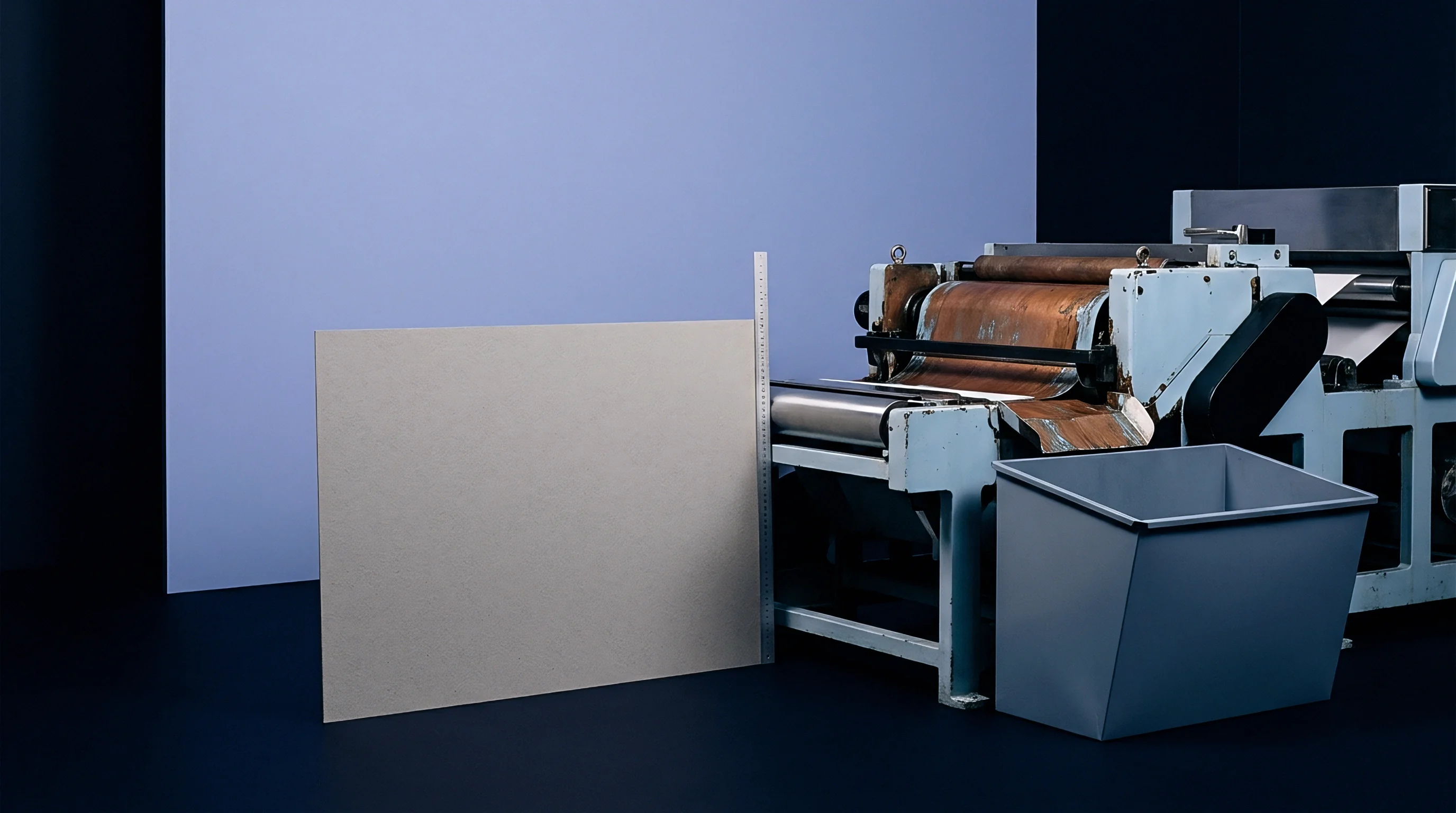
Raw paperboard enters a converting plant as continuous master rolls or pre-cut sheets, where the physical geometry of the knife layout dictates the initial edge trim. That trim scrap directly reduces yield. The mathematical relationship between the width of the mill spool and the combined width of the specified cuts forms the basis of mass balance accounting.
When a 2.8-meter paperboard web is slit into three 800-millimeter ribbons to feed a folding carton line, forty millimeters of edge margin go directly to the extractor hood. This immediate trim loss is certified raw material entering the building that leaves the main production stream before any printing or creasing takes place.
Converting operations generate distinct categories of physical waste that require structured tracking within inventory records. Primary web slitting, sheet squaring, skeleton extraction at the die-cutter, and make-ready setup sheets all remove solid mass from the prime production run. Converting accounting protocols track these physical flows to verify that certified claim quantities match actual stock consumed.
Assigning the full weight of a one-hundred-metric-tonne shipment of FSC Mix Credit solid bleached sulfate board to finished packaging invoices inflates the certified credit balance. Physical conversion losses must be deducted through documented conversion factors.
Continuous reel edge trim differs mechanically from intermittent skeleton waste generated during blanking. Continuous trim maintains a constant width down the full length of the roll, making its mass straightforward to calculate from web dimensions and grammage specifications. Skeletons from sheet-fed platen die-cutters vary much more, carrying complex geometric cutouts, matrix bridges, and nick points that fluctuate with layout nesting efficiency.
Calculating exact material consumption requires separating fixed web edge losses from variable sheet layout waste.

Physical Yield against Paperboard Input
Mass balance accounting reconciles gross paperboard intake against net finished product output over a set reporting period. Net operational yield equals the mass of saleable converted packaging divided by the mass of virgin or recycled paperboard unreeled at the feeder. Across typical solid bleached sulfate (SBS) and folding boxboard (FBB) converting lines, gross yield figures range between seventy-eight percent and ninety-two percent, leaving eight to twenty-two percent of total incoming fibre as industrial scrap.
Extracted waste streams route to balers for repulping or commercial sale as industrial offcuts in secondary recycling markets.
| Loss Stream | Physical Origin | Typical Weight Variance (%) | Accounting Treatment |
|---|---|---|---|
| Primary Web Trim | Slitter edge knife trimming on reel fed operations | 1.5 – 3.5 | Immediate volumetric credit debit |
| Make-Ready Sheets | Color matching, registration, and press calibration | 2.0 – 5.0 | Non-claimable gross intake deduction |
| Die-Cut Matrix | Platen punch skeleton and window cutouts | 5.0 – 14.0 | Yield factor adjusted ledger offset |
| Defective Stripping | Internal blank separation and edge damage | 0.5 – 2.0 | Periodic physical count reconciliation |
Chain of custody schemes, including FSC-STD-40-004 and PEFC ST 2002, mandate that certified output volumes never exceed the equivalent mass of certified input stock after accounting for manufacturing waste. When converting facilities fail to adjust their credit accounts using real process yield baselines, they over-allocate certified logos and claim statements on commercial invoices. A line operating at an eighty-five percent real yield that applies a one-to-one conversion factor inflates its certified credit ledger by fifteen percent.
This discrepancy triggers non-conformities during annual surveillance audits, exposing the converter to scope suspensions and commercial claim revocations.
Documenting primary trim loss starts at the slitter-rewinder or press feeder. Plant floor operators record roll identification numbers, tare weights, and actual sheet counts into enterprise resource planning databases. These entries provide the baseline data needed to build verified yield factors.
When incoming paperboard rolls carry certified claims, maintaining accurate mass accounting prevents non-certified scrap from diluting certified balances, particularly since skeletons contain high grade virgin fibre.
- Feeder Calibration Verification of electronic roll stand scales using certified calibration weights occurs prior to raw stock intake logging.
- Tare Weight Deduction Core tube weights, wrapper paper, and protective outer headers are weighed and subtracted from gross intake weight.
- Edge Width Logging Real-time optical sensors measure total trimmed web width to establish precise percentage losses for each knife configuration.
- Baler Reconciliation Compressed scrap bales are weighed and categorized by grade code to cross-check calculated scrap against physical offcuts.
Inaccurate recording of initial edge trim carries mathematical errors forward into every subsequent processing stage. When a packaging plant underreports slitter waste, the unrecorded loss manifests as an artificial inventory surplus in stock ledgers. During physical inventory audits, this discrepancy forces material write-downs that invalidate historical certified claim additions and result in formal audit findings.

Shrinkage

Moisture Conditioning and Volatiles Equilibrium
Paperboard contains structural water that fluctuates based on ambient temperature and relative humidity during storage, printing, and converting. Fiber swelling occurs when uncoated boxboard absorbs moisture in unconditioned storage facilities, altering absolute sheet weight without changing dry fiber mass. Standard paperboard grades exit the paper machine at five to eight percent moisture content, governed by ISO 287 testing procedures.
If converted sheets undergo drying during multi-pass UV offset printing or hot-air extrusion coating, water evaporation reduces total batch mass. Accounting for water loss prevents false material deficit flags in mass balance systems.
Dry mass verification forms the absolute baseline for chemical and structural accounting across cross-border supply chains. When a batch of folding boxboard enters a converting plant at seven percent moisture and leaves a high-temperature coating tunnel at four percent moisture, the process experiences a three percent physical weight drop. In a fifty-tonne production run, this volatile loss accounts for 1.5 tonnes of non-fiber mass reduction.
Failing to separate moisture evaporation from solid fiber scrap leads managers to assume process scrap occurred on the press floor, distorting actual yield baselines.
Relative humidity changes during storage modify paperboard weight by up to three percent without altering dry fiber content.
Mass balance ledgers must incorporate moisture correction calculations when raw material receipts and finished goods dispatches occur under different environmental conditions. Standard laboratory testing utilizes TAPPI T402 or ISO 187 conditioning environments, set at twenty-three degrees Celsius and fifty percent relative humidity. Weighing unconditioned paperboard stock directly off freight vehicles introduces immediate mass discrepancies: wet autumn deliveries register higher gross weights than dry summer shipments of identical caliper and sheet dimensions.

Environmental Conditioning Standards for Mass Determination
Precision mass determination requires determining the dry solids content of incoming board stock through oven-dry testing under ISO 638 specifications. Samples are weighed before and after drying at one hundred five degrees Celsius until constant mass is attained. The resulting percentage coefficient allows plant accountants to convert gross physical weight into standardized bone-dry mass.
This standardized baseline eliminates environmental moisture noise from manufacturing yield equations, ensuring that certified fiber claims reflect real physical pulp content.
Coating applications introduce additional mass dynamics that complicate straightforward weight-in to weight-out comparisons. Clay coatings, extrudable polyethylene barriers, and aqueous varnishes add solid non-fiber mass to the board surface. A liquid packaging board receiving a twenty-gram-per-square-meter extrusion layer of polyethylene increases total sheet weight while decreasing the percentage of certified forest fiber per kilogram of finished product.
Mass balance accounting rules require deducting non-certified coating layers from the total output weight before allocating certified fiber claim credits to customer invoices.
Volatile organic compounds, functional additives, and aqueous inks also experience evaporation loss during heat curing. Solvent-based flexographic inks drop fifty to seventy percent of their applied wet weight as solvents evaporate in high-speed drying tunnels. Plant mass balance algorithms must compensate for ink film drying to prevent coat weight calculations from skewing total plant yield metrics across different board calipers.
Ignoring water gain and volatile loss dynamics undermines inventory controls and certification compliance. Unadjusted mass records produce false physical variances that trigger unnecessary physical counts, stock adjustments, and administrative investigations into missing raw materials. Accurate environmental mass accounting maintains clear traceability between certified raw pulp inputs and finished package dispatches.


Ledger

Conversion Factor Calculations for FSC and PEFC Claims
Maintaining valid chain of custody credit ledgers requires calculating explicit conversion factors for every distinct packaging design and converting process. Under FSC-STD-40-004 Clause 10.1 and PEFC ST 2002 Clause 6.3, a conversion factor represents the ratio between net certified output mass and gross certified input mass. If a folding carton design requires 1.25 kilograms of certified paperboard to produce 1.00 kilogram of finished, stripped cartons, the process conversion factor is 0.80, and debits must occur before finished cartons are dispatched.
To record certified sales under the credit system, the converting facility must debit its credit ledger using the inverse of the conversion factor or multiply net production weight by the scrap multiplier. Operating with outdated or generalized conversion factors across diverse product lines violates certification standards. Complex rigid boxes with heavy windowing, foil stamping, and internal dividers generate significantly lower yields than simple auto-bottom cartons; applying a flat plant-wide yield factor over-allocates certified credits to complex jobs while under-crediting simple runs.
Credit account ledgers operate under strict temporal limits defined by certification bodies. Both FSC and PEFC rules specify that accumulated certified credits expire if not claimed within a maximum rolling window, typically twenty-four months. Converters cannot hold credits indefinitely to cover future production spikes.
Furthermore, credit ledgers cannot run into a negative balance; dispatches of certified product made before raw material invoices are entered into the ledger constitute an immediate breach of chain of custody requirements.

Which Yield Losses Can Converters Exclude from Mass Ledgers?
Certain process losses occurring during converted package production cannot be credited back to certified raw material pools or claimed as certified recycled fiber. Internal reject rolls, trim scrap, and die-cut skeletons sold to commercial waste merchants exit the certified converting loop entirely. Once scrap material is sold or transferred to an uncertified third party, its certified status terminates completely.
A converter cannot credit the fiber weight of sold waste back into its certified credit bank, nor can it pass certified claims to scrap buyers unless certified under a specific scrap recovery scope.
FSC-STD-40-004 mandates that certified credit deductions must reflect real job-specific scrap rates rather than theoretical mill averages.
When certified scrap is reprocessed internally within an integrated mill site, specific mass accounting rules govern its re-entry into the production process. Pre-consumer offcuts returned directly to the hydrapulper require fresh mass logging, and reclaimed fiber yields must account for pulping losses, de-inking sludge removal, and screening rejects before entering recycled credit accounts, as uncertified scrap invalidates claim balances.
- Flat Yield Assumption Using a blanket ninety percent yield calculation across all box styles, leading to credit over-allocation on complex die-cut cartons.
- Delayed Intake Posting Failing to log certified paperboard receipts into the credit ledger before dispatching finished packaging orders to clients.
- Coating Weight Inclusion Counting non-certified plastic extrusions and heavy aluminum foil layers as certified forest fiber mass in sales ledgers.
- Scrap Recapture Double-Counting Adding baled plant trim back to certified credit banks without maintaining an accredited scrap recovery scope.
- Unadjusted Moisture Discrepancy Ignoring board drying losses during hot extrusion, resulting in apparent physical inventory deficits during audits.

Credit Account Debits across Multi-Stage Production
Multi-stage packaging converting introduces cumulative yield losses that must be accounted for sequentially within mass ledgers. A job moving through sheet-fed printing, flatbed die-cutting, window patching, and folder-gluing experiences incremental scrap losses at each station. The mass balance ledger must track input and output weights at every manufacturing milestone to preserve trace integrity.
Because calculation errors invalidate certified percentage claims, establishing cumulative credit debits involves multiplying stage-specific yield factors to get an overall job conversion rate. Consider a process where printing yields ninety-seven percent, die-cutting yields eighty-eight percent, and folding-gluing yields ninety-six percent. The overall process yield factor is the product of these three values, calculated as 0.97 multiplied by 0.88 multiplied by 0.96, which equals 0.8204.
For every metric tonne of certified paperboard fed into the print press, only 820.4 kilograms of certified package credit can be drawn from the credit ledger for customer sales invoicing.
Certification auditors cross-examine credit ledger debits against physical shipping notes and job routing sheets during annual inspections, where audit gaps generate mandatory corrective actions. Discrepancies between physical dispatch weights and credit ledger deductions signal inadequate internal controls. Under FSC guidelines, failure to maintain accurate conversion factors results in a Major Non-Conformity, giving the facility five operational days to correct systemic accounting errors before certificate suspension protocols initiate.
Per FSC-STD-40-004 Clause 10.4, “The organization shall calculate and apply up-to-date conversion factors for all product groups subject to credit accounting, updating factors whenever process technologies, board specifications, or product dimensions change.” Compliance requires documenting periodic yield reviews and updating ERP conversion parameters at least annually.


Allowance

Scrap Yield Baselines by Converting Operation
Establishing realistic scrap yield baselines requires empirical benchmarking across distinct converting machinery and material substrates. A high-speed flexo folder-gluer processing corrugated boxboard operates under different scrap dynamics than a narrow-web rotary die-cutter converting solid bleached boxboard for pharmaceutical cartons. Base setup waste, sheet positioning margins, and mechanical defect rates define the inherent scrap footprint for each equipment category.
Make-ready waste varies directly with job run length and setup complexity. A short production run of five thousand folding cartons incurs the same initial setup scrap sheets as a long run of five hundred thousand units. On short runs, make-ready scrap forms a significantly higher percentage of total board consumption.
Mass balance accounting systems must incorporate dynamic scrap baselines that adjust for job size rather than relying solely on static percentage allowances.
| Converting Process | Substrate Class | Make-Ready Loss (Sheets/Run) | Running Scrap Rate (%) | Typical Net Yield (%) |
|---|---|---|---|---|
| Sheet-Fed Offset & Platen Die-Cut | FBB / SBS (250-400 gsm) | 150 – 350 | 2.5 – 4.5 | 83.0 – 91.0 |
| Rotary Web Flexo & Blanking | Liquid Packaging Board | 300 – 800 meters | 1.5 – 3.0 | 88.0 – 94.0 |
| Multi-Layer Lamination & Cut | Recycled Chipboard / Microflute | 200 – 500 | 4.0 – 7.0 | 78.0 – 86.0 |
| Rigid Box Setup & Wrapping | Cover Paper + Greyboard | 100 – 250 | 3.0 – 6.0 | 82.0 – 88.0 |
Advanced converting facilities utilize automated waste tracking systems integrated directly into press control units. Photoelectric sensors count incoming sheets, die-cut blanks, and ejected defect pieces in real time. This operational data streams into central material management software, continually refining historical yield baselines.
Real-time data collection replaces historical estimation, allowing precise credit debit calculations for every completed job ticket.

Worked Conversion Calculation for Folding Carton Stocks
Take a production order for 100,000 retail folding cartons printed on 350 gsm Solid Bleached Sulfate (SBS) board. The specification calls for a blank size of 300 mm by 400 mm, printed six-up on a standard 720 mm by 1020 mm parent sheet.
First, calculate net single carton weight and sheet utilization geometry. A single blank area equals 0.12 square meters. At 350 gsm (0.000350 tonnes per square meter), one finished carton weighs exactly 0.042 kilograms.
Total net order weight for 100,000 finished cartons equals 4,200 kilograms (4.20 metric tonnes). Six blanks per sheet yield a net useful area of 0.72 square meters per parent sheet. The parent sheet area is 0.7344 square meters.
The raw sheet weight is 0.25704 kilograms. Sheet layout efficiency equals 0.72 divided by 0.7344, which yields 98.04 percent structural layout efficiency within the sheet border, leaving 1.96 percent as outer sheet border trim.
Second, calculate total sheet consumption including make-ready and running scrap allowances. Producing 100,000 good blanks requires 16,667 perfect parent sheets. Press setup requires 250 make-ready sheets for offset ink balancing and 150 make-ready sheets for die-cutter matrix registration.
Running defect allowances are set at 2.5 percent of total sheet volume (417 sheets). Total required raw parent sheets equal 16,667 plus 250 plus 150 plus 417, totaling 17,484 sheets. Total gross paperboard intake mass equals 17,484 sheets multiplied by 0.25704 kilograms per sheet, resulting in 4,494.10 kilograms (4.494 metric tonnes).
Third, establish the final job conversion factor and mass balance ledger debits. The job conversion factor equals net output mass divided by gross input mass: 4,200.00 kg divided by 4,494.10 kg, which equals 0.9346 (93.46 percent overall job yield). Total physical process waste equals 294.10 kilograms (6.54 percent total material loss).
To log this transaction under FSC credit accounting rules, the converter must debit its FSC Mix Credit board ledger by exactly 4.494 metric tonnes of input stock. The customer invoice records 4.200 metric tonnes of net sold cartons with an FSC Mix Credit claim statement. The remaining 0.294 tonnes of physical scrap are recorded as unclaimable plant waste in internal recycling accounts.
Setup scrap numbers are frequently based on ideal machine runs rather than historical job ticket averages. Relying on ideal conditions understates real scrap, leaving unaccounted scrap gaps in physical stock ledgers.
- Review production history across at least twenty consecutive job runs for the specific board grade and press line.
- Calculate average make-ready sheet consumption by comparing initial gross feeder counts against first approved impression sheets.
- Measure average running defect percentages by tracking rejected blanks at folder-gluer automated sorting stations.
- Determine sheet skeleton trim mass by weighing ten unstripped die-cut sheets and subtracting the weight of ten net blanks.
- Aggregate all loss components to establish the verified baseline conversion factor for entry into ERP master data files.
In converting plants operating without automated sheet counters, scrap allowances understate actual setup waste by up to four percent.
Standardizing scrap yield baselines provides the operational framework required to maintain compliance across complex packaging portfolios. Accurate baseline factors eliminate manual estimation, streamline annual audit reviews, and protect converting operations from claim allocation errors.


Discrepancy
Audit Verification Protocols and Credit Deficits
Certification scheme auditors utilize rigorous mass balance reconciliation protocols during annual facility evaluations. Inspectors cross-examine three primary data points over a twelve-month reporting window: certified raw stock purchase invoices, enterprise credit ledger transaction logs, and customer sales dispatches carrying certified claim statements. If total dispatched certified product mass exceeds available certified input stock adjusted by verified conversion factors, a credit deficit exists, which can trigger reweighing of inbound packaging lots by customs inspectors.
Credit deficits constitute a direct breach of chain of custody certification requirements, indicating that uncertified paperboard was substituted into certified finished packaging orders. When auditors identify an unreconciled credit deficit, standard protocols mandate issuing a Major Non-Conformity notice. The certified organization must conduct a root-cause analysis, quantify the volume of mislabeled packaging shipped to clients, and issue formal correction notices to affected customers within five business days.
Failure to rectify credit deficits results in immediate certificate suspension, public listing on certification registers, and potential legal exposure under trade misrepresentation laws.
External supply chain scrutiny extends beyond scheme audits into national market surveillance under consumer protection and environmental labeling legislation. Enforcement agencies under the EU Unfair Commercial Practices Directive and national trading standards authorities inspect physical packaging claims for verifiable documentation. If a brand advertises packaging as containing seventy percent recycled fiber, but the converter’s mass balance ledgers show a net certified input allocation of only fifty percent due to unadjusted scrap losses, the brand faces substantial administrative fines and mandatory product recalls.

Regulatory Enforcement under Packaging Waste Directives
Emerging regulatory frameworks, including the EU Packaging and Packaging Waste Regulation (PPWR), impose strict mandatory mass balance accounting rules for recycled content declarations and extended producer responsibility (EPR) fee modulations. EPR schemes grant fee reductions to packaging utilizing verified post-consumer recycled (PCR) content. To qualify for fee modulations, converting facilities must prove PCR mass balance integrity through third-party audited CoC frameworks, strictly excluding pre-consumer industrial offcuts and process scrap from recycled content calculations.
Under PPWR rules, claiming internal converting scrap as recycled content in consumer packaging declarations is explicitly prohibited. Process offcuts returned directly to pulping systems represent recovered industrial material, not post-consumer waste. Converting accounting systems must maintain isolated ledgers for pre-consumer scrap and post-consumer recycled pulp inputs to ensure regulatory compliance.
Inaccurate classification of industrial trim as post-consumer content exposes packaging producers to severe non-compliance penalties and EPR fee recalculations backdated across multiple operating years.
Regulatory frameworks explicitly prohibit counting internal factory edge trim as post-consumer recycled content in packaging declarations.
Contractual liability for non-compliant environmental claims rests on the commercial terms established between brand buyers and converting partners. Standard procurement agreements incorporate explicit warranty clauses requiring converters to maintain full chain of custody certification, apply accurate job-specific conversion factors, and supply verifiable mass balance dossiers upon request. If a converting plant’s accounting failure invalidates a brand’s certified packaging claims, contract indemnification clauses transfer regulatory fines, recall costs, and legal fees directly back to the converting entity.
Establishing robust mass balance accounting controls protects commercial relationships, maintains legal compliance, and secures supply chain integrity. Precise tracking of deckle trim, moisture conditioning, credit account mathematics, and operational scrap yield baselines provides the verifiable foundation required for credible environmental packaging claims.