Unresolved Discrepancies between Laboratory Screen Slot Pass-Through Thresholds and Commercial Paper Stock Sticky Accumulation
Laboratory screen slot pass-through fails to predict commercial micro-sticky deposition due to thermal softening and shear-induced particle coalescence.

Bench
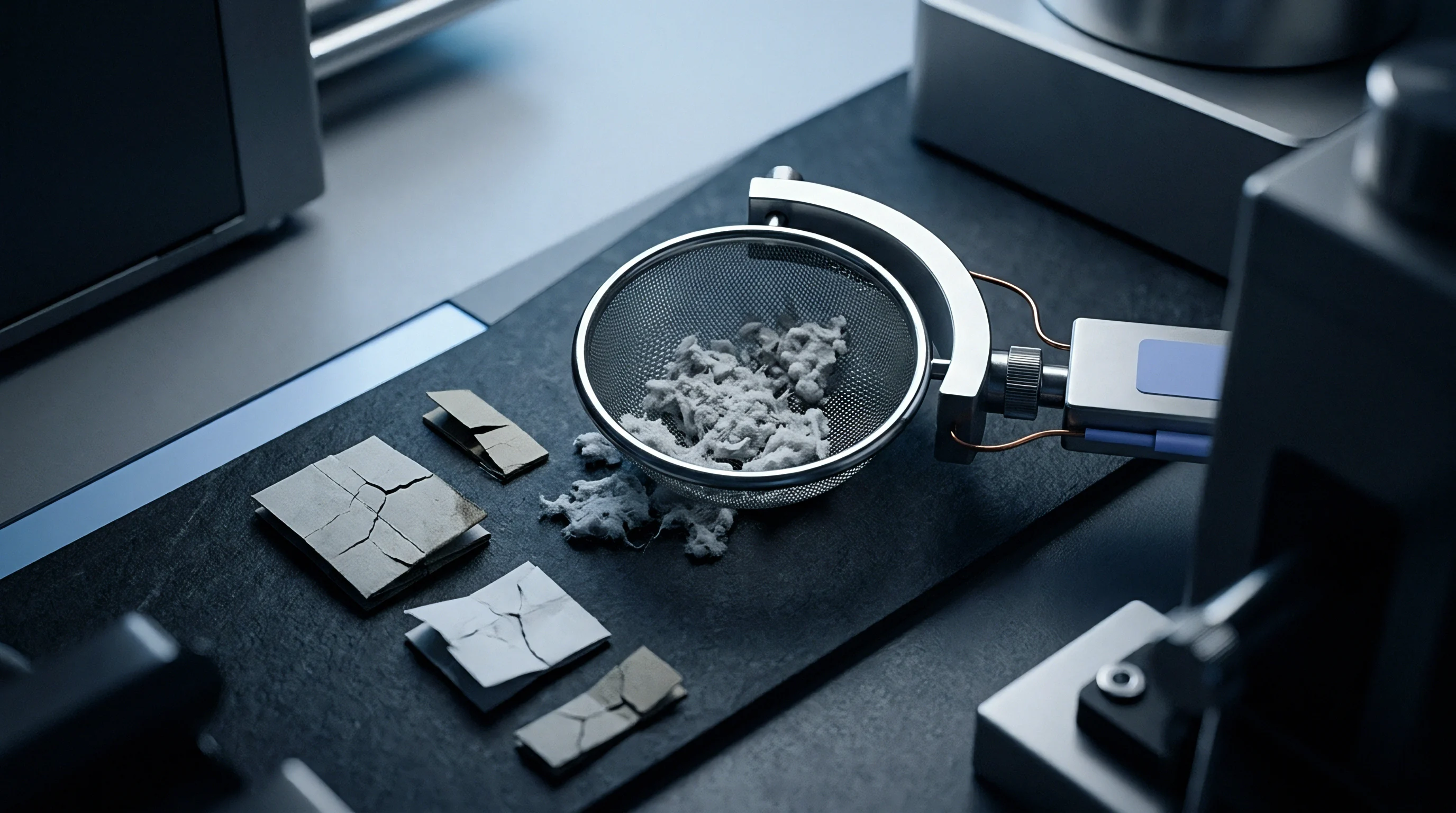
Laboratory evaluation of recovered paper pulp relies on screenability assays that quantify macro-sticky contamination through standardized slot fractionators. Test methods including TAPPI T 275, ISO 5263, and INGEDE Method 4 use slotted laboratory screens with nominal slot widths of 0.10 millimeters or 0.15 millimeters to isolate tacky synthetic contaminants from cellulosic fibers. The primary objective involves measuring the oven-dry mass of rejects retained on the screen basket after a prescribed volume of pulped slurry passes through under controlled hydraulic pressure.
Standard laboratory testing assumes physical slot rejection correlates directly with contaminant removal efficiency during commercial packaging stock preparation.
Fractionation Dynamics in Standardized Somerville and Haindl Apparatus
Standard test procedures isolate coarse contaminants by passing an aqueous suspension over a slotted plate under constant hydraulic pressure and continuous rinsing. The Somerville fractionator uses a flat screen plate containing 0.15 millimeter slots subjected to mechanical vibration at 690 cycles per minute. The Haindl fractionator employs a cylindrical screen plate featuring 0.10 millimeter slots backed by a reciprocating membrane that generates hydraulic pulsations.
In both bench instruments, suspension consistency is maintained at 0.2 percent to 0.5 percent dry solids with liquid temperature standardized at 20 degrees Celsius. These conditions prevent synthetic adhesives, pressure-sensitive labels, and hot-melt polymers from sticking to metal surfaces during screening.
Inside laboratory fractionators, synthetic contaminants remain largely rigid. Operating at 20 degrees Celsius keeps common packaging adhesives well below their glass transition temperature. Ethylene vinyl acetate hot melts, polyvinyl acetate dispersions, styrene-butadiene rubber latexes, and acrylic pressure-sensitive adhesives retain high complex modulus values under ambient laboratory conditions.
Because the slot profile remains stationary, particles larger than the nominal slot width cannot deform or stretch under the low hydrodynamic shear forces present in laboratory test cells.
Laboratory screen slot thresholds measure rigid particle geometry under cold hydraulic conditions while ignoring thermal deformation.

Limitations of Low-Consistency Particle Separation
Mechanical screening on testing tables operates at fluid consistencies between zero point two and zero point five percent solids to eliminate fiber mat formation over screen slots. A fiber network forming on the screening plate alters the effective slot opening, artificially retaining fine particles. While low consistency keeps fiber flocs from plugging laboratory slots, it dilutes hydrophobic contaminant particles, suppressing particle-to-particle collisions so synthetic adhesive fragments remain isolated rather than forming larger agglomerates.
The geometry of laboratory screen slots differs fundamentally from commercial hardware. Laboratory plates feature flat rectangular slots with smooth stainless steel edges and zero contouring. Commercial stock preparation screens employ contoured slot profiles, such as step-wave or fine-groove geometries, designed to induce localized micro-turbulence and prevent slot blinding at production consistencies between 1.5 percent and 3.5 percent solids.
Without fluid turbulence during laboratory testing, non-spherical particles like thin film fragments and elongated synthetic fibers can align perpendicular to the slot opening and pass into the accepted stock fraction.
| Standard / Method | Laboratory Slot Width & Profile | Commercial Stock Slot Width & Contour | Pass-Through Cutoff Mechanism |
|---|---|---|---|
| TAPPI T 275 (Somerville) | 0.15 mm Flat Stainless Steel | 0.12 mm to 0.18 mm Contoured Step-Wave | Static Geometric Cutoff at 20 °C |
| INGEDE Method 4 (Haindl) | 0.10 mm Flat Smooth Membrane | 0.10 mm to 0.15 mm Wedge Wire Profile | Pulsated Hydraulic Rinse without Thermal Softening |
| Pulmac Master Screen | 0.10 mm or 0.15 mm Flat Plate | 0.15 mm to 0.22 mm Smooth Bar Profile | Positive Displacement Rotor Pressure Field |
| PTS-RH 021/97 Bench Assay | 0.12 mm Flat Precision Slot | 0.10 mm to 0.15 mm High-Turbulence Wave | Batch Washing at Low Consistency |
| Test conditions standardized at 0.2 percent to 0.5 percent consistency and 20 °C fluid temperature per normative standard text. | |||
Discrepancies in particle retention stem from fundamental physical mechanisms during laboratory screening. Standardized test protocols classify all organic matter passing through a 0.10 millimeter slot as clean fiber furnish or benign fine material. Several operational failure modes explain why laboratory screening results misrepresent commercial stock cleanliness:
- Thermal Modulus Suppression prevents adhesive softing by enforcing a fixed 20 degree Celsius liquid temperature throughout the test sequence.
- Hydrodynamic Shear Absence allows deformable synthetic particles to traverse flat slots without undergoing elongation or cross-sectional reduction.
- Extreme Colloidal Dilution eliminates hydrophobic particle collision opportunities, halting premature agglomeration inside the test chamber.
- Static Edge Geometry fails to generate micro-vortices that would otherwise force flexible film fragments through screen openings in industrial applications.
Laboratory fractionators exist solely to establish relative cleanliness indices between pulp batches rather than simulate commercial mill stock preparation lines.
Coalescence
Pressure drops across industrial stock preparation screens force flexible contaminants through slot geometries narrower than the unformed particle diameter. In commercial recycled paper mills, stock suspension temperatures range from 45 degrees Celsius to 65 degrees Celsius. Chemical additives, mechanical refining, and continuous pumping impart high kinetic energy into the fiber slurry.
Under these conditions, synthetic polymers pass through the glass transition phase, transforming rigid adhesive particles into viscoelastic fluids.

Thermodynamic and Hydrodynamic Drivers in Mill Stock Systems
Commercial recycled pulp circuits operate at elevated energy states where mechanical energy inputs translate into fluid thermal energy. Viscoelastic adhesives soften dramatically when stock temperatures cross their specific glass transition threshold. For styrene-butadiene rubber latices and acrylic packaging adhesives, glass transition occurs between minus 10 degrees Celsius and plus 15 degrees Celsius.
Hot-melt packaging adhesives soften between 40 degrees Celsius and 55 degrees Celsius. Cold slurry prevents binder softening in laboratory tests, but mill stock preparation channels supply continuous heat that increases polymer chain mobility.
Hydrodynamic shear forces within commercial pressure screens further alter particle dimensions. Rotor blades moving past screen baskets at peripheral speeds between 15 and 25 meters per second create high negative pressure pulses followed by intense positive acceleration fields. Under these conditions, a soft adhesive particle with an unformed diameter of 0.30 millimeters elongates into a thin strand, passing lengthwise through a 0.15 millimeter commercial screen slot.
Once past the screen plate, the shear stress collapses and the surface tension of the hydrophobic polymer causes the strand to reform into a spherical particle inside the accepted stock stream.
At slurry temperatures above forty-five degrees Celsius, micro-sticky pass-through rates exceed eighty-two percent across zero point one five millimeter slots.
Can Sub-Hundred-Micron Slots Predict Downstream Colloidal Agglomeration?
Particle size distributions measured immediately after laboratory fractionation frequently show complete removal of synthetic binder fragments exceeding 100 micrometers. However, particles smaller than 100 micrometers ~ designated as micro-stickies and colloidal dispersoids ~ flow freely through both laboratory and commercial screen baskets. These sub-hundred-micron contaminants carry high specific surface area and elevated hydrophobic surface energy.
Without stabilizing surface-active agents, hydrophobic particles minimize their interfacial free energy in water by adhering to each other upon physical impact.
Shear forces inside stock pumps and disc refiners induce orthokinetic coagulation. As stock flows through refining zones where bar clearance measures less than 0.5 millimeters, micro-sticky particles undergo millions of collisions per second. High mechanical shear strips protective surfactant coatings from adhesive dispersions.
Exposed hydrophobic surfaces unite upon contact, building macro-sticky agglomerates downstream of secondary and tertiary screening stages. Consequently, pulp that registered zero macro-sticky content during laboratory 0.10 millimeter slot screening arrives at the paper machine headbox containing severe macro-sticky agglomerates measuring over 0.50 millimeters in diameter.
Consider a commercial recycled board line processing 50 tonnes per hour of old corrugated containers operating at 3.2 percent consistency and 52 degrees Celsius. Mechanical pulping and high-density cleaning deliver stock containing 120 grams of disperse micro-stickies per tonne of dry fiber, with individual particle diameters averaging 35 micrometers. Laboratory slot screening of this incoming stock shows zero reject mass on a 0.15 millimeter Somerville plate because all 35-micrometer particles pass through the screen openings.
Inside the mill stock preparation circuit, the pulp passes through two stages of disc refining operating at an energy input of 60 kilowatt-hours per tonne. The combined effects of 52 degree Celsius temperature, mechanical shear, and divalent calcium ion concentration from closed water loops destabilize the disperse particles. Orthokinetic collision efficiency reaches 14 percent across the refining zone.
Downstream laser particle analysis reveals that 68 percent of the initial 35-micrometer micro-stickies coalesce into macro-stickies with mean diameters of 280 micrometers. These newly formed macro-stickies deposit directly onto the press felts and dryer cylinders of the paper machine.
Whether high-frequency ultrasonic attenuation can track micro-sticky agglomeration in real time before stock reaches the headbox remains an unanswered operational question.

Gap
Discrepancies between laboratory screening certificates and paper machine runnability stem from physical differences between bench fractionators and industrial paper mills. Standard recyclability certification protocols evaluate substrate compliance based on the dry mass fraction rejected by a laboratory slotted plate. When an adhesive or coating formulation yields less than 0.5 percent dry reject mass during INGEDE Method 11 or PTS-RH 021/97 testing, the substrate receives a pass certificate for recyclability.
This classification ignores the total mass of disperse organic material that passes through the laboratory slot and enters the water loop.

Recyclability Standard Screenability Criteria versus Mill Machine Deposition
European packaging directives and voluntary industry frameworks rely on laboratory fractionators to gate material entry into secondary fiber markets. A packaging board coated with synthetic wax or acrylic dispersion may show 99.2 percent pass-through efficiency across a 0.15 millimeter laboratory screen slot. Under certification rules, high pass-through efficiency yields a favorable screenability score because minimal mass accumulates on the screen plate.
The laboratory method treats complete pass-through as successful repulping and fiber liberation.
In commercial paper production, complete pass-through of water-insoluble synthetic polymers represents a severe operational hazard. Polymers passing through screen slots enter the paper machine white water circuit. As white water recirculates to conserve fresh water, the concentration of colloidal and micro-sticky contaminants increases exponentially.
Deposition occurs on press felts. Dryer cylinder temperatures exceed sixty degrees. Tacky films transfer from the paper web onto ceramic foil blades, press rolls, and dryer canvas fabrics, causing sheet holes, web breaks, and finished product staining.
Adherence to PTS Method PTS-RH zero two one specifies total extracted sticky mass limits that trigger rejection of non-compliant furnish shipments.

Colloidal Extraction and Thermogravimetric Mass Discrepancies
Chemical extraction assays reveal the magnitude of unmeasured micro-stickies passing through laboratory screen slots. Solvent extraction using dichloromethane or methyl tert-butyl ether isolates total organic solvent-extractable content from accepted pulp filtrate, while thermogravimetric analysis combined with gas chromatography-mass spectrometry identifies the specific polymer composition.
| Stock Prep Process Stage | Shear Rate & Temperature Range | Laboratory Pass-Through Fraction | Commercial Sticky Accumulation Profile |
|---|---|---|---|
| High-Consistency Pulper | 100 to 500 s⁻¹ at 40 °C to 55 °C | 95% to 99% (Dispersed State) | Minimal Deposition (Primary Dispersion) |
| Coarse Slotted Screening | 1,000 to 3,000 s⁻¹ at 45 °C to 50 °C | 85% to 92% (Deformable Pass) | Low Deposition (Macro-Screening Accept) |
| Disc Refining & Deflaking | 10,000 to 35,000 s⁻¹ at 50 °C to 65 °C | 100% (Colloidal Pass) | High Coalescence (Orthokinetic Agglomeration) |
| Headbox & Forming Fabric | 2,000 to 8,000 s⁻¹ at 50 °C to 60 °C | N/A (Accepted Stock) | Severe Deposition (Wire & Foil Blade Tack) |
| Press Section & Dryer Cans | Static Pressure at 60 °C to 115 °C | N/A (Sheet Web Contact) | Critical Deposition (Felt Clogging & Spotting) |
Quantifying micro-sticky deposition potential requires monitoring critical stock parameters beyond simple slot reject mass balance calculations. Mill operators manage stock prep systems through structured diagnostic protocols:
- Sample accepted pulp filtrate immediately downstream of secondary slotted screens using a 200-mesh dynamic drainage jar.
- Determine the colloidal micro-sticky concentration via ethyl acetate chemical extraction combined with gravimetric residue drying.
- Measure the dynamic surface charge and hydrophobic particle distribution using micro-electrophoresis and laser particle counters.
- Subject the accepted filtrate to thermomechanical shear at 55 degrees Celsius in a laboratory mixer to calculate the downstream macro-sticky formation index.
Relying exclusively on bench screening certificates for secondary furnish approval leads to unscheduled machine downtime and premature press felt replacement costs.

Friction
Disagreements between packaging converters and paper mill purchasing agents peak when certified recyclable paperboard yields severe press felt contamination. Converter marketing departments present laboratory recyclability certificates issued by accredited test houses to prove environmental compliance under European Packaging and Packaging Waste Regulation guidelines. These certificates state that the packaging material achieved screenability scores exceeding 90 percent using standard laboratory slot protocols.
Paper mill technical managers reject these claims when the furnish causes sticky deposits on paper machine clothing.
Commercial Liability and Recyclability Qualification Certificate Disconnects
Certificates issued under voluntary recycling schemes document laboratory compliance under static bench conditions. Standard test certificates from PTS, INGEDE, or Cepi document pass-through performance under precise laboratory parameters, while explicitly disclaiming performance guarantees on commercial paper machines. Scope lines for the exact grade tested confirm that bench passes do not cover high-temperature commercial re-pulping operations.
The legal gap between laboratory qualification and commercial reality creates financial exposure for paper mills buying secondary furnish. When a mill processes 500 tonnes of certified recyclable coated board, disperse polymers build up on forming fabrics and press felts. Because lab slots miss micro-stickies entirely, the resulting sticky buildup forces the mill to perform solvent boilouts, stop production, or replace ruined felts prematurely.
Standard raw material procurement contracts rarely tie substrate acceptability to micro-sticky chemical extraction thresholds, leaving the paper mill to absorb operational losses.
Higher hydrodynamic shear in stock preparation pipelines converts microscopic adhesive fragments into macroscopic wire deposits.
Contractual Verification Mechanics for Recycled Fiber Furnish
Procurement documents specifying secondary fiber quality routinely rely on TAPPI or INGEDE laboratory metrics. To protect mill operations, commercial purchasing contracts must incorporate dual-threshold quality specifications combining laboratory slot screening with chemical micro-sticky extraction limits.
Verification protocols must mandate batch-level testing of incoming furnish before offloading at the mill ramp. A decision checklist for robust furnish verification includes the following mandatory items:
- Laboratory Macro-Sticky Mass Limit verified via 0.10 millimeter Haindl slot fractionator not exceeding 0.10 percent dry mass.
- Solvent Extractable Micro-Sticky Threshold measured via methyl tert-butyl ether extraction on accepted screen filtrate capped at 250 parts per million dry fiber mass.
- Thermal Softening Index determined via differential scanning calorimetry showing adhesive softening points above 70 degrees Celsius.
- Deposition Potential Rating established via stainless steel rotor vibration deposition tests executed at 55 degrees Celsius stock temperature.
Incorporating Annex C of the EN 13430 recyclability standard into purchasing terms transfers financial responsibility for micro-sticky felt contamination directly to the substrate manufacturer.

Ledger
Financial losses resulting from micro-sticky deposition accumulate across multiple operational centers in a paper mill. Raw material selection decisions based solely on low purchase price per tonne frequently increase total landed manufacturing costs due to unhedged downtime. Unwashed felts reduce drainage capacity.
When micro-stickies fill the porous structure of press felts, dewatering efficiency drops, raising steam consumption in the dryer section and forcing machine speed reductions.
Quantifying Financial Loss from Downstream Machine Downtime
Unplanned papermaking stoppages driven by press felt solvent washing directly erode mill operating margins. A typical containerboard machine producing 40 tonnes per hour incurs fixed operating costs of 4,200 Euros per hour. When micro-sticky accumulation causes five web breaks per day, lost production time averages 2.5 hours daily.
Direct production losses equal 100 tonnes of finished paper per day, representing 45,000 Euros in unrecoverable margin at current containerboard prices.
Chemical boilout costs and felt replacement cycles multiply total losses. Cleaning contaminated press felts requires continuous chemical metering of solvent micro-emulsions and periodic batch washings with organic solvents, which causes added production downtime. Accelerated felt compaction from micro-sticky embedding reduces felt operational lifespan from 45 days down to 18 days.
Replacing a triple-layer press felt costs 38,000 Euros for the fabric alone, excluding four hours of installation downtime. Standard mass balance calculations hide organic pitch. Calculating total cost per tonne of processed secondary fiber demands combining raw material purchase prices with downstream wash water chemical treatment fees and solvent boilout downtime expenses.