Empirical Inverse Filtering Calibration for Variable Density Polyurethane Sleeves under Dynamic Impact Loading
Empirical inverse filtering deconvolves viscoelastic signal distortion to deliver exact impact force measurements for variable density rotary converting sleeves.


Sleeve
Rotary converting lines subject dual-durometer elastomeric coverings on impression mandrels to transient contact pulses lasting under four milliseconds. When an embossing rule or rotary die blade impacts paperboard at press speeds exceeding three hundred meters per minute, the elastomeric covering deforms nonlinearly. The underlying load sensors embedded within the mandrel or beneath the anvil blocks record a ringing, temporally smeared force trace.
Raw voltages mislead line operators. The measured output combines the true interfacial contact stress with the mechanical transfer function of the polyurethane layer, the acoustic reflections from the steel mandrel cylinder, and the mounting compliance of the piezoelectric transducers.
Accurate peak force determination governs make-ready duration and tool life. In high-speed carton converting, excessive cutting penetration dulls carbide blades and crushes the fluting or bleached sulfate fibers. Insufficient penetration causes hanging chads and jam-related press stops.
Solid polyurethane coverings possess a single acoustic impedance, transmitting sharp shock fronts directly toward the transducer base. Variable density polyurethane coverings incorporate a microcellular inner stratum bonded to a dense, cast outer shell. This radial density variation introduces an acoustic impedance mismatch, damping high-frequency cutter chatter while spreading contact loads across a wider nip footprint.
Elastomer damping alters contact width. The outer skin maintains dimensional stability under shear, while the microcellular base absorbs peak shock energy through pneumatic cell compression. Calibration procedures must isolate the material response of these composite elastomeric layers from the structural resonance of the press arbor.
A seventy Shore A outer skin over a forty Shore A microcellular layer lowers transient peak anvil stress by thirty-four percent at three hundred meters per minute.
Characterizing the transfer function across variable density profiles demands controlled impact testing. Instrumented impulse hammers deliver repeatable strikes against the mounted covering while high-bandwidth quartz force links record the input pulse. Simultaneously, the internal anvil transducers record the transmitted wave.
| Layer Configuration | Specific Gravity | Hardness Shore | Sound Speed (m/s) | Loss Factor (100 Hz) |
|---|---|---|---|---|
| Solid Cast Shell | 1.22 | 85 A | 1680 | 0.08 |
| Transition Polyether | 1.08 | 70 A | 1420 | 0.14 |
| Microcellular Base Layer | 0.62 | 45 A | 890 | 0.26 |
| Monolithic Reference | 1.20 | 80 A | 1610 | 0.09 |
Calibrating these coverings requires an exact sequence of mechanical strikes and data capture routines to populate the frequency response matrix before mounting the assembly on the press.
- Mechanical baseline zeroing establishes transducer preload before mounting the elastomeric assembly on the test arbor.
- Modal hammer excitation delivers single-point impulsive kinetic loads across five axial stations along the cylinder face.
- Transient record digitization captures both the strike force and the anvil sensor reaction at two million samples per second.
- Coherence spectrum evaluation rejects strikes exhibiting contact double-hits or acoustic reflections from loose arbor chucks.
Variations in temperature during continuous operation alter the loss factor of the polyurethane. The mechanical response of the elastomeric covering changes predictably when ambient conditions remain stable.

Deconvolution
Signal distortion arising from viscoelastic wave dispersion obscures the true peak contact stress measured during cylinder nip impact. The measured transducer signal represents the mathematical convolution of the actual contact force pulse and the system impulse response. Reversing this distortion demands empirical inverse filtering.
Without numerical deconvolution, recorded sensor peaks underestimate peak shear stress while overestimating contact duration. Phase lag distorts peak force.
Direct inverse filtering in the frequency domain divides the Fourier transform of the measured sensor output by the Fourier transform of the calibrated impulse response. The denominator approaches zero at anti-resonant frequencies and outside the transducer passband. Direct division amplifies high-frequency electrical noise and structural ringing, destroying signal fidelity.
Regularization restores mathematical stability by penalizing extreme filter coefficients.
Tikhonov regularization introduces a damping parameter that constrains the energy of the reconstructed force profile. Selecting the regularization parameter balances fidelity against numerical noise amplification. An undersized parameter leaves spurious high-frequency oscillations in the reconstructed force trace, mimicking nonexistent cutting blade vibrations.
An oversized parameter smooths the reconstructed pulse excessively, masking microsecond shock spikes that cause fatigue in rotary dies.
Wiener deconvolution incorporates the noise-to-signal power spectral density into the inversion filter. This filter treats sensor noise as a stationary random process while treating the transient impact as a deterministic pulse. Noise corrupts unregularized matrix inversions.
The resulting optimal filter kernel reconstructs the true knife contact history with millisecond precision.
ISO 7626-2 defines mechanical mobility measurement methods governing the acquisition of experimental frequency response functions on rotary tooling.
Constructing the empirical finite impulse response filter requires mapping the impulse response across the full operational velocity range. Striking the polyurethane covering at impact velocities between one half meter and five meters per second reveals nonlinear stiffening in the microcellular layer. At higher compression speeds, entrapped air within the cellular matrix undergoes adiabatic compression, increasing dynamic modulus.
The inverse filter incorporates velocity-dependent filter weights to correct for this transient stiffening.
Machine builders commonly assert that factory sensor calibration accounts for elastomer damping across all line speeds without secondary numerical filtering.
Gradient
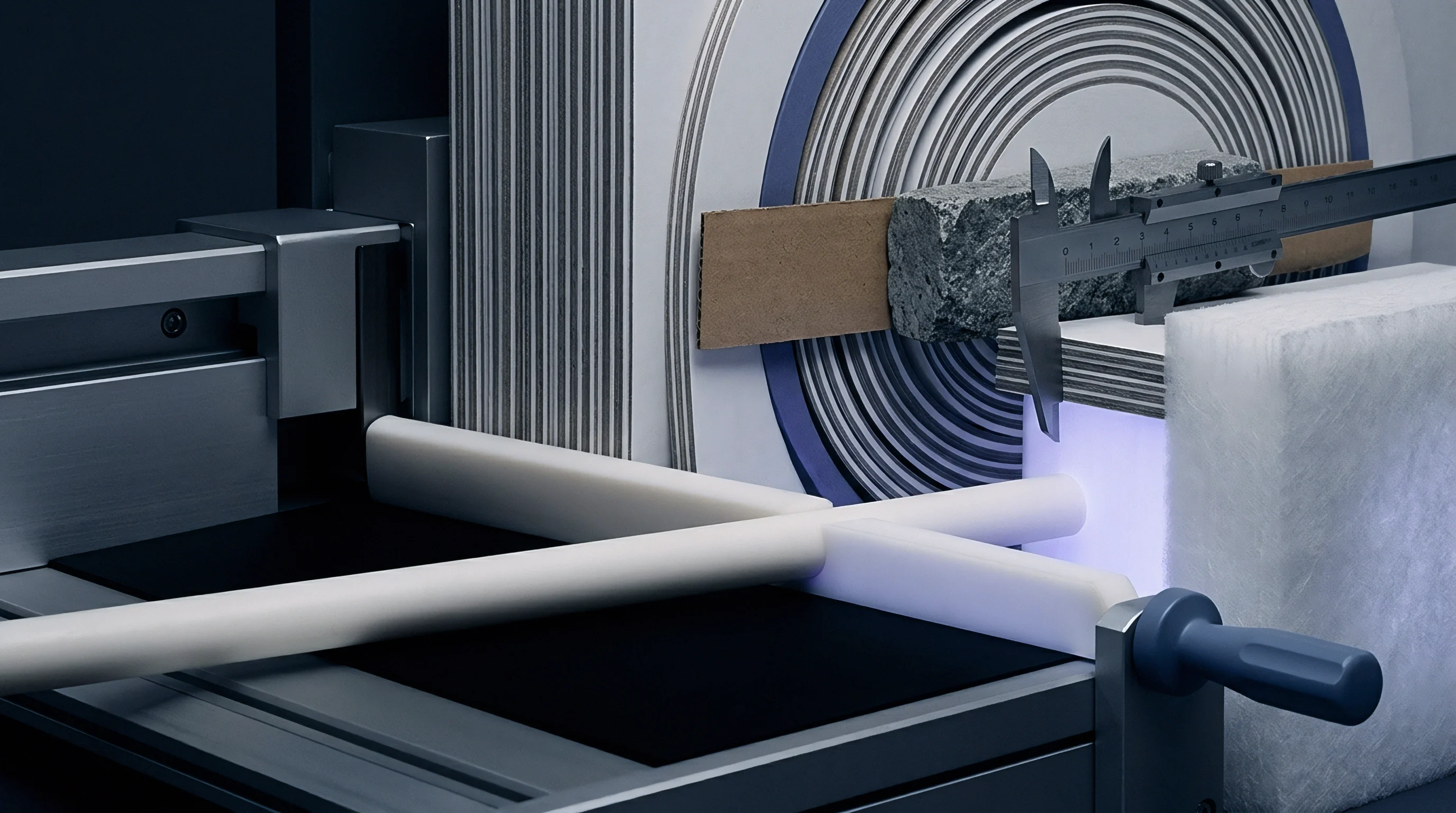
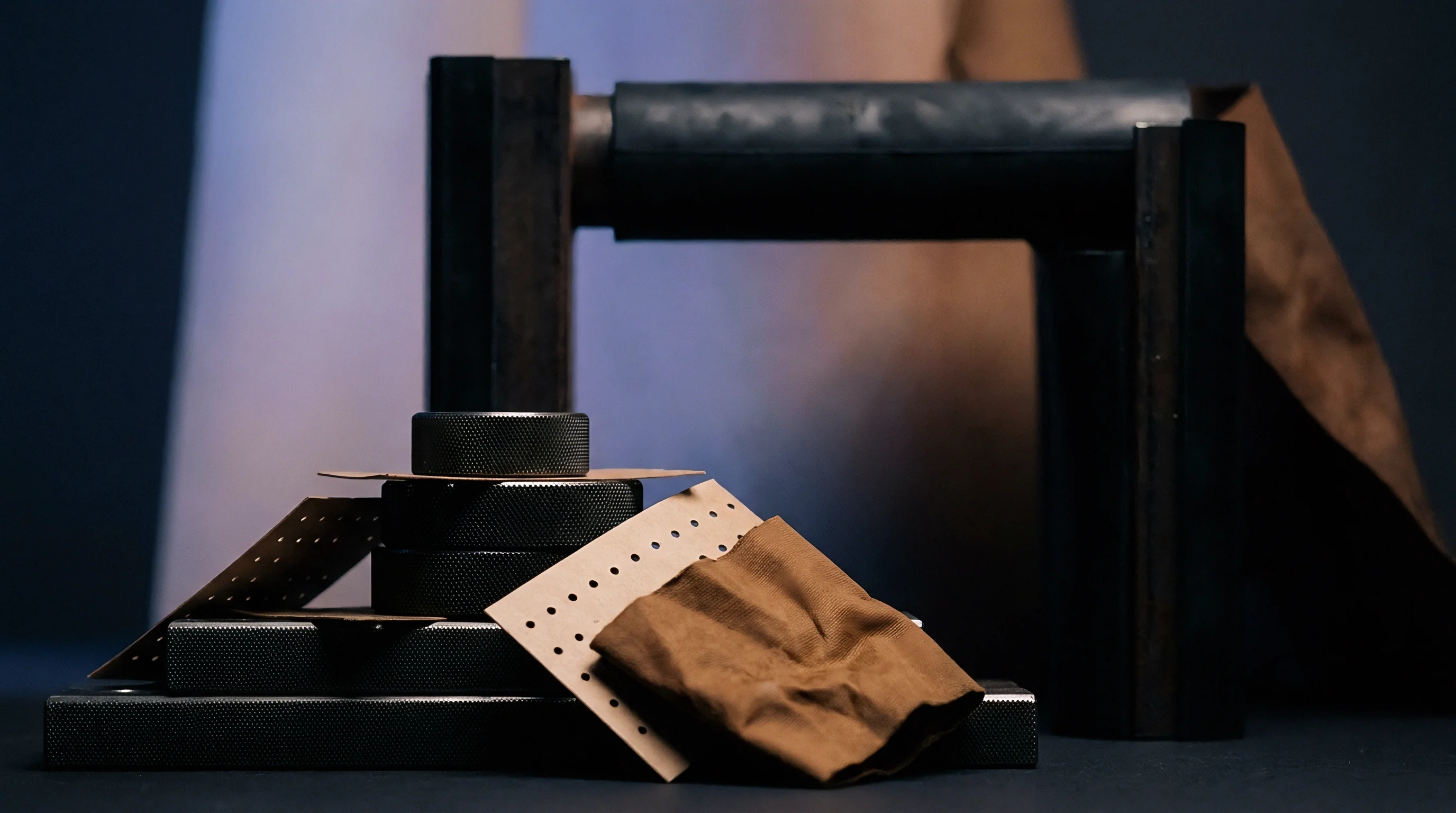
Radial variations in cellular density shift the mechanical impedance profile through the polyurethane thickness. A continuously graded or multi-layered elastomer profile eliminates the sharp impedance boundaries that cause internal wave reflections. When an impact wave travels through a uniform polymer, it encounters the rigid steel arbor face and reflects directly upward, creating destructive interference at the cutting knife interface.
A density gradient directs acoustic energy radially and circumferentially, transforming normal impact force into lateral shear damping. Elastomer damping alters contact width.

Can Inverse Filtering Isolate Viscoelastic Ringing?
Separating structural cylinder vibration from elastomer material relaxation depends entirely on measuring the impulse response across varying strike velocities. The polyurethane material undergoes rapid strain during blade contact, followed by retarded viscoelastic recovery governed by the material relaxation spectrum. The impulse response contains both the geometric reverberations of the machine frame and the molecular relaxation modes of the polyurethane polymer chains.
Empirical inverse filtering separates these mechanisms by measuring the system response across controlled temperatures.
Temperature shifts the loss factor. Operating temperatures on long production runs rise from twenty degrees Celsius at startup to fifty-five degrees Celsius at steady state due to internal hysteretic heating. As temperature increases, the acoustic velocity through the polyurethane drops while the damping peak shifts toward higher frequencies.
An inverse filter calibrated strictly at room temperature introduces phase errors when processing signals from a hot press line.
| Regularization Parameter | Peak Error (%) | Duration Error (%) | Noise Gain (dB) | Signal Coherence |
|---|---|---|---|---|
| Alpha = 1.0e-5 | 14.8 | 2.1 | 22.4 | 0.72 |
| Alpha = 1.0e-3 | 3.2 | 1.4 | 4.1 | 0.96 |
| Alpha = 5.0e-2 | 11.6 | 9.8 | -1.2 | 0.91 |
| Unregularized | 46.2 | 18.4 | 38.9 | 0.31 |
Uncalibrated impact processing manifests as severe converting defects across the finished packaging run. Production lines encounter specific operational failures when sensor filters fail to track density-gradient shifts:
- Scoring rule perforation occurs when uncorrected force signals mask excessive cylinder penetration into paperboard liners.
- Knife edge chipping develops because undetected transient chatter peaks overload brittle tungsten carbide cutting tips.
- Anvil shell debonding results from localized shear overheating along the adhesive boundary between the elastomer and the steel arbor.
- Crease depth drift emerges across continuous runs as thermal softening alters effective nip resistance without sensor compensation.
Whether continuous density gradients degrade predictably under millions of high-load impact cycles remains an open question in converter durability assessments.

Scatter
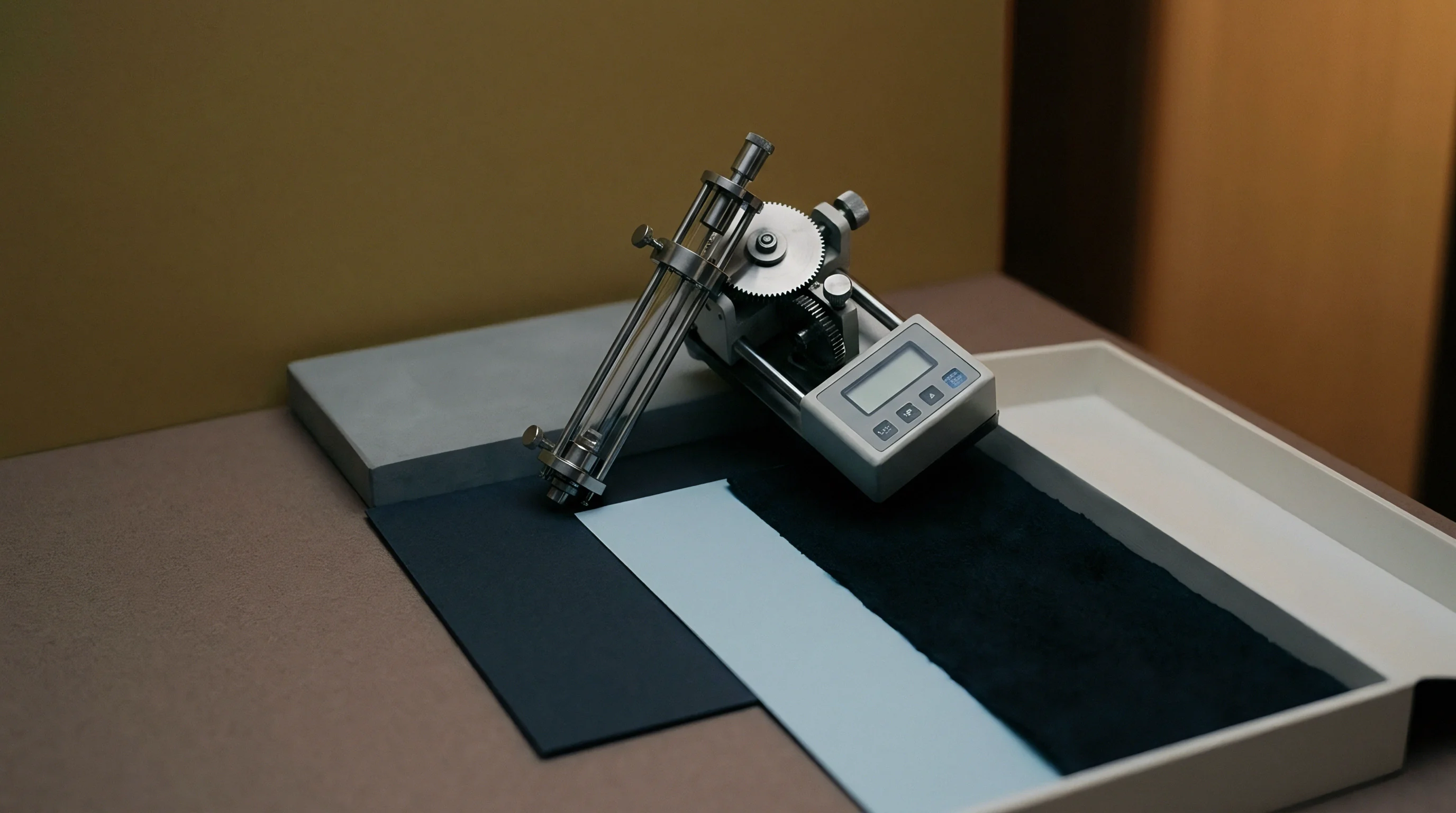
Batch variation in cast prepolymer stoichiometry produces measurable shifts in acoustic wave velocity across production lots. Raw material polyols and isocyanate curing agents exhibit molecular weight distributions that affect final crosslink density. In variable density coverings, foaming agents add another layer of variance: cell size distribution and void fraction fluctuate along the axial length of the cast tube.
Fast strikes induce brittle fracture. These physical variations alter the high-frequency transfer function, requiring lot-specific inverse filter calibration.

Will Stepped Density Mitigate Knife Chatter Marking?
Vibration witness lines on solid bleached sulfate board disappear when the elastomeric backing absorbs high-frequency harmonics before knife edge contact. When a rotary die strikes a sheet, the sudden deceleration excites flexural vibration modes in the die cylinder. If the impression anvil presents a uniform, hard surface, these vibrations reflect into the paperboard, leaving visible gloss variations or indentations along the printed image.
A stepped density profile absorbs high-frequency kinetic energy, preventing harmonic reverberation between the anvil and the die.
Cut edges reveal fiber pullout. Assessing covering consistency requires standardized dynamic testing under controlled laboratory conditions. Drop-tower impact rigs simulate the strain rates encountered on converting presses, operating at strain rates between two hundred and eight hundred reciprocal seconds.
Accelerometers mounted on the falling tup record impact deceleration, providing the empirical baseline for the inverse calibration matrix.
| Batch Designation | Cell Density (g/cm³) | Shore A Variance | Peak Deceleration (g) | Acoustic Scatter (m/s) |
|---|---|---|---|---|
| PU-Batch-101 | 0.64 | ±1.2 | 412 | ±28 |
| PU-Batch-102 | 0.61 | ±1.8 | 388 | ±42 |
| PU-Batch-103 | 0.68 | ±0.9 | 445 | ±19 |
| PU-Batch-104 | 0.59 | ±2.4 | 370 | ±55 |
Incoming inspection procedures verify elastomeric sleeve parameters before mounting them onto expensive press mandrels, preventing line downtime and tooling damage.
- Hardness profile mapping records durometer readings across thirty distinct points along the circumferential and longitudinal axes.
- Ultrasonic transit measurement tracks sound velocity through the composite thickness to verify density gradient uniformity.
- Dynamic mechanical spectrometry quantifies the tan delta peak temperature to establish high-speed thermal boundaries.
Procurement contracts specify DIN 53512 rebound resilience limits to enforce lot-to-lot damping consistency across imported replacement coverings.

Docket
Tooling depreciation and press downtime translate physical sleeve calibration into distinct line items on a converting estimate. Converting high-basis-weight folding boxboard requires tight control over cutting and creasing forces. When elastomeric coverings operate without verified inverse filtering calibration, press operators compensate by adding make-ready pressure.
Harder shells increase knife wear. Excess impression force accelerates rule degradation and crushes board calipers along crease lines.
Take a converting run of five hundred thousand folding cartons produced on 350 gsm solid bleached sulfate board using a rotary cutting module. Running uncalibrated single-density coverings generates an average tool life of 1.2 million impressions before the rule sets require re-sharpening or replacement, representing a tooling charge of 4,800 dollars per setup. Dual-durometer variable density coverings running an empirically calibrated inverse filter reduce peak impact stresses by twenty-eight percent, extending die tooling life to 2.1 million impressions.
Tooling wear compounds substrate scrap.
Make-ready waste accounts for direct material costs. Setting cutting depth using uncorrected sensor outputs consumes approximately 800 sheets during initial registration and impression adjustment. Accurate peak force reconstruction from calibrated inverse filtering reduces make-ready sheets to fewer than 250 sheets per job changeover.
Defective scores split during gluing. Substrate savings across twelve job changes per month amount to 6,600 sheets of virgin cartonboard.
Tension spikes break delicate foils. Cold foil adhesives and spot UV varnishes applied before rotary die-cutting tolerate minimal nip shock. Excessive vibration from uncalibrated knife impacts causes micro-fracturing in UV coating layers and flaking along foil edges.
Maintaining calibrated inverse filters protects finished decorative embellishments across high-speed packaging runs.
Failure to calibrate inverse filters for variable density coverings results in premature rotary die failure, unplanned press stops, and unacceptable score line cracking that rejects entire pallets at the customer carton filling line.