Fluorescent Spectrophotometry Principles for Paper Coating Analysis
Fluorescent spectrophotometry verifies paper coating brightness and tint by balancing calibrated ultraviolet excitation against stilbene fluorophore saturation limits.

Lamp
Spectrophotometers flashing pulsed xenon gas discharges measure reflectance across the ultraviolet and visible spectrum from 300 to 700 nanometres. Instruments record spectral radiance factors by separating pure surface reflection from wavelength-shifted emissions generated by fluorescent whitening agents in the paper coating layer. The incoming energy excites stilbene molecules embedded in the mineral matrix, shifting radiation absorbed between 340 and 380 nanometres into emitted blue light between 420 and 460 nanometres.
Accurate evaluation demands constant surveillance of this ultraviolet excitation flux relative to visible emissions.
Xenon flash lamps deliver discrete pulses. High-speed electronic sensors capture the reflected wavefront before thermal drift alters the gas tube temperature. Laboratory conditioning at 23 degrees Celsius and 50 percent relative humidity, regulated by ISO 187, stabilizes the moisture content of the sheet coating at approximately five to six percent.
That equilibrium moisture maintains the physical spacing between coated particles and organic optical brightening molecules, preventing localized structural compaction that distorts reflectance values.

Spectral Energy Distribution across Excitation Bands
Illumination standards define the exact ratio of ultraviolet radiation to visible light hitting the paper surface. The international reference illuminant D65 simulates average daylight with a correlated colour temperature of 6504 Kelvin, featuring substantial radiant flux in the 300 to 400 nanometre ultraviolet band. Tungsten-halogen sources fail to produce adequate ultraviolet energy below 360 nanometres without severe thermal load on the paper sample.
The flash duration of a xenon tube lasts fractions of a millisecond, preventing the heating of organic binders or moisture evaporation from the starch network during the reading cycle.
Stilbene molecules absorb ultraviolet radiation efficiently. Excited electrons drop through vibrational relaxation. The emission spectrum presents a characteristic bell-shaped curve peaked near 440 nanometres, directly counteracting the natural yellowish reflectance profile of kraft wood pulp.
In uncoated sheets or base papers with low brightness, the underlying lignin absorbs heavily in the near-ultraviolet region, competing directly with synthetic fluorescent molecules for available photons. Applying a uniform mineral coating insulates the optical brightener from the light-absorbing base furnish, raising fluorescence efficiency.
Pulsed xenon arc sources require optical filtering to prevent excessive short-wavelength radiation from degrading stilbene molecules during measurement cycles.
Short-wavelength radiation below 320 nanometres produces photolytic cleavage of conjugated double bonds within stilbene compounds. Optical glass filters cut off deep ultraviolet radiation, blocking wavelengths that never occur in normal pressroom or retail environments. Spectrophotometers isolate the excitation bands through motorized filter assemblies, alternating between ultraviolet-included settings to capture total radiance and ultraviolet-excluded settings using a 420-nanometre high-pass filter.
- Stray light leakage across the diffraction grating contaminates faint ultraviolet signals with intense visible green and red wavelengths.
- Arc discharge jitter alters the spatial position of the plasma within the xenon bulb, creating non-uniform illumination on the specimen port.
- Filter aging shifts the transmission boundary of cut-off glass toward longer wavelengths following prolonged exposure to flash radiation.

Dual Beam Optics and Radiant Stability
Split optical paths monitor lamp output fluctuations in real time. One light channel travels directly to an internal reference photodiode while the primary channel illuminates the coating specimen within the integration sphere. Calculating the ratio between the specimen signal and the reference signal neutralizes pulse-to-pulse energy variances inherent to gas discharge tubes.
The instrument microprocessor corrects the spectral curves instantaneously, holding analytical variance within 0.05 reflectance units across consecutive flashes.
Detector arrays split the reflected beam using concave holographic gratings onto silicon photodiode arrays with spectral resolutions of 10 nanometres or 5 nanometres. Older filter-wheel instruments rotated mechanical discs to sample individual wavelengths, introducing mechanical backlash and slower acquisition speeds that permitted sample movement during multi-angle evaluations. Modern diode array systems record all visible and near-ultraviolet channels simultaneously within ten milliseconds, preserving optical registration across wet or unconditioned coating trials.

Slurry
Coating kitchens combine inorganic pigments, synthetic latices, co-binders, and fluorescent brightening additives into high-solids aqueous formulations applied at film weights ranging from 8 to 22 grams per square metre. Disulphonated and tetrasulphonated stilbene derivatives dominate paper coating applications because their molecular geometries match the polarity of water-soluble synthetic polymers. Pigments create the refractive matrix, while binders anchor the mineral particles to the moving base sheet, controlling the spatial dispersion of fluorescent molecules across the finished dry micro-structure.
The solids fraction of the coating mixture reaches 60 to 70 percent on modern blade and curtain coaters. At these high concentrations, steric hindrance and electrostatic forces dictate rheology and molecular distribution. An uneven distribution of fluorescent brightening agents throughout the dried coating thickness produces optical mottle under retail ultraviolet illumination, appearing as splotchy or cloudy patches across printed white spaces.
Optical Brightener Carriers in Latex Formulations
Polyvinyl alcohol activates disulphonated stilbene chemistry. The hydroxyl groups along the polyvinyl alcohol backbone interact with the sulphonic acid groups of the brightening molecule, preventing molecular aggregation and uncoiling the stilbene structure into its most efficient planar conformation. Carboxymethyl cellulose and modified starches serve as secondary carriers, stabilizing the optical agent in the aqueous phase and ensuring even migration toward the sheet surface during the drying cycle.
Latex binders, including styrene-butadiene and styrene-acrylate emulsions, display neutral or slightly quenching tendencies toward fluorescent brighteners. Acrylate chemistries provide superior optical yield compared to styrene-butadiene polymers, which retain residual unsaturated bonds capable of absorbing ultraviolet photons. The chemical affinity of the brightener must align with the carrier phase rather than dissolving into the latex polymer droplets, where the fluorophore becomes trapped and optically inactive.
- Carrier compatibility verification matches the anionic charge density of the optical brightener against water-retention aids before pigment addition.
- Binder ratio balancing maintains synthetic latex levels below twelve dry parts per hundred parts pigment to prevent fluorophore encapsulation.
- Thermal drying profiling prevents excessive hot-air velocity from pulling mobile brightener molecules away from the surface into the raw base paper.
Coating layers containing three dry parts of calcium carbonate per part of clay exhibit a ten percent drop in fluorescent emission efficiency at twenty-three degrees Celsius and fifty percent relative humidity.

Mineral Pigment Absorption and Scattering Coefficients
Precipitated calcium carbonate provides high light scattering and minimal ultraviolet absorption, creating an exceptional foundation for fluorescent efficiency. The rhombohedral and scalenohedral crystal forms scatter visible light at 457 nanometres with great efficacy, amplifying the blue emission generated by the optical brightening agent. Kaolin clay contains trace amounts of ferric oxide and titanium minerals that absorb ultraviolet energy directly, dampening the excitation beam before stilbene molecules can harvest the photons.
Pure anatase titanium dioxide absorbs ultraviolet energy. Rutile titanium dioxide exhibits an even steeper ultraviolet absorption band, terminating all fluorescent activity when incorporated into coated board formulations at levels above two dry parts per hundred pigment. When high opacity demands titanium dioxide addition, papermakers position the fluorescent brighteners in a secondary topcoat layer, relying on an undercoat containing titanium dioxide to block dark furnish show-through.
| Pigment Blend Composition | Carrier System | ISO Brightness (UV Included) | ISO Brightness (UV Excluded) | Fluorescent Component |
|---|---|---|---|---|
| 100% Precipitated Calcium Carbonate | 1.5 parts Polyvinyl Alcohol | 98.4% | 86.2% | 12.2% |
| 70% Carbonate / 30% Fine Kaolin Clay | 1.5 parts Polyvinyl Alcohol | 95.1% | 85.8% | 9.3% |
| 50% Carbonate / 50% Fine Kaolin Clay | 1.5 parts Starch Ether | 92.6% | 85.1% | 7.5% |
| 95% Carbonate / 5% Rutile TiO2 | 1.5 parts Polyvinyl Alcohol | 89.4% | 88.1% | 1.3% |

Where Does Optical Brightener Quenching Begin?
Concentration thresholds dictate the boundary where fluorescent emission peaks and begins its downward reversal. Adding more optical brightening agent into the coating formulation increases sheet whiteness up to a critical saturation limit, typically between 0.8 and 1.4 dry parts of active chemical per hundred parts of inorganic pigment. Beyond this saturation point, adjacent stilbene molecules interact directly rather than transferring energy to the surrounding matrix, losing excitation energy as heat through non-radiative collision mechanisms.
Fluorophore molecules aggregate at high concentration. Dimers and multimers form within the dried binder film, shifting the absorption spectrum toward longer visible wavelengths. The coating develops an unattractive greenish-yellow cast, reversing the exact aesthetic property the formulation sought to achieve.
Sourcing personnel walking coating facilities frequently hear operators claim that base sheet yellowness was too severe to balance without pushing liquid brightener pumps past their calibrated setpoints.
Geometry
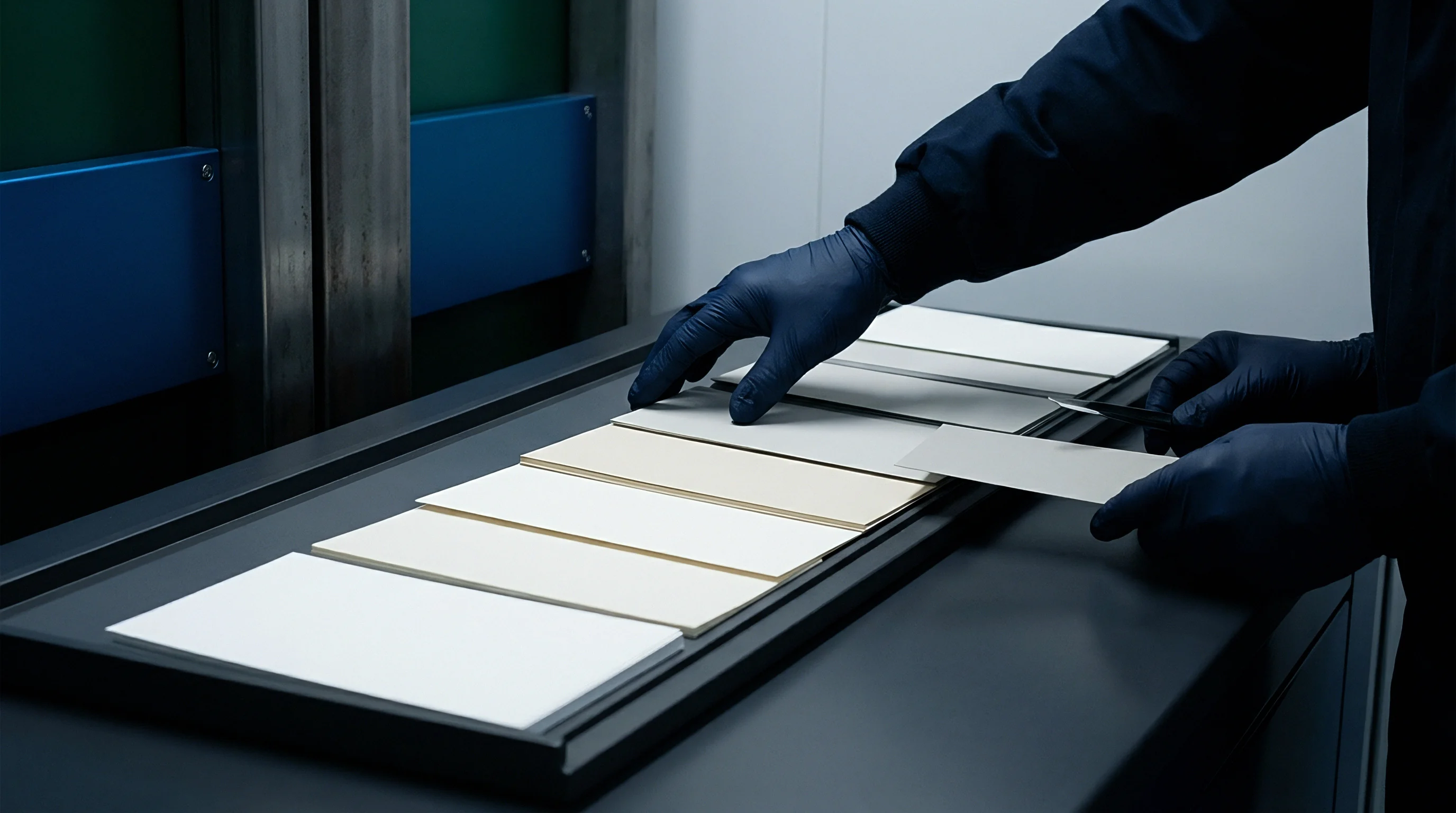
Spectrophotometer optical architecture governs how illumination strikes the coated sheet and how sensors collect reflected rays. Two principal geometric layouts serve paper evaluation: diffuse illumination with directional observation at zero degrees, designated d/0, and directional illumination at 45 degrees with observation at zero degrees, designated 45/0. International standards divide sharply between these configurations, producing numerical differences that prevent direct cross-comparison between laboratory test sheets and commercial delivery specifications.
Paper surfaces possess structural topography composed of compressed cellulose fibres, mineral platelets, and latex micro-domains. The arrangement of the light source, the integration sphere walls, and the collection lenses determines the degree to which macro-roughness and micro-gloss influence the recorded fluorescent emission. Selecting the wrong optical configuration produces false brightness readings on calendered folding boxboard and coated fine papers.
Diffuse Sphere against Directional Annular Optics
Integrating spheres used in d/0 instruments feature hollow spherical cavities coated internally with barium sulphate or sintered polytetrafluoroethylene. Light from the pulsed flash lamp reflects hundreds of times across the diffusely scattering white interior walls before washing uniformly over the specimen aperture from all angles. A photodiode detector sits normal to the specimen plane, collecting reflected light along the zero-degree axis through a baffled port that prevents direct sight of the sphere entrance.
Diffuse d/0 geometry integrates scattered rays. The integrating sphere averages out structural variations caused by blade streaks, coating ridges, and wire-mark orientation. In contrast, 45/0 instruments illuminate the paper specimen using an annular ring of light angled at 45 degrees, capturing reflections at zero degrees normal to the sheet surface.
This directional design replicates human visual inspection under a standard graphic arts viewing booth, responding strongly to changes in surface micro-contour and varnished gloss.
Adherence to ISO 2469 diffuse geometry prevents directional gloss sheen from distorting brightness readings across high-calendered board surfaces.

Specular Component Inclusion for High Gloss Sheets
Specular gloss components distort colour coordinates. When testing high-gloss coated grades such as cast-coated label stock or double-blade coated art papers, specular reflection produces intense, unpolarized surface shine. Instruments operating under d/0 geometry feature a movable specular gloss trap positioned on the sphere wall along the angle of equal reflection.
Opening the trap excludes specular gloss from the reading, measuring diffuse reflectance alone, while closing the trap includes total surface reflection.
ISO paper standards, including ISO 2470-1 and ISO 11475, demand specular component inclusion to maintain energy conservation across the integration cavity. Removing the gloss trap creates an optical loss window that changes the sphere balance, altering the effective ultraviolet excitation level on fluorescent specimens. The technical parameters defining this measurement geometry appear in standard testing contracts, which state that any reported brightness figure derived without identifying the integration sphere diameter and gloss port status voids the conformance certificate.
| Optical Configuration | Standard Designation | Illumination Source | Specular Trap Setting | Primary Industrial Application |
|---|---|---|---|---|
| Diffuse d/0 | ISO 2469 / ISO 2470-1 | Filtered Xenon (C) | Included | European pulp and paper mill brightness |
| Diffuse d/0 | ISO 11475 | Adjusted D65 Daylight | Included | CIE Whiteness in global packaging board |
| Directional 45/0 | TAPPI T 452 | Incandescent / Filtered | Excluded by geometry | North American paper and board trade |
| Directional 45/0 | ASTM E1347 | Pulsed Xenon / LED D65 | Excluded by geometry | Graphic reproduction and print proofing |
Hue
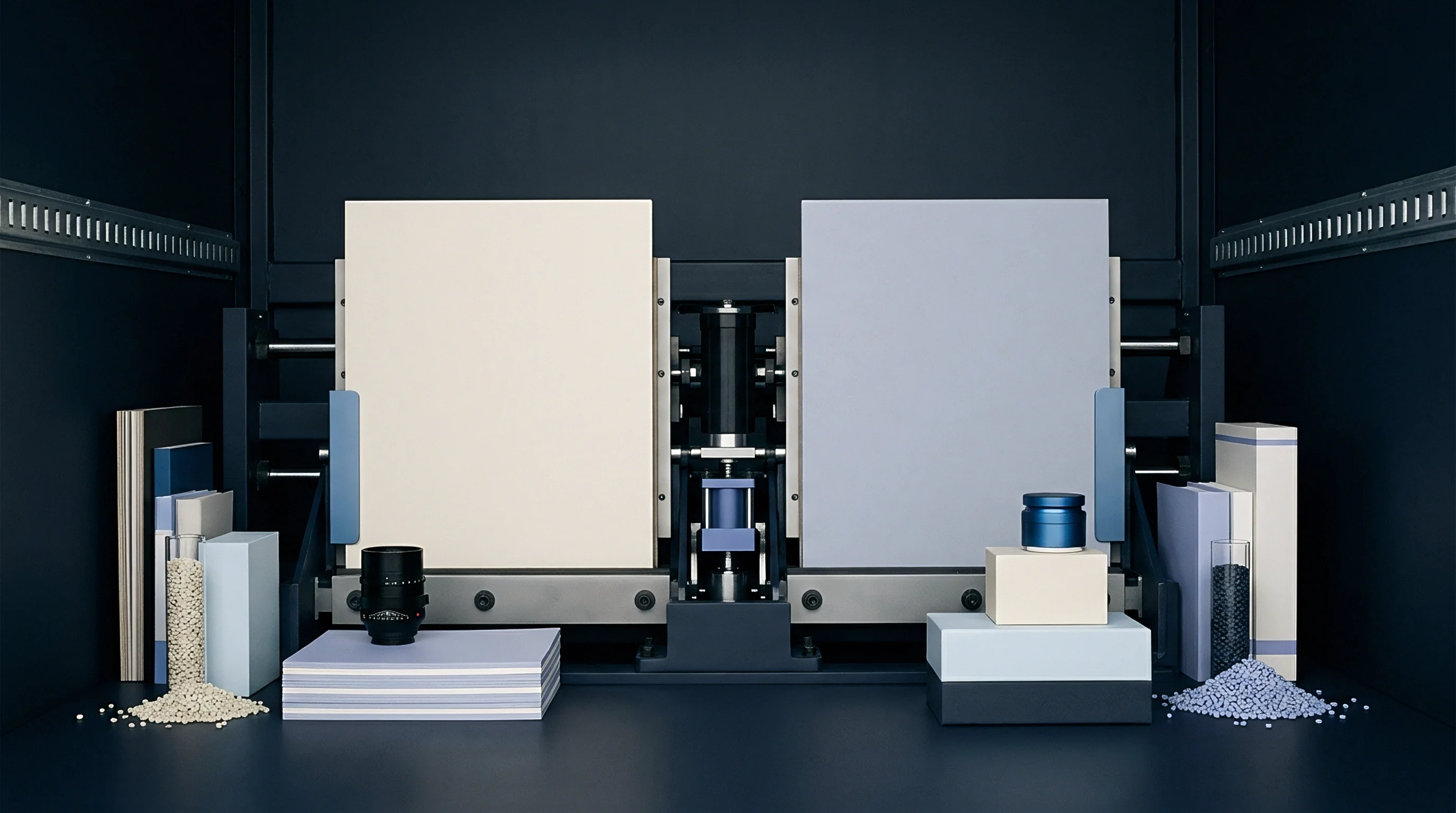
Perceived whiteness depends on a delicate chromatic balance between yellow-blue and red-green axes in colour space. Natural cellulose fibres and mechanical pulps absorb light in the short blue wavelengths, giving unbleached or semi-bleached sheets a dull yellowish shade. Fluorescent brightening agents counteract this tint by emitting blue light between 430 and 450 nanometres, neutralizing yellowness and raising the overall luminous reflectance factor.
The resulting chromaticity coordinates shift directly toward the blue region of the CIELAB colour diagram.
Fluorescence adds radiance to reflected waves. In heavily brightened coated sheets, total reflectance factors in the emission band frequently exceed 100 percent when evaluated relative to an ideal non-fluorescent diffuser. This excess radiance tricks the human visual cortex into perceiving extraordinary cleanliness and brightness, provided the blue emission does not tilt into an unnatural violet or green secondary hue.

Should Calibrated Filters Control Ultraviolet Energy?
Ultraviolet content in real-world lighting varies significantly between natural sunlight, industrial fluorescent tubes, and modern solid-state light-emitting diodes. An instrument testing a brightened paper with uncalibrated ultraviolet excitation reports inflated brightness values that collapse when the finished package sits on a store shelf illuminated by commercial warm LEDs that emit zero ultraviolet energy. Motorized insertion of an optical cut-off filter isolates the exact fluorescent contribution, allowing laboratory technicians to calculate both total reflectance and base substrate reflectance.
Adjusting the physical position of a partial-absorbance ultraviolet filter aligns the instrument light source with standard illuminants. ISO 11475 requires adjusting the ultraviolet excitation level until measured CIE whiteness matches the certified values of transfer reference standards. During the middle of the twentieth century, synthetic stilbene brighteners were developed for commercial textile laundering before finding broader technical adoption across continuous paper machine coating operations.
Modern digital spectrophotometers automate this adjustment by capturing separate ultraviolet-included and ultraviolet-excluded flashes, calculating mathematical fluorescent vectors without physical filter movement.
Chromaticity Coordinates and Blue Tint Deviations
Chromaticity values define the exact visual tint of the white sheet under standardized viewing conditions. In the CIELAB colour coordinate system, the a-star axis tracks the balance between red and green shades, while the b-star axis tracks yellow and blue tones. High concentrations of fluorescent whitening agents drive the b-star parameter into negative territory, indicating an intense cool blue shade favored by commercial print buyers.
A high-brightness board with an a-star value of 1.5 and a b-star value of negative 10.0 appears crisp and cool under daylight.
Green shade shift destroys sheet brightness. When paper mills overload coating formulations with stilbene compounds beyond the carrier retention capacity, the a-star value shifts negatively toward green, while the b-star value retreats back toward zero. The eye detects this shift instantly as a muddy grey or murky olive undertone across packaging surfaces.
Sourcing specifications that neglect tint tolerances allow suppliers to deliver sheets that match nominal brightness numbers while failing graphic reproduction requirements.
A simple practical guideline guides mill operations: when additions of brightening chemical produce an immediate green hue shift on the monitoring console, the coating line has exhausted its chemical carrying capacity.


Calibration
Instrument accuracy across international paper supply lines hinges on a three-tier metrological traceability chain. National standardizing laboratories maintain level one primary reference instruments, using high-precision spectral radiance calibrations tied to blackbody radiators. Level two certifying institutes distribute secondary transfer standards, consisting of durable non-fluorescent opal glass tiles and specialized fluorescent plastic plates, to paper testing laboratories and mill quality departments worldwide.
Level three working instruments on factory floors calibrate daily against these reference materials.
Calibrating an instrument for fluorescent paper measurement involves two independent phases: photometric scale calibration and ultraviolet level adjustment. Photometric calibration establishes the absolute zero point using a light trap and the 100 percent reflectance baseline using a clean, non-fluorescent sintered polytetrafluoroethylene reference tile. The subsequent ultraviolet adjustment adjusts the instrument excitation source to reproduce standardized daylight emissions from a certified fluorescent standard of known radiance factor.
Transfer Standards and Working Reference Tile Decay
Working reference tiles degrade under continuous factory exposure. Sintered polytetrafluoroethylene tiles collect airborne contaminants, dust, and pressroom chemical vapors, which yellow the tile surface and depress short-wavelength reflectance. Fluorescent reference materials, typically cast acrylic plates or high-stability cotton linters papers impregnated with stable fluorophores, undergo irreversible photochemical degradation when exposed to ambient room light or repeated high-intensity xenon flashes.
Working tiles suffer rapid photo-chemical decay. A laboratory using an uncertified reference tile that has lost two percent of its fluorescent emission will over-adjust the instrument ultraviolet filter, boosting the lamp excitation output to compensate for the deteriorated reference. When that over-energized spectrophotometer reads production paper samples, it records artificially elevated fluorescent brightness values, masking coating kitchen failures and shipping out-of-specification stock to converters.

Fluorescence Ratio Adjustments under Standard Illuminants
Adjusting the instrument to match ISO brightener standards demands exact mathematical and physical alignment. The operator measures a non-fluorescent white ceramic standard, followed by a certified fluorescent reference standard featuring an assigned brightness value determined by an authorized level two standardizing laboratory under ISO 2469 conditions. The internal software compares the measured difference between ultraviolet-included and ultraviolet-excluded readings against the certified value, altering the position of the mechanical ultraviolet adjustment vane until the error falls within 0.1 brightness units.
Published literature documents that a properly adjusted instrument holds optical uncertainty to plus or minus 0.3 CIE Whiteness units on double-coated bleached boards. This precision level rests on testing twenty replicate punchings from a single mill reel under ISO 187 conditioning, assuming baseline furnish opacity exceeds 98 percent. Should atmospheric humidity swing by 15 percent, or the sample backing pad degrade from clean white pulp sheets to dirty backing board, that uncertainty band widens past 1.5 CIE Whiteness units, obliterating commercial tolerance bands.
- Chamber temperature verification checks that the internal integration sphere temperature rests between 20 and 25 degrees Celsius before initializing source lamps.
- Black cavity nulling sets the lower photometric boundary by firing the flash sequence directly into an open light trap free of internal dust.
- Primary non-fluorescent standardization establishes the absolute spectral reflectance scale across all wavelengths using a level two certified white porcelain plate.
- Ultraviolet excitation adjustment modifies the variable filter position until readings on the certified fluorescent transfer standard match its calibration certificate.
- Secondary control verification measures a designated working paper standard to confirm stability before approving production coil runs.
| Calibration Level | Reference Material Type | Traceability Standard | Recalibration Interval | Permissible Tolerance |
|---|---|---|---|---|
| Primary (Level 1) | Pressed BaSO4 / Sintered PTFE | BIPM / National Metrology Labs | 12 Months | ±0.05% Reflectance |
| Secondary (Level 2) | Fluorophore-Doped Ceramic / Opal Glass | ISO Authorised Laboratories | 6 Months | ±0.15 CIE Whiteness |
| Working (Level 3) | High-Stability Enamelled Tile | Mill Testing Laboratory | Daily Pre-Shift | ±0.30 CIE Whiteness |
| Methods note: Calibration tolerances derived from ISO 2469 and ISO 11475 protocols for diffuse d/0 geometry at 23°C and 50% relative humidity. | ||||
Technicians often debate whether aging paper reference tabs retain acceptable calibration stability over thirty days when vacuum sealed inside desiccated aluminium foil pouches, leaving open the question of how quickly ambient oxygen degrades dry stilbene molecules during long-term storage.


Outlay
Optical brighteners represent one of the most expensive liquid chemical additives consumed in modern paper coating operations. Active liquid stilbene concentrates command prices ranging between 2,800 and 4,500 US dollars per dry metric tonne, depending on sulfonation levels and molecular purity. In a high-speed coating facility producing 200,000 tonnes of coated board annually, brightener chemistry consumes between 600,000 and 1.2 million US dollars in annual operating budgets, making precision spectrophotometric control a financial priority.
Formulation errors generate hidden financial waste. Papermakers struggling to reach contractual brightness targets often instruct coating kitchen personnel to increase brightener dosing rates rather than correcting furnish bleaching inefficiencies or adjusting pigment slurry ratios. When the formulation crosses the saturation limit, every additional kilogram of optical brightening agent pumped into the blending chest yields zero measurable brightness gain while driving cash directly into effluent treatment ponds.
Cost Penalties of Formulation Overdosing
Overdosing brightener chemistry triggers immediate economic losses through direct chemical waste and downstream coating defects. When stilbene molecules self-quench, the reflectance at 457 nanometres plateaus while costs escalate linearly. Take a production run of 50 tonnes of 250 g/m² coated folding boxboard carrying a topcoat layer of 12 g/m² applied with a 65 percent solids slurry.
At a standard dosing level of 0.8 dry parts brightener per hundred parts pigment, the run consumes approximately 115 kilograms of active optical brightener, costing 460 US dollars at 4.00 US dollars per kilogram.
If machine operators boost the dosing rate to 1.6 dry parts per hundred pigment to mask poorly bleached thermomechanical pulp in the middle plies, chemical consumption doubles to 230 kilograms, incurring an immediate 460-dollar direct chemical penalty on the 50-tonne batch. Because the 1.6-part dosing exceeds the carrying capacity of the 1.5 parts polyvinyl alcohol carrier in the formulation, the excess chemical aggregates, dropping the measured ISO brightness by 1.2 points and shifting the a-star value from 0.8 to negative 1.4. The mill spends 920 dollars on chemical additives to produce board that fails customer colour tolerances.
Mill Batch Variation and Pressroom Spoilage
Pressroom waste escalates during shade mismatches. When a packaging converter loads a 15-pallet order of coated boxboard onto a high-speed sheet-fed offset press, variation in fluorescent whitening levels between paper reels disrupts colour management curves. Modern commercial printing presses rely on closed-loop spectrophotometers mounted directly on the delivery console, scanning colour bars containing 50 percent and 100 percent halftone screen patches to regulate ink film thickness.
Uncontrolled brightness swings trigger press downtime. If pallet five carries an ISO brightness of 94 percent with a CIE whiteness of 125, and pallet six carries board from an over-quenched mill batch with a brightness of 90 percent and a greenish cast, the pressroom spectrophotometer perceives a sudden density shift across light highlight areas. The automated console floods yellow and magenta ink onto the sheet to correct the perceived colour imbalance, throwing fine highlight skin tones and corporate brand colours out of commercial specification.
At packaging print rates exceeding 800 US dollars per press hour, sorting mixed pallet runs and cleaning contaminated ink units erodes converter gross margins and prompts pallet rejections.
Coating formulations demand rigorous optical surveillance. Failing to catch an over-quenched coating formulation at the mill coater allows defective board to reach the converter, where inconsistent fluorescent whitening forces press stops, ruins process colour ink balances, and drives high volumes of printed packaging directly into the waste compactor.