Ink Holdout and Dot Gain When a Stock Changes Grade
Changing stock grades alters micro-porosity and light scattering, shifting ink holdout and dot gain, requiring immediate press curve and ink film adjustments.
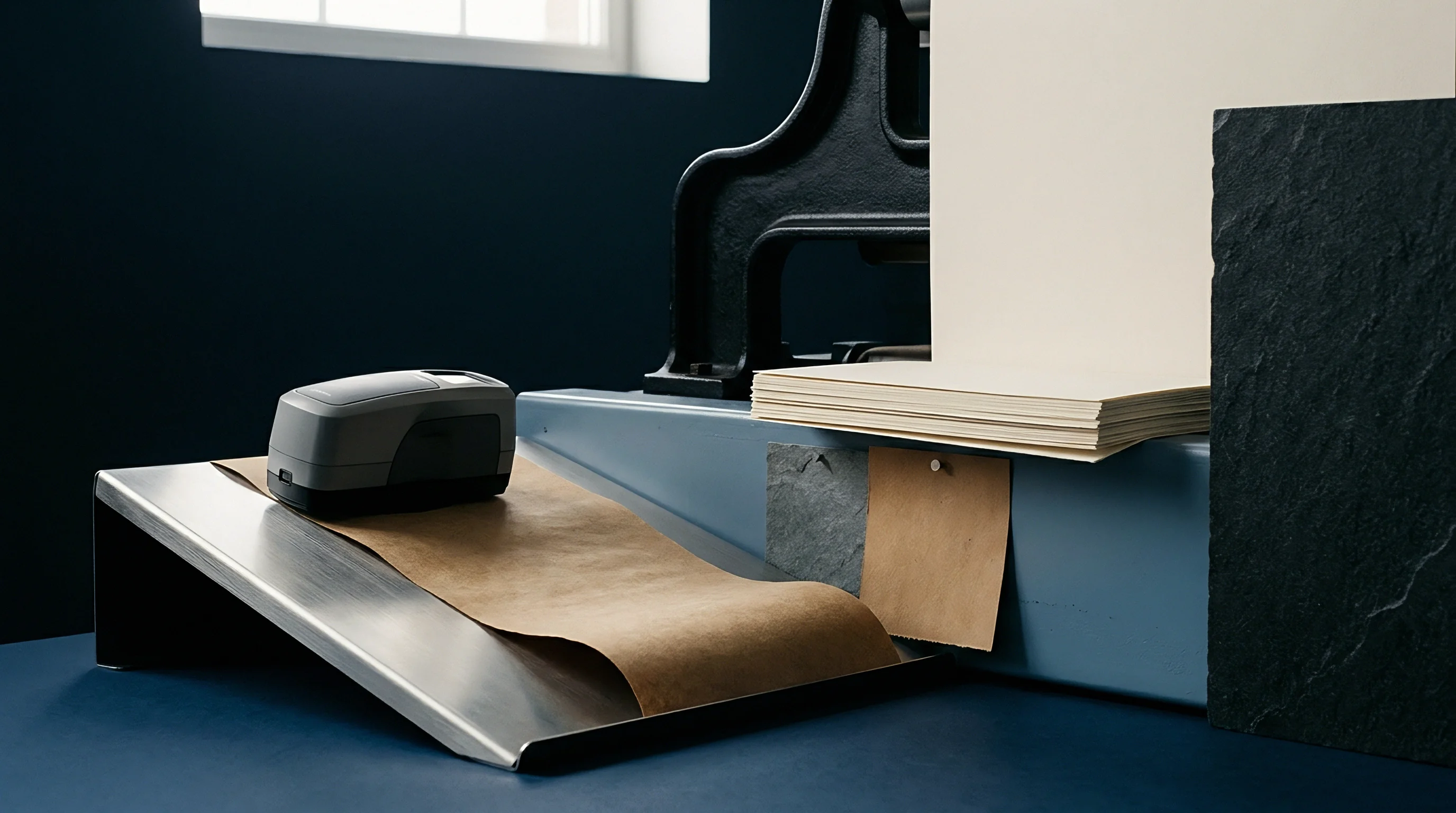

Pore
A Parker Print-Surf measurement of 0.85 micrometres on a double-coated sheet shifts to 4.20 micrometres on an uncoated offset stock. That change in surface structure alters how liquid ink sets during the fractions of a second it has on impression. Ink holdout is simply the substrate’s ability to retain pigment particles and binder resins on its surface while governing how quickly fluid vehicles enter the underlying capillary structure.
Grade shifts introduce changes in pore diameter, surface energy, and sizing chemistry that rebalance mechanical filtration against capillary draw. A coated woodfree sheet features micro-pores from 0.05 to 0.5 micrometres across, formed by packed mineral pigments like kaolin clay and calcium carbonate. An uncoated sheet instead exposes open fiber lumens and inter-fiber voids, forming macro-pores between 1.0 and 10.0 micrometres.
Under the Lucas-Washburn equation, capillary pressure driving vehicle absorption scales inversely with pore radius ~ where penetration distance equals the square root of the product of pore radius, liquid surface tension, contact angle cosine, and elapsed time, divided by twice the dynamic viscosity of the liquid. Smaller pores generate stronger capillary suction force, yet simultaneously restrict mass fluid flow by increasing hydrodynamic resistance along the capillary walls.
On coated papers, tightly packed mineral platelets work like a micro-sieve during ink application. Under impression pressure, the liquid vehicle ~ aliphatic hydrocarbon solvents, vegetable oils, and low-viscosity alkyd resins ~ separates almost immediately from the high-molecular-weight pigment matrix. Pigment particles averaging 0.2 to 0.8 micrometres across are simply too large to fit into smaller pores.
A dense filter cake forms quickly over the coating, trapping pigment at the surface to produce high optical density, sharp edge definition, and high print gloss. Switch to an uncoated sheet, and without that mineral barrier, the ink vehicle and pigment enter the fiber matrix together. Capillary pull draws fluid deep into the sheet before solvent loss or polymer oxidation can build up vehicle viscosity.
As pigment drops beneath the optical surface, visible color strength falls, leaving press operators to run thicker wet ink films just to hit density targets.
Surface sizing applied at the size press alters fluid absorption on uncoated and lightly coated grades. Synthetic sizing agents such as alkyl ketene dimer and alkenyl succinic anhydride lower the surface energy of cellulose fibers, raising the liquid-solid contact angle. On uncoated sheets with high Cobb values, capillary forces pull liquid vehicles into the sheet within milliseconds of leaving the nip.
Standard testing under ISO 535 measures water absorption in grams per square metre over a set period, typically 60 seconds. A Cobb 60 rating under 25 grams per square metre shows solid liquid resistance, keeping the vehicle on the surface long enough for the ink film to consolidate. A Cobb 60 over 40 grams per square metre pulls solvent out too fast, leading to setting failures, bronzing, or severe density drop-off.
Surface roughness tested per ISO 8791-4 on a Parker Print-Surf instrument at 1000 kilopascals clamp force separates micro-topography from sheet compressibility. Lower Parker Print-Surf roughness values mean greater contact area between the ink film on the offset blanket and the substrate, reducing the physical ink film thickness required for complete coverage.
Pore radius reduction by half quadruples the capillary resistance to ink vehicle drainage while doubling the time required for solvent penetration.
Air permeability testing offers an indirect measure of total interconnected void space across the sheet thickness. Under ISO 5636-5, Gurley air resistance records the seconds needed for 100 millilitres of air to pass through a designated area under uniform pressure. High-holdout coated papers routinely generate Gurley values over 3000 seconds per 100 millilitres, reflecting a tight surface barrier that limits vehicle migration into the core.
Uncoated offset papers yield Gurley numbers between 15 and 45 seconds per 100 millilitres, confirming an open structure that speeds up absorption. Moving from a high-Gurley to a low-Gurley stock fundamentally shifts how the ink sets. With high-Gurley substrates, setting depends on low-viscosity oils draining into the thin mineral coating before surface resins dry by oxidation.
On low-Gurley substrates, bulk capillary action pulls vehicle directly into the fiber substrate, stripping solvent away from the pigment layer before surface resin cross-linking even begins.
Coating chemistry dictates the surface energy baseline behind wet ink behavior. Formulations rich in ground calcium carbonate produce porous structures with substantial pore volume but tight capillary diameters, accelerating initial vehicle drainage. Fine kaolin clay creates tortuous, low-porosity surface layers that slow vehicle drainage, building up holdout and gloss.
Precipitated calcium carbonate provides controlled, narrow pore size distributions that balance high holdout with fast setting speeds. Wet ink spreading depends on the interaction between non-polar ink solvents and polar paper surfaces. Contact angle goniometry breaks total surface free energy down into polar and dispersive components.
If paper surface energy falls below the wet ink film’s surface tension, incomplete wetting leads to pinholing and mottling. If surface energy far exceeds ink surface tension, wet ink spreads unchecked through the pore network, degrading dot sharpness before viscosity gains can stop lateral movement.
A double-coated woodfree stock conditioned at 23 degrees Celsius and 50 percent relative humidity retains over 92 percent of oil-based pigment solids within 1.2 micrometres of the surface.
Switching paper grades means adjusting ink formulations to match substrate absorption. Standard sheetfed offset inks for coated papers run lower tack and lower viscosity so they do not pick fine coating particles from the sheet. Put those low-viscosity inks on a porous uncoated sheet, and they sink deep, dropping optical density and causing severe show-through on the reverse side.
Inks for uncoated stock use higher pigment concentrations, higher binder resin ratios, and higher tack levels to combat fast capillary pull. Under ISO 187, laboratory testing takes place at 23 degrees Celsius and 50 percent relative humidity. Substrate moisture directly alters fiber swell and pore volume: in high humidity, swelling fibers restrict macro-pore space while expanding internal surface area, subtly shifting absorption on uncoated papers.
On coated grades, humidity changes affect binder flexibility and internal stress, changing how micro-cracks form in the mineral matrix under print nip pressure.
Moving from a double-coated woodfree sheet to recycled packaging board introduces uneven absorption across the sheet surface. Recycled fibers bring shortened cellulose strands, leftover de-inking chemicals, and variable filler loads that disrupt local capillarity. The top liner on recycled boxboard usually carries a light single coat meant to balance print quality against flex during scoring and folding.
That thin coating layer provides partial holdout, but local coat-weight variations create micro-zones of uneven vehicle absorption. Wet ink sets at different rates across these heterogeneous surfaces, causing density mottling in mid-tone screen areas. Mercury intrusion porosimetry shows whether pore volume distribution is mono-modal or bi-modal.
A mono-modal structure centered around 0.1 micrometres encourages uniform vehicle separation and high holdout. A bi-modal structure with peaks at both 0.05 micrometres and 2.0 micrometres triggers strong capillary suction alongside localized bulk flow, complicating dampening control and wet ink film stability on press.
| Grade Classification | Parker Print Surf Roughness (micrometres at 1000 kPa) | Air Permeability (Gurley ISO 5636-5 s/100 mL) | Surface Energy (mN/m) | Ink Vehicle Absorption Rate (micrometres/s^0.5) | Primary Pores Distribution Peak (micrometres) |
|---|---|---|---|---|---|
| Triple Coated Woodfree (WFC) | 0.75 – 0.95 | 3200 – 4500 | 38 – 42 | 0.12 – 0.18 | 0.06 – 0.09 |
| Single Coated Boxboard (GC2) | 1.20 – 1.60 | 1100 – 1800 | 36 – 40 | 0.25 – 0.35 | 0.15 – 0.30 |
| Uncoated Woodfree (WFU) | 3.80 – 4.80 | 20 – 40 | 30 – 34 | 0.85 – 1.20 | 1.50 – 3.50 |
| Uncoated Recycled Kraft (UBK) | 5.50 – 7.20 | 8 – 18 | 26 – 32 | 1.40 – 2.10 | 4.00 – 8.00 |
| Data measured using ISO 8791-4 for roughness, ISO 5636-5 for air permeability, and automated contact angle goniometry for surface energy. | |||||
Substrate changes affect print performance through specific failure modes tied to surface physics and chemical interactions.
- Pigment Filtration Breakdown happens when large macro-pores allow ink to drain into the web structure, leaving too little colorant at the optical interface and dropping solid density below target.
- Solvent Vehicle Extraction Trap occurs when fast capillary absorption pulls liquid carriers from the ink film before polymers coalesce, leaving a powdery layer prone to rub-off and scuffing.
- Density Saturation Plateau occurs when running a thicker wet ink film fails to raise reflection density, causing heavy dot spread and drying issues without adding visual color strength.
- Localized Density Mottling stems from uneven coat weight or varying recycled fiber density, creating irregular vehicle absorption across neighboring zones in solid prints.
- Surface Fiber Picking occurs when high-viscosity inks on porous or lightly sized grades pull harder than the sheet’s internal z-directional bond strength, tearing fibers from the paper surface.
Fiber processing geometry sets fundamental limits on surface smoothness and pore size. Mechanical pulping leaves intact fiber bundles and lignin residues, creating stiff, rough sheets that need heavy calendering or thick mineral coatings to print well. Chemical pulping removes lignin, producing flexible fibers that form dense, uniform sheets with smaller inter-fiber voids.
Wet-end internal sizing agents spread hydrophobic molecules over fiber surfaces, altering contact angles without changing physical pore dimensions. When diagnosing ink holdout problems, separating physical roughness from chemical absorption pinpoints the cause of setting failures. A sheet with low Parker Print-Surf roughness can still exhibit poor holdout if its chemical sizing cannot resist the ink vehicle’s solvent chemistry.
On the flip side, a rough paper with high hydrophobic sizing might mechanically distort printed dots while keeping the ink vehicle right at the optical boundary.
Lab tests for grease and oil resistance offer practical detail on how paper handles oil-based inks. TAPPI T 559 testing ~ the Kit test ~ rates surface resistance to non-polar fluids using solutions of castor oil, toluene, and heptane. Though designed for greaseproof packaging, higher Kit ratings on uncoated sheets correlate closely with stronger ink holdout.
Standard uncoated offset papers usually score low Kit numbers between 1 and 3, reflecting quick hydrocarbon penetration. Specialty barrier-treated offset sheets can reach Kit numbers between 7 and 12, holding back hydrocarbon vehicles while retaining an uncoated look and feel. Comparing Kit values with Cobb 60 water absorption figures lets buyers see whether a paper depends on hydrophobic chemistry, lipophobic chemistry, or calendering density for its holdout performance profile.
High mineral filler content changes ink holdout mechanics compared to pure fiber structures. Adding precipitated calcium carbonate, kaolin clay, or titanium dioxide at the wet end fills voids between cellulose fibers, shrinking macro-pores and boosting light-scattering opacity. But while mineral fillers improve smoothness and opacity on uncoated papers, they also alter capillary absorption.
Mineral particles create micro-voids that pull low-viscosity ink solvents faster than pure cellulose fibers. As a result, an uncoated sheet with 25 percent calcium carbonate filler loading offers a smoother surface topography but drains ink vehicle quicker than an unfilled sheet of the same grammage. When choosing heavily filled grades, press operators have to weigh the gain in smoothness against density loss from accelerated vehicle absorption.
Matching substrate porosity to ink vehicle viscosity avoids both surface picking and excessive vehicle drainage.

Spread
An optical dot gain measurement at 50 percent nominal tint might read 64 percent on a glossy coated sheet, but climb to 78 percent on an uncoated offset stock printed under identical press settings. Tone value increase is the combined physical and optical enlargement of halftone dots between the digital prepress file and the printed paper. It splits into two distinct behaviors: mechanical dot gain and optical dot gain.
Mechanical gain occurs when impression cylinder pressure squeezes wet ink sideways during image transfer. Optical gain occurs when light entering the paper scatters inside the fiber matrix before reflecting back through the ink film, forming a visual halo around the physical dot border. Switching stock grades shifts both physical ink spread and internal light scattering, requiring systematic recalibration of press parameters and prepress compensation curves.
Mechanical dot gain responds directly to surface roughness, sheet compressibility, and wet ink film thickness. On smooth, triple-coated sheets, press operators run thin wet ink films around 1.0 to 1.2 micrometres to reach target solid ink densities. Under standard nip pressure, this thin layer experiences minimal lateral squeeze because the dense mineral coating limits fluid movement.
On rough uncoated paper, reaching target solid density forces operators to increase film thickness to 2.2 to 3.0 micrometres. That extra ink fills deep surface valleys, but under nip pressure, excess fluid squeezes out past the plate dot boundaries. Soft, compressible substrates like uncoated packaging boards yield significantly in the nip, expanding the blanket-to-paper contact area and driving mechanical gain higher in mid-tone screen areas.
What Happens to Mechanical Tone Value Increase When Changing Grades?
Mechanical tone value increase climbs fast when press settings dialed in for coated paper run porous or rough stocks without adjustment. The physical squeeze of wet ink depends on fluid tack, dynamic viscosity, blanket hardness, nip pressure, and paper topography. On coated paper, wet ink stays concentrated at the surface nip interface where shear rate drops immediately upon exiting the nip.
On an uncoated sheet, liquid ink enters surface capillaries while spreading outward at the same time. Running high dampening solution feeds compounds this gain: fibers absorb water from the emulsified fountain solution, swelling locally and changing local compressibility. Damp fibers resist oil-based ink, causing wet ink to slip sideways along wet fiber boundaries and expanding dots beyond their nominal geometric targets.
Optical dot gain follows light scattering principles described by the Yule-Nielsen model. The Yule-Nielsen equation adjusts the traditional Murray-Davies formula using an empirical exponent ~ the n-factor ~ to account for photon scattering in the paper matrix. On smooth, bright coated papers with high opacity, light penetration stays shallow, keeping Yule-Nielsen n-factors between 1.5 and 1.8.
Optical gain remains low because photons exit close to where they entered. On uncoated offset paper or recycled packaging board, open fiber structures allow deeper light penetration. Light hitting the unprinted paper around a halftone dot scatters sideways beneath the surface, emerging through the underside of the adjacent printed dot.
This internal scattering creates a visual perception of a larger dot area than physically exists on the paper surface. On uncoated grades, the Yule-Nielsen n-factor ranges from 2.5 to 4.0, meaning optical scattering can account for up to half of total measured tone value increase.
ISO 12647-2 specifies a target tone value increase of 14 percent at mid-tone for coated offset stock compared to 22 percent for uncoated offset grades.
Print contrast calculations show how heavy dot gain fills in shadow detail. ISO standard print contrast (the K-value) compares reflection density in a solid patch to a 75 percent halftone tint area. Using the Brunner formula, print contrast equals solid density minus 75 percent tint density, divided by solid density.
High-holdout coated papers regularly yield K-values between 40 and 50 percent, maintaining clean separation between deep shadow tones and solid ink zones. Uncoated papers drop to K-values between 18 and 28 percent. High tone value increase on uncoated grades causes dots in the 75 to 90 percent region to bridge entirely, washing out shadow detail into solid ink patches.
Trying to push solid density higher on uncoated stock only worsens shadow collapse as mechanical squeeze merges adjacent dots into flat tone films.
Adjusting line screen frequency offers a direct way to manage tone value increase on lower-grade substrates. Standard offset work on high-holdout coated paper uses rulings of 175 to 200 lines per inch, or stochastic screens down to 20-micrometre spot sizes. At 175 lines per inch, a mid-tone dot has a small physical diameter and a high perimeter-to-area ratio.
Every micrometre of lateral mechanical ink squeeze adds a noticeable percentage to total dot area. On uncoated or recycled paper, high screen rulings cause severe dot bridging and runaway tone value increase. Dropping the screen ruling to 133 or 150 lines per inch enlarges individual dots while reducing their total combined perimeter length per unit area.
That shorter overall perimeter cuts exposure to mechanical squeeze and optical halo scattering boundaries, restoring separation across mid-tone details.
Adapting offset press operations during a grade shift requires systematic adjustments to dampening, ink balance, pressure, and prepress curves.
- Fit blanket cylinders with hard micro-ground compressible blankets to limit nip distortion and cut mechanical ink movement across rough paper surface topography.
- Calibrate CTP plate imagers with substrate-specific tone value compensation curves that pull down digital mid-tone values by 8 to 14 percent relative to coated profiles.
- Set impression cylinder squeeze to the minimum mechanical pressure needed for clean ink transfer across the highest peak of the paper profile.
- Increase ink pigment loading while trimming duct roller ink film thickness to maintain color strength without applying excessive liquid volume.
- Set dampening solution conductivity between 900 and 1200 microSiemens per centimetre and adjust isopropyl alcohol substitutes to maintain surface tension near 35 millinewtons per metre, restricting ink emulsification.
Wet trapping on multi-color presses depends directly on ink film tack viscosity and substrate holdout capabilities. In sequence printing, the first printed ink film must possess higher tack than subsequent ink films to allow clean transfer on downstream units. On high-holdout coated paper, the first ink film quickly loses low-viscosity solvents into the micro-porous coating, raising its tack before reaching the next print unit.
That fast setting profile ensures high trapping efficiency. On an uncoated or lightly sized substrate, liquid vehicle absorption happens too fast or unevenly, stripping solvent before binder resins assemble. The tack profile breaks down unpredictably, causing second and third inks to pick or back-trap onto downstream blankets.
Adjusting ink tack sequences across press units prevents trapping failure when running variable-holdout grades.
| ISO 12647 Grade Designation | Target Wet Film Thickness (micrometres) | Solid Ink Density (Cyan, ANSI T) | TVI at 50 Percent Nominal Tint (Percent) | Yule-Nielsen Factor n | Print Contrast Value K (Percent) |
|---|---|---|---|---|---|
| Paper Type 1 (Coated Woodfree Gloss) | 1.05 – 1.20 | 1.45 – 1.55 | 13.0 – 15.0 | 1.60 – 1.75 | 42.0 – 48.0 |
| Paper Type 2 (Coated Woodfree Matt) | 1.15 – 1.30 | 1.30 – 1.40 | 16.0 – 18.0 | 1.80 – 2.00 | 36.0 – 42.0 |
| Paper Type 4 (Uncoated Woodfree White) | 2.10 – 2.50 | 0.95 – 1.10 | 22.0 – 26.0 | 2.70 – 3.20 | 22.0 – 28.0 |
| Uncoated Recycled Containerboard (GD2) | 2.80 – 3.40 | 0.80 – 0.95 | 28.0 – 34.0 | 3.40 – 4.10 | 14.0 – 20.0 |
| Tone value increase and density measured using ANSI T reflection densitometry under ISO 12647-2 standard press conditions. | |||||
Spectrophotometric evaluation of printed gamuts highlights how low substrate holdout and high dot gain restrict color output. A wide color gamut relies on high solid ink densities paired with precise tone reproduction across mid-tones and highlights. Moving from Grade 1 coated woodfree to Grade 4 uncoated woodfree shrinks achievable CIELAB gamut volume by 35 to 50 percent.
Solid black density drops from 1.70 on gloss coated stock to 1.10 on uncoated paper. High dot gain on uncoated stock compresses dynamic range, burning out highlights or collapsing shadow detail. Color management workflows must rely on substrate-specific ICC profiles that map source color spaces into the compressed volume achievable on absorbent grades.
Running an uncoated job with a coated ICC profile leads to oversaturation, ink pooling in dark areas, and extended drying times that induce set-off in the delivery pile.
Surface strength evaluated via TAPPI T 459 wax pick tests or ISO 3783 automated IGT pick testing dictates maximum allowable ink tack at high production speeds. Coated papers offer high surface pick resistance when the coating binder adheres firmly to the base paper structure. Lightly coated boxboards or low-grade recycled stocks have weaker internal bond strength and pick resistance.
Running high-tack inks on weak-surface grades tears mineral particles, fibers, or entire coating fragments from the sheet surface. Those picked fragments stick to offset blankets, creating hickeys and white spots in solid printed areas. Operators running weak substrates must blend in tack-reducing compounds or alkyd oil reducers, accepting lower initial setting speeds to protect sheet surface integrity.
Inline inspection systems on modern presses use high-resolution line-scan cameras to monitor dot structure and color consistency at full production speeds. They read tonal values across dedicated control strips printed on sheet margins, comparing density figures against target ISO 12647-2 press curves. When changing stock grades, inspection thresholds must be updated for the new substrate’s physical limits.
Setting inspection tolerances based on coated paper benchmarks when running uncoated or recycled packaging board triggers non-stop false alarms for density drop, dot gain variance, and dynamic range compression. Calibration targets need to align with the specific tone value increase curves for that paper category, separating genuine press drift from natural substrate variations.
Under Section 4.3 of the standard print supply agreement, press recalibration costs transfer to the buyer whenever stock substitutions shift the nominal tone value increase curve by more than five percentage points.

Ledger
Switching specifications from 150 grams per square metre C2S triple-coated paper to 120 grams per square metre uncoated woodfree changes ink consumption by 28 percent per thousand sheets while cutting press running speed by 15 percent. Substrate choice drives the true financial cost of a print run far past the raw price per metric tonne of paper. While uncoated or recycled grades often carry lower baseline purchasing costs per tonne than premium triple-coated woodfree papers, their operational impact on ink mileage, press efficiency, spoilage allowances, and post-press processing can quickly erase baseline material savings.
Assessing a substrate grade shift requires a comprehensive landed cost analysis that incorporates ink volume multipliers, drying energy requirements, prepress setup overhead, and end-of-life packaging recyclability fees.
Ink consumption is a direct financial variable when switching paper grades. Offset printing ink bought by weight yields variable sheet coverage depending on paper holdout. On high-holdout coated papers, applying 1.1 grams of ink per square metre delivers target solid optical density.
On porous uncoated offset papers, reaching target visual density requires applying 1.8 to 2.4 grams of ink per square metre. Over a print run of 500,000 packaging units, that volumetric shift increases total ink mass consumption by hundreds of kilograms. Spot colors formulated with expensive organic pigments or metallic flakes amplify this cost differential dramatically.
When estimating ink budget lines during substrate substitution, pricing models must apply an ink mileage multiplier ranging from 1.25 for single-coated boxboards up to 1.60 for porous recycled linerboards.
Setting behavior drives press speed restrictions that directly alter hourly machine costs. Offset printing presses running high-holdout coated paper reach speeds up to 18,000 sheets per hour, taking advantage of rapid infrared and hot-air drying to stabilize ink films before piling in the delivery sheet catcher. When running uncoated or heavily absorbent stocks, deep ink vehicle drainage slows surface resin polymerization.
Excessive wet ink volume increases the risk of ink set-off, where wet ink transfers to the underside of the adjacent sheet in the delivery stack. To prevent set-off, press operators drop machine running speeds to 12,000 or 14,000 sheets per hour while increasing anti-set-off spray powder application. Lower running speed inflates machine hour charges billed to the job, while heavy spray powder usage creates rough surface textures that degrade secondary lamination and foil stamping adhesion.
Parent sheet yield and trim waste calculations shift significantly when moving between paper grades due to variations in caliper and sheet bulk. Paper bulk, expressed in cubic centimetres per gram, represents the reciprocal of sheet density. Standard glossy coated papers display low bulk values between 0.8 and 1.0 cubic centimetres per gram.
Bulky uncoated offset papers display high bulk values between 1.3 and 1.6 cubic centimetres per gram. Swapping a 300-gram-per-square-metre coated boxboard for a 250-gram-per-square-metre high-bulk uncoated board maintains equivalent package stiffness while reducing overall sheet weight by 16.6 percent. Freight costs charged by weight decrease accordingly, and lower tonnage reduces raw material outlay.
However, high-bulk sheets take up more room on pallets, require larger reel diameters, and alter die-cutting creasing matrix depths, introducing tooling modifications that offset part of the savings.
Higher ink film thickness applied to absorb stock increases energy consumption in extended infrared dryer passages.
Prepress recalibration creates immediate upfront outlay when switching substrate grades late in project development. Transferring artwork designed for a coated sheet onto an uncoated or packaging board substrate requires re-separating all image files. Color profiles must be regenerated, total ink limit (TIL) values must be reduced from 320 percent down to 260 or 280 percent to stop ink pooling, and dot gain compensation curves must be re-authored in the CTP raster image processor (RIP).
Skipping prepress file re-separation leads to extreme shadow plugging, long drying times, and job rejection at final delivery inspection. Contracting prepress departments to regenerate color separations and output new printing plates incurs hard costs for digital proofing, plate materials, and operator labor that must be factored into the decision to alter substrate grades.
| Specification Parameter | Baseline Coated Boxboard (GC2) | Substituted Recycled Boxboard (GD2) | Variance Unit Impact | Net Financial Effect (EUR) |
|---|---|---|---|---|
| Substrate Cost per Tonne (300 gsm) | 1450.00 | 1120.00 | -330.00 EUR/tonne | -1650.00 |
| Ink Consumption (kg per 100k sheets) | 42.50 | 68.00 | +25.50 kg (+60%) | +382.50 |
| Average Press Speed (sheets/hour) | 15000 | 11500 | -3500 sh/h (-23%) | +620.00 |
| Anti-Set-Off Powder Usage (kg) | 2.00 | 5.50 | +3.50 kg (+175%) | +28.00 |
| Make-Ready Spoilage Allowance (sheets) | 1200 | 2800 | +1600 sheets (+133%) | +246.40 |
| Prepress Profile & Plate Generation | Included | Re-separated | 4 New Plates + Proofs | +450.00 |
| Net Financial Balance | Baseline | Substituted | Combined Operational Variance | +76.90 |
Running press dryers at maximum power consumes substantial electrical energy to drive off solvents and moisture. Infrared drying lamps combined with hot air knives accelerate ink setting on absorbent grades, but running drying systems at full capacity increases kilowatt-hour consumption. On press lines equipped with UV or LED curing systems, stock changes alter energy dynamics differently.
UV inks cure via photochemical cross-linking rather than vehicle absorption. However, porous uncoated sheets absorb photoinitiators and liquid monomer components away from the surface before the sheet reaches the UV lamp module. Uncured monomer trapped beneath the surface leads to residual odor, migration non-compliance in food packaging, and incomplete surface curing.
Curing UV inks on porous stocks requires higher lamp power outputs or specialized high-reactivity ink formulations that command price premiums in the market.
Extended Producer Responsibility (EPR) regulations and eco-tax fee structures in major markets penalize packaging choices that complicate recycling loops or introduce chemical contaminants. Recyclability assessment schemes, such as PTS-RH 021/97 or CEPI recyclability laboratory testing protocols, grade finished printed packages based on fiber yield and de-inkability. Coated papers printed with standard mineral-oil-free offset inks achieve high de-inkability scores because mineral coatings release ink films easily during flotation pulping.
Uncoated papers carrying heavy ink weights allow pigment particles to penetrate deep into fiber lumens, complicating de-inking and lowering recycled pulp brightness. High ink coverage on uncoated packaging boards increases de-inking sludge yields, subjecting the packaging brand to higher per-tonne EPR compliance surcharges in jurisdictions that modulate fees based on recyclability testing grades.
Purchasing specifications and commercial contracts must incorporate precise technical clauses to manage risk when executing substrate substitutions. Blanket purchase orders that specify paper solely by grammage and trade name leave buyers vulnerable to mill-side furnish shifts that alter ink holdout without changing basis weight. Procurement documents must write explicitly bounded technical parameters for Parker Print-Surf roughness, Cobb 60 absorption limits, and minimum surface energy figures directly into supply contracts.
Defining target solid densities alongside maximum acceptable tone value increase limits in contract addendums ensures that substrate suppliers share financial responsibility if delivered paper lots display abnormal absorption characteristics that cause print failures or force excessive ink consumption during production.
Calculating total delivered unit costs demands combining sheet yield, extra ink volume, press speed penalties, and waste disposal fees into a single financial calculation. When press operators compensate for poor ink holdout by flooding the sheet, solvent retention delays converting operations, blocking risks multiply in the delivery pile, and the apparent savings in substrate purchase price vanish before the finished cartons reach the gluer.