Inline Decurling Bar Penetration and Water Dampening Mechanics on Lamination Lines
Inline decurling bar penetration forces mechanical yield in paper fibers while reverse dampening restores moisture loss to eliminate single-sided lamination curl.
Swell
Single-sided thermal lamination destabilizes paperboard webs because polymer film shrinkage and fiber matrix dehydration act on opposite sides of the sheet. When a semi-crystalline film such as oriented polypropylene or polyethylene terephthalate passes through a heated laminating nip between 95 and 125 degrees Celsius, two mechanisms occur simultaneously. Nip pressure thermally expands the polymer film while the paperboard drives off free moisture into the ambient air and the adhesive layer.
As the composite web leaves the nip nip-chilled, the cooling film contracts rapidly and relaxes its secondary orientation. The paperboard, stripped of bound moisture during heating, remains locked in a compressed, thermally expanded state. This cross-sheet strain imbalance generates an internal bending moment that forces the unlaminated reverse side outward, creating classic dish curl toward the laminated surface.
The severity of sheet curl depends on the film’s viscoelastic properties, extrusion layer thickness, and the hygroexpansion coefficient of the fiber matrix. Oriented polypropylene films exhibit thermal expansion coefficients from 60 to 100 times 10 to the minus sixth per Kelvin, whereas virgin bleach sulphate cartonboard has machine-direction hygroexpansion factors between 0.05 and 0.15 percent per single percent change in moisture content. Cross-direction factors run two to four times higher because fibers align preferentially on the paper machine wet end.
When lamination dries the board from a nominal 6.5 percent moisture content down to 4.0 percent, cross-direction contraction in the board pulls against the longitudinal shrinkage of the cooling film. This differential contraction occurs on any single-sided lamination line running above eighty meters per minute, generating a steep tensile peak at the film-board interface balanced by a broad zone of compressive stress through the lower pulp layers.
Polymer Contraction and Moisture Loss Dynamics
A film’s orientation and heat-setting history dictate how much it shrinks after leaving the nip. Biaxially oriented films retain residual strain in their amorphous polymer chains; contact with the heated laminating roll relaxes that strain, causing the film to pull back toward its original dimensions. Whether using water-based acrylics, solventless polyurethane, or hot-melt polyolefins, the lamination adhesive transfers this pull directly into the top liner of the paperboard.
If the adhesive layer develops high green strength before the web cools completely, that full contraction force lands on the upper fibers. They yield under tension, locking permanent curl into the sheet before the stack ever reaches room temperature.
Moisture escapes the sheet rapidly during heating.
Heat at the laminating nip raises the core temperature of the paperboard past the vaporization point of capillary water. Moisture drives away from the hot roll toward the cooler, unlaminated back of the sheet. Some escapes into ambient air, while some remains trapped inside the inner plies of multi-ply board.
This uneven moisture gradient across the caliper generates temporary hygro-mechanical strain: the top liner dries first and contracts, middle plies absorb vapor and swell briefly, and the bottom liner retains its moisture until the stack conditions. Once resting on the pallet, the board slowly moves toward equilibrium with ambient humidity, causing secondary shifts in shape over twenty-four to seventy-two hours.
| Film Polymer Type | Nominal Film Caliper (µm) | Thermal Contraction Coefficient (10^-6/K) | Substrate Basis Weight (g/m²) | Substrate MD/CD Hygro Ratio | Peak Interfacial Shrinkage Force (N/15mm) | Uncorrected Curl Radius (mm) |
|---|---|---|---|---|---|---|
| Biaxially Oriented Polypropylene (BOPP) | 12 | 85 | 230 gsm Folding Boxboard | 2.4 | 4.2 | 140 |
| Biaxially Oriented Polypropylene (BOPP) | 18 | 92 | 350 gsm Solid Bleached Sulphate | 1.8 | 6.8 | 95 |
| Polyethylene Terephthalate (PET) | 12 | 25 | 250 gsm Folding Boxboard | 2.3 | 8.5 | 70 |
| Polyethylene Terephthalate (PET) | 24 | 28 | 380 gsm Coated Unbleached Kraft | 3.1 | 14.1 | 45 |
| Biaxially Oriented Polyamide (Nylon) | 15 | 110 | 300 gsm Solid Bleached Sulphate | 1.9 | 18.4 | 30 |
Board rigidity resists the bending moment created by the shrinking film. Because flexural rigidity scales with the third power of caliper, thicker substrates deflect far less under identical shrinkage forces. A 450-micrometer folding boxboard resists curl much better than a 200-micrometer label paper.
Even so, thick boards develop higher internal shear stresses at the adhesive interface. These stresses sit latent in the structure until downstream converting ~ die-cutting, embossing, or scoring ~ alters local boundary conditions. When a die blade cuts into a stressed board, that force balance breaks, causing immediate distortion and register errors on high-speed folder-gluers.
Moisture loss rises sharply as nip temperature and dwell time increase. Slowing the line down to cure adhesive dries the board further, worsening post-lamination curl. Running faster cuts dwell time in the heated nip and preserves core moisture, but risks under-activating dry-bond extrusion coatings or water-borne glues.
Converting engineers balancing throughput against sheet flatness must treat heat input and substrate hygroexpansion as connected variables rather than independent parameters.
The dimensional movement of a single-sided laminated sheet follows the moisture differential across its caliper regardless of web speed.

Interfacial Strain Mechanics across Board Calipers
Elastic deformation accounts for only part of post-lamination curvature. Outer cellulose fibers directly beneath the adhesive layer undergo plastic deformation under combined thermal and moisture stresses. Fiber networks in paperboard are anisotropic, showing high tensile strength along the fiber axis but low resistance to compression across it.
As the sheet cools, the contracting film places adjacent paper fibers under longitudinal compression. If that stress exceeds the critical buckling limit of the moist or semi-dry fibers, they micro-buckle permanently.
Applied heat forces rapid moisture loss from the board.
That micro-buckling alters the structural memory of the board. When the paper reabsorbs moisture, the compressed top layer cannot recover its original length, leaving permanent distortion even if ambient humidity returns to baseline storage conditions. Converting lines operating without mechanical or hydraulic decurling rely on post-storage conditioning to settle internal stresses ~ a process that takes days and yields unpredictable sheet tolerances.
Correcting curl inline requires intervening directly at the nip exit, while the film remains pliable and the paperboard fibers retain heat.
Interfacial shear stress tracks directly with the elastic modulus of the chosen laminating film. Oriented polyamide films exert massive shrinkage forces due to their high moisture absorption and tensile modulus, creating severe curl profiles that easily overpower standard tension rolls. Polyethylene terephthalate films show low thermal expansion but maintain high stiffness, resisting mechanical flattening attempts once cooled.
Polypropylene films present a moderate modulus but undergo viscoelastic creep, causing curl shape to shift over seventy-two hours under pallet pressure.
The polymer film contracts immediately upon cooling.
Uncontrolled sheet curl degrades yield across every secondary converting step. High-speed feeders demand flat stock within tight mechanical tolerances; a corner lift over five millimeters triggers optical sensor faults and double-sheet misfeeds. Stacks with severe bow curl cannot clear sheet-fed varnish passes or automatic foil stamping platen presses without edge snagging and surface scuffing.
Curl mitigation must occur inline right after film consolidation, before the adhesive matrix cross-links and locks the internal strain profile into place.
Paperboard matrices exhibit directional moisture elasticity that complicates inline corrections.
Penetration
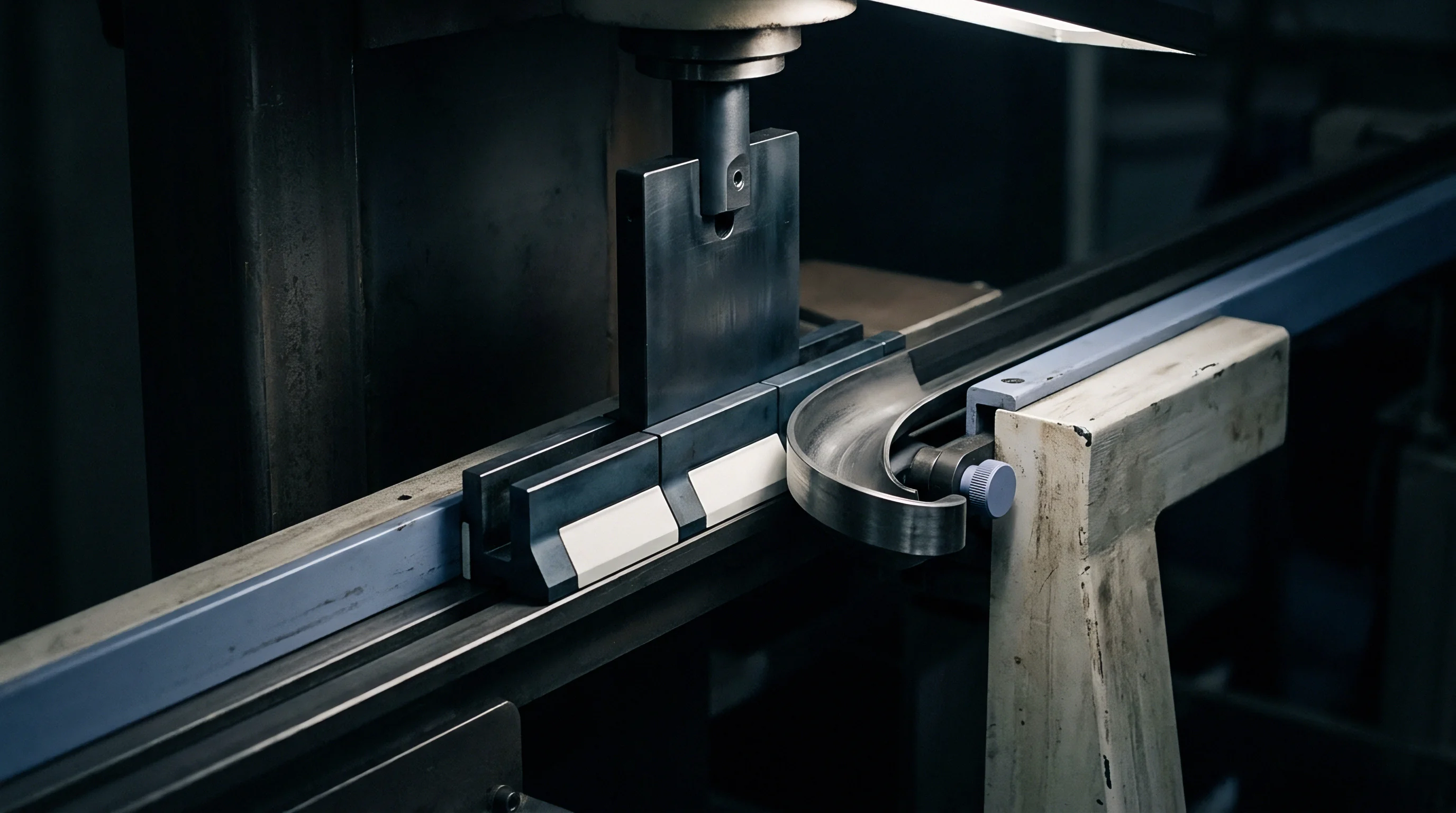
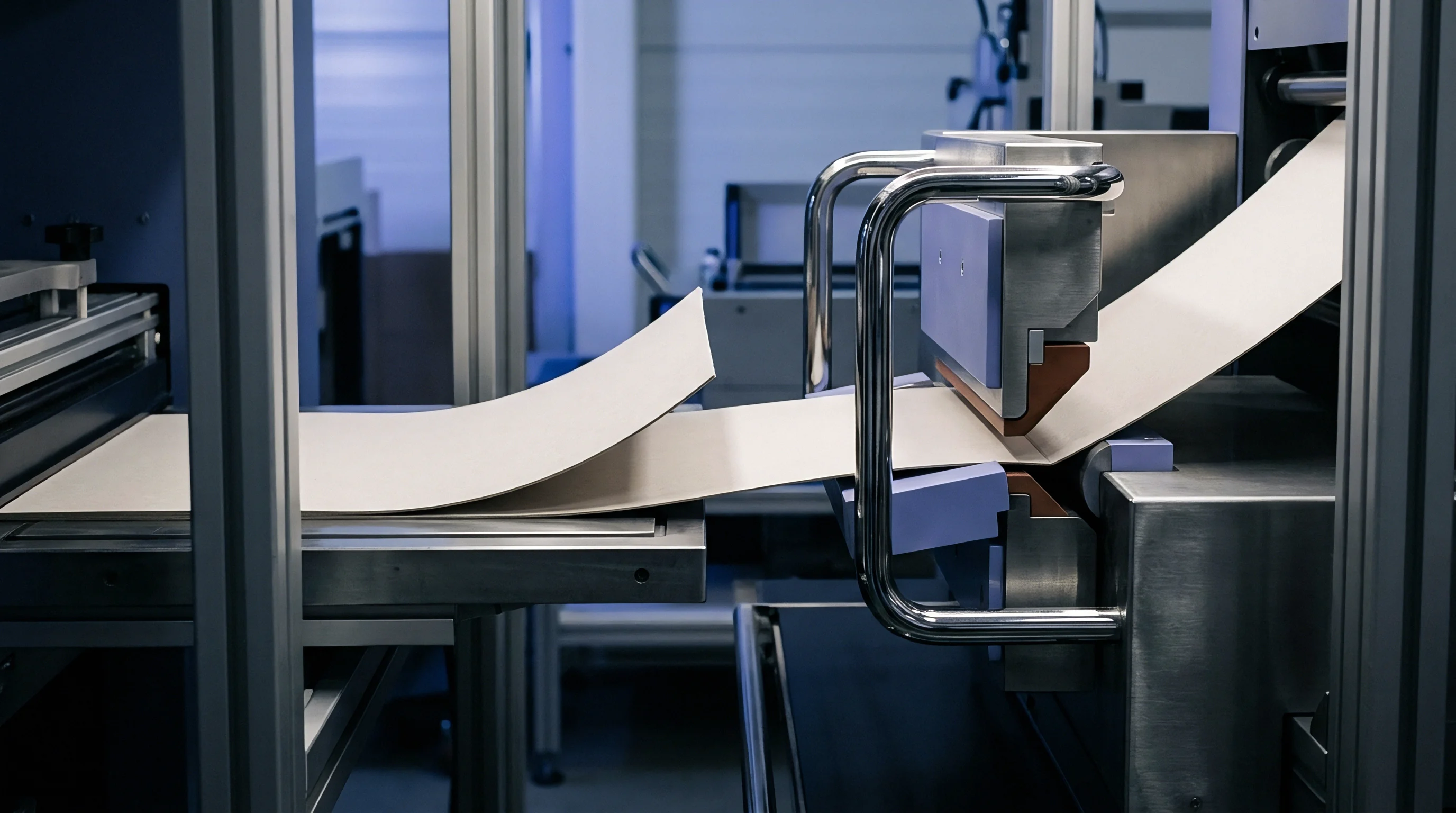
Inline mechanical decurling uses localized reverse bending to induce controlled plastic deformation within the board, counteracting the contraction force exerted by the film. The decurling assembly mounts a small-diameter breaker bar or precision-ground stationary blade right after the laminating nip and cooling rolls. As the single-sided laminated web passes over this bar, the unlaminated paper side rides directly on the steel or ceramic radius.
Held under web tension, the sheet wraps around the bar at a sharp angle, subjecting the lower plies of the board to extreme tensile strain.
Mechanical decurling works by stretching the unlaminated paper side past its elastic yield point. Permanently lengthening those fibers relative to the film surface sets up a counter-bending mechanical moment. How deep the breaker bar pushes into the web path determines the wrap angle and the resulting bending radius applied to the sheet.
Deeper penetration increases the wrap angle, driving higher peak bending stresses and deeper plastic strain penetration through the board caliper.
Breaker Bar Radius and Wrap Angle Mechanics
Bar diameter, penetration depth, and web tension together dictate how strain is distributed through the board caliper. Small bar diameters, typically between 6 and 15 millimeters, produce sharp bending radii that concentrate strain within a narrow deformation zone. Bar diameters over 25 millimeters spread bending forces over a broader area, requiring significantly higher web tension to reach equivalent plastic strain.
During high-speed conversion trials, test data tracked the relationship between wrap angle and burst strength retention. Increasing wrap angle over a small-diameter bar extends dwell time under peak strain, speeding up plastic yield in the paper fibers.
Web tension drives the paperboard against the breaker bar radius. Without enough tension, the moving web floats over the bar surface instead of wrapping to the set geometry. On the other hand, heavy web tension combined with deep bar penetration creates high localized shear stresses that can tear the web or cause internal delamination within multi-ply folding boxboard.
| Substrate Grade | Caliper (µm) | Bar Diameter (mm) | Penetration Depth (mm) | Calculated Wrap Angle (deg) | Tensile Loss Ratio (%) | Surface Cracking Threshold |
|---|---|---|---|---|---|---|
| Coated Recycled Board (CRB) | 300 | 10 | 12 | 35 | 4.2 | No Cracking |
| Coated Recycled Board (CRB) | 300 | 10 | 22 | 62 | 11.8 | Micro-Fissuring Visible |
| Folding Boxboard (FBB) | 380 | 12 | 15 | 42 | 3.5 | No Cracking |
| Folding Boxboard (FBB) | 380 | 12 | 28 | 78 | 14.2 | Delamination Hazard |
| Solid Bleached Sulphate (SBS) | 450 | 15 | 18 | 48 | 2.1 | No Cracking |
| Solid Bleached Sulphate (SBS) | 450 | 15 | 32 | 85 | 8.6 | Top Coat Splitting |
The mathematical strain ε experienced by the outer fiber layer during reverse bending over a breaker bar follows the classical Euler-Bernoulli beam formulation modified for small radii:
ε = fraczρ = fract/2Rbar + t/2
where t represents total board caliper, z is the distance from the neutral stress axis to the outer paper surface, and Rbar is the radius of the decurling bar. As bar radius Rbar decreases or board caliper t increases, strain on the outer fibers climbs rapidly. If that calculated strain exceeds the ultimate tensile limit of the cellulose fibers, the reverse side suffers catastrophic cracking, destroying the printing surface or weakening the board prior to converting.
Mechanical stress concentrates where the unlaminated board contacts the bar. Long virgin kraft fibers absorb reverse strain well because of their high elasticity. Recycled plies, loaded with short fibers and mineral fillers, exhibit low stretch capacity and fracture easily under sharp bending radii.
Lines running recycled cartonboard must use larger decurling bar diameters combined with moderate penetration depths to avoid cracking the reverse liner.
A breaker bar penetration setting of 22 millimeters on a 10-millimeter bar at 120 meters per minute reduces board tensile strength by 11.8 percent on 300-micrometer recycled board.
Strain Localization and Fiber Structure Yielding
Plastic deformation alters the mechanical moment of inertia of the sheet. Under reverse bending, hydrogen bonds between individual cellulose fibers break selectively within the tension zone. This localized micro-fracturing drops machine-direction flexural rigidity, letting the sheet lie flat under minimal force.
However, over-decurling weakens the board excessively, creating a loose, limp sheet that feeds poorly in automated packaging equipment.
Plastic deformation permanently resets the web profile.
Uneven breaker bar wear compromises overall sheet flatness.
Stationary decurling blades generate considerable friction against the moving web. That friction creates localized heating and static electricity while accelerating bar wear along the contact line. Grooves worn into a stationary bar scratch the unlaminated paper surface and cause uneven decurling across the web width.
Rotating decurling rolls eliminate sliding friction and surface scratching, but introduce vibration at high speeds if roll concentricity drifts by more than twenty micrometers.
Motorized linear actuators or manual micrometric screws control decurling bar depth. Modern lines integrate digital position sensors that track bar penetration down to sub-tenth-millimeter resolution. Operators adjust penetration continuously across a run to compensate for speed changes, shrinking unwind roll diameters, and subtle batch-to-batch shifts in board moisture.
Over-penetration leads to severe material degradation that shows up downstream. When reverse bending forces exceed internal bond shear strength in multi-ply board, internal delamination occurs. The board splits inside into separate thin layers, permanently ruining its structural stiffness and score performance.
This failure mode often stays hidden on the lamination line, surfacing only when finished cartons collapse under pallet loads in a warehouse.
Mechanical decurling alone compensates for all film contraction forces if web tension remains above three hundred Newtons per meter width.
Dampening
Mechanical decurling alone cannot achieve long-term flat sheet stability when single-sided lamination strips significant moisture from the paperboard substrate. Mechanical stretching alters fiber geometry but leaves the sheet in a state of severe moisture imbalance. As the dry laminated board absorbs ambient moisture during storage, the unlaminated paper side expands continuously, reversing the decurling bar’s correction and re-establishing severe curl over time.
Inline water dampening addresses this root cause by applying controlled micro-quantities of moisture directly to the unlaminated reverse side of the web prior to rewinding or inline sheeting.
Applying liquid water rehydrates dry paper fibers right after they pass through the heated laminating nip and mechanical decurler. Introduced moisture moves into the porous capillary network, restoring equilibrium moisture content and expanding the reverse liner immediately. This swelling action opposes the permanent shrinkage of the laminating film, establishing a permanent hydraulic counter-stress that remains stable even as the finished product encounters shifting humidity levels.
Fluid Application Kinetics and Wetting Mechanics
Modern inline dampening systems use non-contact applicators to deliver precise water volumes across high-speed webs. Centrifugal rotor dampeners use spinning disks to atomize water into fine, uniform micro-droplets that transfer onto the moving paper surface without pressure. Ultrasonic spray nozzles and high-frequency electrostatic applicators provide alternative non-contact delivery options, enabling precise dosing from 0.5 to 3.5 grams of water per square meter of board surface.
Surface tension governs how fast water droplets wet and absorb into the unlaminated paper face. Sizing agents like alkyl ketene dimer or alkenyl succinic anhydride added during papermaking give the surface hydrophobic properties, delaying water penetration. If surface water remains unabsorbed when the web reaches the rewind reel or sheet stacker, liquid moisture transfers onto the adjacent film face, causing optical water-spotting, film staining, or stack blocking.
| Substrate Surface Condition | Cobb60 Value (g/m²) | Water Pick-Up Rate (g/m²) | Dwell Time to Full Uptake (ms) | Post-Dampening Moisture (%) | Stack Block Hazard Level | Flatness Retention (30 Days) |
|---|---|---|---|---|---|---|
| Hard Sized Kraft Back | 18 | 0.8 | 450 | 5.2 | Elevated | Moderate Decay |
| Hard Sized Kraft Back | 18 | 1.8 | 850 | 6.1 | Critical | Severe Edge Curl |
| Medium Sized FBB Back | 32 | 1.2 | 220 | 5.8 | Negligible | Excellent Flatness |
| Medium Sized FBB Back | 32 | 2.4 | 410 | 6.9 | Moderate | Stable Surface |
| Soft Sized / Absorbent Back | 55 | 1.5 | 95 | 6.2 | Negligible | Excellent Flatness |
| Soft Sized / Absorbent Back | 55 | 3.0 | 180 | 7.6 | Elevated | Reverse Bow Curl |
The penetration of applied water droplets into the microporous fiber matrix obeys the Lucas-Washburn equation for capillary flow within porous media:
h2 = fracγ · r · t · costhη2η
where h is the liquid penetration depth, γ is the water surface tension, r represents the average capillary pore radius of the paperboard, t is contact time, thη is the contact angle, and η is liquid dynamic viscosity. Mechanical decurling performed right before dampening significantly alters this capillary uptake. By micro-fracturing the outer fiber layers, the decurling bar increases effective pore radius r, accelerating water penetration and reducing the dwell time required for complete liquid absorption before web winding.
Adding surfactants to dampening fluid lowers surface tension γ and decreases contact angle thη, accelerating water uptake into hard-sized kraft surfaces. However, chemical additives must comply strictly with international food-contact packaging regulations if the laminated board is intended for dry or greasy food packaging applications. Plain deionized water remains the industry standard, heated slightly to 35 to 45 degrees Celsius to reduce viscosity η and speed up absorption kinetics naturally.
Per EN 13430 standard compliance audits, moisture rehydration systems applying non-deionized industrial tap water risk mineral salt accumulation on reverse board surfaces that invalidates recyclable repulping classifications.

Interplay between Mechanical Yielding and Moisture Uptake
Combining inline decurling bar penetration with water dampening allows converting lines to achieve stable sheet flatness with lower mechanical strain and lower total moisture addition. Relying solely on mechanical decurling degrades board strength through excessive strain. Relying solely on water dampening risks stack blocking and extended drying times.
Operating both systems in series optimizes performance: moderate mechanical decurling opens the fiber matrix, allowing precise, low-volume water application to instantly re-establish equilibrium within the lower plies.
Rapid water uptake disrupts internal fiber bonds.
Dampening volume must scale dynamically with web speed. At line speeds of 150 meters per minute, a web spends less than 50 milliseconds traveling from the dampening applicator to the inline rotary sheet cutter. If liquid water remains on the surface upon sheeting, stack pressure forces water into intimate contact with the film layer of the underlying sheet, triggering local film delamination or surface spot defects.
Automated dosing systems tie water pump speed directly to encoder signals from the main drive shaft, maintaining precise gram-per-square-meter dosing during line acceleration and deceleration.
Board temperature at the dampening unit strongly influences rehydration effectiveness. Web surfaces exiting cooling rolls at temperatures above 45 degrees Celsius evaporate applied micro-droplets prematurely, losing moisture to the exhaust hood before it can penetrate the paper matrix. Installing chilled water rolls prior to the dampening unit drops web surface temperature to 22 degrees Celsius, optimizing capillary penetration into the cellulose network.
A plant lost a dispute over a forty-ton shipment of laminated beverage packaging because moisture logs failed to document that reverse-side dampening fluid temperature had dropped to twelve degrees Celsius during a winter night shift, preventing fluid penetration and causing severe stack warp twenty-four hours later.
Static charges on the moving web disrupt water droplet trajectories during non-contact dampening. High voltage charges generated by film unwinding and heated nip contact cause atomized water droplets to repel from the paper surface, accumulating instead on machine frames, idler rolls, and optical sensors. Active AC ionizing bars installed directly upstream of the dampening chamber neutralize surface charges, ensuring clean, uniform droplet deposition across the entire web width.
Equilibrium
Keeping sheets flat across variable storage and converting environments demands real-time monitoring and adaptive control of both decurling bar penetration depth and reverse-side dampening volume. Sheet flatness cannot be treated as a static measurement made at the stacker. Laminated board stacks undergo continuous hygro-mechanical stress relaxation over extended periods.
As internal temperature gradients dissipate and moisture distributes evenly through the pallet core, the original balance of forces established on line shifts continuously toward a final long-term equilibrium state.
Inline inspection systems deploy laser triangulation sensors and optical displacement meters above the delivery table to capture three-dimensional sheet profiles in real time. These sensors measure edge lift, center bow, and diagonal twist on cut sheets coming off the rotary knife. Digital control algorithms process these geometric inputs, generating closed-loop feedback signals that continuously drive motorized decurling bar actuators and proportional water dosing valves to correct detected flatness deviations before out-of-spec material accumulates on the pallet.

Inline Monitoring and Closed-Loop Control Architecture
Sensor placement dictates feedback loop responsiveness. Positioned too close to the decurling bar, sensors measure transient mechanical bending before the substrate relaxes; positioned too far downstream, signal latency allows hundreds of out-of-tolerance sheets to pass into the stack during process drift. The optimal measurement node sits immediately following the sheet laydown assembly, where individual sheets lie unconstrained on a flat vacuum conveyor belt.
Sudden web tension spikes can easily tear lighter paper webs.
The operational sequence for calibrating inline decurling penetration and water dampening follows a rigid verification workflow during make-ready. Operators execute these systematic adjustments to establish stable running parameters before releasing the line for volume production.
- Confirm baseline substrate moisture content using an inline microwave or near-infrared sensor prior to web threading at the unwind stand.
- Set initial laminating nip pressure and roll temperatures to matched values specified in the master job docket for the selected film caliper and board weight.
- Engage the inline decurling bar to a zero-penetration baseline position where the bar lightly touches the web without altering the natural pass line.
- Activate web tension control loops, establishing nominal line tension based on board basis weight and caliper specifications.
- Bring the lamination line up to standard operating speed, allowing roll temperatures and web drying zones to reach thermal equilibrium.
- Inspect first-off cut sheets visually and measure edge curl magnitude using a standardized flatness gauge on the inspection table.
- Increase mechanical decurling bar penetration depth incrementally until machine-direction bow curl is visually neutralized.
- Activate the reverse-side dampening unit, setting initial water dosing to 1.0 gram per square meter to compensate for thermal nip drying.
- Re-evaluate cut sheet flatness after two minutes of continuous running, balancing penetration depth against water application to eliminate cross-direction dish curl.
- Lock closed-loop control parameters into the line management software to enable automated feedback adjustments throughout the production run.
Multi-ply board structures exhibit delayed hygroexpansion dynamics that complicate closed-loop control. Outer plies respond to water application within milliseconds, whereas dense bleached hardwood middle plies absorb moisture slowly over hours. An inline adjustment that produces a perfectly flat sheet at the stacker laydown table may over-correct as moisture migrates into the core plies during pallet storage, resulting in reverse bow curl after twenty-four hours.
Process engineers must calibrate inline target profiles based on aged pallet performance rather than immediate off-line aesthetics.
Does Reverse Dampening Neutralize Post-Lamination Curl?
Reverse dampening neutralizes post-lamination curl when application rates match the exact volumetric moisture deficit created by thermal nip exposure, but it cannot overcome structural curl induced by severe mechanical fiber fracture. When water application matches drying loss, the hygroexpansion of the reverse paper fibers balances the thermal contraction of the film layer. However, if an aggressive decurling bar has crushed the internal cellulose network through excessive penetration depth, applying water to the damaged fibers causes localized swelling without restoring structural stiffness, leaving the sheet limp and prone to ambient moisture distortion.
Moisture trapped in a pallet creates distinct microclimates within a stacked load of laminated board. The exterior edges of sheets exposed to room air lose or gain moisture rapidly in response to ambient relative humidity shifts. The interior core of the pallet, sealed under immense hydrostatic pressure from the weight of overlying board, retains its post-lamination moisture state for weeks.
This differential equilibration rate causes edge wave or center tight curl profiles to develop selectively within specific zones of the pallet during storage.
Internal stack temperatures remain elevated for hours after sheeting.
| Conditioning Time (Hours) | Pallet Zone (Core vs Edge) | Average Board Temp (°C) | Core Moisture Content (%) | Edge Curl Displacement (mm) | Delamination Risk Level |
|---|---|---|---|---|---|
| 0 (Off Line) | Pallet Core | 52 | 4.1 | +1.2 | Negligible |
| 0 (Off Line) | Pallet Edge | 48 | 4.3 | +1.5 | Negligible |
| 12 | Pallet Core | 38 | 5.2 | +0.4 | Low |
| 12 | Pallet Edge | 26 | 6.1 | +3.8 | Moderate |
| 24 | Pallet Core | 28 | 5.8 | -0.1 | Negligible |
| 24 | Pallet Edge | 23 | 5.9 | +0.8 | Low |
| 72 | Pallet Core | 23 | 5.9 | 0.0 | Negligible |
| 72 | Pallet Edge | 23 | 5.9 | +0.2 | Negligible |
Automated pallet wrapping with stretch film immediately following sheeting locks in stack moisture, preventing rapid edge desiccation. However, wrapping warm pallets containing elevated moisture from excessive reverse dampening traps water vapor inside the load. As the pallet cools, condensation forms on the internal film wrapping, causing severe water damage, mildew growth, and stack blocking along top and bottom pallet layers.
Pallet core moisture equilibration requires a minimum seventy-two-hour dwell time at controlled storage conditions of 21 degrees Celsius and 50 percent relative humidity prior to high-speed die-cutting operations.
Converting specifications must incorporate explicit tolerances for allowable sheet curvature based on standardized measurement protocols. ISO 12647 and trade guidelines define acceptable flat-sheet tolerances as maximum edge deflection per meter of web width. Enforcing these metrics requires standardized conditioning protocols for off-line sample testing.
Standard purchase specifications mandate that flat-sheet samples conditioned for twenty-four hours at 23 degrees Celsius and 50 percent relative humidity per ISO 187 must display no edge lift exceeding 3.0 millimeters across a one-meter chord, rendering any delivery failing this threshold subject to full lot rejection at the supplier’s expense.
Arbitration
Choosing and setting up inline decurlers and dampening hardware directly affects overall yield and landed unit cost on single-sided lamination runs. Incorrectly calibrated decurling systems produce unacceptably high spoilage rates across downstream print finishing, die-cutting, and automatic box-erecting lines. When curling board jams high-speed feeder heads or misaligns inside folding-gluer registration channels, production stops, scrap rates escalate, and job margins disappear entirely.
Defective or curled sheets frequently trigger feeder stops downstream.
Downstream converting spoilage scales exponentially with sheet distortion severity. A batch of laminated cartonboard exhibiting an uncorrected dish curl of eight millimeters generates up to fifteen percent spoilage on high-speed flatbed die-cutters due to sensor trips, sheet misregistration, and stripping section jams. Implementing optimized decurling bar penetration and reverse-side dampening reduces overall converting scrap below 1.5 percent, preserving profit margins on long-run packaging orders.
Waste Arithmetic on Downstream Converting Lines
Capital investment in advanced dual-action decurling and dampening hardware pays off through immediate waste reduction and line speed optimization. A modern non-contact rotor dampening system integrated with motorized decurling bar positioners represents a significant line retrofit cost. However, operating without precise dampening limits maximum lamination speed on thin substrates, as operators must run lines slower to prevent excessive thermal dehydration of the board core.
Tooling wear and energy consumption add direct operating costs to decurling operations. High-tension decurling over small-diameter stationary bars accelerates web drive motor power consumption by up to twelve percent due to friction losses. Stationary ceramic decurling blades require periodic replacement every six to twelve months to prevent edge scoring, while high-frequency water dampening systems require regular maintenance of fluid pumps, micro-filters, and ultrasonic transducers to prevent nozzle clogging and uneven spray deposition across the web.
The failure modes detailed below illustrate the operational consequences of mismanaged decurling bar penetration and water dampening parameters on downstream converting equipment.
- Micro-Cracking of Top Coating occurs when excessive decurling bar penetration depth forces outer paper fibers beyond their ultimate tensile strain limit, ruining subsequent over-varnishing passes.
- Internal Board Delamination arises when extreme reverse bending shear stresses destroy weak fiber bonds in recycled middle plies, causing structural box failure under vertical stacking.
- Pallet Block and Sticking results from excessive water dampening application rates that leave unabsorbed moisture on reverse board surfaces prior to stack accumulation under high pressure.
- Reverse Edge Curling occurs when over-dampening hydrates the unlaminated liner excessively, causing the board to bow outward away from the film side after full stack drying.
- Register Drift in Die-Cutting stems from unstable moisture equilibration across the pallet width, causing local dimensional expansion that shifts print-to-cut alignment across the sheet.
- Web Tensile Breakage happens when high mechanical decurling bar engagement combines with excessive web tension to exceed the web tensile strength during line speed ramps.
Extended producer responsibility schemes and recyclability assessment protocols under EN 13430 and CEPI guidelines penalize single-sided laminated packaging if the barrier film cannot be separated efficiently from the fiber matrix during repulping. Excessive mechanical decurling bar penetration that forces polymer film particles deep into micro-fractured surface fibers impedes mechanical film detachment in industrial pulpers, lowering the overall recyclability score of the finished board.
The decision checklist below guides packaging engineers and converting foremen in establishing optimal decurling parameters for single-sided lamination orders.
- Substrate Fiber Composition determines maximum allowable decurling bar wrap angle based on virgin kraft versus recycled furnish ductility limits.
- Film Thermal Shrinkage Rating dictates the required counter-stress magnitude to be generated through combined mechanical bending and hydraulic swelling.
- Laminating Nip Temperature establishes the total expected core moisture loss requiring reverse-side water dampening compensation.
- Downstream Converting Sensitivity defines the maximum allowable sheet curvature threshold based on press feeder and folder-gluer entry tolerances.
- Pallet Storage Duration governs whether inline adjustments must target immediate flat sheet delivery or long-term equilibrium states.
Commercial contracts for custom single-sided lamination runs should explicitly define flatness measurement protocols, test atmospheres, and defect liability thresholds to avoid costly post-delivery disputes. The financial impact of delivered out-of-spec board falls entirely on the converter if the customer’s purchase docket specifies precise ISO flatness metrics. Integrating inline closed-loop decurling monitoring with digital lot logging provides verifiable proof of compliance before pallets leave the plant floor.
The trade-offs between mechanical decurling bar penetration and hydraulic water dampening remain a subject of active debate: does deep mechanical deformation permanently alter the structural flexural modulus of recycled paperboard in ways that hydraulic moisture rehydration can never fully repair?