Quantifying Mechanical Adhesion Failure Mechanics at the Substrate Film Adhesive Interface
Lamination failure stems from dyne decay and score mismatch; precise surface energy matching and matrix sizing prevent debonding and lower EPR packaging costs.
Tack
Initial contact between a liquid resin film and a solid substrate comes down to thermodynamic wetting kinetics ~ how effectively the adhesive flows into surface irregularities before cross-linking or solvent evaporation locks the bond line. On high-speed converting lines running biaxially oriented polypropylene (BOPP) or polyethylene terephthalate (PET) through heated nip rollers above two hundred meters per minute, liquid adhesives have only milliseconds to bridge surface valleys. Incomplete contact leaves micro-voids trapped along the interface, creating primary stress concentrations that invite failure during die-cutting and creasing.

Thermodynamic Surface Energy Components
Solid substrates carry distinct surface free energy values split between polar and dispersive forces. Uncoated paperboard is dominated by dispersive London forces with polar hydrogen-bonding sites on exposed cellulose fibers, whereas synthetic polymer films run much lower. Unmodified polypropylene sits around twenty-nine millinewtons per meter ~ well below the thirty-four to forty millinewtons per meter typical of solventless polyurethane adhesives.
Spontaneous wetting only happens when the solid substrate’s total surface free energy exceeds the liquid’s surface tension. While dynamic contact angles below ninety degrees permit spontaneous spreading, converting operations aim for angles under thirty degrees to pull the fluid deep into the porous paperboard matrix.
Surface tension forces dictate initial adhesive distribution. Dispersive interactions stem from temporary dipoles in non-polar structures, while polar forces rely on permanent dipoles and hydrogen bonding. Matching dispersive components when laminating extruded polyethylene to bleached solid board minimizes interfacial tension; high interfacial tension simply creates a thermodynamic barrier to bonding.
Surface energy profiles are routinely boosted through chemical priming or oxidation. Corona treatment, for instance, grafted hydroxyl, carbonyl, and carboxyl groups onto polyolefin surfaces to push surface energy into the target forty to forty-four millinewtons per meter range. Without that boost, liquid adhesives bead up instead of wetting out ~ and that treatment decays over storage.
Owens Wendt Rabel Kaelble Interfacial Analysis
Calculating interfacial energy between liquid coatings and solid polymers relies on contact angle measurements using two diagnostic probe liquids. The Owens-Wendt-Rabel-Kaelble method splits surface energy into distinct dispersive and polar components, using double-distilled water for high polar tension and diiodomethane for purely dispersive tension. Benchmarking incoming substrate reels under ISO 19403-2 guidelines establishes this baseline profile, with solid-liquid interfacial energy calculated via geometric mean relationships:
Interfacial tension equals solid surface energy plus liquid surface tension minus twice the square root of solid dispersive energy multiplied by liquid dispersive energy, minus twice the square root of solid polar energy multiplied by liquid polar energy. Aligning polar components keeps interfacial tension minimal, maximizing thermodynamic adhesion. If a board mill applies fluorochemical sizing to boost grease resistance, polar surface energy can crash below six millinewtons per meter.
Water-borne acrylic adhesives will not wet fluorinated board at that level, and solventless polyurethanes fail similarly unless alcohol-based wetting agents lower the liquid tension.
Corona discharge treatment decays non-linearly when exposed to ambient humidity during roll storage.
Dynamic Wetting at High Laminator Speeds
Liquid spreading must match web velocity during inline lamination to prevent micro-cavities. As web speed rises, the dynamic advancing contact angle increases ~ balancing viscous forces against surface tension via the capillary number ~ and can approach one hundred eighty degrees. Air entrapment begins at a critical capillary number set by viscosity and substrate roughness.
High-viscosity solventless adhesives running at forty-five poise at room temperature require lamination temperatures between eighty and one hundred five degrees Celsius to drop viscosity below ten poise.
Nip pressure forces liquid adhesive into the paperboard topography, driving fluid into interfiber voids. Substrate roughness, measured via Parker Print-Surf under ISO 8791-4, determines required coat weight: smooth bleached board (Parker Print-Surf under one point five micrometers) works with as little as one point two grams per square meter, while rough recycled stock (Parker Print-Surf over four micrometers) requires over three grams per square meter to fill the valleys. Insufficient coat weight on rough board leaves discontinuous bond lines that invite micro-delamination under bending stress.
Polyolefin Corona Treatment Decay Profiles
Polypropylene film rolls lose surface oxidation quickly in humid storage. While corona treatment generates transient peroxides and free radicals on the film surface, atmospheric moisture and additive migration steadily degrade dyne levels. Erucamide slip agents and antistatics migrate from the core to the surface, forming a weak boundary layer over oxidized polar sites.
Dyne testing with ethyl cellosolve solutions shows drops from forty-two down to thirty-four dyne-centimeters across thirty days in a warehouse.
Plant quality control requires dyne testing right before lamination. Running film with degraded dyne levels leads straight to debonding along the score line, failing right through the boundary layer formed by migrated fatty amides. Inline treaters ~ like flame oxidation or high-output corona units on the laminator unwind ~ restore surface energy just prior to adhesive application.
This dynamic treating cleans organic surface contaminants and regenerates polar hydroxyl groups, maintaining interfacial bond strength during high-speed runs.
Delamination field failures stem from ambient roll storage conditions at converting plants, where surface dyne decay progresses beyond ninety days.
Shear
Tangential mechanical forces across the boundary layer dictate long-term bond durability under load. Laminated cartons stacked on pallet tiers experience constant static shear parallel to the adhesive layer. Interfacial shear resistance depends on the cohesive shear modulus of the cured polymer and mechanical keying into the board surface.
Under sustained tangential loads, viscoelastic adhesives deform over time, failing via creep or sudden joint fracture.
Could Surface Energy Degradation Invalidate Peel Test Data?
Measurement errors spike when dyne levels drop below contractual specifications. As surface energy decays, mechanical peel tests end up measuring weak boundary layer failure instead of polymer toughness. A drop from forty-four to thirty-four dynes per centimeter on corona-treated polyolefin film cuts peel values by sixty percent, producing force-displacement curves that reflect interfacial slip rather than cohesive energy dissipation.
Tests run on aged stock generate misleading fracture data that fails to predict actual packaging performance.
Checking dyne levels before running adhesion trials distinguishes wetting failures from formulation defects. Drop shape analysis separates dispersive and polar contributions ~ dispersive losses point to additive bloom, while polar drops indicate ozone degradation of hydroxyl groups. Standard ASTM D2578 dyne solutions work well for fast shop-floor checks, but laboratory goniometry is needed to determine whether poor peel results stem from surface aging or low cross-link density.

Viscoelastic Creep Compliance in Laminated Structures
Polymer networks inside packed shipping containers deform continuously under static loads. Viscoelastic creep compliance tracks this time-dependent movement under shear stress. Solventless two-component polyurethanes soften noticeably near their glass transition temperature: below it, rigid polymer chains maintain a high shear modulus; above it, thermal energy enables segment mobility and increases compliance.
Static shear on warm pallets accelerates this creep, causing film slippage along folded carton panels.
Dynamic mechanical thermal analysis (DMTA) measures shear storage and loss moduli across operating temperatures. Storage modulus reflects elastic energy retention, while loss modulus quantifies energy dissipated as heat. Their ratio, tan delta, peaks at the glass transition temperature.
If board laminates sit in hot warehouses at forty to fifty-five degrees Celsius and the adhesive glass transition falls in that band, shear delamination follows. Formulations bound for tropical transit require higher cross-link density to lock down chain mobility and maintain modulus.
Dynamic mechanical analysis measures viscoelastic stress relaxation across commercial laminates. Quality control rejected fourteen thousand laminated folding cartons after high-temperature creep testing revealed bond slippage exceeding zero point five millimeters.
| Substrate Material | Surface Treatment | Water Contact Angle (deg) | Diiodomethane Angle (deg) | Dispersive Energy (mN/m) | Polar Energy (mN/m) | Total Surface Energy (mN/m) |
|---|---|---|---|---|---|---|
| Bleached Solid Board (SBS) | Standard Mill Size | 68.4 | 38.2 | 40.5 | 6.2 | 46.7 |
| Uncoated Kraftboard | None | 76.1 | 44.5 | 37.2 | 3.8 | 41.0 |
| BOPP Film (20 um) | Corona Treated (42 dyne) | 62.3 | 35.1 | 42.1 | 4.8 | 46.9 |
| BOPP Film (20 um) | Aged 60 Days (Un-treated) | 91.5 | 52.4 | 33.1 | 0.8 | 33.9 |
| Metallized PET (12 um) | Vacuum Vacuum Aluminum | 54.2 | 28.9 | 44.8 | 8.4 | 53.2 |
| Annealed Aluminum Foil | Degreased Passivated | 42.1 | 22.4 | 46.2 | 14.1 | 60.3 |
Thermal Expansion Mismatch across the Interface
Paperboard fibers and synthetic films expand at drastically different rates during thermal cycles. Cellulosic board has thermal expansion coefficients of five to eight times ten to the minus sixth per Kelvin, compared to over one hundred twenty times ten to the minus sixth per Kelvin for polypropylene films. Heated lamination nips run up to one hundred ten degrees Celsius to encourage adhesive flow; as the web exits and cools to ambient room temperature, the film contracts twenty times faster than the board.
That differential contraction locks residual interfacial shear stress into the laminate, scaling directly with the temperature drop and the film’s elastic modulus. As the film shrinks against the rigid board, the resulting shear forces curl the sheet toward the film side. Severe curl jams press feeders and die-cutters, while inducing micro-cracks if adhesive shear strength falls below the residual stress.
Interfacial Micro-Mechanics under Sustained Stress
Local stress concentrations build around micro-voids in solventless resin layers ~ voids formed by air entrapment during mixing or incomplete wetting over coarse board fibers. Under shear loads, stress at the edges of these spherical voids reaches up to three times nominal levels. Once that local stress exceeds adhesive yield strength, micro-fractures form in the polymer matrix and hop from void to void under cyclic stress.
Interfacial micro-mechanics determine whether failure runs cohesively through the adhesive or interfacially along the substrate. High cohesive strength paired with poor surface wetting forces cracks along the board face, producing clean film separation with no fiber tear. In contrast, fiber tear shows that adhesive shear strength and interfacial bond energy exceed the board’s internal z-direction tensile strength.
Standard shear tests evaluate bond quality by calculating the percentage of fiber tear across failure zones.
- Adhesive Interfacial Failure Clean separation occurring precisely at the adhesive-substrate boundary line with no polymer transfer or substrate surface rupture.
- Cohesive Layer Split Mechanical fracture propagating entirely inside the bulk adhesive film, leaving equal resin residues attached to both substrate surfaces.
- Substrate Fiber Tear Structural failure occurring within the paperboard matrix, pulling cellulose fibers away from the core sheet during force application.
- Adhesive Creep Delamination Time-dependent plastic deformation of the bonding resin under sustained static load resulting in delayed panel separation.
- Thermal Shock Debonding Interface cleavage induced by differential thermal contraction stresses across mismatched film and paperboard expansion gradients.
Polyurethane laminating adhesives exhibit a fourfold increase in creep compliance when temperature rises from twenty to forty-five degrees Celsius under continuous static load.
The converter paid four thousand two hundred dollars in air freight to replace an entire press run when thermal creep compliance shifted during transit across desert trade corridors.
Peel
Measuring true interfacial fracture toughness requires separating the actual work of adhesion from plastic bending in the flexible backing. Standard peel tests measure total energy consumed when pulling a flexible strip off a rigid board at fixed crosshead speeds. That gross energy combines thermodynamic surface work, viscoelastic dissipation in the resin, and plastic deformation from flexing the film.
Failing to strip out backing deformation results in artificially inflated bond strength figures.
Fracture Toughness and Work of Adhesion
Thermodynamic bond energy marks the theoretical threshold for interfacial separation. Reversible work of adhesion equals substrate surface energy plus film surface energy minus interfacial tension, typically landing between fifty and one hundred millijoules per square meter for board-polymer systems. Yet practical peel tests measure fracture energies from ten to five hundred joules per square meter ~ three to four orders of magnitude above thermodynamic predictions.
Viscoelastic dissipation explains this huge gap. Tensile loads stretch the adhesive at the crack tip, uncoiling and sliding polymer chains so energy dissipates as friction before chemical bonds break. This dissipation acts as a multiplier: stronger thermodynamic bonding increases stress concentration at the crack tip, which in turn drives higher viscoelastic dissipation through the surrounding resin matrix.
Kinetic Rate Dependence in Debonding Tests
Crosshead speed directly shifts measured peel forces. Following Williams-Landel-Ferry behavior, increasing peel speed from ten to three hundred millimeters per minute makes the polymer behave more rigidly and less ductily. Higher rates limit chain movement, shrinking the plastic deformation zone ahead of the crack tip and creating distinct kinetic regimes based on pull speed.
At low peel rates, polymer chains have time to relax, producing low forces dominated by creep. At intermediate speeds ~ typically fifty to three hundred millimeters per minute ~ viscoelastic dissipation peaks, yielding maximum peel resistance. At very high speeds, the adhesive turns brittle and glassy, causing dissipation and measured force to drop rapidly.
ISO 8510-2 standardizes these rate conditions for consistent comparison between runs.
- Condition test specimens at twenty-three degrees Celsius and fifty percent relative humidity for forty-eight hours under ISO 187 guidelines.
- Cut specimen strips precisely twenty-five millimeters wide along the paperboard grain direction using a dual-blade precision cutter.
- Clamp the rigid board substrate into the lower tensile grip of an INSTRON load frame equipped with a free-sliding ninety-degree peel fixture.
- Initiate crosshead displacement at three hundred millimeters per minute while recording force data at a sampling rate of one kilohertz.
- Calculate fracture energy by subtracting film bending strain energy from total measured peel work.
| Film Laminate Combination | Adhesive Chemistry | Peel Angle (deg) | Crosshead Speed (mm/min) | Average Peel Force (N/25mm) | Interfacial Energy G_c (J/m²) | Dominant Failure Mode |
|---|---|---|---|---|---|---|
| SBS Board / 12 um Gloss PET | Solventless 2K Polyurethane | 90 | 300 | 4.8 | 142.0 | Substrate Fiber Tear |
| SBS Board / 20 um Corona BOPP | Solventless 2K Polyurethane | 90 | 300 | 3.2 | 88.5 | Cohesive Adhesive Split |
| SBS Board / 20 um Matt BOPP | Water-borne Acrylic Emulsion | 90 | 300 | 1.9 | 45.2 | Adhesive Interfacial Failure |
| Kraftboard / 15 um LDPE Extruded | Extrusion Polyethylene Tie | 180 | 300 | 6.1 | 195.0 | Substrate Fiber Tear |
| Coated Board / 12 um Met-PET | 2K Solvent-Borne Polyurethane | 90 | 300 | 3.9 | 112.4 | Metal Layer Delamination |

Energy Dissipation in Film Bending Strain
Flexural bending absorbs significant mechanical work during ninety-degree peel tests. As the film detaches, it bends ninety degrees under load, undergoing elastic-plastic deformation at the root of the peel zone. That plastic bending consumes work that never reaches the bond line.
Peel force equations from Rivlin and Kendall quantify this energy distribution:
Total work recorded by the load frame equals interfacial fracture energy plus strain energy in the detached arm plus plastic work dissipated bending the backing strip. With thicker films like fifty-micrometer PET or seventy-micrometer polyolefin, plastic bending can account for up to seventy percent of the total load cell reading. Subtracting bending strain using beam-on-elastic-foundation models isolates the true critical energy release rate.
Testing lamination adhesion under ISO 8510-2 without controlling crosshead velocity invalidates energy dissipation calculations in flexible backings.
Crack Tip Mechanics and Interface Fracture Energy
Microscopic stress concentrates right at the leading edge of delamination, where crack tip opening displacement describes local deformation. Tensile peel loading splits local stress into normal tensile (Mode I) and shear (Mode II) components. Standard ninety-degree peel tests create mixed-mode conditions, where the ratio of Mode II shear to Mode I tension dictates how the crack moves along the interface.
Evaluating fracture toughness with a ninety-degree peel apparatus shows how stress ratios govern failure paths. High Mode II shear components drive crack fronts down into paperboard fibers to produce fiber tear, whereas high Mode I tensile stress promotes clean interfacial cleavage along weak boundary layers. Tailoring adhesive shear modulus alters internal stress partitioning right at the crack tip.
Procurement contracts citing FINAT FTM 1 without specifying pulling rate and substrate grain direction leave peel force tolerances effectively unenforceable during commercial disputes.

Score
Creasing film-laminated board creates intense localized strain along the fold line. Steel rules press into the sheet during die-cutting, driving multi-ply board into counter-matrix channels. This deforms internal fibers and intentionally shears internal plies along the fold axis, weakening z-direction strength so the carton snaps into a sharp ninety-degree corner.
Adding a high-elongation synthetic film over the board alters how those forces distribute across the score bead.
Crease Line Micro Mechanics and Strain Fields
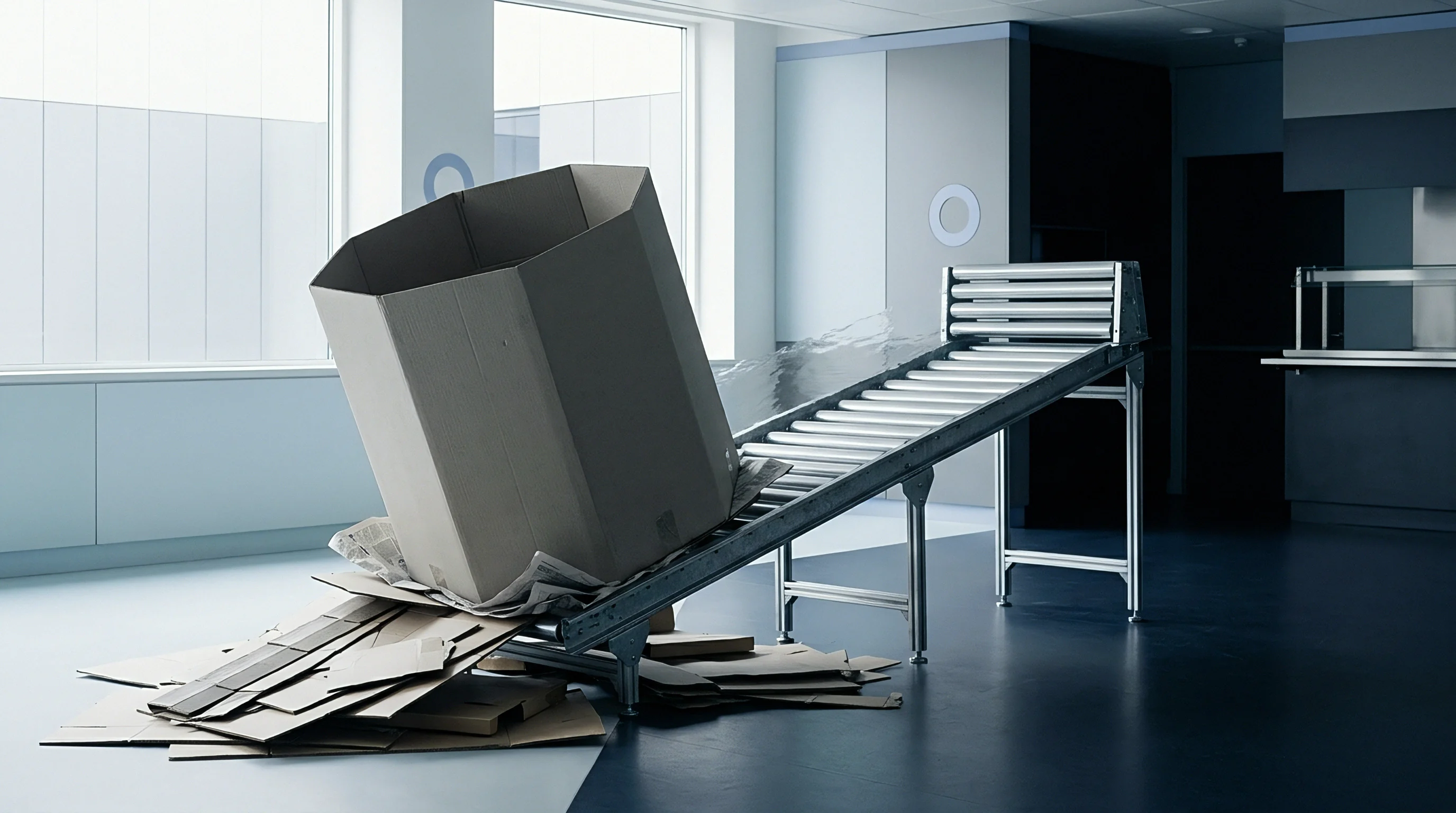
Compression from male creasing rules forces inner board plies to buckle outward into female channels, forming a raised bead on the reverse side. Simultaneously, outer plies and attached laminating film undergo extreme tensile elongation across the crease radius, with peak strain concentrated directly over the apex of the rule. Outer fiber strain scales inversely with the bend radius.
Whether synthetic films survive scoring depends on tensile elongation limits. Gloss PET typically tolerates eighty to one hundred twenty percent elongation at break, whereas soft-touch BOPP reaches forty to sixty percent under fast strain rates. If rule penetration forces film stretch past its yield limit, micro-cracks form along the score line, exposing cellulose fibers to ambient humidity and causing localized edge curl.

Delamination Propagation along Fold Radius
During box erection, micro-cracks propagate along the adhesive boundary layer. High-speed packaging machinery folds blanks through ninety to one hundred eighty degrees at over three hundred cartons per minute. These rapid folds generate high internal bending moments, where tensile pull on the film tries to shear it off the board surface.
Separation starts at micro-voids in the high-strain score area.
Interfacial shear during folding sends separation cracks running parallel to the score. If adhesive fracture energy falls below the film’s elastic bending strain, delamination spreads from the crease into flat panel areas, appearing as silver bubbles or blistering along carton edges. Beyond ruining optics, this delamination destroys barrier performance against moisture, oxygen, and mineral oil.
| Board Caliper (um) | Board Tensile Stiffness (kN/m) | Film Type & Caliper | Crease Rule Width (mm) | Die Channel Width (mm) | Score Depth Ratio (%) | Delamination Threshold Angle (deg) |
|---|---|---|---|---|---|---|
| 350 | 14.2 | 12 um Gloss PET | 0.71 | 1.40 | 65 | 180 (No Delamination) |
| 450 | 18.5 | 20 um Soft-Touch BOPP | 1.05 | 1.90 | 60 | 115 (Edge Blistering) |
| 550 | 24.1 | 15 um Matte BOPP | 1.42 | 2.40 | 55 | 95 (Severe Separation) |
| 400 | 12.8 | 12 um Metallized PET | 0.71 | 1.50 | 70 | 165 (Micro Crack Only) |
| 300 | 11.0 | 20 um Gloss BOPP | 0.71 | 1.30 | 65 | 180 (No Delamination) |
Counter Matrix Channel Geometry Calibration
Proper matrix channel width prevents edge crushing while preserving bead definition. Standard female channel width equals one point five times board caliper plus creasing rule thickness. Narrower channels pinch the plies, creating excessive interface shear that ruptures outer board fibers and strips the film away.
Matrix channel depth should match nominal board caliper. Shallow channels crush paper plies beyond their elastic limit, preventing clean internal bead formation and dumping all bending strain onto the outer film layer. Target score depth ratios of fifty-five to sixty-five percent board penetration direct deformation into internal plies, shielding the outer film-adhesive bond line.
- Matrix Channel Width Optimization Matching female die channel dimensions precisely to board thickness and creasing rule width prevents interface crushing during scoring passes.
- Crease Depth Control Regulating male rule penetration depth forces internal paperboard ply separation, suppressing tensile strain buildup on the outer laminating film.
- Film Elongation Matching Specifying film backings with tensile elongation capacity exceeding peak score line strain prevents film splitting during rapid ninety-degree folding.
- Grain Alignment Verification Running primary score lines perpendicular to paperboard mill grain direction reduces peak outer fiber strain during high-speed carton erection.
Substrate Stiffness versus Film Strain at Yield
Extensibility differences between paper plies and plastic film dictate whether scores survive high-speed folding. Paperboard stiffness (ISO 2493) increases with the third power of caliper: heavy board (four hundred fifty to six hundred micrometers) resists bending and concentrates stress along the score line, requiring deeper rule penetration to achieve clean folding.
Interface shearing occurs frequently when die cutters operate with worn steel crease rules. Rounded, worn rules distort pressure across the matrix channel, forming uneven beads that shift peak tensile strain to the score edges. These unbalanced strain fields generate asymmetric peel forces that strip film off board fibers during folder-gluer runs.
Fresh tooling prevents uneven strain distributions across sensitive score lines.
When film elongation at yield exceeds the tensile strain limit of board fibers, delamination shifts from cohesive adhesive failure to interfacial fiber tear.
Matching crease matrix dimensions to board caliper stops localized interface shearing during ninety-degree carton assembly.


Reckoning
Calculating the true landed cost of film-laminated packaging requires accounting for scrap, energy overhead, and extended producer responsibility surcharges. Film lamination adds an off-line converting pass that introduces extra waste, lead-time delays, and compliance fees. Across European markets, non-separable plastic laminates face steep financial penalties under eco-modulated waste schemes, forcing buyers to weigh lamination costs against the performance of modern dispersion coatings.
Waste Arithmetic across Added Converting Passes
Adding a lamination pass increases spoilage during setup and registration. Offline thermal units consume one hundred fifty to three hundred sheets of high-grade board per job setup just to stabilize temperature and web tension ~ a severe penalty on short runs. On a five-thousand-sheet order of SBS board, make-ready scrap consumes six percent of substrate volume, while running waste adds another one point five to three percent from tension shifts and static sheet double-feeds.
Spoilage costs go beyond lost board. Defective laminated sheets passing inspection carry compounding scrap through foil stamping, die-cutting, and gluing. A sheet with score-line micro-delamination consumes expensive machine time across multiple converting steps before discovery at the folder-gluer packing station, driving up net carton costs.
Extended Producer Responsibility Surcharges for Plastic Lamination
National waste programs penalize multi-material laminates that impede fiber recovery. Under EU directives enforced by organizations like CITEO in France or LUCID in Germany, packaging fees are eco-modulated. Paperboard with non-separable plastic film exceeding five percent total weight gets categorized as non-recyclable or hard-to-recycle composite material.
While standard board incurs base fees around one hundred fifty Euros per tonne, non-separable plastic laminates face surcharges exceeding six hundred Euros per tonne.
Extended Producer Responsibility (EPR) fees heavily impact carton economics. A brand owner shipping ten million forty-gram perfume cartons annually uses four hundred tonnes of laminated board. Choosing non-separable film over recyclable aqueous dispersion coatings adds one hundred eighty thousand Euros per year in eco-modulation penalties alone.
Landed cost estimates must factor in these end-of-life fees alongside converting pass prices.
Recyclability Grading under European Test Schemes
Laboratory pulping determines whether plastic film detaches cleanly from paper fibers. Testing under CEPI Recyclability Test Method Version 2 or PTS-RH 021/97 subjects samples to aqueous repulping in mechanical disintegrators at forty degrees Celsius, five percent consistency, and ten minutes of agitation. Certification requires complete fiber separation through a one hundred fifty-micrometer slotted screen with rejects below six percent.
Plastic films create contrasting repulping challenges. High-adhesion films resist separation, dragging usable fibers into reject streams and lowering yield. Low-adhesion films shatter into micro-plastic flakes that slip through screens and contaminate mill water circuits.
Clean separation without fragmentation requires adhesives engineered for water solubility or alkali removal during pulping.
Commercial Break Even Analysis for Coating Alternatives
Dispersion coatings remove the offline converting step, though moisture barrier properties differ. High-solids aqueous coatings and UV inline varnishes run through press coater units up to fifteen thousand sheets per hour. Applying coatings inline eliminates lamination setup and cuts lead times by twenty-four to forty-eight hours, with coat weights of three to six grams per square meter delivering adequate rub and moisture protection for dry food packaging.
Deciding between film lamination and dispersion coatings depends on run length, durability requirements, and gloss targets. Lamination offers gloss above eighty-five units at sixty degrees and scuff resistance suited for luxury packaging. But on runs under ten thousand sheets, setup costs, scrap, and EPR surcharges make lamination thirty to forty percent more expensive per thousand units than inline dispersion coating.
The open operational question is whether online acoustic emission monitoring can catch score-line micro-delamination before cartons reach high-speed filling lines.