Mechano Sorptive Creep Failure Analysis in Corrugated Transport Boxes
Dynamic ambient relative humidity accelerates creep collapse in corrugated boxes far beyond static moisture limits, requiring dynamic SCT safety factors in structural engineering.
Kinematics
Cellulosic fiber structures deform faster when mechanical loads coincide with changing ambient moisture levels. When relative humidity fluctuates, paperboard panels give way far quicker than they do in a steady, high-humidity environment. This physical process, known as mechano-sorptive creep, causes structural collapse in corrugated transport boxes during storage and ocean transit.
Structural degradation occurs because water molecules entering and exiting the cell wall continuously alter internal load-bearing pathways. The cell wall matrix consists of semi-crystalline cellulose microfibrils embedded in an amorphous hemicellulose and lignin matrix. Under static dry conditions, intrachain and interchain hydrogen bonds hold this network in a rigid configuration.
When ambient relative humidity rises, water vapour penetrates the amorphous zones, swelling the inter-fiber bonds and softening the hemicellulose matrix.
Strain accelerates during moisture movement because of transient-state dynamics, not simply absolute moisture content. Standard creep theories assume that material deformation rates scale strictly with moisture content and applied stress, but paperboard deviates from this pattern. A box stored at a constant ninety percent relative humidity deforms at a predictable rate governed by secondary creep mechanics.
Exposing that same box to alternating cycles of fifty percent and ninety percent relative humidity accelerates total deflection, causing structural collapse at load levels far below static design thresholds. Tensile and compressive forces redistribute continuously across microscopic regions as water molecules break and reform hydrogen bonds under stress.

Molecular Hydrogen Bond Disruption under Dynamic Sorption
Water adsorption introduces free hydroxyl groups that compete directly with existing fiber-to-fiber bonds within the paperboard sheet. As water vapor diffuses into the cell wall, it breaks secondary hydrogen bonds between adjacent cellulose chains. Applied mechanical stress biases the direction in which these bonds re-establish once water desorbs.
During moisture uptake, the amorphous regions swell, increasing molecular mobility and allowing polymer chains to slip past one another along the axis of applied force. Upon desorption, water molecules exit the network, allowing hydrogen bonds to reform in newly deformed physical locations. Moisture cycling creates a mechanical ratchet effect.
Each absorption and desorption leg adds permanent, unrecoverable plastic strain to the linerboard and fluting components.
Humidity flushes disrupt hydrogen bonds far faster than static saturation. Structural slip occurs primarily during the transient sorption phase, precisely when moisture content changes rapidly over time. The rate of strain accumulation correlates directly with the magnitude and frequency of relative humidity shifts.
Rapid diurnal humidity spikes cause steep internal moisture gradients across the thickness of the containerboard. These localized gradients generate internal shear stresses that add to the external compressive loads caused by pallet stacking.
Transient Moisture Gradients and Fiber Network Stress Redistribution
Thick linerboard faces absorb moisture unevenly across their cross-sections during ambient humidity fluctuations. The outer skin of a corrugated wall responds immediately to ambient air changes, while the interior core lags behind due to internal vapor diffusion resistance. This imbalance creates severe moisture gradients between the outer surface, inner surface, and internal fluting.
Differential swelling across the cross-section induces localized bending moments, forcing individual plies to warp even under pure vertical compressive loads. Localized micro-buckling begins in areas where moisture accumulation is highest, transferring structural load onto drier, stiffer zones of the container panel.
- Transient Hygro-expansion Stress introduces localized bending forces inside the paperboard wall as moisture fronts move through the sheet thickness.
- Hydrophobic Sizing Fatigue accelerates water vapor penetration into amorphous cellulose zones following repeated wetting and drying cycles.
- Bond Breaking Ratchet locks in plastic shear strains every time hydrogen bonds reform during the desorption phase of the ambient cycle.
- Amorphous Matrix Softening reduces the shear modulus of hemicellulose, lowering the critical stress threshold for micro-buckling in fluting medium.
Cellulose networks subjected to mechanical load during active moisture exchange undergo structural reorganization that permanent static loads cannot produce. As compressive forces push against the vertical fluting channels, the combined action of stress and moisture diffusion forces the amorphous matrix into micro-yielding events. The accumulated micro-yields weaken the structural stiffness of the container wall, degrading panel flat crush resistance and edge crush strength simultaneously.
Over prolonged transport schedules, these microscopic disruptions aggregate into visible creases along the box corners, leading to ultimate structural collapse.
Relative humidity variations generate dynamic structural strains inside paperboard that exceed static high-humidity deformation rates.
The rate of structural degradation depends on the frequency of moisture cycling, the amplitude of relative humidity changes, and the baseline mechanical load on the transport box. Higher baseline stress levels amplify the ratchet effect, reducing the time required for micro-buckling to transition into full-scale panel failure. When recycled fibers are introduced into the containerboard formulation, the lower initial fiber length and elevated fines content worsen this dynamic, as shorter fibers present a higher density of stress-concentrating bond terminations.
Understanding these internal kinematics allows packaging engineers to evaluate laboratory test results beyond simple static compression numbers.
Whether structural failure under cyclic humidity can be fully mitigated through chemical cross-linking agents without destroying sheet recyclability remains an active area of investigation.
Bench
Testing corrugated transport packaging requires methods that reproduce field failure mechanisms rather than idealized static laboratory environments. Traditional Box Compression Tests (BCT) performed under standard conditioning of twenty-three degrees Celsius and fifty percent relative humidity per ISO 187 yield single-point burst values. These static figures fail to reveal how the transport container will perform under cyclic moisture flushes.
Evaluators must measure short-span compression strength (SCT) and edge crush resistance (ECT) under active humidity cycling to capture mechano-sorptive creep rates. Standard static tests measure initial structural capacity; dynamic creep tests measure structural endurance over time.
Data from short-span compression creep testing reveals stark performance differences between virgin kraftliner and recycled testliner grades. Under steady-state conditioning at fifty percent relative humidity, virgin kraftliner demonstrates high load retention. Exposing specimens to humidity cycling between fifty percent and ninety percent relative humidity every six hours dramatically alters performance.
Recycled testliner experiences a rapid strength drop, failing in less than half the time of virgin kraftliner under identical mechanical loads. The elevated fines content and shortened fiber length in recycled stocks increase susceptibility to moisture-induced strain accumulation.
Short-Span Compression under Dynamic Relative Humidity
Short-span compression testing per ISO 9895 measures the compressive strength of paperboard over a gauge length of seven-tenths of a millimeter. This micro-scale test prevents sheet buckling, isolating the true compressive strength of the fiber matrix. Performing SCT inside a controlled climate chamber with rapidly shifting relative humidity provides direct insight into local fiber matrix behavior.
Test data demonstrates that compression strength decays rapidly during the absorption phase of each humidity cycle. The rate of strength loss slows during desorption, but the unrecoverable strain continues to grow linearly with each completed cycle.
Edge crush testing per ISO 3037 evaluates vertical load-bearing capacity for a full corrugated wall section. When subjected to creep testing under cyclic humidity, ECT specimens exhibit step-wise strain increases coincident with moisture flushes. Recycled testliners show a 42 percent strength reduction under twenty-four-hour cyclic humidity flushes compared to static ninety percent relative humidity.
Static high-humidity testing alone leads to significant overestimations of real-world container performance.
Discrepancies between Static Stacking and Ambient Cyclic Endurance
Standard static stacking tests performed per ISO 2234 apply a constant dead weight to a transport box maintained at steady temperature and humidity. Test laboratories often use static results to approve packaging specifications for international ocean freight. Transport containers in field conditions experience temperature swings that force relative humidity to alternate between fifty percent during dry daytime hours and ninety-five percent during cool night hours.
This environmental cycling induces severe mechano-sorptive creep that static ISO 2234 tests cannot detect.
- Condition specimen sheets inside an environmental chamber at twenty-three degrees Celsius and fifty percent relative humidity for twenty-four hours to establish moisture equilibrium.
- Mount the prepared sample into an automated short-span compression testing rig equipped with continuous displacement sensors and load cells.
- Apply a sustained compressive baseline load equal to forty percent of the ultimate dry compression strength of the specimen.
- Ramp the chamber relative humidity from fifty percent to ninety percent over a forty-five minute window, hold for two hours, then return relative humidity to fifty percent over forty-five minutes.
- Repeat the humidity ramp cycle continuously until structural specimen failure occurs or displacement exceeds maximum instrument sensor stroke.
- Record displacement-time curves and calculate the secondary and tertiary creep strain rates for each relative humidity leg.
Laboratory protocol selection directly influences the reliability of box strength predictions. Relying on static conditioning data creates a false sense of security regarding stack stability. Testing equipment designed for cyclic environmental exposure exposes structural weaknesses in containerboard formulations prior to mass production.
Short-span compression testing performed under 50% to 90% relative humidity cycles at 23°C reveals up to 7.2-fold increases in strain accumulation rates for recycled fluting compared to static testing.
Dynamic climate testing validates whether wet-strength additives and internal sizing treatments actually improve creep resistance under moisture flux. Chemical surface treatments often impede liquid water penetration while leaving the sheet fully permeable to ambient water vapor diffusion. Water vapor penetration continues to drive hydrogen bond rearrangement within the fiber network regardless of surface hydrophobicity. bench evaluations must separate surface water repellency performance from internal matrix mechano-sorptive resistance.
Paperboard that meets static edge crush specifications will collapse in humid transit environments if dynamic moisture cycling is omitted from laboratory qualification.
Ply
Board architecture and paper chemistry determine a transport box’s structural resistance to dynamic moisture exposure. Corrugated board consists of flat linerboard plies bonded to fluted corrugated medium using starch adhesives. The structural performance of this composite relies on fiber quality, internal sizing, wet-strength resin chemistry, and flute geometry.
Softwood virgin fibers provide long, flexible cellulose chains that maintain structural entanglement even when moisture softens individual bonds. Recycled fibers contain shortened, damaged fragments with reduced hydrogen bonding capability, increasing reliance on chemical additives to survive moisture swings.

What Moisture Fluctuation Range Triggers Accelerated Box Buckling?
Relative humidity fluctuations as narrow as fifteen percent can initiate mechano-sorptive creep acceleration if the upper threshold exceeds seventy-five percent relative humidity. Above seventy-five percent relative humidity, moisture content in containerboard enters the capillary condensation regime. Water molecules condense inside microscopic pores within the cell wall, softening the hemicellulose matrix and accelerating micro-buckling under load.
Diurnal swings between sixty percent and eighty-five percent relative humidity prove particularly destructive to stacked corrugated packaging.
| Flute Designation | Flute Height (mm) | Pitch Length (mm) | Take-Up Factor (Medium Ratio) | Flat Crush Strength (ISO 3035) (kPa) | Relative Creep Rate Factor (Cyclic vs Static) |
|---|---|---|---|---|---|
| A-Flute | 4.5 – 5.0 | 8.0 – 9.5 | 1.52 | 260 | 1.85x |
| C-Flute | 3.6 – 4.2 | 6.8 – 7.9 | 1.43 | 310 | 1.60x |
| B-Flute | 2.2 – 3.0 | 5.5 – 6.5 | 1.32 | 410 | 1.35x |
| EB-Flute (Double Wall) | 4.3 – 5.2 | Combination | 1.75 Total | 680 | 1.20x |
| BC-Flute (Double Wall) | 6.1 – 7.2 | Combination | 1.78 Total | 590 | 1.40x |
B-flute structures exhibit lower initial vertical compression strength but maintain higher resistance to moisture-induced panel buckling due to superior flat crush stiffness and shorter unsupported span lengths between glue lines.
Substrate Chemistry and Wet-Strength Resin Mechanics
Internal sizing agents such as Alkyl Ketene Dimer (AKD) and Alkenyl Succinic Anhydride (ASA) retard liquid water absorption by lowering surface energy. These hydrophobic sizing treatments alter the contact angle of liquid droplets on the linerboard surface. Sizing agents do not prevent gaseous water vapor diffusion into the amorphous cellulose matrix.
Under elevated atmospheric relative humidity, water vapor bypasses surface sizing, diffusing into the fiber core and triggering mechano-sorptive creep degradation.
- Polyamide-Epichlorohydrin Resins create water-insoluble covalent cross-links across cellulose microfibrils, retaining structural strength during high-humidity exposure.
- Alkenyl Succinic Anhydride Sizing provides rapid surface hydrophobicity, reducing liquid water uptake during accidental condensation exposure.
- Semi-Chemical Birch Fluting contains native lignin structures that reinforce fiber walls against compressive shear failure under high ambient humidity.
- Carrier Starch Gelatinization determines glue line water resistance, preventing fluting-to-liner delamination inside warm, humid transport environments.
Cross-linking wet-strength resins like Polyamide-Epichlorohydrin (PAAE) form covalent networks that protect fiber-to-fiber contacts against water degradation. These wet-strength resins do not eliminate mechano-sorptive creep entirely, but they reduce total creep strain rates by limiting inter-fiber distance expansion during moisture absorption. Recycled containerboards often lack sufficient native lignin to maintain structural stiffness when wet, requiring higher dosage rates of synthetic wet-strength additives to match virgin performance parameters.
Clause 4.2 of standard supply contracts specifies that surface sizing levels certified via Cobb water absorption tests do not constitute proof of structural creep resistance under cyclic atmospheric humidity.
Adhesive integrity along the flute tips represents another vulnerable failure point inside corrugated board constructions. Native corn or wheat starch adhesives absorb moisture rapidly in high-humidity environments. If the starch glue line softens, the fluting medium separates from the outer linerboard faces, causing immediate loss of structural composite action.
Adding ketone-formaldehyde or synthetic resin cross-linkers to the corrugating starch formulation locks the glue line, ensuring that failure occurs within the paper sheet rather than along the adhesive bond line.
Increasing board grammage is often presented as a solution to high-humidity performance issues, though it does not alter underlying substrate chemistry.
Transit
The physical journey of a transport box exposes packaging to harsh microclimates that trigger severe mechano-sorptive failure. Ocean shipping containers cross temperature zones, generating internal microclimates characterized by severe diurnal relative humidity swings. A container loaded in a warm, humid region cools rapidly at night on open ocean waters, driving internal container humidity past the dew point.
Condensation forms on metal container ceilings and drips directly onto stacked pallets, creating localized saturation zones within the packaging stack.
Cold chain logistics operations generate severe ambient moisture shifts during routine cross-docking procedures. When chilled produce boxes move from a four-degree Celsius cold storage facility across an ambient loading dock at twenty-five degrees Celsius and eighty percent relative humidity, moisture condenses instantly on the cold paperboard surface. The outer linerboard face absorbs free liquid water while the inner fluting plies absorb moisture vapor.
This asymmetric moisture loading generates intense transient hygro-expansion stresses, causing outer panel bulging and accelerated creep collapse under vertical pallet loads.
Microclimate Dynamics inside Ocean Containers and Cold Warehouses
Microclimates inside ocean containers fluctuate drastically based on solar radiation, ocean spray, and cargo respiration. During daylight hours, solar heating elevates internal air temperatures near the roof of the sea container to over sixty degrees Celsius, driving moisture out of wooden pallets and organic cargo into the surrounding air space. As temperatures drop at night, this airborne moisture rapidly condenses, creating rain-like conditions inside the sealed steel container.
Corrugated transport boxes positioned on top of pallet loads absorb this falling condensate, experiencing rapid strength degradation.
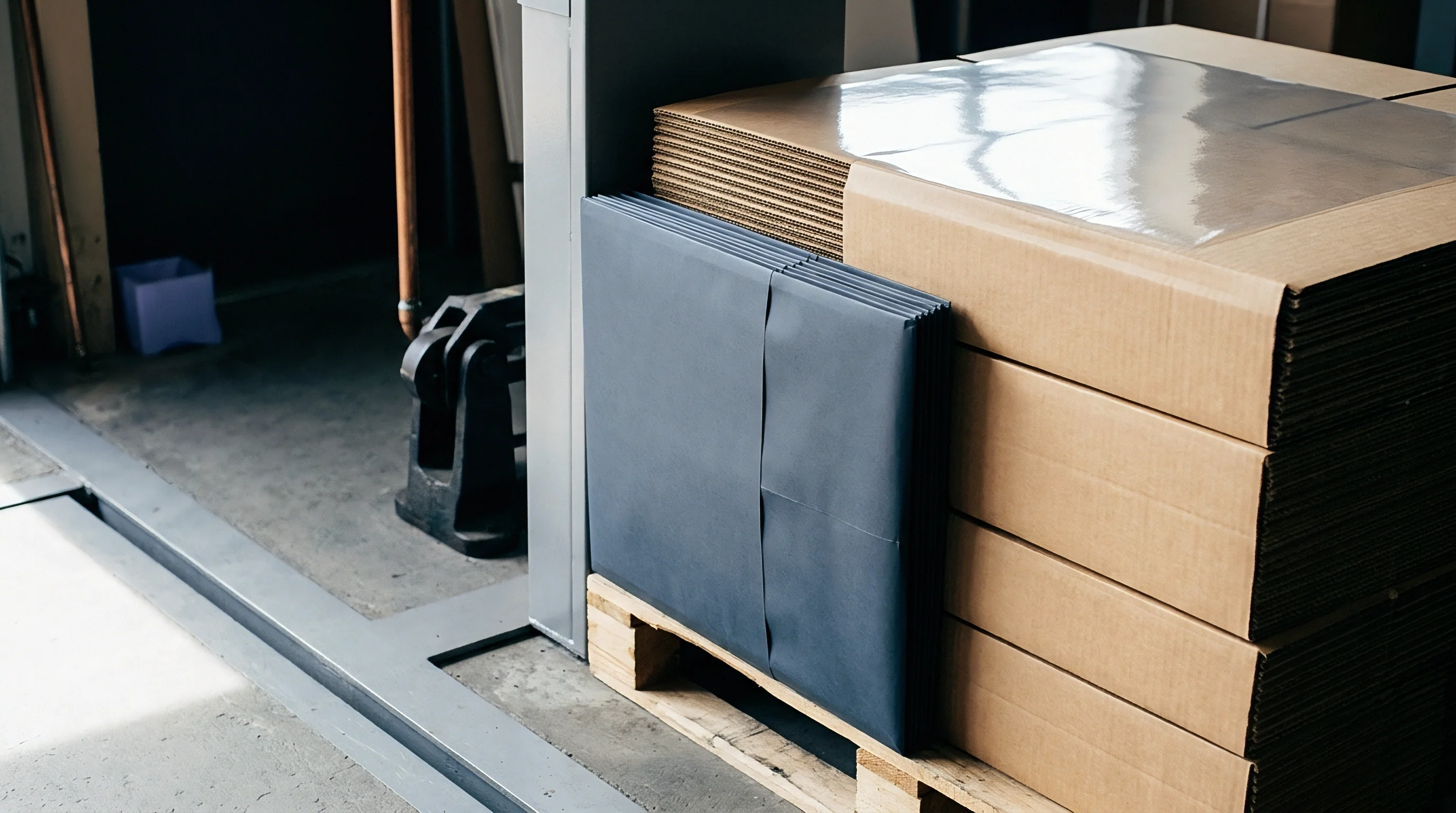
Palletized boxes positioned at the bottom of a six-high pallet stack endure continuous static loading while subjected to atmospheric cycling. When relative humidity fluctuates inside the container, bottom-tier packaging panels undergo progressive creep deformation. As the bottom boxes deform, the center of gravity of the entire pallet column shifts, introducing side-thrust forces that pull adjacent stacks out of vertical alignment.
Once alignment degrades, corner post load paths misalign, causing catastrophic stack collapse inside the container.
Pallet Column Alignment and Pallet Stretch-Wrap Vapor Trapping
Pallet stacking patterns dictate how structural compressive loads distribute across individual box corners. Interlocking stacking patterns, where alternating box layers rotate ninety degrees to lock the pallet together, reduce total stack compression strength by up to fifty percent compared to straight column alignment. Interlocking patterns transfer compressive loads away from vertical box corners toward the center of unsupported panel walls.
Under cyclic moisture exposure, unsupported panel walls flex outward under load, accelerating mechano-sorptive panel failure.
Plastic stretch wrap applied around pallet loads often worsens moisture-induced creep issues if applied incorrectly. Impermeable stretch wrapping traps moisture within the palletized box load, preventing wet packaging from drying during ambient humidity decreases. If boxes are wrapped while containing elevated moisture levels, the enclosed space remains at near saturation relative humidity, suppressing moisture drying cycles while allowing continuous creep strain accumulation under static stack weight.
Perforated or breathable stretch films allow vapor exchange, preventing internal moisture accumulation.
Continuous stretch wrapping around moist corrugated packaging traps internal water vapor, maintaining near-saturated microclimates that accelerate corner compression failure.
Pallet overhang represents an aggressive structural risk factor in commercial transit operations. Transport boxes extending over pallet edges by as little as two centimeters experience up to a thirty-two percent reduction in vertical load capacity. Overhang removes bottom support from vertical box corners, concentrating structural loads onto unsupported fluting edges.
When combined with mechano-sorptive creep triggered by ambient humidity shifts, overhanging packaging panels buckle rapidly, tilting the entire pallet load against adjacent container walls.
Failing to account for container moisture cycling results in crushed bottom-tier packaging, ruined product integrity, rejected customs declarations, and complete loss of insurance coverage for damaged goods.
Paperwork
Proving compliance and performance for paper packaging requires robust documentation throughout the international supply chain. Buyers must establish chain-of-custody tracking while verifying that containerboard substrates comply with food contact, environmental, and packaging waste regulations. FSC-STD-40-004 and PEFC ST 2002 standards mandate strict tracking of certified virgin and recycled fiber fractions across paper production operations.
When sourcing high-performance containerboard, chain-of-custody certificates ensure that raw material declarations match physical mill shipments.
Recycled fiber claims printed on packaging carry structural implications that must be verified through laboratory test documentation. High recycled content declarations often correlate with reduced fiber length and increased mechano-sorptive creep susceptibility. Buyers must cross-reference converter certificates of analysis against actual paper batch mill test reports.
Verification prevents suppliers from substituting lower-grade recycled testliners under high-performance virgin kraftliner contract line items.
Chain of Custody Verification and Fiber Provenance Auditing
Forest certification schemes use transfer, percentage, or credit accounting systems to track fiber origins through paper converting mills. Under the credit system, a mill may produce containerboard containing both certified virgin fiber and uncertified recycled material while selling a portion of output under certified claims. Buyers must examine the scope line on converter certificates to verify whether claims apply to specific packaging lots or general mill production volume.
Scope exclusions often leave specialized wet-strength and recycled packaging grades uncovered by primary certification marks.
When claims cross customs borders, regulatory authorities require documentary proof connecting printed packaging claims to certified supply chain entities. A claim without supporting documentary evidence creates legal exposure under unfair commercial practices legislation. Importers must maintain a complete compliance dossier containing mill certificates, test reports, and conversion records.
The compliance file proves that packaging materials meet declared structural, chemical, and environmental specifications.

Regulatory Barriers and Recyclability Design Compliance
Food contact packaging must comply with stringent regulatory frameworks, including EU Regulation EC 1935/2004 and BfR Recommendation XXXVI for paper and board. Wet-strength additives like polyamide-epichlorohydrin (PAAE) and internal sizing chemicals must be evaluated for chemical migration limits. Synthetic resins must not release restricted substances such as epichlorohydrin, 1,3-dichloro-2-propanol (1,3-DCP), or 3-monochloro-1,2-propanediol (3-MCPD) into sensitive food products.
Sourcing compliant chemical additives ensures structural wet-strength integrity without creating food safety violations.
- Chain of Custody Certificate Scope validates whether specific packaging linerboard batches are covered by FSC or PEFC certified claim flows.
- BfR XXXVI Migration Report confirms that internal wet-strength resins and sizing agents comply with food-contact chemical release limits.
- PPWR Recyclability Assessment certifies that synthetic wet-strength resin concentrations remain below thresholds that interfere with repulping operations.
- Batch Certificate of Analysis documents physical edge crush, short-span compression, and Cobb water absorption values for shipped box lots.
The European Union Packaging and Packaging Waste Regulation (PPWR) mandates strict design-for-recyclability criteria across all transport packaging formats. Wet-strength resins used to counter mechano-sorptive creep can impede paper repulping operations during post-consumer recycling. Under PPWR performance metrics, packaging components must achieve high recyclability grades (Grade A to Grade D) based on fiber yield and repulpability efficiency.
Excessive use of non-dispersible cross-linking resins risks downgrading recyclability scores, exposing brand owners to elevated Eco-Modulated Extended Producer Responsibility (EPR) fee penalties.
Section 8.3 of standard international supply agreements mandates that non-compliant packaging batches failing certified edge crush thresholds under ambient moisture cycling shall be returned at supplier expense.
Documentary verification bridges the gap between lab-tested performance and real-world compliance. Maintaining audit-ready compliance dossiers protects buyers against customs delays, regulatory fines, and unexpected field packaging failures. Systematically verifying certificate scopes ensures that paper specifications deliver both physical durability and legal compliance across export markets.

Ledger
Calculating accurate load-bearing requirements for corrugated transport packaging requires adjusting basic compression formulas to account for environmental degradation. The traditional McKee formula estimates Box Compression Test (BCT) strength based on Edge Crush Test (ECT) results, box perimeter, and board caliper. This basic formula assumes static laboratory conditioning at twenty-three degrees Celsius and fifty percent relative humidity.
To account for real-world mechano-sorptive creep, engineers apply environmental reduction factors (C_e), stacking duration factors (C_t), and pallet pattern factors (C_p) to determine allowable real-world stacking loads.
| Transport Stress Parameter | Operating Variable Range | Reduction Factor Symbol | Design Multiplier (Virgin Kraft) | Design Multiplier (Recycled Testliner) |
|---|---|---|---|---|
| Controlled Climate Storage | 50% Static RH, 23°C | C_e1 | 1.00 | 1.00 |
| High Humidity Static Storage | 90% Static RH, 23°C | C_e2 | 0.55 | 0.42 |
| Cyclic Ambient Transport Zone | 50% to 95% Dynamic RH Cycles | C_e3 | 0.38 | 0.21 |
| Long-Term Stacking Duration | 90 to 180 Days Continuous Load | C_t | 0.60 | 0.50 |
| Interlocking Pallet Pattern | Rotated Layer Alignment | C_p | 0.50 | 0.50 |
| Pallet Overhang Defect | 25 mm Edge Overhang | C_h | 0.68 | 0.65 |
BCT = 5.87 x ECT x sqrt( P x d )
In this equation, BCT represents peak box compressive strength in Newtons, ECT represents edge crush strength in Newtons per meter, P represents box outer perimeter in meters, and d represents total board caliper in meters. To calculate real-world load capacity (BCT_allowable), structural engineers multiply initial BCT strength by appropriate reduction factors:
BCT_allowable = BCT x C_e x C_t x C_p x C_h
Derivation of Safety Factors for Mechano-Sorptive Degradation
Evaluating reduction factor derivations highlights the severe impact of recycled fiber substitution under dynamic ambient humidity conditions. Standard virgin kraftliner boxes operating in cyclic transport environments require an environmental reduction factor (C_e) of 0.38, reflecting a sixty-two percent capacity loss due to dynamic mechano-sorptive strain accumulation. If the board formulation is changed to recycled testliner without increasing sheet grammage, the environmental factor drops to 0.21, representing a seventy-nine percent loss of static load capacity.
Storage duration factors (C_t) account for static fatigue over extended warehouse storage schedules. Paperboard under continuous load experiences progressive strain growth even at constant humidity. Over a ninety-day storage window, virgin kraftliner retains sixty percent of its initial compressive strength (C_t = 0.60), whereas recycled containerboard retains fifty percent (C_t = 0.50).
Multiplying these factors together reveals that total structural safety factors under cyclic conditions must often exceed 5.0 to prevent stack failures.

Worked Calculation of Stacking Load Capacity under Cyclic Moisture
Consider a standard export transport box measuring 0.40 meters in length, 0.30 meters in width, and 0.30 meters in height, constructed from C-flute double-face corrugated board with a caliper (d) of 0.004 meters. The perimeter (P) equals 1.40 meters. Laboratory testing of virgin C-flute board specimens yields an ECT value of 6,500 N/m.
Inserting these values into the baseline McKee equation yields initial compression strength:
BCT = 5.87 x 6500 x sqrt( 1.40 x 0.004 ) = 2,854 N
This box displays an initial dry compression strength of 2,854 Newtons, equivalent to a static collapse load of approximately 291 kilograms. When this box is deployed into an export ocean transport route involving dynamic humidity cycles (C_e = 0.38), ninety-day storage times (C_t = 0.60), and column-stacked pallets with no overhang (C_p = 1.00, C_h = 1.00), allowable load capacity drops dramatically:
BCT_allowable = 2854 x 0.38 x 0.60 x 1.00 x 1.00 = 650.7 N
Dynamic environmental exposure reduces real-world load capacity from 2,854 Newtons down to 650.7 Newtons (66.3 kilograms). If the transport planner fills each box with 15 kilograms of product, individual bottom-tier boxes must support five layers of stacked packaging above them, representing a static dead weight load of 75 kilograms (735.7 Newtons). Because required stack load (735.7 N) exceeds allowable load capacity (650.7 N), bottom-tier boxes will suffer mechano-sorptive creep collapse during ocean transit.
To restore structural integrity, packaging engineers must upgrade board specifications. Replacing standard liners with heavy-weight virgin kraftliner treated with internal AKD sizing increases initial ECT to 8,500 N/m while improving the environmental reduction factor (C_e) to 0.45. Recalculating allowable load capacity demonstrates structural compliance:
BCT_new = 5.87 x 8500 x sqrt( 1.40 x 0.004 ) = 3,732 N
BCT_allowable_new = 3732 x 0.45 x 0.60 x 1.00 x 1.00 = 1007.6 N
The upgraded specification delivers an allowable load capacity of 1,007.6 Newtons (102.7 kilograms), providing a safe margin above the 735.7 Newton stacking load. When specifying corrugated transport packaging, procurement teams must enforce safety factor calculations based on dynamic cyclic performance rather than dry static BCT values. Audits of failed container shipments show that incorrect safety factor selection accounts for the vast majority of structural field failures.
Commercial packaging procurement contracts must incorporate explicit reduction factor tables based on verified transport humidity profiles. Contract specifications that rely exclusively on dry burst strength or static BCT numbers fail to allocate liability for moisture-induced transit damage. Specifying short-span compression creep targets under dynamic relative humidity ensures that containerboard suppliers deliver substrates engineered to survive international logistics routes.