Matt Lamination Cracking at the Crease against Gloss That Survives
Matt lamination cracks at the crease because silica matting inclusions reduce film elongation capacity, requiring expanded matrix channels to lower folding strain.

Fracture
When a folded carton passes through an automated gluer, the exterior surface of the crease undergoes extreme elongation. Under identical folding geometry, board caliper, and machine speed, gloss lamination stays continuous while matt lamination splits into jagged white lines along the outer crease spine. That fracture exposes underlying paperboard fibers and broken ink layers to atmospheric moisture, weakening the hinge and ruining the appearance of the finished carton.
The mechanical difference between gloss and matt film under bending force comes down to how each polymer structure handles tensile strain. Standard gloss biaxially oriented polypropylene film is built on a relatively pure, continuous polymer matrix. When the board underneath bends ninety or one hundred eighty degrees, the outer film stretches smoothly across the crease crown.
Elongation at break for a typical gloss polypropylene lamination layer spans between one hundred thirty and one hundred eighty percent, giving the film enough elasticity to cover the expanded outer perimeter of the score without reaching its ultimate tensile limit.
Matt lamination film has a much lower failure threshold. Its surface contains microscopic discontinuities designed to scatter light and create a non-reflective, tactile finish, introduced by incorporating particulate matting agents or co-extruding incompatible polymer phases into the top skin layer. Under bending strain, these surface irregularities concentrate mechanical stress instead of spreading it evenly across the sheet.
As the paperboard substrate yields along the score line, fibers pull apart underneath, and localized tensile strain builds up wherever a light-scattering inclusion or surface crater sits on the outer radius. The local elongation capacity of a matt polypropylene skin drops to between thirty-five and sixty-five percent. When bending strain from folding a four hundred micrometre SBS board exceeds that lower limit, micro-cracks form at surface discontinuities and travel straight through the full thickness of the film layer.
Adhesive thickness plays a similar role in distributing stress. Thermal lamination bonds film to printed paperboard with a heat-activated ethylene vinyl acetate copolymer or polyolefin extrusion coating. This adhesive acts as a cushion between rigid paperboard fibers and the extensible film layer.
A thin layer transfers sharp shear forces from fracturing fibers directly into the skin, whereas a thicker adhesive layer absorbs part of that shear through plastic deformation, dampening the shock delivered to the film during high-speed folding.
A broad creasing matrix channel distributes outer fold tension across a wider polymer area than a narrow matrix channel.
Ink chemistry on the printed substrate adds another complication in thermal lamination. UV-cured offset inks and heavy trapping of digital toners can release volatile compounds or form rigid, cross-linked surface shells that block adhesive penetration. When matt film is laminated over poorly cured ink or a high-wax formulation, the adhesive cannot form a continuous bond.
The film then delaminates from the ink during creasing before it actually cracks, and once unbacked, it folds over a zero-radius bend that hastens mechanical failure.
Stresses propagate across several material interfaces during high-speed converting operations, each following a distinct failure path.
- Micro-void propagation starts at synthetic particle interfaces inside the matt skin under peak outer-radius tension.
- Interfacial delamination occurs when thermal adhesive bond strength falls below the shear force driven by paperboard memory.
- Transverse film tearing follows micro-void growth, tracking parallel to the score line along the axis of maximum tensile strain.
- Substrate fiber lifting happens when strong film adhesion pulls the top liner off a low-internal-bond board.
Surface treatment levels on the film also alter how cracks progress along the score. Standard processing uses corona discharge to push polypropylene surface energy above thirty-eight dynes per centimeter so the thermal adhesive can wet out properly. Over-treated film turns brittle at the skin, while under-treated film debonds prematurely under score stress.
Gloss films tolerate higher corona exposure without losing strain capacity because they lack the particulate inclusions that trigger cracks under tension.
Matt films trade tensile elasticity for optical dispersion, leaving converted score lines inherently prone to polymer splitting under a ninety-degree fold.
Silica
Inorganic additives and incompatible polymer blends produce low-gloss surfaces by creating a micro-textured topography. To drop gloss readings below ten units at a sixty-degree angle, film manufacturers add synthetic amorphous silica particles to the outer skin layer during co-extrusion. Ranging from one to five micrometers in size, these particles sit embedded in the polypropylene matrix and project slightly above the film surface to disrupt specular reflection.
While silica particles scatter light, structurally each embedded particle acts as an unbonded inclusion within the polymer matrix. Synthetic silica is an inorganic mineral, so it forms no covalent bonds with surrounding non-polar polypropylene chains. Under mechanical tension, the polymer stretches around the rigid particle, creating sharp stress concentrations at the boundary.
As the film stretches over the outer crown of a paperboard crease, the polypropylene matrix pulls away from the silica, opening sub-micron voids that widen under continued strain.
Manufacturing biaxially oriented polypropylene (BOPP) involves stretching the extruded sheet in both the machine and transverse directions, aligning polymer chains parallel to the film plane for higher tensile strength and clarity. Gloss BOPP maintains high chain orientation across its full thickness and stretches smoothly. Matt BOPP, by contrast, relies on a multi-layer co-extrusion structure where a thick, highly oriented core is capped by one or two un-oriented or modified skin layers containing matting additives.
The skin layer of a matt film often blends incompatible polymers like polyethylene and polypropylene alongside the silica particles. Their immiscibility forms micron-scale phase boundaries that diffuse light efficiently, but drastically reduce elongation capacity. While the core layer might stretch one hundred fifty percent before breaking, the skin layer fractures once tensile strain exceeds forty percent.
As soon as the surface skin breaks, stress concentrates in the core beneath, causing a clean crack through the entire film thickness.
| Film Specification | Total Caliper (µm) | Matting Mechanism | Elongation at Break (%) | Crease Failure Point |
|---|---|---|---|---|
| Standard Gloss BOPP | 12 to 15 | None (Smooth Surface) | 140 to 180 | Exceeds 180° Fold Strain |
| Standard Matt BOPP | 15 to 18 | Synthetic Silica Inclusions | 40 to 65 | Splits at 90° Fold Strain |
| Soft-Touch Matte TPU | 18 to 22 | Cross-linked Polyurethane | 85 to 110 | Survives 90°, Splits at 180° |
| High-Gloss PET Film | 12 to 14 | None (High Crystallinity) | 110 to 140 | Survives 180° High Shear |
Soft-touch matte films behave differently from silica-filled options. Instead of simple silica particles, high-end matte films use an extruded or liquid-applied coating of cross-linked polyurethane or specialized elastomeric resin. That polyurethane matrix provides a tactile feel while holding higher elasticity than silica-loaded polypropylene skins, yielding elongation at break values between eighty-five and one hundred ten percent.
They perform better than standard matt polypropylene, but high surface friction in the urethane layer still makes soft-touch films more prone to crease splitting than gloss BOPP because the surface resists slipping smoothly across the creasing matrix during folding.
A matt polypropylene skin layer containing four percent synthetic silica by weight loses over sixty percent of its elongation capacity compared to a gloss skin layer of identical thickness.
Performance in thermal lamination depends heavily on the co-extruded adhesive backing. Thermal matt film combines a twelve-to-fifteen-micrometer base layer with a six-to-twelve-micrometer adhesive layer of polyolefin or ethylene vinyl acetate. Heated nip rollers melt this adhesive at one hundred to one hundred twenty degrees Celsius, pressing it into the paperboard surface under pneumatic pressure so it fills the valleys between board fibers and locks onto the ink.
The mechanical properties of the adhesive layer shift over time as ethylene vinyl acetate coatings undergo slow secondary crystallization and plasticizer migration after application. Fresh out of the laminator delivery stack, the warm adhesive is soft and compliant, cushioning stresses if creased immediately. After twenty-four to forty-eight hours at room temperature, however, the adhesive crystallizes and hardens.
This rising tensile modulus limits its ability to absorb shear, transferring more mechanical stress directly into the matt film skin during die-cutting.
Surface metrics underline these physical differences. Standard gloss BOPP has a smooth profile with uniform surface energy, allowing adhesive to wet evenly and distribute bending stresses predictably. Matt film shows surface roughness values (Ra) between zero point six and one point eight micrometers.
The resulting peaks and valleys create local thickness variations across the sheet, with thin spots acting as pre-scored failure paths under mechanical strain.
Environmental storage conditions and post-lamination curing temperatures can accelerate micro-void formation along the silica-polypropylene interface well before the sheet ever reaches the die-cutter.
Rule
Press mechanics dictate how much strain reaches the film layer during score formation. Creasing laminated folding boxboard without cracking the outer skin requires precise die setup. Rather than cutting board fibers, the creasing rule deforms them downward into a female channel, creating internal delamination within the paperboard core that acts as a controlled hinge during folding.
Crease geometry determines whether the film survives. As the male steel creasing rule pushes board into the matrix channel, the print-side liner stretches over the channel shoulders. Matrix channel width sets the bending radius of the outer laminated surface.
If the channel is too narrow, the film is pulled around a sharp radius under heavy tensile load, snapping along the score line regardless of film quality.
Calculating female channel width requires adjusting standard board creasing formulas for the extra caliper and lower strain tolerance of laminated sheets. Un-laminated paperboard uses a channel width equal to the male rule thickness plus one point five times the board caliper. For matt laminated board, that width needs to expand to the rule thickness plus one point eight to two point zero times board caliper.
Opening the channel increases the outer film’s bending radius, cutting peak tensile strain across the score crown.
| Board Caliper (µm) | Rule Thickness (pt) | Gloss Matrix Width (mm) | Matt Matrix Width (mm) | Matrix Depth (mm) |
|---|---|---|---|---|
| 250 (approx 300 gsm) | 2 pt (0.71 mm) | 1.10 to 1.20 | 1.30 to 1.40 | 0.30 |
| 350 (approx 380 gsm) | 2 pt (0.71 mm) | 1.35 to 1.45 | 1.50 to 1.65 | 0.40 |
| 400 (approx 420 gsm) | 3 pt (1.07 mm) | 1.80 to 1.95 | 2.05 to 2.20 | 0.50 |
| 450 (approx 460 gsm) | 3 pt (1.07 mm) | 1.95 to 2.10 | 2.20 to 2.35 | 0.50 |
Creasing rule thickness plays just as big a role. Swapping a two-point (zero point seven one millimeter) rule for a three-point (one point zero seven millimeter) rule on board over three hundred fifty micrometers creates a broader, rounded crease profile. The thicker rule forces more board material into the matrix, spreading film elongation across a wider area.
Opening matrix channel width by zero point one5 millimeters reduces folding scrap by 4.2 percent.
Grain direction alters how stress develops. When a score runs parallel to the board grain, the fold forms between aligned cellulose fibers. The board bends easily, but because underlying fibers part cleanly with little resistance, the outer film absorbs concentrated strain.
When a score runs cross-grain, the crease has to force stiff fibers to buckle inward. That resistance demands higher platen tonnage and drives up internal shear stress within the adhesive layer.
Setting up a die-cutting press for delicate matt film follows a strict mechanical order on the floor:
- Verify paperboard caliper across three points of the printed stack using a calibrated digital micrometer.
- Select a male creasing rule thickness matched to board caliper, stepping up to a three-point rule for calipers over three hundred fifty micrometers.
- Mount a countersunk phenolic or vulcanized rubber creasing matrix with a channel width calculated at one point nine times board caliper plus rule thickness.
- Adjust platen impression pressure upward from zero until score lines form fully without crushing board fibers along the crease shoulders.
- Check crease profile depth under fifty-times optical magnification to confirm continuous film coverage along the score spine.
Matrix channel depth must match the compressed thickness of the substrate. If it is too shallow, the male rule crushes the paperboard core against the channel floor, damaging the internal fiber bonds needed to absorb bending energy. That pinching action presses the outer film against the steel edges of the female channel, causing mechanical scoring or micro-fracturing before the carton ever reaches the gluer.
Standard print quality specifications dictate that film lamination along folded score lines must exhibit zero surface cracking visible to the unassisted eye at a distance of thirty centimeters under standard daylight illumination.
Counter-plate materials determine score consistency across long runs. Milled steel counter-plates and high-density phenolic resin systems maintain exact channel dimensions over hundreds of thousands of impressions. Pressboard or fiber-board matrix strips, on the other hand, degrade under continuous impact ~ their channels widen and the shoulders soften.
As those shoulders round off, score sharpness deteriorates, leading to erratic folding and sudden film fracture midway through a run.
Creasing rules with rounded, fully polished crowns prevent film scoring, whereas standard ground-edge rules carry micro-burrs that can slice into brittle matt film on impact.

Gauge
Verifying folding integrity in the lab requires standardized testing before committing to production print runs. Quality control cannot rely on manual thumb-creasing at the press. Validating film integrity across score lines takes precise measurements of tensile strain capacity, adhesive bond strength, and environmental resistance under controlled conditions.
Conditioning controls board moisture. Paperboard is hygroscopic, its mechanical properties shifting with ambient relative humidity. Standard testing mandates conditioning samples at twenty-three degrees Celsius and fifty percent relative humidity for twenty-four hours under ISO 187.
Dry paperboard loses internal ply-delamination capacity, forcing the outer liner to absorb excess strain during creasing and cracking otherwise healthy matt lamination. Humid board softens, blunting crease definition and raising the risk of delamination along score shoulders.
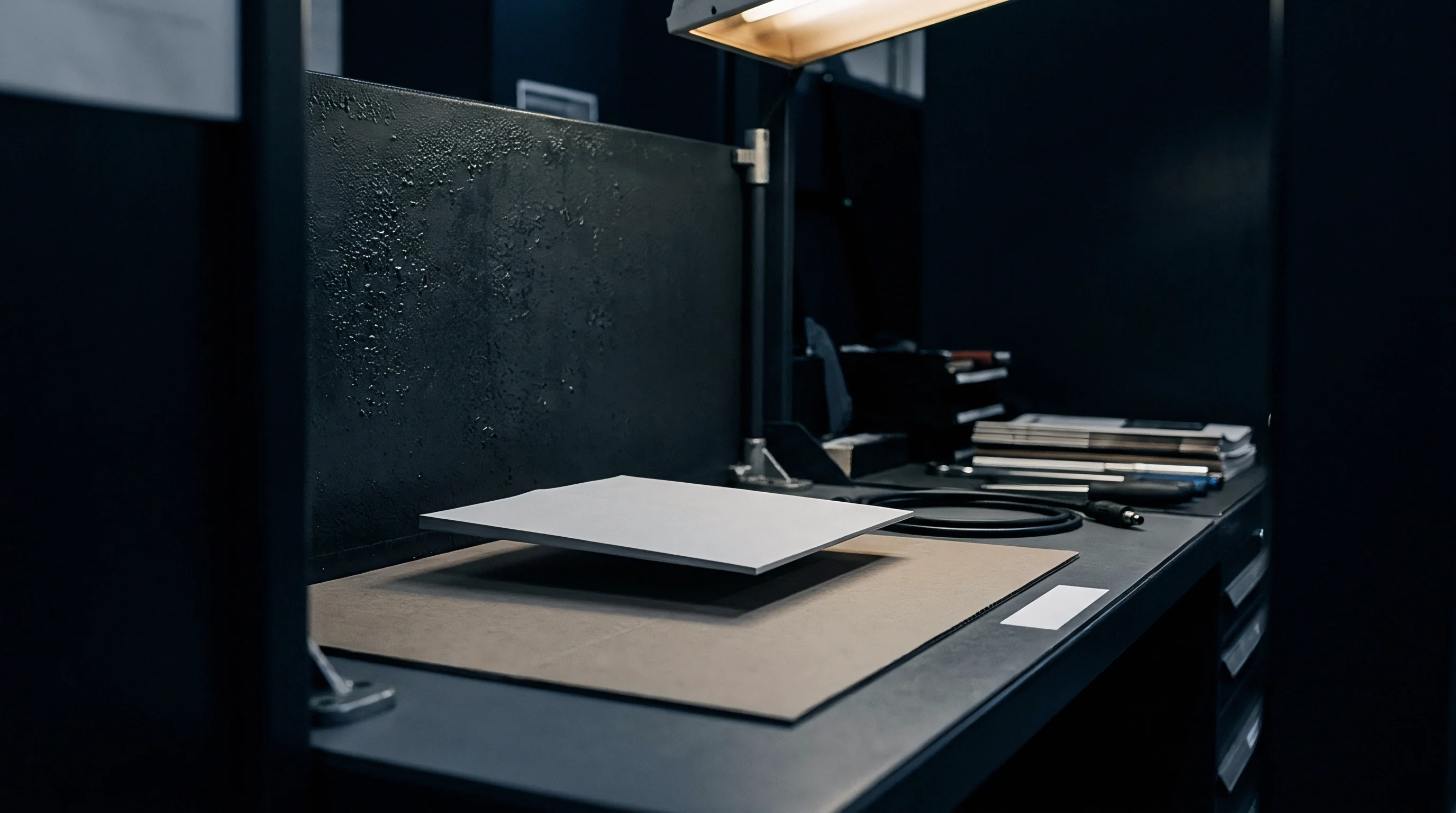
How Crease Depth Modulates Polymer Shear Stress
Deep score formation forces the paperboard liner into extreme extension, driving up shear forces at the film-adhesive interface. Evaluating crease integrity means looking at both surface cracking and internal board delamination. TAPPI T 829 provides a framework for testing score quality by measuring the force needed to bend a pre-creased sample ninety degrees.
High resistance to bending shows incomplete internal breakdown, which leaves the exterior film layer carrying excess load during folding.
Weak adhesion accelerates splitting. If the bond between thermal adhesive and printed ink is weak, the film tents across the crease instead of conforming to the paperboard contour. Testing bond strength follows ISO 2409 or ASTM D3359 cross-hatch tape procedures: a precision grid is cut through the film into the ink, then standardized pressure-sensitive tape is applied and pulled rapidly at a ninety-degree angle.
If the rating drops below 4B, the film detaches under creasing stress, fracturing the score during assembly.
Qualifying a matt lamination batch before releasing press runs requires checking key performance metrics across incoming roll stock and converted proofs:
- Film Elongation At Break tested per ASTM D882 to verify incoming matt film meets minimum stretch specifications.
- Thermal Adhesive Surface Energy measured via dyne pen or contact angle goniometry to confirm corona treatment exceeds forty dynes per centimeter.
- Crease Bending Stiffness quantified on a Marbach or Lorentzen & Wettre crease tester to confirm score bending force falls below un-creased board benchmarks.
- Optical Microscopic Score Audit inspecting folded hinges under fifty-times magnification to catch sub-micron surface fractures before shipment.
Measuring male rule penetration against matrix channel depth during setup keeps press operators from over-impressing score lines to compensate for dull die components. Over-impression crushes the board matrix, causing fiber failure that travels upward through the adhesive into brittle matt film skins.
A paperboard sample conditioned at thirty percent relative humidity exhibits up to forty percent higher crease cracking incidence than an identical sample tested at fifty percent relative humidity.
Automated inspection systems on high-speed folder-gluers monitor score integrity in real time. High-resolution line-scan cameras above the folding belt capture images of every carton spine as it moves from flat blank to glued sleeve. Optical algorithms flag exposed white paperboard fibers along dark crease lines, ejecting defective cartons from the delivery stream before packing.
Supply contracts for high-finish packaging should explicitly tie lamination failure criteria to ISO 2409 cross-hatch tape testing paired with fifty-times optical microscopic inspection of ninety-degree folded sample scores.

Expense
Financial yields on laminated folding cartons depend directly on scrap rates during folding and gluing. Adding a surface lamination film increases raw material costs, introduces a secondary converting pass, and elevates spoilage risk at the die-cutter and gluer. While gloss film runs as a predictable, low-scrap step, matt film introduces volatility that can quickly erode job profitability if creasing parameters are off.
Scrap rates eat into margins fast. Running standard gloss BOPP lamination adds roughly zero point zero five to zero point zero eight Euros per square meter in material and machine time, with gloss make-ready scrap at die-cutting typically staying under one point five percent. Matt BOPP carries a raw material premium of fifteen to twenty-five percent over gloss because of specialized co-extrusion resins and silica additives, while soft-touch matte TPU films raise material costs by sixty to one hundred percent over base gloss film.
The financial impact of film choice becomes severe when factoring in high-speed folder-gluer scrap. A line running at three hundred meters per minute generates hundreds of defective cartons every minute if matt film begins splitting at the crease. If score cracking causes a job rejection at final pack-out, the lost cost includes far more than the lamination pass ~ it burns the paperboard substrate, multi-color offset printing, hot foil stamping, blanking, and freight logistics.
| Production Variable | Standard Gloss BOPP | Standard Matt BOPP | Soft-Touch Matte TPU |
|---|---|---|---|
| Film Pass Cost (€ / 1,000 units) | 14.50 | 18.20 | 34.00 |
| Die-Cutting Spoilage Rate (%) | 0.8% | 2.5% | 4.1% |
| Folder-Gluer Scrap Rate (%) | 0.5% | 3.8% | 5.2% |
| EPR Recycling Surcharge (€ / ton) | 120.00 | 120.00 | 280.00 |
| Net Landed Unit Cost (€) | 0.142 | 0.158 | 0.189 |
Film selection also affects regulatory costs. Extended Producer Responsibility (EPR) rules under packaging waste directives penalize non-recyclable composite materials, as plastic film applied to fiber-based substrates complicates mechanical pulping during recycling. European packaging frameworks charge higher recycling fees on paperboard where plastic lamination exceeds five percent of total package weight.
Gloss and matt BOPP films at twelve to fifteen micrometers generally stay under that threshold on three hundred fifty gsm board, but thicker soft-touch films can push composite weight into the higher fee bracket.
Converting logs from high-speed carton lines confirm that matt film jobs scheduled without expanded matrix channel geometry suffer an average four point two percent higher scrap rate than equivalent gloss jobs. On a run of one hundred thousand luxury folding cartons, that drop represents four thousand two hundred wasted units, consuming raw material and machine capacity for nothing.
Choosing premium film formulations or specialized matrix systems requires balancing material surcharges against scrap reduction. Soft-touch films with elastomeric additives cost more upfront, but they reduce folding line scrap by up to sixty percent compared to cheap silica-loaded matt films ~ offsetting their higher roll price through lower factory spoilage.
Omitting expanded creasing matrix channels on matte-laminated cartons risks severe score splitting across high-volume runs, adding the full expense of re-printing, re-laminating, and re-die-cutting under tight delivery deadlines.