Inline Schopper Riegler Control Loops for High Hydration Paper Furnish
Inline Schopper Riegler control loops stabilize high hydration furnish by dynamically adjusting refiner specific edge load to maintain sheet density and machine speed.
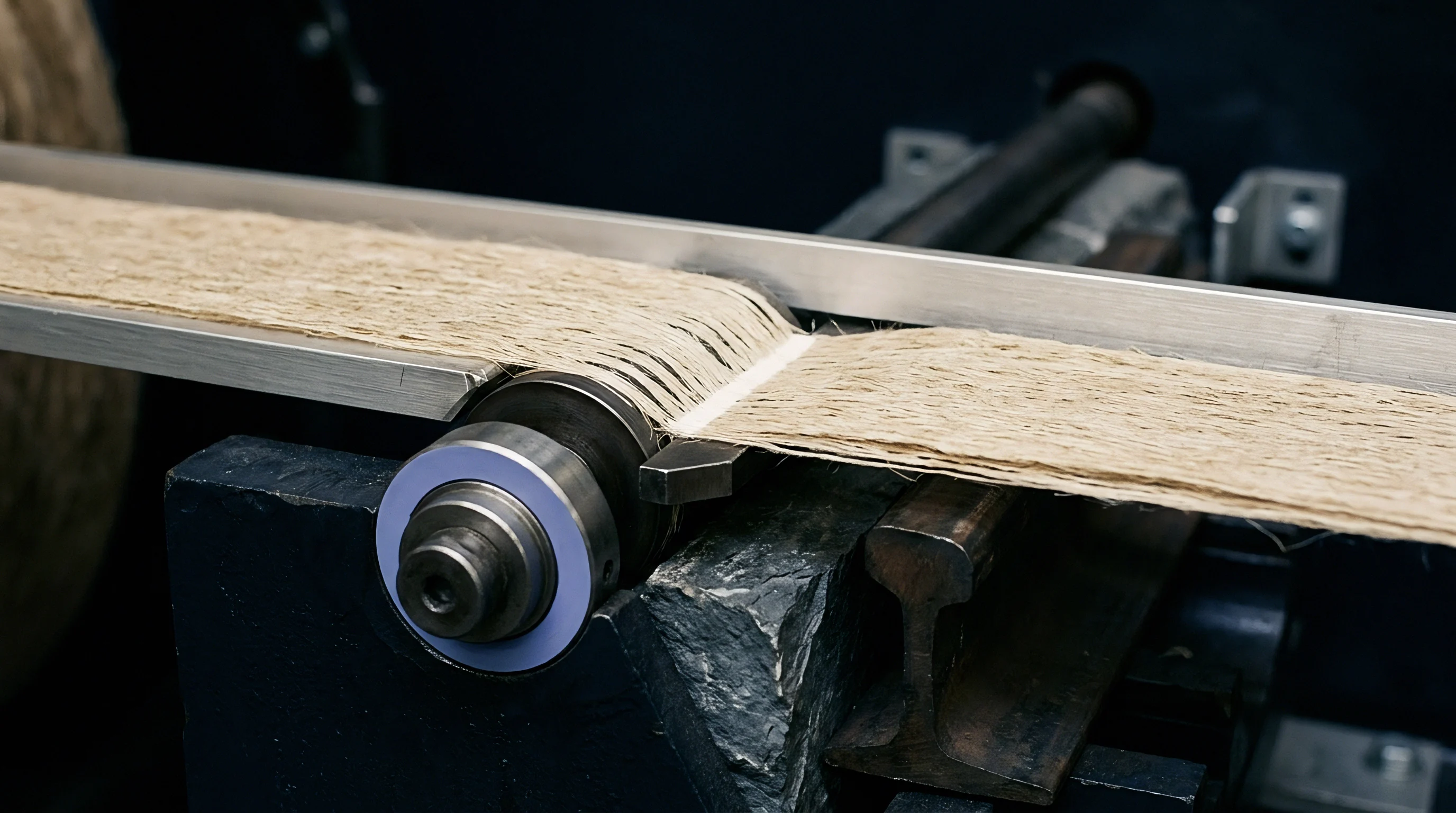

Loop
Refiner control architectures in specialty paper mills process real-time freeness readings to modulate Specific Edge Load across disc plates. The control loop must manage severe process dead times resulting from chest retention volumes. In a mill line producing 65 g/m² glassine packaging stock, stock spends between eight and twenty minutes moving from the primary refiner dump tank through the blend chest to the headbox stream.
Direct feedback control based solely on headbox freeness causes severe hunting, where refiner disc gaps continuously overshoot and undershoot target positions. Effective control loops combine feedforward mass flow calculations with cascade feedback algorithms that trim energy input based on continuous inline Schopper Riegler signals.

Feedback and Feedforward Refiner Control Topologies
Stock preparation lines running high hydration packaging furnish integrate specific energy meters directly into the DCS interface. The feedforward loop measures volumetric stock flow via electromagnetic flowmeters and stock consistency via inline shear or microwave transmitters. Multiplication of mass flow by target Specific Refining Energy (SRE, expressed in kWh/tonne) establishes the baseline motor load for the refiner drive.
Refiners burn excess power here. The inline Schopper Riegler sensor sits immediately at the refiner outlet pipe to provide a fast-responding inner feedback loop. If the inline transmitter detects a drop from 82 °SR to 79 °SR due to raw softwood furnish density shifts, the cascade controller increases plate motor load to raise energy input by 12 kWh/tonne before stock enters the main machine chest.
| Sensor Technology Type | Measurement Cycle Time | Sensitivity to Fines (70-90 °SR) | Consistency Operating Range | Primary Drift Mechanism |
|---|---|---|---|---|
| Near-Infrared Optical Backscatter | 2 to 5 seconds | High indirect response | 1.5% to 5.0% consistency | Pigment and shade variations |
| Continuous Differential Filtration | 45 to 90 seconds | Direct physical response | 2.0% to 4.5% consistency | Screen mesh micro-fouling |
| Pulsed Ultrasonic Attenuation | 1 to 3 seconds | Moderate response | 0.8% to 6.0% consistency | Micro-bubble entrainment |
| Vibrating Blade Viscometric | Continuous real-time | Low correlation to SR | 2.5% to 4.0% consistency | Slurry temperature shifts |
Inline Calibration and Verification Sequence
Maintaining sensor accuracy in slurries exceeding 80 °SR demands strict routine checks against laboratory bench standard procedures.
- Extract three duplicate 1000 mL stock samples from the inline sensor sampling valve over a two-minute operating window under stable refiner load.
- Measure sample temperature immediately to 0.1 °C precision and determine absolute stock consistency according to ISO 536 standard drying procedures.
- Dilute stock precisely to 0.2 percent consistency using deionized water at 20.0 °C to eliminate ambient water chemistry deviations.
- Execute laboratory Schopper Riegler testing per ISO 5267-1, recording side-orifice drainage volume within fifteen seconds of manual valve release.
- Input laboratory verified values into the inline transmitter software to update the multi-point linear regression slope factor.
A stable inline control loop depends more on consistent raw material furnish ratios than on aggressive controller gain settings.
Valve
Actuation of the plate gap mechanism directly adjusts the Specific Edge Load applied to the pulp slurry. Electromechanical gap actuators use precision ball screws driven by stepper motors to position refiner disc plates within tolerances of single micrometres. In high hydration furnish refining, the gap between rotating and stationary bars narrows to between 15 and 40 micrometres.
A variation of five micrometres changes bar-to-fibre impact forces, dramatically altering fines cleavage and fibre wall swelling. Fast-acting hydraulic anti-collision valves protect refiner plates from clashing during sudden stock feed loss, maintaining set gap dimensions against stock pressure surges up to 600 kPa.

Specific Edge Load Modulation and Gap Actuation Mechanics
Refining high hydration stock demands narrow plate gap positioning down to five micrometres without clashing segments. Specific Edge Load (SEL, J/m) defines the intensity of individual bar impacts on fibres passing through the refining zone. For high hydration barrier packaging sheets, low refining intensity prevents shortening of softwood tracheids while maximizing internal fibrillation.
Softwood kraft furnish requires SEL target settings between 0.8 J/m and 1.4 J/m. When inline Schopper Riegler sensors report a negative deviation from target, the controller moves the plate gap valve closer by micro-increments, raising SRE while holding SEL constant by adjusting total motor power alongside stock flow throughput.
Refiner energy consumption increases by 8.5 kWh per tonne for every single degree increase in Schopper Riegler freeness above 78 °SR.

Worked Refiner Energy Compensation Calculation
Consider a specialty packaging line processing 40 dry tonnes per hour of softwood kraft furnish targeted at 82 °SR for dense barrier sheet production. The initial unrefined pulp enters the system at 16 °SR. Baseline specific refining energy requirement sits at 195 kWh/tonne, delivered by two disc refiners in series drawing a combined active power of 7,800 kW.
Stock consistency stays locked at 3.6 percent, and incoming stock temperature measures 38 °C. An unannounced raw material swap changes incoming pulp drainability from 16 °SR to 22 °SR while increasing coarse fibre ratio. The inline optical transmitter detects a drop in discharge hydration state to 78.5 °SR under constant refining power. The control loop must apply energy compensation to restore the target 82.0 °SR hydration level to prevent paper machine drainage acceleration and density loss.
The required energy adjustment is calculated using empirical furnish response parameters. For this furnish, the refining response yields 0.11 °SR per kWh/tonne at energy levels above 150 kWh/tonne. Calculation of required SRE increase:
Required SR increase = 82.0 °SR – 78.5 °SR = 3.5 °SR
Additional SRE = 3.5 °SR / (0.11 °SR / kWh/tonne) = 31.82 kWh/tonne
New total target SRE = 195 kWh/tonne + 31.82 kWh/tonne = 226.82 kWh/tonne Calculation of new total refiner motor load:
Total motor power = 40 dry tonnes/hour 226.82 kWh/tonne = 9,072.8 kW
Power increase required = 9,072.8 kW – 7,800 kW = 1,272.8 kW (a 16.3 percent increase in electrical load) Actuator repositioning:
Disc gap stepper motor steps inward by 8.2 micrometres to reduce average bar gap from 28 micrometres to 19.8 micrometres, elevating specific edge load from 1.0 J/m to 1.15 J/m to drive fibrillation.
Converting yield impact:
Assuming electrical energy costs 0.12 EUR per kWh, the energy cost per dry tonne climbs from 23.40 EUR to 27.22 EUR, adding 3.82 EUR per dry tonne. For a 60 g/m² barrier sheet, this equates to a cost increase of 0.229 EUR per thousand square metres of delivered substrate. Failure to execute this automated adjustment causes paper machine speed reductions from 650 m/min to 580 m/min due to web flutter in the dryer section, incurring a lost machine time cost of 1,450 EUR per operating hour.
| Parameter / Condition | Target State (82 °SR) | Low Hydration (77 °SR) | High Hydration (87 °SR) |
|---|---|---|---|
| Specific Refining Energy (kWh/t) | 195.0 kWh/t | 154.5 kWh/t | 237.5 kWh/t |
| Machine Wire Drainage Rate (L/min) | 1,200 L/min | 1,650 L/min | 850 L/min |
| Wet Press Solid Content (%) | 41.5% solids | 44.0% solids | 37.2% solids |
| Steam Consumption (t steam / t paper) | 2.10 t/t | 1.85 t/t | 2.65 t/t |
| Max Operating Machine Speed (m/min) | 650 m/min | 710 m/min | 540 m/min |
| Substrate Air Resistance (Gurley s/100 mL) | 4,500 s | 850 s | 14,000 s |
| Landed Energy Cost per 1000 m² (EUR) | 1.404 EUR | 1.112 EUR | 1.710 EUR |
Allowing refiner control loops to operate without dynamic specific energy correction leads to severe basis weight profile distortion across the wire, web breaks in the open-draw press section, and out-of-specification grease resistance that renders entire converted packaging reels unsalable.


Signal
Measurement noise in inline Schopper Riegler devices stems primarily from stock temperature variations, consistency fluctuations, and chemical additive interference. Stock temperature shifts the baseline. Water viscosity decreases by approximately 2.4 percent for every 1.0 °C temperature increase.
Stock at 48 °C drains significantly faster through an inline measurement screen than stock at 38 °C at identical pulp hydration levels. Inline transmitters without integrated algorithm compensation generate false low Schopper Riegler signals during summer production runs, causing control loops to over-refine stock, crush fibres, and waste huge amounts of electrical energy.

What Dynamic Interferences Skew Real-Time Schopper Riegler Readings?
Pulp slurries conditioned with wet strength resins and cationic starches exhibit modified surface charges that alter fluid flow through the test screen. Fines choke the wire mesh. Cationic polyamines compress the electrical double layer of hydrated cellulosic micro-fines, accelerating flocculation inside the inline measuring chamber.
This chemical agglomeration mimics a false freeness increase, causing inline optical sensors to register lower hydration than laboratory bench tests perform under high dilution. Stock consistency variations act as another primary noise vector. A consistency surge from 3.2 percent to 3.8 percent increases slurry yield stress within the measurement cell, restricting filtrate flow and artifically inflating the calculated Schopper Riegler reading by up to five degrees.
ISO 5267-1 specifies test execution at exactly 0.2 percent stock consistency and 20.0 °C temperature, parameters that inline control loops must mathematically model from real-time header sensors.

Fines Accumulation and Mesh Fouling Mitigations
Micro-fines generated during intensive refining block the orifice of continuous filtration units within hours of uninterrupted running.
- Automated acid wash cycles clear mineral scale and cationic resin deposits from stainless steel measurement screens using weak organic acid flushes every twelve operating hours.
- High-pressure water back-flushing blasts entrapped gelatinous micro-fines off the drainage wire mesh between discrete measurement cycles using 800 kPa deaerated mill water.
- Temperature compensation algorithms normalize measured drainage velocities back to the ISO 5267-1 standard baseline of 20.0 °C using real-time RTD sensor inputs.
- Microwave consistency feed-forward locks freeze refiner gap adjustment outputs whenever header consistency drifts outside a pre-set window of plus or minus 0.15 percent solids.
Equipment suppliers frequently claim their optical freeness sensors operate entirely maintenance-free in high hydration packaging lines, ignoring the inevitable window coating caused by hydrophobic wood extractives and wet-strength polymer buildup over extended production runs.
Scale
Substrate performance on converting lines correlates directly with the consistency of stock refining control at the wet end. Paper machines running highly hydrated furnish produce sheets with tight pore structures, high z-directional tensile strength, and low air permeability. If refining loop control drifts by more than two degrees Schopper Riegler, sheet density fluctuates along the reel length.
This density variation alters solvent absorption during siliconization or barrier coating operations, leading to uneven coating weight distribution and severe converting line web tracking defects.

Substrate Property Impact across Converting Operations
Paper sheets produced from furnish refined above 80 °SR exhibit low air permeability below 0.05 micrometres per Pascal-second alongside high density above 1.1 grams per cubic centimetre. Inline testing prevents off-spec reels. High hydration furnish increases fiber-to-fiber hydrogen bonding, raising bursting strength while decreasing tear resistance.
Tight control preserves tensile strength. When refiner control loops maintain Schopper Riegler targets within a tight band of plus or minus 1.0 °SR, converting machines achieve predictable heat-seal speeds and uniform barrier performance. Drying energy demands climb exponentially.
Over-refined stock retains excessive water into the dryer section, forcing paper machine speed curtailments and increasing thermal stress on the paper web.
Maintaining stock hydration within a total variance band of 1.5 °SR reduces converting line edge-curl defects by over eighty percent on high-speed extrusion coating lines.
Specification Limits and Mill Delivery Dossier Terms
Commercial contracts for high hydration specialty paper specify acceptable Schopper Riegler bands of plus or minus two degrees around nominal target. Paper machines run faster then. Goods-in quality protocols mandate certificate of analysis documentation for every delivered reel set.
- Target Schopper Riegler baseline setting defined with a maximum permitted mill process variation of plus or minus 1.5 °SR across the entire tambour reel.
- Gurley air resistance floor established above 3,500 seconds per 100 mL for greaseproof barrier packaging grades under ISO 5636-5 atmospheric conditioning.
- Maximum refining energy allocation capped at 240 kWh per dry tonne to preserve sheet tear strength index above 4.5 millinewtons square metres per gram under ISO 1974 testing.
- Inline sensor verification audit log attached to mill delivery dossiers showing daily calibration compliance against ISO 5267-1 manual bench samples.
Substrate purchase specifications for high-hydration packaging grades state that paper delivered with air permeability variations exceeding ten percent from certified reel averages shall be rejected at the converter dock without financial penalty to the buyer.