Real-Time Paper Defect Mapping in Slitter Allocation
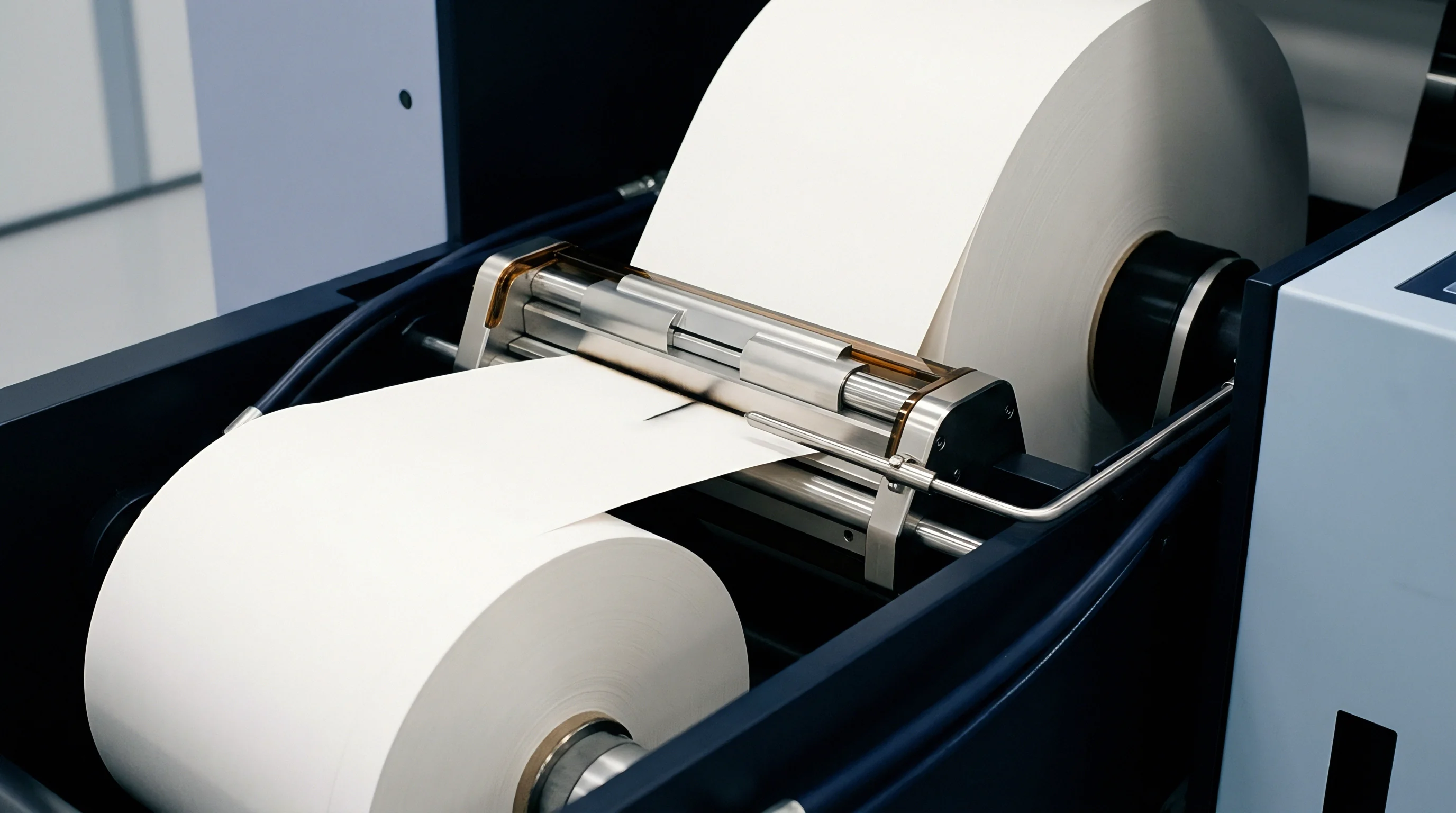
Real-time defect mapping integrates optical scanner coordinates into slitter algorithms, shifting knives dynamically to isolate web flaws into trim waste.


Detection

Optical Resolution and Real-Time Signal Processing across Fast Webs
Automated surface inspection equipment mounted on high-speed paper machines and rewinders operating at speeds up to 2500 metres per minute utilizes continuous line-scan charge-coupled device cameras paired with high-frequency light-emitting diode arrays. Camera lines capture up to 160,000 lines per second across web widths exceeding 9000 millimetres, delivering spatial spatial-sampling resolutions of 0.1 millimetres in the cross-machine direction by 0.1 millimetres in the machine direction. System performance depends upon light transmission and reflection geometry.
Transparent or semi-translucent sheets such as lightweight glassine or 40 grams per square metre kraft paper use transmitted illumination to reveal internal furnish impurities, whereas coated folding boxboard relies on dark-field and bright-field reflected illumination to separate surface pinholes, coating streaks, and calender cuts from micro-roughness anomalies.
High web speed amplifies position error. To tie optical signals to absolute physical locations along a continuous paper roll, line-scan image capture interfaces directly with optical rotary shaft encoders attached to lead-in rolls. Encoder pulse trains establish machine-direction spatial increments down to sub-millimetric bands.
Cross-machine spatial coordinates index against fixed mechanical edge guides or laser edge-position sensors that track web weave. Raw grey-scale image frames undergo real-time matrix convolution on localized field-programmable gate arrays, isolating localized contrast changes against background furnish noise caused by formation variation and surface topography. Optical sensors miss subsurface voids.
Coated paperboard web inspection systems operating under ISO 187 standard conditioning at 23 degrees Celsius and 50 percent relative humidity require optical spatial sampling down to 0.08 square millimetres to isolate coating skips before rewinder knife engagement.
Grey-scale image thresholding splits web anomalies into distinct geometric classes based on aspect ratio, perimeter density, contrast polarity, and structural continuity. Dark spots caused by wet-end slime lumps or oil droplets exhibit high radial contrast contrast gradients, whereas machine-direction streaks from damaged doctor blades present high length-to-width ratios spanning tens of metres. Pinholes and water drops exhibit high transmitted light transmission with minimal cross-direction footprint.
Signal processing pipelines compress these boundary frames into compact coordinate arrays containing machine-direction offset, cross-machine position, severity score, and defect class taxonomy.
When false reject rates escalate during production runs, machine operators often claim that uncalibrated optical gain settings over-index micro-formation variations as surface flaws.


Flaw

Taxonomy of Sheet Discontinuities and Spatial Clustering Analysis
Paper substrates host structural anomalies originating from the pulp furnish, wet-end formation, pressing, drying, surface sizing, coating, and calendering operations. Structural imperfections carry different operational consequences depending on the intended printing or converting conversion step. A pinhole that causes immediate liquid ink strike-through on a high-speed flexo press represents an absolute failure for liquid packaging board, yet the same pinhole inside a corrugated medium fluting layer yields zero structural impact.
Real-time mapping systems categorize anomalies using severity metrics mapped to client packaging specifications.
| Discontinuity Class | Optical Detection Mode | Typical Size Range | Downstream Operational Impact | Slitter Allocation Action |
|---|---|---|---|---|
| Slime Hole | Transmitted bright-field | 0.5 mm – 12.0 mm diameter | Immediate web break on high-speed presses | Trim allocation or cut-out rewind |
| Coating Streak | Reflected dark-field | 0.2 mm width, variable length | Visual reject on printed packaging face | Shift slitter position to margin edge |
| Calender Cut | Reflected low-angle bright-field | 10.0 mm – 150.0 mm length | Tensile split during web tensioning | Total roll section reject |
| Shive / Bark Particle | Reflected diffuse gray-scale | 0.1 mm² – 3.0 mm² area | Surface pick during offset litho printing | Assign to secondary substrate order |
| Oil / Grease Spot | Transmitted infrared absorbency | 1.0 mm – 8.0 mm diameter | Repulpability failure and poor glue adhesion | Downgrade roll to low-specification order |
Encoder slip invalidates spatial coordinates. Spatial clustering routines evaluate the density of mapped sheet flaws across moving web windows. Random single shives scattered across a parent roll remain acceptable in low-grade sack kraft paper, but five consecutive shives within a 1-metre machine-direction window trigger high-risk cluster flags.
System algorithms compute spatial spatial-density maps that group proximate flaws into unified exclusion zones. These exclusion zones bound the physical roll real estate that cannot touch high-specification finished roll cuts.
Web tension governs tracking accuracy. Physical web movement between the optical scanner head and the downstream slitter table creates spatial tracking error. Mechanical web wander, paper hygroexpansivity shifts from humidity gradients, and roll winder vibration induce lateral displacement.
Precision tracking systems compensate for spatial deviation by updating edge-position offsets continuously through feedback loops tied to slitter carriage positioning motors.
- Holes and Edge Cracks high-risk structural voids that generate instant web separation when subjected to machine-direction converting web tension exceeding 0.5 kilonewtons per metre.
- Foreign Inclusions embedded metallic, plastic, or high-density shive particles that damage sensitive flexographic printing plates, gravure cylinders, or rotogravure tooling during high-speed converting runs.
- Surface Dirt and Spots visual contrast anomalies exceeding ISO 5350 dirt count tolerances, rendering premium folding boxboard unmarketable for luxury cosmetic or pharmaceutical packaging applications.
- Coating and Sizing Skips un-sized or un-coated surface patches that cause localized absorption spikes during liquid Cobb sizing tests and uncontrolled ink feathering during print runs.
Substrate stability determines spatial map validity through high-speed slitters.


Allocation

How Do Real-Time Algorithms Map Spatial Defect Clusters?
Translating spatial flaw maps into dynamic knife positioning schedules requires solving a multi-objective variant of the One-Dimensional Cutting Stock Problem. Standard deckle optimization algorithms calculate slitter positions to minimize trim loss based purely on ordered roll widths and parent reel deckle constraints. Dynamic spatial optimization overlays spatial defect coordinates onto the deckle canvas.
The algorithm evaluates candidate cut patterns against spatial inclusion and exclusion zones in real time as the reel unrolls at the slitter-rewinder.
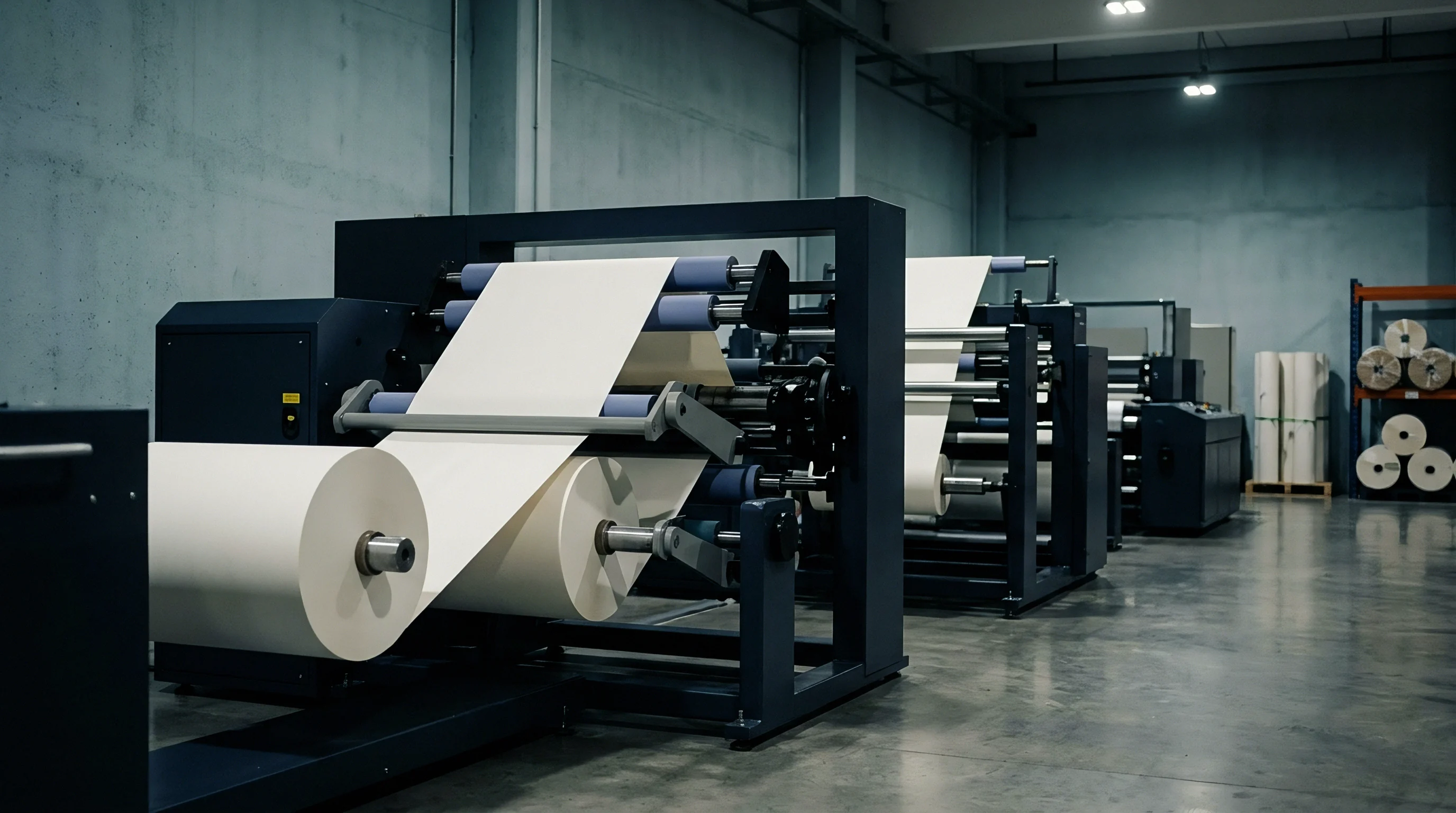
Knife repositioning takes several seconds. Automated slitter tables contain motorized upper and lower shear knife pairs mounted on common linear positioning tracks. Moving a knife pair to a new cross-machine coordinate position while the web runs requires precise speed reduction or active slitter repositioning windows.
The allocation engine calculates whether to execute a dynamic knife shift during run speed, perform a controlled deceleration to reposition knives, or route defective sections into waste cores.
Dynamic slitter allocation algorithms balancing pattern changes against mill production schedules keep total web scrap below 1.8 percent on high-speed paperboard rewinders.
Consider a parent reel with a deckle width of 4800 millimetres unrolling at 1500 metres per minute. The primary order book demands finished rolls of 1200 millimetres width for food-grade packaging. The optical scanner detects a severe 8-millimetre slime hole located 1150 millimetres from the left web edge, persisting through a machine-direction length of 180 metres.
Static slitter allocation places four 1200-millimetre cuts across the deckle, forcing the slime hole into the first finished roll roll width and causing the rejection of a 180-metre roll segment weighing 310 kilograms. Spatial defect allocation shifts the slitter positioning geometry: the system moves the left-hand trim knife inward by 50 millimetres, sets two 1200-millimetre cuts, allocates one 1000-millimetre cut for a secondary industrial grade order, and places a 1300-millimetre cut on the right edge. The slime hole falls entirely into the 50-millimetre edge trim strip, saving 295 kilograms of Prime substrate at the expense of a temporary 1.0 percent increase in edge trim scrap.
| Allocation Mode | Trim Waste Rate | Prime Grade Yield | Downgrade Tonnage | Slitter Adjustment Delay |
|---|---|---|---|---|
| Static Deckle Optimization | 1.2% | 84.5% | 14.3% | 0 seconds (Fixed knives) |
| Real-Time Spatial Edge-Shifting | 2.4% | 95.8% | 1.8% | 1.2 seconds |
| Dynamic Width Swapping | 1.8% | 92.1% | 6.1% | 3.5 seconds |
| Full Splice Cut-Out Routing | 4.5% | 95.5% | 0.0% | 14.0 seconds (Web stop) |
Trim waste accumulates rapidly. Miscalculating slitter response times relative to spatial flaw positions causes the knife carriage to cut directly through a high-severity flaw zone, corrupting adjacent finished rolls across multiple slit channels and compounding scrap costs.


Tolerance

Mechanical Constraints and Web Dynamics during High-Speed Knife Repositioning
Knife displacement creates short rolls. Mechanical slitter carriages operate under physical speed and acceleration limits imposed by stepper motor torque, spindle friction, and structural rigidity. Standard automated slitter positioning systems achieve cross-machine movement speeds between 20 and 80 millimetres per second with positioning repeatability of plus or minus 0.15 millimetres.
When a spatial flaw cluster approaches the slitter table at web speeds exceeding 20 metres per second, the physical lead time required to shift a knife pair dictates the minimum distance from the scanner head to the slitter station.
Caliper drift alters roll density. Physical paper properties directly constrain dynamic slitter allocation options. Tensile anisotropy, measured via ISO 1924 tensile testing, dictates the maximum lateral force a web edge can absorb during slitter knife engagement.
If a dynamic edge shift reduces the edge trim width below twice the sheet caliper, the thin trim strip lacks mechanical bending resistance, causing trim flutter, vacuum chute clogging, and catastrophic web tearing across the slitter table.
ISO 2470 bright-white boxboard webs subjected to dynamic slitter shifts require edge trim widths exceeding 2.5 times local caliper to prevent edge trim flutter and chute jams.
- Encoder position verification matches absolute web machine-direction increments against optical scanner frame indices.
- Flaw coordinate projection calculates the precise arrival time of spatial defect coordinates at the slitter knife plane.
- Allocation optimization selects the optimal knife placement plan that minimizes economic value loss across all active orders.
- Knife carriage drive motors execute synchronized positioning moves before the lead edge of the flaw zone crosses the blade point.
- Edge trim suction chutes adjust air velocity automatically to accommodate dynamic trim width variations without web disruption.
Standard packaging supply contracts stipulate that delivered finished rolls containing unmapped physical surface defects exceeding 2.0 square millimetres per ISO 5350 sampling protocols entitle the converter to reject the entire reel lot at mill expense.


Valuation

Economic Yield Equations and Financial Trade-Off Modeling
Financial optimization of paper reel allocation weighs trim waste costs against downgrade penalties and scrap write-offs. Paper substrate is manufactured by weight per metric tonne but converted by surface area per square metre. Converting raw parent reel yields into finished saleable packaging rolls requires tracking substrate yield metrics across three core financial output buckets: Prime Grade sales value, B-Grade or downgraded secondary market sales value, and repulpable scrap value.
Unmapped defects reach the customer. Downstream converter failure costs dwarf mill-level trim waste fees. If a mill ships a roll containing an unmapped calender cut to a high-speed packaging converter, the web breaks during gravure printing, causing press downtime billed at 850 Euros per hour plus press plate damage.
Dynamic slitter allocation algorithms incorporate risk-weighted penalty factors: the economic loss of sending a high-risk flaw into a premium printing roll exceeds the financial loss of taking an extra 40 millimetres of trim scrap at the slitter rewinder.
Converting virgin kraftliner into corrugated boxes yields optimal financial returns when slitter defect avoidance algorithms target total roll reject rates under 0.5 percent of reel mass.
| Allocation Strategy | Prime Yield (Tonne) | Downgrade Yield (Tonne) | Trim Scrap (Tonne) | Net Revenue (€) | Net Economic Yield (€/Tonne) |
|---|---|---|---|---|---|
| Baseline (No Map Integration) | 7.80 | 1.85 | 0.35 | 10,420 | 1,042.00 |
| Aggressive Defect Avoidance | 9.45 | 0.00 | 0.55 | 11,615 | 1,161.50 |
| Balanced Downgrade Routing | 8.90 | 0.80 | 0.30 | 11,480 | 1,148.00 |
| Max-Width Fixed Slit Allocation | 8.10 | 1.50 | 0.40 | 10,750 | 1,075.00 |
Lower grades absorb localized flaws. Take a 10-tonne parent reel of 250 grams per square metre coated folding boxboard valued at 1300 Euros per metric tonne for Prime Grade packaging applications. Assume repulpable mill scrap yields a recovery value of 180 Euros per metric tonne, while secondary B-grade rolls for unprinted inner packaging sell at 750 Euros per metric tonne.
Without spatial flaw mapping, standard slitter allocation produces 7.8 tonnes of Prime Grade board, 1.85 tonnes of B-grade board containing unmapped minor spots, and 0.35 tonnes of trim scrap, netting 10,420 Euros total reel value. Deploying real-time defect-mapped slitter allocation increases edge trim scrap to 0.55 tonnes by dynamically avoiding spatial defect zones, but elevates Prime Grade output to 9.45 tonnes with zero B-grade downgrade. Net reel revenue rises to 11,615 Euros, representing a net value gain of 119.50 Euros per parent reel tonne.
Which spatial defect density threshold makes total rewinder web cut-out economic compared to dynamic knife repositioning on low-grammage packaging paper?

Handoff
Roll Map Data Architecture and Digital Supply Chain Integration
Raw data without spatial context fails. Transferring defect location data from the paper mill rewinder to downstream converting facilities requires standardized digital roll maps. Modern paper manufacturing relies on XML and JSON data schemas specified under TAPPI TIP 0304-63 technical guidelines.
These data structures register every physical roll by a unique 18-digit Global Individual Asset Identifier barcoded onto the core inner wall and roll packaging label.
Static allocation guarantees scrap loss. Digital roll maps link physical roll IDs to two-dimensional spatial coordinate databases stored in cloud repository nodes. When a finished roll arrives at a packaging converter, the converting press unwinder reads the roll core barcode and downloads the spatial defect map automatically.
The converting line uses this map to adjust press speed, skip defective sheet lengths during die-cutting, or activate automated reject gates on sheet-fed lines.
- Global Roll Identification Number standard 18-digit asset code linking physical rolls directly to mill quality databases.
- Spatial Defect Grid Coordinates exact machine-direction and cross-machine distance vectors for every mapped surface anomaly.
- Defect Classification Class and Severity standard taxonomy codes identifying flaw geometry, contrast intensity, and operational risk category.
- Recommended Converting Operational Limits maximum web tension and press operating speed thresholds calculated from roll flaw density profiles.
Integrating real-time optical map tracking directly into automated slitter control architectures establishes complete physical traceability from parent reel winder to finished packaging blank. Mill management systems store these spatial defect records permanently within quality dockets. Converter goods-in inspection protocols cross-reference delivered roll barcodes against cloud-hosted defect databases before reel mounting, validating roll compliance prior to high-speed printing.
Dynamic map data exchange converts physical paper rolls into intelligent assets, allowing slitter knives and converting equipment to adapt automatically to natural raw material variance across continuous packaging webs.