Real Time Web Tension Autocorrelation Modeling in Paperboard Converting Lines
Real time autocorrelation modeling isolates tension disturbances in paperboard converting, preventing barrier micro-cracks and regulatory compliance failures.

Signal

Load Cell Sensor Dynamics and Signal Acquisition
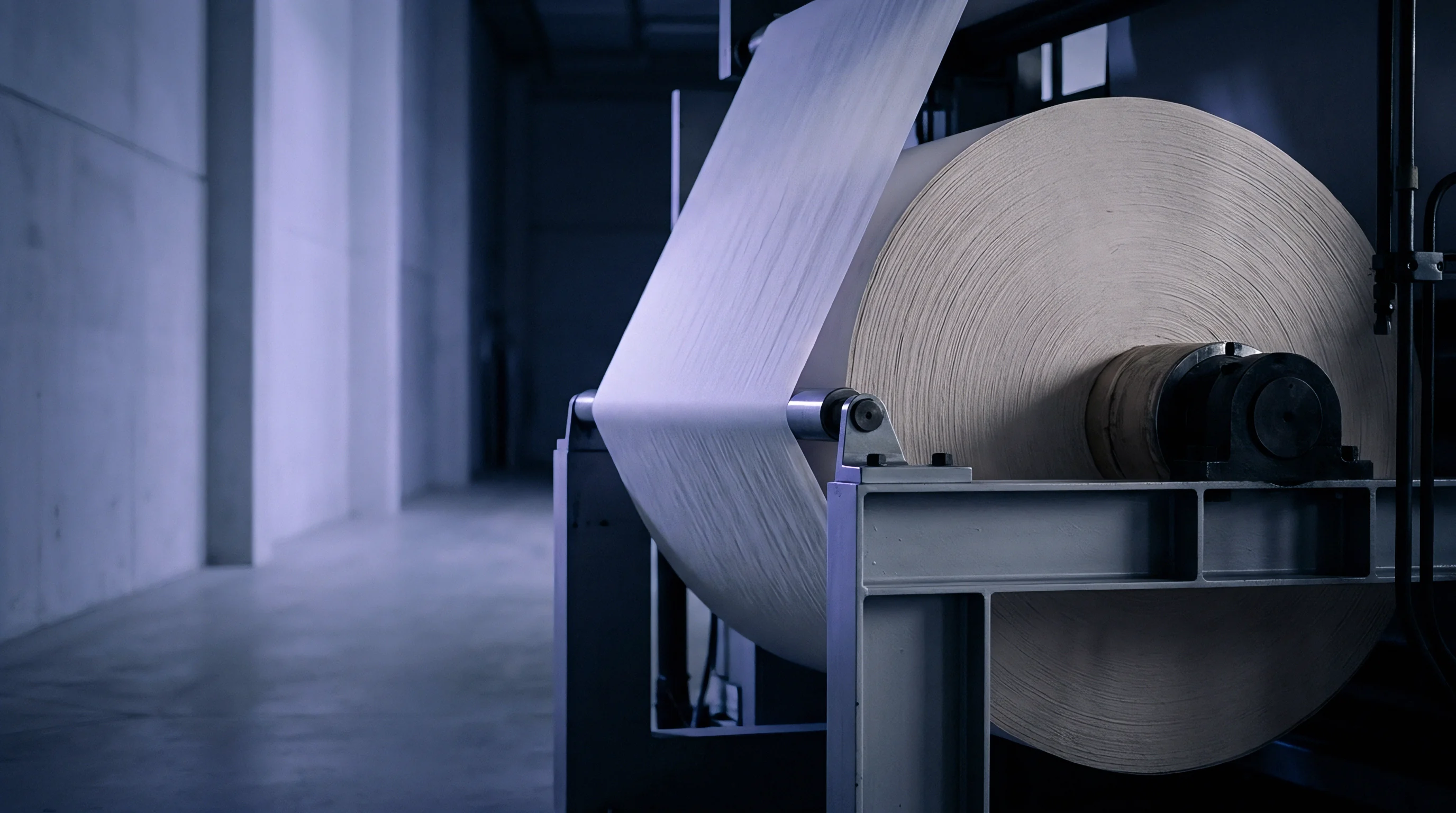
High-speed converting machinery processes paperboard webs at production speeds reaching six hundred meters per minute across multiple un-wind stands, flexographic print stations, rotary creasing dies, and draw nips. Piezoelectric and strain-gauge load cell arrays installed on fixed dead-shaft idler rolls continuously measure web force dynamics. Digital converters capture load signals at sampling frequencies between one hundred Hertz and one kilohertz, transforming mechanical force vectors into detrended time-series voltage data.
Sensor placement immediately downstream of the unwind spindle isolates mechanical disturbances originating from incoming parent reel geometry.
Unwinding paperboard rolls introduces cyclic tension fluctuations caused by reel out-of-roundness, core eccentricities, and roll shell mass imbalance. As unwind roll radii decrease, rotational frequency increases proportionally, shifting the fundamental frequency of mechanical tension perturbations higher across the run. Standard proportional-integral-derivative controllers fail to damp these dynamic disturbances because feedback phase delays match or exceed the oscillation period.
Extracting deterministic periodic components from background measurement noise requires dynamic spectral estimation operating directly on continuous sensor feeds.
Autocorrelation Lag Spectrum and Frequency Identification
The autocorrelation function computes the statistical dependency of a continuous tension signal against a time-shifted version of itself. For a discrete tension deviation time-series x(t) recorded over an evaluation window of duration T, the normalized autocorrelation coefficient Rxx(τ) at lag time τ follows the mathematical formulation:
Rxx(τ) = fracint0T – τ x(t) , x(t + τ) , dtint0T x(t)2 , dt
Evaluating Rxx(τ) across discrete lag intervals reveals periodic mechanical perturbations as distinct local maxima in the lag domain. High autocorrelation values at specific lag times indicate recurring tension spikes linked directly to rotational component geometry. Calculating the inverse of the peak lag duration yields the exact fundamental frequency of the mechanical disturbance on the line.
- Unwind Out-of-Roundness ~ Low-frequency tension oscillations occurring at the rotational period of the primary unwind parent roll.
- Nip Roll Eccentricity ~ Mid-frequency cyclic tension variations tied directly to drive roll radius runout.
- Dancer Arm Resonance ~ Sustained natural frequency oscillations triggered by inadequate pneumatic damping in mechanical accumulator assemblies.
- Gear Mesh Harmonics ~ High-frequency ripple propagating from worn transmission gearing into the converting zone.
Whether real-time autocorrelation models can isolate structural web variations from mechanical roll eccentricities when both operate within identical sub-Hertz frequency bands remains an open engineering question.

Grain

Viscoelastic Strain Dynamics across Board Grades
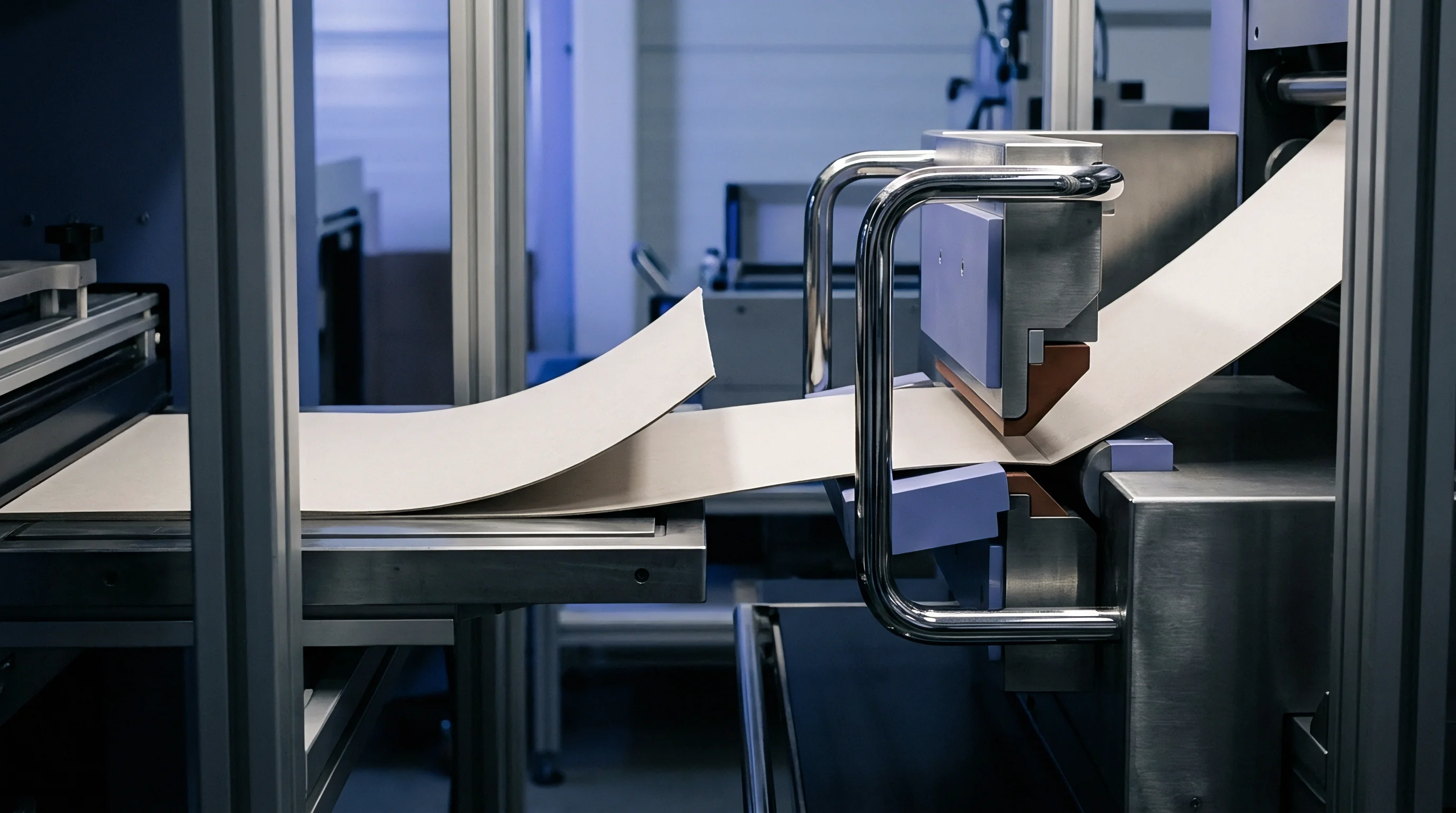
Fiber alignment along the machine direction creates anisotropic mechanical behavior throughout paperboard structures. Solid bleached board, folding boxboard, and coated recycled board exhibit distinct elastic moduli, tensile strength profiles, and bending resistance characteristics when subjected to rapid strain rates. Under dynamic web tension, the substrate behaves as a non-linear viscoelastic material, combining instantaneous elastic extension with delayed viscous relaxation.
Structural differences across multi-ply board grades alter tension response times. High-density outer plies of bleached chemical pulp carry high tensile strain, while bulky mechanical pulp middle layers in folding boxboard govern overall bending stiffness. The elastic modulus E and internal damping coefficient η determine the characteristic tension relaxation time constant τr = η / E. When converting line acceleration rates exceed the material relaxation time constant, internal tensile stresses accumulate rapidly, increasing web break frequency at die-cutting units.
High-yield folding boxboard at 350 grams per square meter exhibits a cross-direction tensile relaxation time constant of 42 milliseconds at 50 percent relative humidity.

Moisture Modulated Stress Relaxation Mechanics
Equilibrium moisture content directly alters the hydrogen bonding matrix within pulp fibers. Ambient relative humidity fluctuations or uneven reel conditioning shift board moisture content away from standard target levels of seven percent. Elevated moisture content softens the cellulose structure, reducing tensile modulus while extending viscous relaxation duration.
Lower moisture content increases fiber brittleness, lowering strain-to-break thresholds under sudden web draw tension changes.
| Grade Designation | Grammage (g/m²) | MD Bending Stiffness (mN·m) | CD Bending Stiffness (mN·m) | MD Tensile Modulus (GPa) | Relaxation Time Constant (ms) |
|---|---|---|---|---|---|
| Solid Bleached Board (SBB) | 270 | 18.5 | 9.2 | 7.8 | 28 |
| Folding Boxboard (FBB) | 350 | 24.0 | 11.5 | 5.2 | 42 |
| Solid Unbleached Board (SUB) | 310 | 22.1 | 10.8 | 6.9 | 34 |
| Coated Recycled Board (CRB) | 400 | 16.2 | 7.4 | 4.1 | 55 |
- MD Stiffness Ratio Check ~ Verify ratio of machine direction to cross direction bending stiffness before setting draw roll differential speed.
- Moisture Equilibrium Audit ~ Measure core moisture content of incoming parent reels to adjust dynamic modulus variables in the controller baseline.
- Grammage Caliper Validation ~ Input measured caliper profiles into the feed-forward model to prevent web tension setpoint drift across batch boundaries.
Higher moisture content accelerates web stress relaxation, requiring tighter sensor sampling windows to prevent tension setpoint drift.

Fracture
Why Do Transient Tension Spikes Degrade Water-Based Dispersion Coatings?
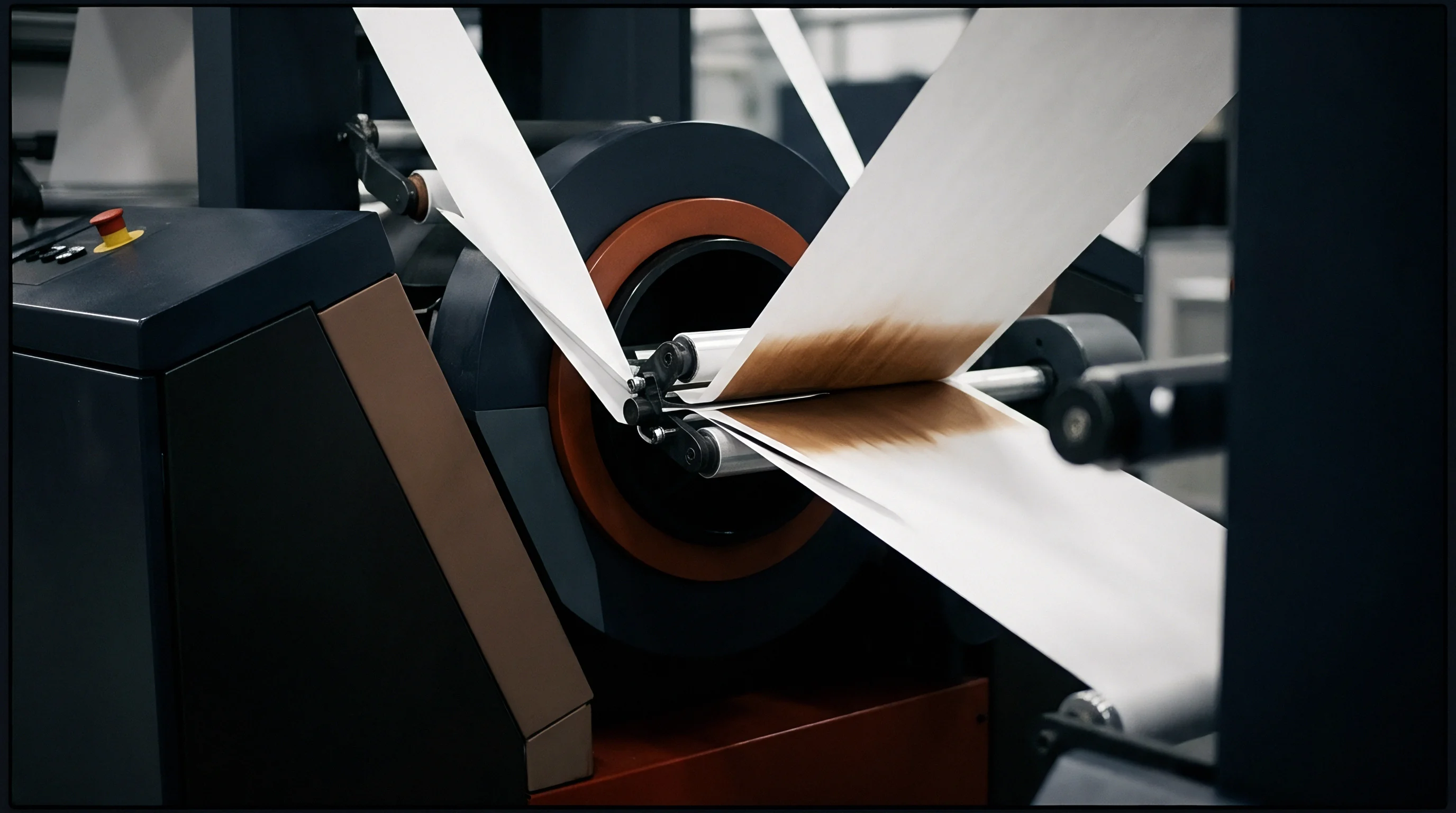
Water-based acrylic and dispersion polymer coatings applied to paperboard surfaces form functional barriers against mineral oil, grease, and liquid water migration. These thin barrier layers possess lower strain limits than the underlying fiber matrix. Transient tension spikes exceeding the critical yield strain of the dry polymer matrix induce microscopic tensile fractures across the coating layer.
Microscopic fractures compromise functional barrier integrity without displaying visible surface defects or causing full web break events.
| Coating Chemistry | Substrate Grade | Peak Web Strain (%) | Micro-Crack Density (cracks/mm²) | Overall Migration Rate (mg/dm²) | Regulatory Compliance Status |
|---|---|---|---|---|---|
| Water Dispersion Acrylic | FBB 300 g/m² | 0.85 | 0.0 | 2.1 | Pass |
| Water Dispersion Acrylic | FBB 300 g/m² | 1.45 | 14.2 | 11.8 | Fail |
| Extrusion Polyethylene (PE) | SBB 270 g/m² | 1.80 | 0.0 | 1.5 | Pass |
| Extrusion Polyethylene (PE) | SBB 270 g/m² | 2.60 | 8.7 | 14.3 | Fail |
| Bio-based PLA Coating | SUB 310 g/m² | 1.10 | 22.5 | 18.9 | Fail |
Substrate stretch during high tension transients creates shear stress at the interface between the pulp sheet and the barrier film. Separation of the functional coating from outer fibers leads to localized flaking under creasing matrices. Evaluation under EN 1186-3 overall migration standards using food simulant D2 demonstrates that micro-cracked samples exceed legal migration limits of ten milligrams per square decimeter, converting compliant raw materials into non-compliant finished packaging.
Exceeding substrate strain limits causes irreversible barrier matrix cracking long before web breaks occur on the line.

Matrix Creasing Strain Boundaries in Multi-Ply Board
Creasing operations prepare folding boxboard for folding by forming controlled internal delamination zones along score lines. Proper creasing requires precise alignment between male creasing rules and female matrix channels. Tension transients skew web position relative to the die-cutter cylinder, shifting creasing lines off-center by fractions of a millimeter.
Misaligned creasing forces shear top liner fibers rather than delaminating middle plies, inducing surface cracking along package edges during final cartoning.
- Extract the maximum peak tension values from the autocorrelation real-time dataset across a twenty-minute production window.
- Sample converting line output immediately following identified tension transient spikes exceeding one hundred fifteen percent of setpoint baseline.
- Perform overall migration testing per EN 1186-3 using fatty food simulant D2 for ten days at forty degrees Celsius.
- Measure pinhole permeability using bathophenanthroline indicator solutions applied to the functional barrier surface under controlled dwell conditions.
Uncontrolled tension spikes that damage barrier integrity leave the brand owner vulnerable to total lot rejections at destination ports and full financial liability under food contact compliance enforcement.

Filter
DSP Windowing and Spectral Peak Extraction
Hardware-accelerated digital signal processors compute sliding-window autocorrelation estimates directly within drive control units. High-speed Fast Fourier Transform operations calculate autocorrelation sequences by multiplying frequency spectra of windowed time-series inputs by their complex conjugates. This frequency-domain calculation reduces operational computational complexity from square order down to log-linear order, enabling real-time execution at millisecond update intervals.
mathcalFRxx(τ) = |X(f)|2
Calculated autocorrelation vectors pass through dynamic peak-detection routines that monitor lag spectrum amplitude shifts. Peak detection algorithms isolate dominant lag indices τp corresponding to periodic mechanical perturbations. The identified lag value maps to precise mechanical components using line speed feed data, establishing exact cause-and-effect correlation between drive components and tension disturbances.
Non-compliance with ISO 12647-2 alignment tolerances triggers automated process halts when feed-forward compensation limits are breached.

Feed-Forward Velocity Compensation Loop Architecture
Feedback control loops introduce structural phase lags that limit performance when damping high-frequency tension oscillations. Integrating real-time autocorrelation lag modeling into feed-forward control architectures solves phase delay limitations. The extracted disturbance frequency and phase angle generate predictive velocity override signals fed directly into downstream servomotor drives.
Adjusting nip roll surface velocity in exact antiphase to incoming tension disturbances cancels periodic fluctuations before tension errors pass into converting stations.
| Line Speed (m/min) | FFT Window Size (samples) | Calculation Dwell (ms) | Attenuation Efficacy (dB) | Tension Residual Standard Deviation (N/m) |
|---|---|---|---|---|
| 150 | 512 | 5.12 | 18.4 | 1.2 |
| 300 | 1024 | 3.41 | 16.1 | 1.8 |
| 450 | 2048 | 2.27 | 13.5 | 2.6 |
| 600 | 4096 | 1.70 | 10.8 | 3.9 |
- Parallel FFT Pipeline ~ Process dual load cell time-series arrays concurrently using hardware-accelerated floating-point digital signal processors.
- Lag Window Normalization ~ Scale autocorrelation amplitude coefficients against background noise floors to prevent false feed-forward trigger events.
- Servomotor Gain Matching ~ Align drive speed compensation bandwidth with substrate mechanical relaxation rates to prevent harmonic feedback loops.
Mechanical reel eccentricities are frequently treated as inherently uncontrollable background noise rather than compensated for through real-time velocity feed-forward controls.

Audit

Traceability Requirements under Chain-of-Custody Frameworks
Chain-of-custody standard FSC-STD-40-004 and PEFC ST 2002 framework requirements govern material traceability throughout converting steps. Converting operations must maintain complete batch records linking certified pulp reels to finished packaging lots. Real-time web tension telemetry stored during converting runs establishes verifiable operational records proving structural integrity was preserved during manufacture.
Audit records showing uncorrected tension spikes over acceptable material strain limits invalidate quality compliance declarations.
European Regulation 1935/2004 obligates converting facilities to implement effective quality assurance systems for packaging materials destined for food contact. The Packaging and Packaging Waste Regulation (PPWR) mandates strict compliance regarding recyclability and chemical safety of functional barrier coatings. When tension instability causes functional barrier micro-cracking, affected production batches fail essential compliance criteria despite carrying valid timber chain-of-custody certification tags.
A declaration of compliance remains invalid if converting line tension dynamics compromise the structural barrier performance tested in laboratory swatches.
Contractual Risk Allocation and Regulatory Compliance Dossiers
Packaging procurement contracts incorporate technical specifications defining acceptable tension variance thresholds, web width tolerances, and maximum migration limits. Technical compliance dossiers must contain both raw material laboratory test certificates and operational telemetry records proving converting conditions remained within safe strain boundaries. Converting facilities failing to maintain calibrated autocorrelation tension logs accept legal liability for non-compliant barrier performance identified downstream by market surveillance authorities.
Contractual quality agreements incorporating Annex B tension stability clauses transfer financial liability for micro-fracture barrier failures directly to the converting operator whenever digital autocorrelation logs reveal uncorrected setpoint deviations exceeding eight percent.