Sub Millisecond Surfactant Adsorption Kinetics under Ultra High Shear Rate Blade Coater Flow
Sub-millisecond dynamic surface tension governs blade coater wetting, where slow surfactant diffusion causes micro-skips, blade bleed, and print defects.
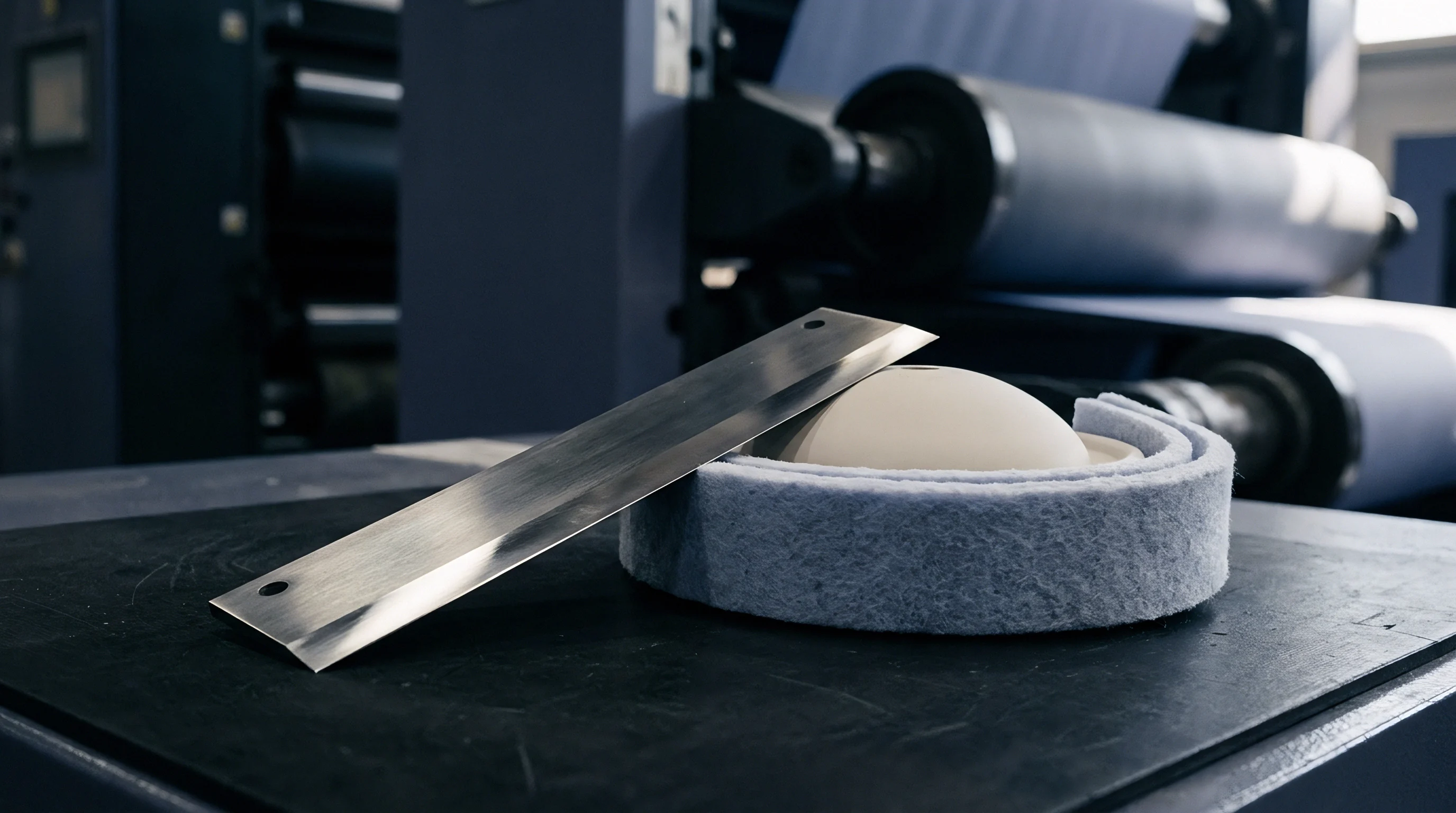
Bevel
Coating color meets the base sheet under the metering blade at web speeds exceeding 1500 meters per minute on modern off-machine coating lines. At this velocity, paper travels twenty-five millimeters every single millisecond. The working land of a standard beveled bent blade spans roughly 0.35 to 0.50 millimeters across the machine direction.
The coating slurry experiences the intense hydrodynamic compression field under that steel bevel for an interval between fourteen and twenty microseconds. The shear rate inside this metering gap easily tops 2,000,000 reciprocal seconds as wet film caliper reduces from thirty micrometers down to eight micrometers.
Hydrodynamic lift pushes the flexible blade tip away from the backing roll. Blade pressure counters this force. Mechanical blade loading controls final coat weight, yet liquid mechanics govern the interfacial integrity of the boundary layer directly beneath the blade heel.
The entering color must displace boundary air carried along the fibrous surface of the moving raw stock. Dynamic wetting dictates whether the formulation coats the sheet continuously or skips over surface voids.
TAPPI T 558 measures dynamic contact angles at 10 milliseconds, yet the blade nip passes within 40 microseconds at 1400 meters per minute.
Surfactant chemistry dictates interfacial properties, yet equilibrium surface tension values derived from static du Noüy ring or Wilhelmy plate testing offer zero operational guidance for this flow regime. A surfactant that drives static surface tension down to 26 millinewtons per meter across thirty seconds can perform like pure deionized water during a twenty-microsecond nip dwell. The interface is expanding and renewing at frequencies far exceeding the relaxation rates of long-chain aliphatic amphiphiles.
- Hydrodynamic Lift balances against the mechanical blade tube pressure, setting the actual gap geometry across the cross-machine profile.
- Extensional Strain accelerates pigment alignment along converging streamlines directly upstream of the blade tip entry zone.
- Boundary Air Stripping determines whether liquid achieves unbroken wetting across microscopic raw stock surface valleys.
- Capillary Suction pulls liquid vehicle from the wet color into base sheet pores during initial pressure development.
The metering gap narrows. Viscous dissipation within the coating layer elevates local fluid temperature by three to six degrees Celsius under continuous production. Local viscosity drops while thermal motion speeds up molecular transport.
This brief thermal spike fails to compensate for the absolute velocity of the substrate through the metering zone. Upstream pond flow presents fresh, unadsorbed air-liquid and solid-liquid interfaces every microsecond.

Diffusion
Molecular transport of amphiphilic additives toward expanding interfaces operates against an unforgiving deadline in the metering nip. A surfactant molecule dissolved in the aqueous phase must migrate from the bulk solution to the liquid-vapor or liquid-fiber boundary. This process divides into two consecutive barriers: diffusion through the hydrodynamic boundary sublayer, and steric orientation into the interfacial monolayer.
Equilibrium values give false comfort. Dynamic surface tension measurements made via maximum bubble pressure tensiometry reveal the severe kinetic penalty surfactants suffer at small surface ages.
Molecules migrate down the gradient. Small molecular size accelerates diffusion through the stagnant layer toward newly generated interfaces. Traditional linear alkyl ethoxylates and fatty alcohol derivatives struggle because their extensive hydrophobic tails create hydrodynamic drag and aggregate into bulky micelles.
Micelle breakdown rates range from milliseconds to hundreds of milliseconds. When the metering event concludes inside twenty microseconds, micellar dissociation cannot resupply monomeric surfactant units. Unassociated single molecules do all the kinetic work.
| Surfactant Chemistry | Concentration (wt%) | Dynamic ST at 1 ms (mN/m) | Dynamic ST at 10 ms (mN/m) | Equilibrium ST (mN/m) |
|---|---|---|---|---|
| Branched Acetylenic Diol (TMDD) | 0.15 | 37.4 | 33.8 | 31.5 |
| Ethoxylated TMDD (3.5 EO) | 0.20 | 42.1 | 36.5 | 30.8 |
| Sodium Dioctyl Sulfosuccinate (DOSS) | 0.20 | 56.8 | 41.2 | 26.2 |
| Linear Alcohol Ethoxylate (9 EO) | 0.25 | 65.4 | 54.1 | 29.4 |
| Sodium Dodecyl Sulfate (SDS) | 0.30 | 68.2 | 59.7 | 34.1 |
Dynamic tension remains high. The data indicates that sodium dioctyl sulfosuccinate achieves an equilibrium surface tension of 26.2 millinewtons per meter, yet at one millisecond its dynamic surface tension registers at 56.8 millinewtons per meter. Water registers 72.8 millinewtons per meter.
At forty microseconds, DOSS functions essentially like plain water at the blade entry zone. Linear alcohol ethoxylates show similar kinetic lag, retaining surface tensions above 65 millinewtons per meter at sub-ten-millisecond timescales.
Branched hydrophobic tails lower dynamic surface tension faster than linear chains under short dwell metering.
Branched structures circumvent this diffusion limitation through compact geometry. Acetylenic glycol derivatives, such as 2,4,7,9-tetramethyl-5-decyne-4,7-diol, place their central hydrophilic triple bond and flanking hydroxyl groups between symmetrical, highly branched alkyl groups. Steric hindrance stalls orientation.
The molecule lacks the expansive coiled conformation of linear ethoxylates. The low molecular footprint accelerates movement through shear fields, permitting rapid orientation without significant internal conformational rearrangements.
Chemical suppliers frequently state that slow-acting wetting agents perform satisfactorily because mechanical blade force overrides dynamic interfacial resistance during normal line operations.
Wetting
Dynamic wetting failures under high-speed blade application produce unmistakable surface scrap on the coated reel. Air displaces the wet film. When dynamic surface tension remains high as the sheet plunges beneath the blade, the dynamic contact angle between the coating color and the raw stock increases steeply.
Hydrodynamic pressure forces the color against the web, but micro-scale air pockets become trapped in sheet surface topography. The incoming rough paper web carries a boundary air layer inside its surface valleys, structured by fiber orientation and micro-porosity.
Uncoated voids show instantly. Trapped micro-bubbles expand immediately after releasing from blade nip pressure, bursting and creating pinholes in the wet color film. Alternatively, the trapped air prevents the coating color from penetrating base sheet crevices.
This failure mode manifests as skip coating and micro-scale uncoated specks that degrade gravure printability and cause catastrophic ink refusal during offset printing. In high-speed rotogravure publication printing, missing dots correlate directly with blade-induced micro-skips generated during the base coating run.
Coating color stripped of fast surfactants causes micro-bubble weeping behind the trailing blade.
Blade bleeding introduces another operational hazard traced to interfacial failures. High dynamic surface tension retards clean separation at the exit bevel. Pigment particles along the low-mobility boundary layer deposit on the back edge of the metering blade.
These deposits desolvate into abrasive crusts that periodically break away or gouge wet coating across the web.
- Heel Weeping occurs when high dynamic surface tension prevents rapid wetting of the steel blade surface, creating an unstable meniscus that deposits dried coating agglomerates onto the exit film.
- Blade Scratches develop when desolvated pigment aggregates wedge beneath the blade bevel, scoring continuous circumferential lines through the wet coating layer.
- Micro-Skip Porosity arises from entrained air packets that fail to displace before passing under the metering land, leaving un-wetted base sheet fibers exposed.
- Mottle Inducement happens when uneven localized surfactant adsorption creates surface tension gradients across the web, driving Marangoni flow during infrared drying stages.
Blade wear accelerates across hours. Running coating colors with inadequate sub-millisecond interfacial reduction forces operators to apply elevated mechanical blade tube pressures to reach target coat weights. This excessive mechanical load abrades the finely ground bevel angle prematurely, destroying runnability and multiplying machine downtime costs across the conversion campaign.
Formulation
Industrial coating colors represent dense multiphase suspensions containing 60 to 70 percent solids by weight. Fine ground calcium carbonate, precipitated calcium carbonate, and kaolin clay dominate the solid phase. Styrene-butadiene or styrene-acrylate latex emulsions serve as principal synthetic binders alongside modified starches.
Surfactants added to this matrix encounter intense competition for available chemical adsorption sites. The specific surface area of coating pigments ranges from eight to sixteen square meters per gram. Added surfactant molecules partition rapidly between pigment mineral surfaces, latex polymer interfaces, and the free aqueous solution.
Calcium ions crosslink the carboxylates. In high-solids paperboard coatings, divalent cations dissolved from calcium carbonate pigments consume conventional anionic wetting agents through precipitative soap formation. The effective bulk concentration of active surfactant drops instantly.
Formulators counteract this loss by utilizing nonionic surfactants with low dynamic surface tension profiles, stabilizing the aqueous phase without triggering catastrophic latex destabilization or foaming.
| Surfactant Package | Dosing Level (dry parts) | High-Shear Viscosity at 10^6 1/s (mPa s) | DST at 2 ms (mN/m) | Blade Bleed Rate (g/hr) | Blade Scratch Frequency (events/reel) |
|---|---|---|---|---|---|
| No Added Surfactant | 0.00 | 48.5 | 68.2 | 14.2 | 3.8 |
| Linear Alcohol Ethoxylate | 0.30 | 46.2 | 61.5 | 11.6 | 2.9 |
| DOSS Anionic Blend | 0.25 | 44.8 | 52.3 | 8.4 | 1.7 |
| TMDD Nonionic Acetylenic | 0.20 | 41.2 | 35.4 | 1.2 | 0.2 |
| Fluorosurfactant Blend | 0.05 | 47.0 | 58.9 | 9.8 | 2.4 |
Viscosity doubles at the tip. Under high shear rates, pigments undergo dilatant transitions if particle-particle stabilization fails. Hydrodynamic lubrication under the blade bevel breaks down entirely when dynamic surface tension spikes prevent uniform liquid wetting around packing pigment clusters.
Incorporating 0.20 dry parts of an acetylenic diol package drops dynamic surface tension at two milliseconds from 68.2 down to 35.4 millinewtons per meter. High-shear viscosity simultaneously decreases from 48.5 to 41.2 millipascal seconds at 1,000,000 reciprocal seconds, suppressing blade bleed from 14.2 grams down to 1.2 grams per operating hour.
Base sheet pores suck water. Rapid immobilization of coating color results from capillary dewatering into the raw stock. Surfactant adsorption kinetics at the wet color-paper interface govern how quickly water and soluble starch binders leave the suspension.
Fast adsorption slows down early dewatering by maintaining a cohesive interfacial tension barrier, preventing premature filtercake formation directly ahead of the blade tip.
Surfactants containing acetylenic backbones reduce blade edge bleeding without generating surface foam in the recirculation tank.
Settlement
Procuring coated grades requires evaluating how mill coating capabilities translate into delivered reel performance on conversion and printing machinery. Base sheets coated under unstable blade conditions arrive with invisible structural flaws. A coated board that appears uniform under basic laboratory grammage testing can possess extensive micro-scale variations in binder distribution and base sheet coverage.
Offset blanket piling follows. When un-wetted voids burst during drying, loose pigment particles deposit on printing blankets, forcing wash-ups every few thousand impressions.
Solids levels drive drying load. Mills running modern coating heads without proper dynamic wetting chemistry are forced to dilute coating solids down to 58 or 60 percent to maintain machine runnability. Dilution introduces a major economic penalty.
Every percentage point of water added to coating color must be evaporated via gas-fired infrared dryers and steam airfoils. Evaporative energy costs escalate directly with water content, inflating the mill conversion cost per metric ton. Furthermore, lower solids promote capillary migration of water into the raw paper, inducing fiber swelling, roughening, and severe loss of sheet stiffness.
Goods-in verification procedures must inspect functional parameters that detect poor dynamic wetting histories. Evaluating delivered stock involves examining surface energy distribution across the cross-machine profile alongside surface roughness measured under pressure.
- Parker Print-Surf Roughness tested at 1000 kPa per ISO 8791-4 catches micro-scale surface depressions caused by skip coating and air entrainment under the blade.
- Mercury Intrusion Porosimetry identifies bimodal pore distributions in the coating layer, revealing micro-void networks caused by fast dewatering and micro-bubbles.
- Micro-Pick Resistance evaluated via IGT printability testing per ISO 3783 demonstrates localized binder depletion where un-wetted base sheet starved the coating layer.
- Cross-Machine Coat Weight Variance profiles measured via offline X-ray fluorescence demonstrate whether excessive blade pressure was applied to compensate for hydrodynamic lift.
Contractual agreements must safeguard the buyer against processing defects generated by mill-level rheological shortcuts. Section 8 of standard paper supply agreements establishes clear commercial recourse when printability failures trace back to coating boundary layer skips, enforcing credit notes for unprinted tonnage and downtime reimbursement for press stops caused by blanket piling.