Constitutive Interfacial Shear Modeling of Micro Structured Polyolefin Matte Skins under High Velocity Contact Loading
High velocity contact loading softens polyolefin matte asperities through adiabatic shear heating, accelerating surface glazing and interfacial peel failure.


Crest
A gloss reading jumps eight Gardner units across a high-speed belt section when the folding carton passes at five hundred meters per minute. That optical shift signals the mechanical destruction of the micro-engineered surface. Polyolefin matte films achieve low specular reflectance through an engineered distribution of microscopic peaks and valleys created during extrusion casting or secondary roll embossing.
When these surfaces enter high-speed converting machinery, contact pressure and sliding friction act directly on the microscopic tips rather than the bulk sheet. Local contact stresses spike sharply. The true contact area represents less than five percent of the nominal boundary during initial engagement, concentrating shear forces onto unsupported polymer peaks.
Finishing specifications routinely treat matte lamination as a static visual property measured at twenty, sixty, or eighty-five degrees. This static perspective fails when carton blanks traverse folder-gluers, rotary creasers, and automated cartoning lines. Under relative velocities between three hundred and seven hundred meters per minute, the contact duration between an individual asperity and machine tooling drops below twenty microseconds.
The deformation regime shifts from quasi-static asperity compliance to high-strain-rate plastic deformation. The matte surface glazes instantly.
Steeper micro-asperity slopes produce higher local contact temperatures and earlier matte burnishing.
Micro-texturing on polyolefin films relies on two commercial production methods: particulate matting agents compounded into the outer skin layer, or physical micro-replication from an engraved chill roll during film extrusion. Silica particles or crosslinked polymethyl methacrylate beads blended into a polyethylene or polypropylene matrix produce random topographical variations. Extrusion texturing creates regular, periodic surface profiles.
Each geometry responds distinctly to high-velocity tangential shear. Particulate systems suffer from particle pull-out and polymer debonding under rapid tangential loading. Extrusion-embossed skins experience progressive plastic flattening and lateral smearing across adjacent cavities.

Topographical Distribution and Asperity Flattening
Surface profilometry across biaxially oriented polypropylene matte films reveals an initial arithmetic mean roughness between 1.8 and 3.2 microns. Ten-point height variations frequently exceed twelve microns on heavily matted grades designed for luxury packaging. High-speed sliding contact against polished steel carton guides collapses these peaks through localized compressive and shear stress combinations exceeding the ambient yield limit of the polyolefin skin.
Roughness drops below one micron. As the peaks flatten into continuous planar facets, specular reflection replaces diffuse scattering, creating the burnished streak known on converting floors as scuffing.
Profilometric evaluation before and after high-velocity contact demonstrates that asperity volume loss does not result from abrasive mass removal. White-light interferometry confirms that the polymer mass from crushed asperity tips displaces laterally into adjacent micro-valleys. Plastic flow redistributes the skin volume without generating particulate debris.
This lateral redistribution fills the light-trapping recesses, permanently altering the surface optics and elevating sliding friction coefficients for subsequent processing stages.

Microstructure Geometry under Shear Displacement
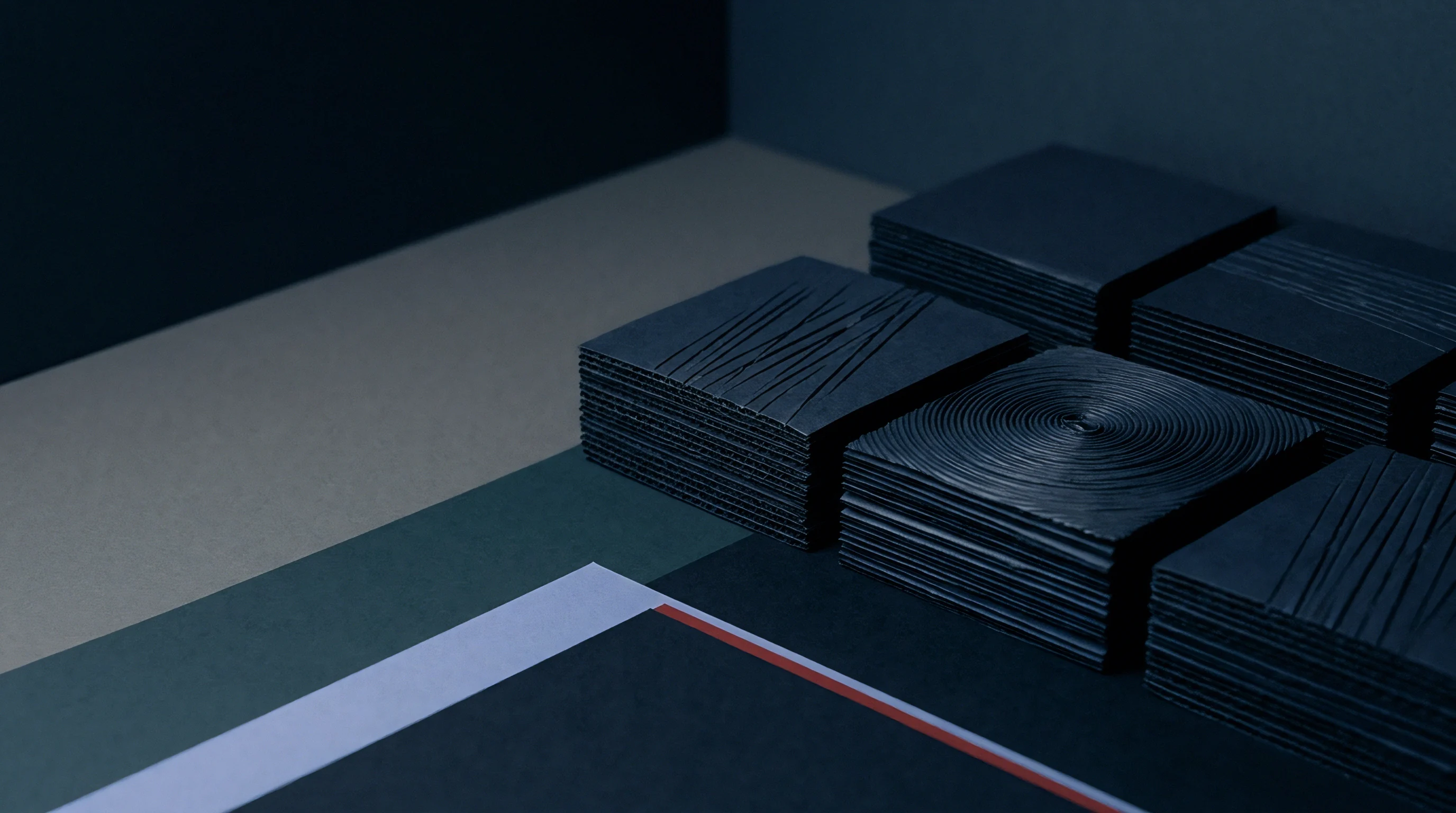
Micro-embossed chill rolls impart truncated pyramidal or spherical cavities directly into the molten polyolefin skin during extrusion. The sidewall angle of these microstructures dictates the shear failure threshold during finishing passes. Steep sidewall angles above forty-five degrees generate severe stress concentrations at the asperity base under tangential displacement.
Asperities shear at the root. Flatter structures with base angles below twenty-five degrees accommodate tangential displacement through laminar plastic shearing across the full asperity height, preserving diffuse light scattering across longer run cycles.
Converting lines experience specific mechanical failure modes when micro-structured skins encounter rapid tangential loads:
- Asperity Flattening and Glazing occurs when normal and tangential stresses exceed the yield point of the polyolefin skin, transforming light-diffusing peaks into reflective planar facets.
- Sub-Surface Shear Banding develops within the oriented polymer matrix beneath micro-valleys, initiating localized material softening prior to visible surface rupture.
- Adhesive Interfacial Peeling manifests when shear stresses transmitted through the polyolefin film exceed the cohesive bond strength of the lamination primer layer.
- Micro-Tear Propagation takes place along lines of particulate fillers, creating longitudinal surface fissures that collect dust and disrupt printed typography.
Steeper asperity slope angles cause faster matte glazing during friction contact.

Strain
Deformation velocities exceeding four hundred meters per minute compress the interaction window between tooling guides and the matte film to sub-millisecond durations. At these loading rates, polyolefin skin layers exhibit pronounced viscoelastic and viscoplastic rate sensitivity. Strain rates inside individual asperity junctions reach values between 103 and 105 s-1.
Polyolefin films display severe rate sensitivity. Under these conditions, the yield strength of semi-crystalline polypropylene doubles relative to standard tensile test values, while ultimate elongation drops by over seventy percent.
Constitutive modeling of this interfacial behavior requires frameworks that capture rate-dependent yield phenomena alongside temperature-dependent softening. Eyring rate theory accounts for the stress-assisted thermal activation of polymer chain segments. At strain rates above 103 s-1, secondary relaxation processes in polyolefins freeze out, shifting the yield locus upward.
Standard Johnson-Cook formulations modified for packaging films capture this rate hardening while balancing the softening induced by plastic work conversion into heat.
Polypropylene skins exhibit a fifty-two percent drop in effective shear yield strength when localized flash temperatures reach seventy degrees Celsius under ten meters per second sliding velocity.
Biaxially oriented polypropylene skins contain crystalline lamellae oriented parallel to the film surface. High-rate shear displacement perpendicular to the orientation axis causes inter-lamellar slip followed by crystallite fragmentation. The initial yield resistance gives way to rapid strain softening within localized shear bands.
When contact loading aligns with the machine direction of the lamination web, yield strength increases by fifteen to twenty-five percent compared to cross-direction loading, dictating carton nesting layouts on the press sheet.

Viscoplastic Flow at High Deformation Rates
Eyring activation kinetics govern the yield point of semi-crystalline polypropylene when loading speeds compress contact dwell time. The effective shear yield stress follows a logarithmic relationship with the plastic shear strain rate. As strain rates climb through the regime typical of high-speed folding hooks and transfer belts, activation volume decreases.
The material resists instantaneous deformation until a critical shear threshold triggers sudden plastic flow. This sudden flow manifests mechanically as stick-slip chatter on folding lines, inducing micro-cracking across carton creases.
Experimental validation of high-rate constitutive models relies on split-Hopkinson pressure bar testing adapted for thin polymer skins, alongside high-speed scratch testers operating up to ten meters per second. These instruments establish the rate sensitivity parameter for commercial lamination films. Polyethylene skins show a lower rate sensitivity exponent than polypropylene, retaining ductile compliance across wider speed envelopes but offering less initial resistance to asperity crushing.
Does Viscous Dissipation Drive Interfacial Yield?
Localized plastic work converts almost entirely into thermal energy within the microscopic contact patches. Because polyolefins exhibit low thermal conductivity, roughly 0.15 to 0.22 W/(m·K), this heat cannot diffuse into the bulk cartonboard during microsecond contact events. Adiabatic conditions prevail at the asperity summits.
Flash temperatures at contact junctions regularly spike forty to eighty degrees Celsius above ambient room temperature.
Thermal accumulation within the skin matrix reduces local yield strength faster than strain-rate hardening elevates it. Frictional heating drives this thermal decay. The polymer enters a thermal softening regime where shear resistance collapses.
Tooling surfaces then plow through the softened polyolefin crests with minimal tangential resistance, dragging liquefied or rubbery material into micro-grooves and creating catastrophic gloss banding across printed blanks.
| Material Grade | Film Caliper (µm) | Shear Strain Rate (s⁻¹) | Shear Yield Stress (MPa) | Flash Temperature Rise (°C) | Friction Coefficient |
|---|---|---|---|---|---|
| BOPP Matte Standard | 15 | 10⁰ | 24.5 | 0.4 | 0.32 |
| BOPP Matte Standard | 15 | 10² | 38.2 | 8.6 | 0.38 |
| BOPP Matte Standard | 15 | 10⁴ | 56.1 | 42.7 | 0.49 |
| BOPP Matte High-Slip | 18 | 10⁴ | 48.3 | 26.1 | 0.28 |
| BOPP Matte Cross-Linked | 20 | 10⁴ | 68.4 | 38.5 | 0.42 |
| PE Matte Extruded | 25 | 10⁴ | 31.2 | 51.3 | 0.54 |
| Testing conducted at 23°C ambient temperature under normal contact pressure of 12.5 MPa using high-speed rotary tribometry against polished tool steel. | |||||
Film vendors frequently claim that line chatter rather than thermal skin softening causes the milky scuff streaks on high-speed gluer folds.


Drag
Tangential friction forces generated across transport belts dictate whether a matte carton glides cleanly or scuffs into scrap. In high-velocity packaging equipment, friction does not obey simple Amontons-Coulomb laws. Contact mechanics operate in an elastohydrodynamic-like boundary state governed by solid-state shear deformation.
The total tangential drag combines adhesive shearing across true contact areas with mechanical plowing of rigid tooling asperities through the compliant polymer skin.
Adhesive friction arises from molecular interactions across intimate contact zones. Plowing friction results from energy dissipated during plastic displacement of polymer volume ahead of sliding asperities. At velocities below fifty meters per minute, adhesive friction dominates total resistance.
Above three hundred meters per minute, plowing friction accounts for more than sixty percent of the recorded shear force. Shear bands form at microscopic voids. As speed climbs, the plowing component scales non-linearly with indentation depth, creating severe drag spikes on tightly set folder-gluer guide rails.
Frictional Mechanics of Microstructured Surfaces
Greenwood-Williamson contact formulations establish how normal force distributes over discrete asperity peaks. For micro-structured matte films, the surface summit distribution rarely conforms to a Gaussian curve. Extrusion-embossed skins display skewed height distributions with plateau-like peaks and sharp valleys.
As normal pressure increases, asperity compliance rapidly increases real contact area, amplifying the adhesive shear contribution.
Tooling material selection alters this frictional balance. Highly polished steel tools with root-mean-square roughness below 0.05 microns produce large real contact areas against flattened polymer peaks, inducing strong molecular adhesion. Textured ceramic or plasma-coated guides maintain air gaps between contacting bodies, limiting adhesive junction growth.
Belt materials on carton folding sections present another variable. Soft polyurethane or nitrile transport belts conform to the matte topography, generating high mechanical interlocking that strips the skin from the board under high acceleration stages.

Do Microstructured Asperities Prevent Adhesive Failure?
Entrapped air pockets residing between texturing peaks reduce the true contact area to a small fraction of the nominal footprint. Under low-speed handling, these microscopic air cushions limit total interfacial shear, preventing scuffing. At high velocities, atmospheric air cannot vent quickly through the tortuous valley network.
Localized hydrodynamic squeeze films develop momentarily, supporting a portion of the normal load and lowering initial sliding drag.
This protective mechanism fails when contact pressures exceed four megapascals. Air escapes or compresses completely, forcing summit peaks into intimate contact with the opposing counterface. The transition from hydrodynamic cushion to direct solid shearing occurs abruptly.
Once intimate contact forms, high sliding velocity accelerates flash heating, causing instantaneous adhesion and tearing along the micro-structured skin surface.
| Tooling Interface | Contact Pressure (MPa) | Relative Velocity (m/min) | Real Contact Area Ratio | Tangential Shear Stress (MPa) | Wear Mode |
|---|---|---|---|---|---|
| Hard Chrome Steel | 2.5 | 100 | 0.038 | 4.2 | Elastic Recovery |
| Hard Chrome Steel | 8.0 | 500 | 0.142 | 18.6 | Asperity Flattening |
| Nitrile Rubber Belt | 1.5 | 450 | 0.285 | 22.4 | Adhesive Tearing |
| Ceramic Plasma Coat | 8.0 | 500 | 0.064 | 9.1 | Micro-Plowing |
| Polished Brass Guide | 5.0 | 350 | 0.118 | 14.8 | Polymer Transfer Film |
High-rate interfacial shear modeling must incorporate specific constitutive inputs to predict friction thresholds accurately:
- Apparent Contact Area defines the macroscopic contact footprint calculated from machine tooling geometry and applied normal clamping force.
- Viscoplastic Tangential Traction represents the shear resistance mobilized within the polymer boundary layer under specific strain rates and temperatures.
- Adiabatic Flash Temperature tracks the instantaneous thermal accumulation within asperity junctions during short contact durations.
- Interfacial Shear Modulus captures the instantaneous elastic stiffness of the skin-substrate composite prior to plastic yield initiation.
Whether cryogenic chill-roll texturing alters the near-surface amorphous fraction enough to suppress velocity-induced boundary slip remains an open scientific debate.

Peel
Interfacial separation between the laminated polyolefin skin and the underlying paperboard core follows mode II shear fracture paths under rapid folder-gluer belt engagement. The composite consists of three distinct mechanical layers: the oriented matte film, the extruded bonding layer or solventless polyurethane adhesive, and the fibrous paperboard substrate. High-velocity friction applies pure shear traction to the outer film face.
This shear transmits directly through the adhesive boundary into the top fiber layer of the paperboard. Delamination destroys carton structural integrity.
Failure manifests along the weakest boundary. On bleached sulfate boards with high internal bond strength, shear localization concentrates within the lamination adhesive. Water-based acrylic adhesives exhibit poor shear fatigue under high deformation rates, rupturing through cohesive shear failure within the dried adhesive film.
Two-component solventless polyurethane systems provide higher crosslink density, transferring the shear stress into the underlying clay coating of the paperboard. When the clay coating delaminates, the matte film peels cleanly away with a chalky white residue adhered to its underside.
Specifying ISO 11339 T-peel values without defining the high-speed peel rate leaves folding cartons vulnerable to shear delamination under rapid converting conditions.
Cohesive zone modeling establishes the traction-separation behavior of this interface. A bilinear traction-separation law defines initial elastic bond stiffness, peak interfacial shear strength, and critical fracture energy. Under dynamic loading rates, the peak shear strength increases due to viscoelastic hardening in the adhesive, but the critical energy release rate drops significantly.
The adhesive layer softens. The bond line behaves in a brittle manner under rapid loading, propagating delamination cracks from minor sheet edge burrs across entire carton panels.
Cohesive Zone Formulations for Bound Interfaces
Traction-separation laws describe the progressive rupture of the primer boundary layer beneath the film. In pure mode II loading, interfacial damage initiates when the tangential shear stress reaches the critical shear strength parameter. Beyond this point, damage evolution reduces the load-bearing capacity of the interface linearly or exponentially until traction drops to zero.
High-velocity belt traction generates mixed-mode loading at the carton leading edge, where belt compression creates concurrent normal compressive and tangential shear stresses.
Formulations must account for compressive normal stress suppressing mode I crack opening while simultaneously increasing the apparent mode II shear resistance through internal friction. If the normal pressure is suddenly removed as the carton leaves a nip section, stored elastic energy within the compressed board fibers drives rapid mode I delamination. The carrier web absorbs tensile loads.
This dynamic spring-back phenomenon splits the adhesive layer immediately after exiting high-pressure folding belts.
Substrate Compliance and Energy Release
Bleached kraft paperboard fibers deform elastically beneath the adhesive boundary before catastrophic shearing occurs. The low out-of-plane shear modulus of paperboard, typically between 30 and 80 MPa, allows substantial shear deformation within the fibrous network. Fiber tear confirms adhesive bond strength.
This compliance absorbs a portion of the kinetic energy imparted by high-speed converting tools, shielding the lamination interface from peak stresses.
Recycled folding boxboard grades containing mechanical pulp or unrefined secondary fibers exhibit lower Z-direction tensile and shear strength. High-velocity surface traction tears the fiber network beneath the clay coating at lower force thresholds than virgin solid bleached sulfate boards. Testing protocols must evaluate the complete laminated composite under conditions mirroring machine operations rather than evaluating unsupported film rolls.
- Condition laminated carton samples at twenty-three degrees Celsius and fifty percent relative humidity for twenty-four hours under ISO 187 standards.
- Mount specimens securely onto the high-velocity sled apparatus using rigid vacuum clamping to prevent backing compliance.
- Accelerate the steel friction tool to the target converting velocity of six hundred meters per minute before initiating interfacial contact.
- Measure transient tangential shear force using high-bandwidth piezoelectric load cells recording at one hundred kilohertz.
- Inspect the contact track using optical interferometry to quantify asperity volume loss and surface gloss alterations.
Neglecting rate-dependent shear yield in adhesive specifications causes delaminated carton flaps, jammed packaging lines, and wholesale batch rejections at retail distribution centers.

Toll
Converting costs escalate when scuffed carton flaps trigger automated vision system rejections at five hundred units per minute. In cosmetic, pharmaceutical, and high-end consumer goods packaging, a visible burnish mark across a deep black or solid blue matte background invalidates the finished carton. Brand specifications set strict optical tolerances.
Line operators slow the machine. Reducing gluer belt speeds from five hundred to two hundred and fifty meters per minute suppresses frictional heating and eliminates matte glazing, but doubles the machine hour cost allocated to the production run.
Tooling wear compounds unit losses. Micro-structured matte films carrying inorganic silica matting agents act as mild abrasives against chrome-plated folding swords, belt guides, and steel tuckers. High-velocity transit accelerates abrasive wear on machine tooling, eroding precision edge radii and generating rough burrs.
These burrs subsequently tear film edges on subsequent sheets. Replacing hardened steel tooling components every three months adds tooling amortization costs that quickly exceed film savings achieved by purchasing cheaper un-oriented matte grades.
Lamination waste on high-speed lines originates primarily from frictional glaze defects rather than structural cartonboard tears.

Production Waste and Machine Speed Economics
A standard production run of fifty thousand cartons accumulates substantial paperboard spoilage when belt shear exceeds material yield thresholds. Take a fifty-thousand carton job on 350 gsm solid bleached sulfate board measuring 400 by 500 millimeters, laminated with a 15-micron BOPP matte skin. The board costs 1,450 EUR per metric tonne.
The matte film adds 0.22 EUR per square meter including adhesive application. Make-ready setup on a high-speed folder-gluer consumes 1,200 sheets while dialing in belt tensions and folding hook clearances. Make-ready waste consumes the run margin.
Running waste accounts for another 2.5 percent of the job on an unstable film specification where thermal glazing occurs intermittently. Total paperboard and film waste reaches 2,450 sheets, totaling 1,715 square meters of composite stock. At raw material costs of 0.47 EUR per sheet, scrap material losses reach 1,151.50 EUR.
Machine run time lost to clearing jams and wiping glazed polymer residue from folding belts adds 2.5 hours of press downtime billed at 220 EUR per hour. The defective finishing pass adds 1,701.50 EUR in direct variance, representing 34.03 EUR per thousand finished cartons.
| Skin Specification | Line Speed (m/min) | Make-Ready Waste (Sheets) | Running Spoilage (%) | Landed Surcharge (EUR/1000 Packs) | Recyclability Class |
|---|---|---|---|---|---|
| Standard BOPP Matte 15µm | 500 | 1,800 | 3.8 | 42.10 | Class B |
| Standard BOPP Matte 15µm | 250 | 800 | 0.8 | 31.50 | Class B |
| High-Slip BOPP Matte 18µm | 500 | 950 | 1.1 | 18.40 | Class B |
| Cross-Linked BOPP Matte 20µm | 550 | 700 | 0.5 | 14.20 | Class A |
| Direct Aqueous Matte Varnish | 450 | 500 | 0.4 | 8.60 | Class AAA |

Extended Producer Responsibility and Recyclability Tariffs
European packaging regulations impose financial surcharges on fiber substrates carrying non-separable polyolefin laminates. Under current packaging waste guidelines, paperboard laminated with double-sided or heavy plastic film faces severe fee modulation penalties. A polyolefin skin thicker than fifteen microns represents more than five percent of the total carton mass on lighter calipers, automatically downgrading the package from high recyclability classifications to lower compliance tiers.
This reclassification triples extended producer responsibility fees across major European territories.
Converters navigating these regulations balance film thickness against shear resistance. Downgauging the polyolefin skin to twelve microns satisfies the five percent plastic mass threshold for fiber repulpability protocols. However, the thinner skin reduces thermal buffer capacity.
Twelve-micron films reach critical flash temperatures and experience interfacial shear failure under lighter contact pressures, exacerbating production scrap. Switching to water-based dispersion barriers or electron-beam cured matte coatings restores recyclability compliance but eliminates the soft-touch haptic signature demanded by luxury brands. Carton packers reject the lot.
Inserting a clause that limits 60-degree gloss shifts to under two units after ASTM D5264 rub testing at high speed shifts financial liability for scuff spoilage back to the film laminator.