Nuclear Mass Metric
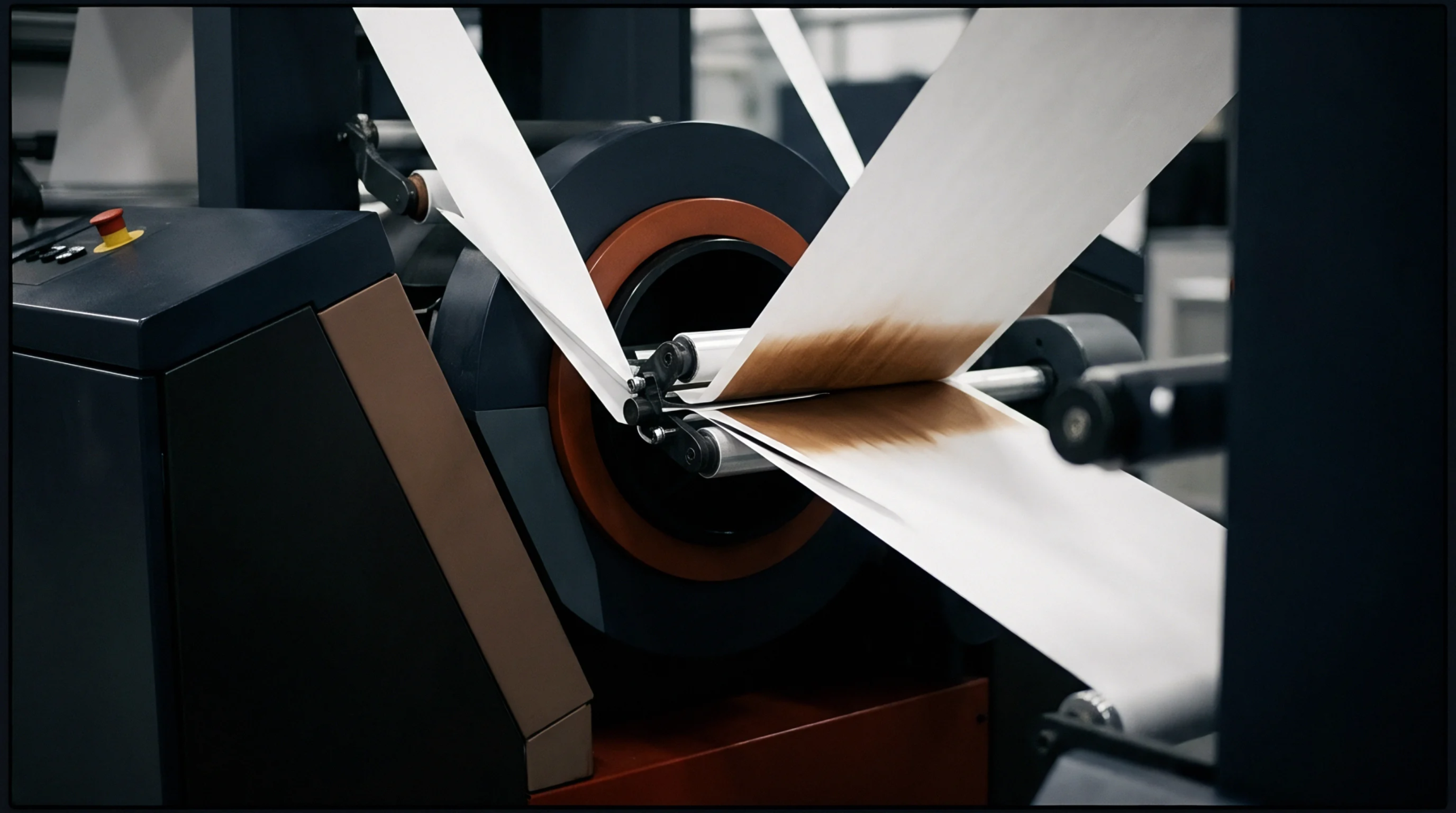
Transmitted beta radiation reduction across a moving continuous web provides non-destructive continuous measurement of total basis weight in paperboard manufacturing. Fast electrons emitted from sealed radioisotopes such as krypton-85 or promethium-147 collide with orbital electrons in the moving paper sheet, scattering and losing kinetic energy in direct proportion to mass per unit area. Modern paper machines rely on beta attenuation across high-speed scanning bridges to regulate slice lip actuators and stock flow valves.
Compositional variations involving heavy mineral pigments introduce mass absorption discrepancies that require ash compensation channels.
Radiation Absorption Physics
Nuclear beta particles undergo inelastic scattering and continuous deceleration as they traverse the cellulose matrix and inter-fibre voids. Mass absorption coefficients govern beam intensity reduction according to an exponential relationship with basis weight, functioning with minimal sensitivity to chemical bonding states. Promethium sources serve lightweight specialty tissues under fifty grams per square metre, while krypton sources cover standard linerboard and medium grades.
Air gap temperature shifts alter the mass of ambient air between the source head and ionization detector, creating baseline drift that scanner heads offset by measuring cold air reference channels off-sheet. Moisture fluctuations influence the mass absorption coefficient slightly, compelling scanner computers to process infrared moisture gauge data simultaneously with radiation counts. High-density coatings laden with titanium dioxide or calcium carbonate exhibit higher electron densities than pure cellulose, which drives apparent mass readings upward unless real-time X-ray ash sensors furnish correction factors.
Detector drift caused by chamber gas leakage or radioactive half-life decay requires routine zeroing off-web to preserve precision down to a tenth of a gram per square metre.
Grammage Control Feedback
Caliper and cross-direction profile consistency depend on real-time feedback loops driven directly by ionizing gauge arrays. Cross-machine basis weight variations activate stepper motors on the headbox slice lip, fine-tuning local pulp suspension volume across widths spanning ten metres. Rapid machine-direction basis weight shifts instruct variable-speed fan pumps to adjust stock consistency before the stock suspension reaches the fourdrinier table.
Consistent beta attenuation data prevent sheet breaks in downstream coating sections and corrugator fluting nips by eliminating thin dry streaks.