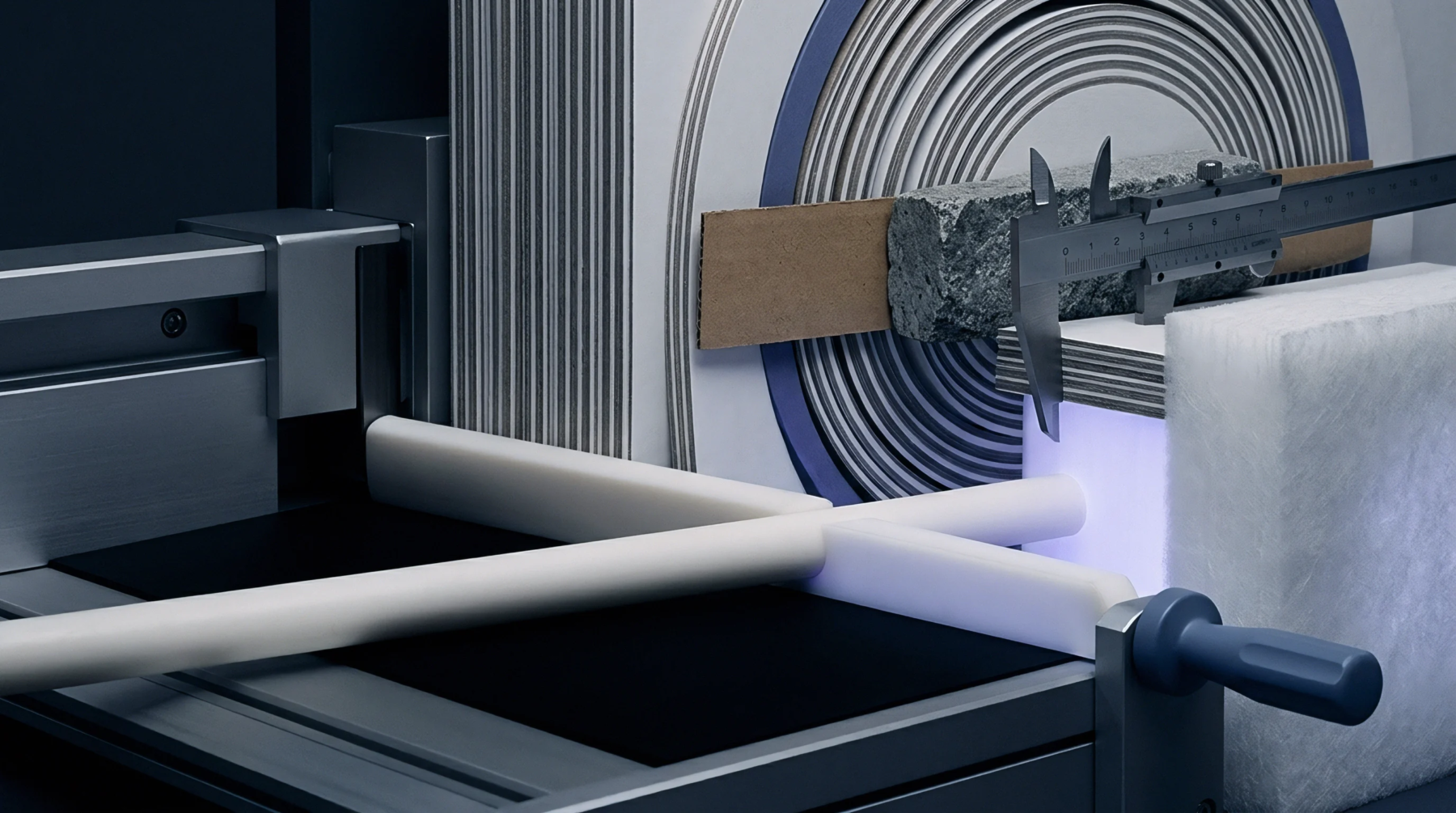
Tooling Geometry Setting
Dimensional adjustment of the vertical penetration of a creasing rule into a counter-matrix channel establishes the crease groove depth in folding carton converting. The setting determines the degree of internal delamination within multi-ply paperboard without rupturing the exterior linerboard or top mineral coating. Penetration depth is governed by the difference between the creasing rule height and the channel depth relative to the thickness of the board substrate.
Proper mechanical calibration ensures that compressive forces shear the central plies of solid bleached sulphate or folding boxboard, creating an internal hinge. The calibration boundary stops before the rule shears through the tensile-loaded outer face plies.
Hinge Formation
Precise depth settings generate controlled delamination across the middle plies of the board structure, allowing the substrate to roll into a clean bead upon folding. Insufficient rule penetration fails to split internal fibre bonds, causing excessive bending stiffness that results in bulging panels and misaligned carton joints on high-speed gluing lines. Excessive penetration fractures the top coating and outer cellulose fibres, producing visible surface cracking, unprinted substrate exposure, and compromised barrier integrity along carton edges.
On automated packaging lines, correctly calibrated creases maintain stable opening forces and square corner geometries under dynamic loading conditions.
Make-Ready Protocol
Operators calibrate penetration settings during die-cutter make-ready using micrometer gauges, carbon paper impression tests, and cross-sectional optical microscopy. Adjustments account for variations in board calipers, moisture content, fibre furnish types, and grain orientation across the layout. Because cross-grain scores require deeper rule penetration to overcome rigid transverse fibres than machine-direction scores, differential shimming is applied beneath specific rule segments.
Calibrating depth to substrate compressibility preserves carton structural integrity across changing production ambient conditions.