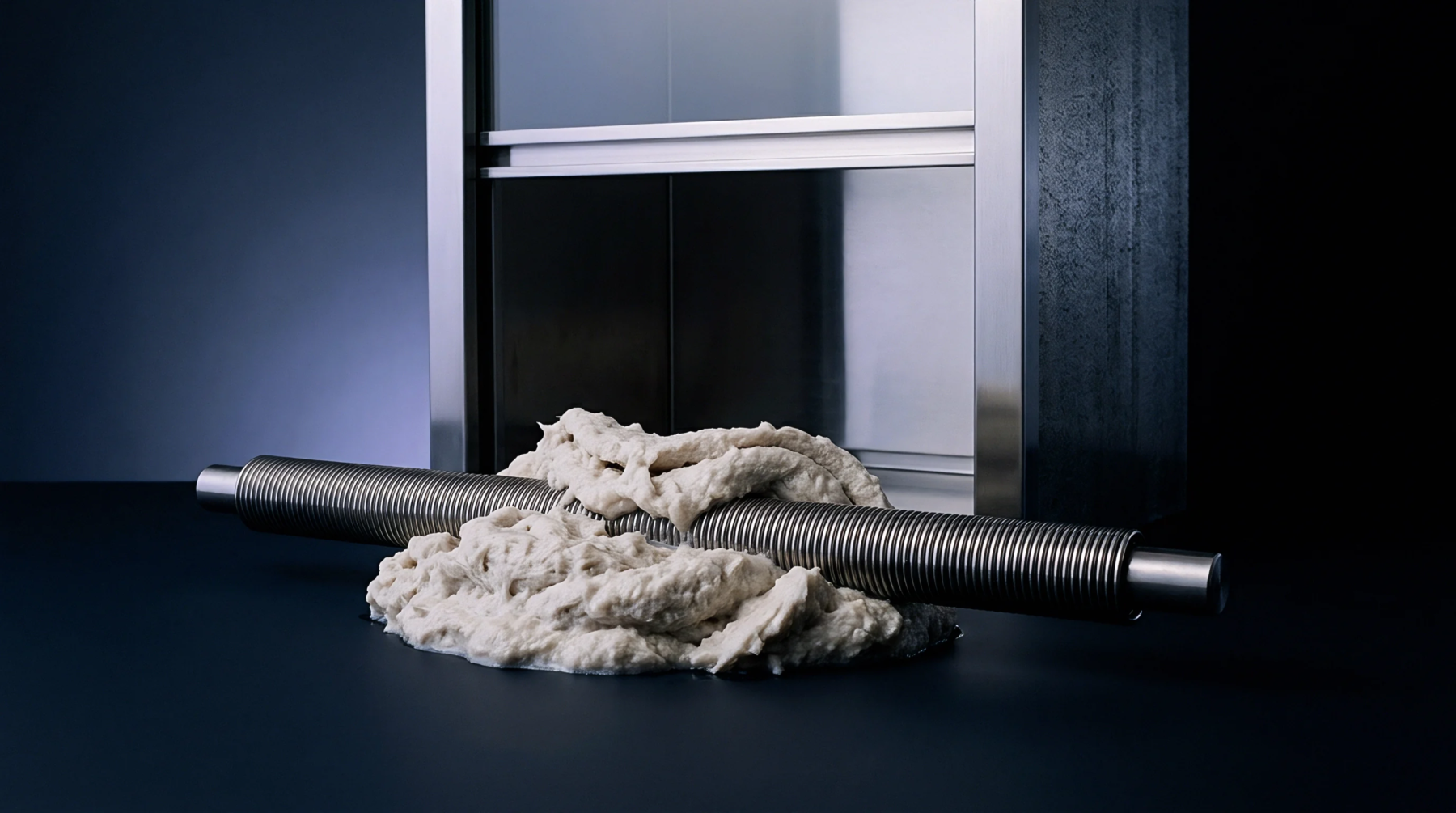
Compaction Mechanism
Irreversible consolidation of settled mineral particles into an unyielding mass marks the structural failure of a concentrated coating suspension. Suspension stability collapses through hard cake formation when repulsive forces between dispersed solids drop below the threshold needed to prevent primary-minimum van der Waals attraction. The settling process begins as gravitational force pulls dispersed pigment particles toward the base of storage vessels, totes, or static delivery lines.
Dense packing expels interstitial carrier liquid, driving particles into direct physical contact where London attraction locks particle faces together. The boundary of this phenomenon separates soft, redispersible flocs settled in secondary energy minimums from non-redispersible crystalline packing at the bottom of the vessel.
Rheological Consequence
Mechanical redispersal becomes impossible through standard agitation once primary electrostatic or steric barriers collapse completely within settled pigment layers. Particle size distribution accelerates this densification, as fine calcium carbonate or clay fractions fill the interstitial voids between larger pigment platelets. High solids slurries operating above sixty-five percent dry weight are particularly vulnerable to this failure mode under extended static storage or vibratory transport.
The cake forms a dense, cement-like floor that fouls mixing impellers, blocks discharge ports, and starves feeding pumps during kitchen make-down operations. Chemical additives such as polymeric dispersants and carboxymethyl cellulose delay cake development by maintaining interparticle spacing, but thermal degradation or bacterial consumption of these stabilizers triggers rapid consolidation. Mill operations faced with this failure face complete loss of raw material, severe pipe abrasion, and downstream coater starvation that forces machine shutdowns.
Dispersion Boundary
Phase segregation stops producing dense cakes when continuous shear, active recirculation, or thixotropic gelling agents hold pigment particles in sustained suspension. Dilute slurries with solids contents below twenty percent settle into loose, voluminous sediments rather than tightly packed mineral matrices. The physical state ceases to apply once pigments are dried onto paper surfaces as finished coating layers.