Quantifying Microscopic Pinhole Formation Mechanisms in High Speed Water Based Dispersion Barrier Coating Applications
Microscopic pinholes form through entrained air bubbles and capillary dewetting during rapid drying, requiring dual-station metering to ensure barrier integrity.
Web
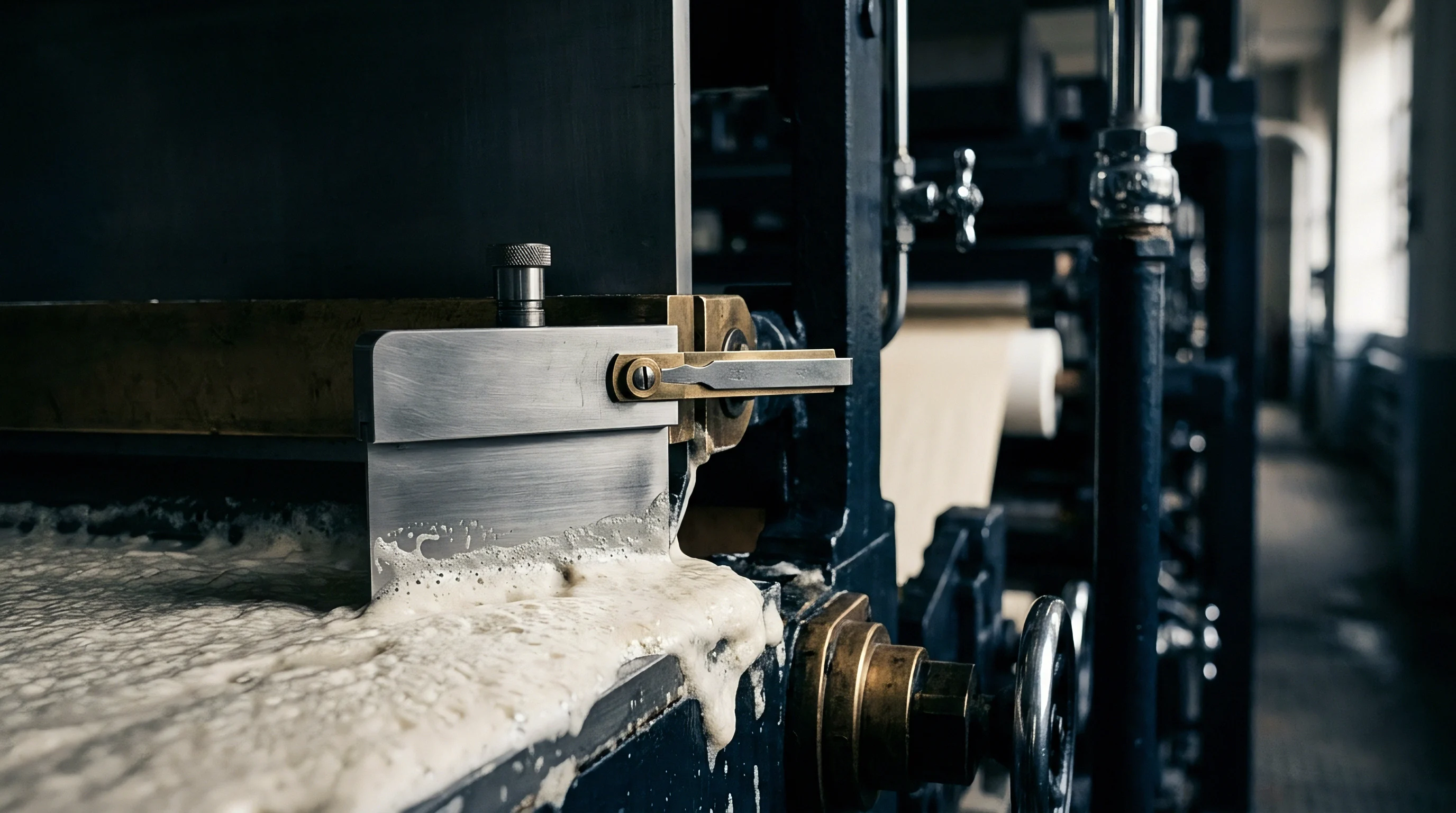
High-speed aqueous dispersion coating lines running solid bleached sulfate and folding boxboard between 600 and 1,200 meters per minute push polymer emulsions against raw paper topographies under intense dynamic shear. At these velocities, a liquid coating film has mere milliseconds to wet, level, and consolidate over cellulose fibres before encountering the drying train. Microscopic pinholes originate at this mechanical boundary.
When a water-based dispersion containing styrene-butadiene, acrylic, or bio-based polymers strikes the moving paper web, air boundary layers dragged along the paper surface become trapped inside surface micro-crevices. The metering blade or curtain head exerts hydro-mechanical pressure, yet local roughness peaks prevent uniform liquid displacement.
Baseboard topography governs initial liquid distribution. Uncoated cartonboard grades exhibit Parker Print-Surf roughness values ranging from 4.5 to 8.0 micrometers at 1,000 kilopascals clamping pressure. Micro-cavities between uncompressed surface fibres harbor micro-pockets of air.
When low-viscosity aqueous formulations pass under a rigid metering blade, local shear rates exceed 100,000 reciprocal seconds. Blade pressure smooths the wet film. Liquid fills upper surface elevations while skimming across deep microscopic depressions.
Entrained micro-bubbles remain pinned beneath the wet film line, unable to escape through the viscous dispersion matrix before the sheet hits the first drying hood.
Dynamic wetting failure at high web velocities traps micro-bubbles beneath aqueous films whenever baseboard Parker Print-Surf roughness exceeds 4.5 micrometers.
Metering methods alter the frequency of air entrapment. Roll applicators with bent blades induce film-splitting patterns that generate microscopic filament breakages, pulling liquid threads apart at the exit nip and creating crater-like voids. Curtain coaters eliminate blade drag, yet introduce web-impact instabilities where high web speeds generate heel-vortex air entrapment along the wetting line.
Liquid surface tension gradients fight inertial forces across the applicator zone. Capillary suction pulls water downward. Unsized cellulose fibres wick water away from the emulsion, destabilizing polymer particles before film leveling finishes.
- Hydrodynamic air entrapment forces atmospheric micro-bubbles into microscopic substrate valleys under the advancing liquid dynamic contact line.
- Cavitation filament breakup creates surface craters along the metering blade heel when negative pressure zones tear the wet coating apart.
- Selective capillary absorption draws free carrier water into porous cellulose networks, precipitating local polymer coagulation before cohesive film formation occurs.
- Fibre bundle protrusion pierces thin wet dispersion layers wherever high-bulk mechanical pulps expand upon initial hydration.
Roughness variations translate directly into barrier discontinuities. A single coat weight of 6 grams per square meter applied in one pass leaves protruding fibres exposed above the dried polymer layer. Applying the same total mass in two discrete passes of 3 grams per square meter seals these valleys.
The initial coating pass acts as a physical sizing barrier that anchors loose fibres and smooths substrate profile depths. The second pass creates a continuous polymer film free of base-sheet interference. Converters running single-pass metering heads face persistent micro-fissures whenever line speeds rise above 800 meters per minute.
Chemical suppliers frequently explain that surface pinholing results entirely from uncontrollable baseboard micro-porosity rather than unstable emulsion rheology under blade nip shear.

Evaporation
Thermal drying sections impose severe evaporative flux across freshly metered aqueous dispersion films. Water removal rates in high-efficiency convective hot air hoods reach 30 to 50 kilograms of water per square meter per hour. Infrared emitters paired with high-velocity air nozzles strip moisture from the coating surface rapidly.
This intense heat input creates steep moisture and thermal gradients between the upper liquid boundary and the underlying cellulose matrix. Rapid moisture loss triggers premature surface skinning, locking wet internal phases beneath a semi-solid polymer shell.
How Rapid Drying Drives Bubble Rupture?
Skinning begins when polymer particle concentrations at the coating-air boundary reach maximum close packing ahead of the bulk film. Styrene-butadiene and polyacrylate latex particles coalesce into an impermeable upper skin while the underlying stratum retains substantial free water. Continued infrared and convective heating boils or vaporizes this trapped carrier moisture.
Vapor pressure blows pinhole vents. Trapped air pockets expand under thermal excitation, pushing through the fragile polymer crust to leave open volcanic craters measuring between 2 and 25 micrometers in diameter.
Convective air currents exacerbate surface rupture through local thermal disruptions. High-velocity nozzle air directed at wet dispersions generates Marangoni convection cells, driven by localized surface tension gradients as water evaporates non-uniformly. Volatiles escape along path lengths of least hydraulic resistance.
Water vapor tracks through voids. If the wet film thickness lacks sufficient viscoelastic yield strength to level these rupture sites before the glass transition temperature arrests flow, the crater solidifies as a permanent pinhole.
| Air Temperature (Celsius) | Air Velocity (m/s) | Evaporative Flux (kg/m2/h) | Infrared Intensity (kW/m2) | Pinhole Density (defects/m2) |
|---|---|---|---|---|
| 120 | 18 | 22.4 | 12 | 14 |
| 145 | 28 | 34.8 | 24 | 88 |
| 175 | 40 | 46.2 | 38 | 412 |
| 205 | 52 | 58.7 | 48 | 1840 |
Drying profiles demand precise zoning to prevent convective skinning. Initial drying zones operating below the boiling point of water allow uniform carrier consolidation without boiling entrained micro-air. Gentle medium-wave infrared heating warms the sheet mass gradually.
Once solids concentrations surpass 75 percent throughout the coating cross-section, secondary high-temperature convective zones complete coalescence. Rushing this consolidation curve guarantees through-thickness capillary channels.
A five-degree jump in initial drying tunnel air temperature accelerates premature skinning before entrained carrier micro-bubbles can escape the wet matrix.
Drying skins the upper layer. Coalescence demands careful temperature matching against the polymer minimum film formation temperature. When ambient web temperatures dip below this thermal threshold, latex particles fail to deform, producing inter-particle micropores rather than continuous barrier films.
Excessive dryer exhaust humidity suppresses evaporation, while dry air at excessive velocity rips the wet surface. Balanced evaporation keeps the consolidation front advancing evenly from the substrate boundary upward to the atmosphere.
Gentle drying curves prevent surface crusting while violent heat inputs produce porous sheets.
Assay
Direct quantification of microscopic pinholes requires metrology capable of distinguishing surface indentations from through-thickness capillary channels. A surface crater extending halfway through an 8-micrometer polymer layer preserves liquid barrier integrity, whereas a 2-micrometer pinhole extending into baseboard fibres causes catastrophic barrier breakdown. Optical inspection systems mounted on slitter-rewinders flag large voids, but sub-micron apertures evade standard line sensors operating at 1,000 meters per minute.
Standardized chemical staining exposes through-thickness defects reliably on pulled sample sheets. Testing under EN 13676 utilizes an organic dye solution consisting of 0.5 grams of ethyl violet dissolved in 100 milliliters of ethanol applied to the barrier surface. The ethanol carrier wets the hydrophobic coating and enters open pinholes via capillary action within two minutes.
Cellulose fibres beneath defect sites absorb the ethyl violet dye, creating visible, high-contrast purple stains against the white bleached paperboard background. Automated flatbed scanners record stained sample areas at 2,400 dots per inch, feeding thresholding algorithms that calculate pinhole counts and surface area defect percentages.
| Metrology Method | Defect Size Floor (microns) | Test Duration per Sample | Substrate Destruction | Detection Mechanism |
|---|---|---|---|---|
| EN 13676 Ethyl Violet | 1.5 | 5 minutes | Destructive | Capillary dye staining |
| High-Voltage Spark Discharge | 0.3 | 15 seconds | Non-destructive | Dielectric air breakdown |
| Helium Gas Permeance | 0.05 | 20 minutes | Non-destructive | Mass spectrometer diffusion |
| Automated Optical Microscopy | 2.0 | 2 minutes | Non-destructive | Reflected light segmentation |
| Methods tested on solid bleached sulfate board coated with 9 gsm styrene-acrylate dispersion under ISO 187 standard conditioning at 23 Celsius and 50 percent relative humidity. | ||||
High-voltage spark testing detects smaller aperture boundaries through dielectric breakdown. An engineered test electrode sweeps the dispersion-coated surface while a conductive grounded plate supports the paperboard reverse side. Pure aqueous polymer films possess high dielectric resistance, withstanding electrical potentials up to 3 kilovolts.
Pinhole voids contain air columns that ionize under much lower voltage thresholds. Spark testing detects sub-micron channels. Each electrical discharge registers as a discrete count, enabling rapid calculation of pinhole frequencies per square meter without wet chemical exposure.
- Atmospheric sample conditioning stabilizes sheet moisture under ISO 187 parameters at 23 degrees Celsius and 50 percent relative humidity for 24 hours.
- Conductive ground mounting places the conditioned board reverse side in continuous mechanical contact with a calibrated copper backing plate.
- Voltage calibration sweep applies a 1.8-kilovolt potential across a brass brush electrode at a continuous linear speed of 100 millimeters per second.
- Discharge spark enumeration logs transient current surges through a high-speed digital pulse counter to compute exact pinhole coordinates.
Helium mass spectrometry quantifies sub-micron void networks that resist dye penetration. A coated specimen clamps inside a sealed dual-chamber diffusion cell. Evacuating the downstream chamber to 0.1 pascals while introducing helium gas at 100 kilopascals to the upstream chamber establishes an elemental concentration gradient.
Helium atoms navigate through-thickness pinhole channels rapidly, entering the mass spectrometer detector. Fickian diffusion through a defect-free polymer matrix requires hours, whereas molecular Knudsen flow through microscopic pinholes registers signal spikes within 15 seconds. This metrology identifies micro-porosity networks responsible for mineral oil vapour leakage.
Helium permeation rates above 1.5 times 10 to the minus nine moles per square meter second pascal establish the presence of through-thickness micro-channels under mass spectrometer testing.
Dye staining reveals microscopic breaks. Line engineers correlate dye stain counts with water vapor transmission rates measured under ISO 2528. Coated boards showing fewer than 5 pinholes per square meter under ethyl violet testing achieve water vapor transmission rates below 15 grams per square meter per day at 38 degrees Celsius and 90 percent relative humidity.
Board showing 250 pinholes per square meter exhibits rates exceeding 180 grams per square meter per day. Pinholes destroy grease resistance. Mineral oil barrier performance collapses completely once pinhole density surpasses 20 defects per square meter under ISO 16532-1 testing.
Metrology engineers continue to dispute whether helium mass flow through high-speed dispersion barriers accurately reflects liquid water capillary penetration under real packaging shelf life conditions.

Dispersion
Formulation chemistry dictates how resilient a wet coating film remains against bubble formation and interfacial dewetting during high-shear application. Aqueous dispersion barriers rely on synthetic or bio-based polymer particles suspended in continuous aqueous phases, stabilized by surfactant systems. Particle size distributions typically center between 120 and 250 nanometers.
If the particle size distribution is excessively polydisperse, small particles pack tightly into interstitial voids during metering, restricting the capillary escape of carrier water and accentuating drying-induced micro-ruptures.
Surfactant dynamics dominate wetting and anti-foaming equilibria. Formulations contain anionic and non-ionic surfactants to depress dynamic surface tension, allowing the liquid to wet hydrophobic fibres across 5-millisecond contact windows. Surfactants depress liquid surface tension.
Surfactant choices introduce processing risks: high concentrations of low-molecular-weight surfactants stabilize micro-air bubbles entrained during high-speed mechanical agitation. Foam bubbles with diameters below 50 micrometers resist standard line deaeration systems, passing through delivery loops directly onto the application head.
When Surfactant Depletion Causes Wetting Failure?
Rapid liquid spreading depletes free surfactant molecules from bulk liquid phases toward expanding interfacial boundaries. If surfactant diffusion rates cannot match the formation speed of new interfaces at 1,000 meters per minute, dynamic surface tension spikes above 55 millinewtons per meter. The wet film contracts locally under Marangoni stress, pulling away from low-energy cellulose regions.
This capillary dewetting mechanism opens microscopic circular voids before the drying hood begins water removal.
- Mineral oil defoamers destabilize bulk foam bubbles yet leave hydrophobic droplets that create severe dewetting craters across dried polymer surfaces.
- Silicone-based surfactants lower equilibrium surface tension efficiently while increasing risk of silicone migration that inhibits downstream heat-sealing passes.
- Polyether-modified siloxanes balance rapid dynamic surface tension reduction with low foam stabilization properties across high-speed metering blades.
- Hyper-platy engineered talcs create tortuous physical barrier pathways within the matrix while raising suspension yield stress under low shear conditions.
Pigment volume concentration governs pinhole formation thresholds. Unpigmented polymer emulsions yield flexible films, yet experience substantial volume shrinkage during drying, generating internal tensile stresses that crack around rigid cellulose fibres. Incorporating high-aspect-ratio platy minerals like hyper-platy talc or delaminated kaolin clay counteracts drying shrinkage.
Pigment aspect ratios above 30 to 1 force migrating water molecules along tortuous pathways. Critical pigment volume concentration sits between 18 and 28 percent for dispersion barriers. Formulations exceeding this boundary lack sufficient free polymer binder to encapsulate pigment platelets, producing inter-particle micropores that function as open pinholes.
Exceeding a 28 percent pigment volume concentration in aqueous dispersion formulations creates through-thickness micropores between unencapsulated mineral platelets.
Rheology modifiers stabilize suspension matrices against phase separation under high-shear doctor blades. Carboxymethyl cellulose, associative polyurethanes, and alkali-swellable emulsions adjust low-shear leveling viscosity and high-shear runnability. Insufficient low-shear viscosity allows wet films to sag into paper pores, exposing fibre tips, while excessive high-shear viscosity induces blade chatter and micro-tearing across the wet boundary layer.
Standard packaging procurement specifications under FEFCO guidelines mandate that finished dispersion barriers show complete absence of staining pinholes over any contiguous 100 square centimeter area to qualify for certified liquid packaging classification.

Settlement
Pinhole formation translates directly into commercial rejects, disputed mill invoices, and regulatory non-compliance. Packaging converters delivering folding cartons for dry food, chilled liquids, or fast-food barrier wraps face strict barrier delivery criteria. When microscopic pinholes pierce an aqueous barrier layer, barrier properties decay non-linearly.
A board containing zero pinholes per square meter maintains water barrier holdout for days; introducing 15 pinholes per square meter reduces water holdout to under two hours.
Regulatory declarations of compliance fail whenever pinholes breach barrier layers intended for direct food contact. European Regulation 1935/2004 requires food contact materials to prevent migration of packaging constituents into foodstuffs in quantities that endanger human health. Mineral oil saturated hydrocarbons and aromatic hydrocarbons migrate rapidly from recycled paperboard substrates into dry food.
Functional dispersion barriers must block mineral oil migration completely. A network of through-thickness microscopic pinholes voids the functional barrier status of the dispersion layer, exposing the converter and brand owner to product recalls and market withdrawal penalties.
| Pinhole Density (defects/m2) | WVTR (g/m2/day at 38C/90% RH) | Cobb60 Value (g/m2) | Heptane Vapor Holdout (hours) | Modulated EPR Fee Penalty (EUR/tonne) |
|---|---|---|---|---|
| 0 to 2 | 8.2 | 1.2 | Over 72 | Base rate |
| 3 to 15 | 24.5 | 4.8 | 28 | Base rate |
| 16 to 80 | 86.0 | 18.4 | 4 | Plus 65 |
| 81 to 400 | 210.0 | 42.0 | Under 1 | Plus 180 |
Extended Producer Responsibility regulations impose modulated fees based on packaging recyclability and material uniformity. High-speed aqueous dispersion coatings preserve paperboard recyclability under EN 13430, qualifying packaging for low fee tiers. Traditional polyethylene extrusion lamination triggers higher plastic-composite disposal tariffs.
If pinholing forces a converter to increase dispersion coat weights from 8 grams to 18 grams per square meter across two added passes to seal defects, the dried plastic-polymer content on the board approaches 8 percent by weight. Schemes such as German Verpackungsgesetz reclassify board with high polymer concentrations, revoking monomaterial paper status and increasing green dot fees by up to 180 Euros per tonne.
Added passes multiply manufacturing expense. Running a two-station coater at 500 meters per minute to apply two thin coats costs significantly more than a single-pass run at 1,000 meters per minute. Tooling make-ready, operator hours, energy consumption across dual drying hoods, and paper waste escalate rapidly.
Running waste on a single high-speed barrier line averages 3.5 percent during stable operation. Introducing pinhole defects that mandate inline speed reductions, blade angle adjustments, and offline roll sorting drives production waste above 9 percent across a full production shift.
Defects multiply packaging compliance penalties. Converters reject porous rolls. The cost of replacing 20 tonnes of failed barrier board, combined with packaging line downtime and emergency slitting schedules, eradicates job profit margins completely.
Underestimating pinhole nucleation mechanisms leaves converters absorbing total batch write-offs when delivered packaging barriers fail fatty food penetration trials at customer fill lines.