Evaluating Water Vapor Barrier Resistance in Bent Dispersion Coated Substrates
Aqueous dispersion barrier retention on bent paperboard depends on balancing latex film elasticity against creasing matrix width to prevent outer radius micro cracking.

Matrix
A first-off creased cartonboard blank pulled from the die-cutter frequently passes gravimetric testing across its flat panels while failing complete package shelf-life trials. When aqueous polymer dispersions replace extruded polyethylene or laminated aluminum foil, moisture protection becomes bonded to the mechanical behavior of a thin latex film resting on a compressible, porous fiber network. The flat sheet delivers a low water vapor transmission rate because the polymer film presents a continuous, non-porous path.
Bending that same sheet through ninety or one hundred eighty degrees shifts the stress state from simple planar tension to severe localized shear and outer-face elongation. The fiber network beneath the surface yields by delamination along internal plies, whereas the top barrier layer stretches over the outer bend radius.
The structural composition of folding boxboard or solid bleached board determines how strain distributes across the coating interface during conversion. Paperboard consists of multiple fiber plies engineered to shear internally under scoring pressure, creating a controlled strain-relief bulge on the inner side of the fold. When male scoring rules press into a matrix channel, the bottom plies stretch while the upper plies compress.
Aqueous dispersion coatings reside on the top surface of the top ply, placing them directly in the region of maximum tensile stress during final carton erection.
The mechanical performance of a folded barrier layer depends on the ratio between coating film elongation at break and the localized tensile strain imposed by the male scoring rule depth.
Aqueous barrier dispersions rely on synthetic or bio-based polymers including styrene-butadiene, pure acrylics, vinyl acetate ethylene, polyhydroxyalkanoates, and polylactic acid latexes. These polymers form films through particle coalescence as water evaporates during infrared and hot-air drying. Coalescence leaves a continuous polymeric matrix, yet the film thickness rarely exceeds eight to fifteen micrometers.
A film of eight micrometers subjected to a sharp bend encounters localized tensile strain exceeding fifteen percent. If the glass transition temperature of the polymer system sits above the ambient converting room temperature, the unplasticized polymer behaves as a brittle solid, forming micro-fractures along the line of maximum tension.
Substrate surface structure alters coat weight uniformity, directly driving local strain concentration. Uncoated or lightly calendered paperboard surfaces contain microscopic peaks and valleys. Dispersion coatings applied via rod or blade coaters fill these valleys, leaving thinner coverage over the raised fibers.
During bending, these thin regions act as stress concentrators where micro-cracks originate. Double-coating strategies, incorporating a pre-coat layer of calcium carbonate or kaolin clay bound with starch or latex prior to the barrier pass, smooth the substrate profile and reduce local coating thickness variation.
Coating penetration into the surface fibers establishes mechanical interlocking. Excessive penetration drains the continuous polymer film from the surface into the Z-direction pore structure, leaving an insufficient surface layer to span mechanical folds. Insufficient penetration causes clean interfacial delamination, where the barrier film lifts off the board during score formation and splits under subsequent folding tension.
Rupture
Failure in bent dispersion coatings manifests along distinct mechanical degradation paths that destroy the barrier network. Tensile tearing occurs when outer-radius strain exceeds the elongation limit of the dry polymer. Interfacial shearing develops when the bond strength between the dispersion layer and the fiber substrate is lower than the internal cohesion of the board plies.
Shearing causes the barrier film to peel away from the score shoulder, leaving an unsupported polymer span that ruptures under minimal handling force.
Pigment loading drastically alters film ductility. Formulators introduce platy minerals like talc, mica, or engineered kaolin clay into dispersion systems to create tortuous pathways that slow water vapor molecule diffusion. These minerals lower formulation raw material costs and prevent reel blocking during rewinding.
High Pigment Volume Concentration levels reduce the volume of elastic binder available to deform around rigid mineral particles.
Exceeding the critical pigment volume threshold leaves dry binder bridges between mineral edges. Bent sections instantly split along particle boundaries, opening direct micro-channels for moisture transport.
- Brittle matrix cracking occurs when the ambient converting temperature drops below the glass transition threshold of the primary polymer, causing straight line splits along the score apex.
- Pinhole micro-cleavage develops around agglomerated mineral filler particles where stress concentration exceeds local adhesive bond strength, creating circular micro-voids across the creased land.
- Substrate fiber tearing arises when the dispersion layer bonds too strongly to a weak top fiber ply, causing the fiber layer itself to split and tear the attached coating apart.
- Interface delamination happens when surface sizing on the baseboard rejects the aqueous coating phase, creating unbonded pockets that blister and pop open during folding.
Measuring water vapor transmission rates before and after creasing reveals the magnitude of mechanical degradation. Standard flat testing on a smooth drawdown sample yields low transmission values that flatter the formulation. The table below presents real-world transmission metrics across primary dispersion chemistries, contrasting flat performance against creased performance under identical testing conditions.
| Dispersion Polymer Type | Dry Coat Weight (g/m²) | Pigment to Binder Ratio | Flat WVTR (g/m²·day) | Creased WVTR (g/m²·day) |
|---|---|---|---|---|
| Styrene-Acrylic Latex | 12.0 | 0:100 (Unfilled) | 4.2 | 8.8 |
| Styrene-Acrylic + Talc | 14.5 | 40:60 | 2.1 | 18.5 |
| Styrene-Butadiene (High Elastomer) | 10.5 | 20:80 | 5.8 | 7.2 |
| Bio-Based PHBV Dispersion | 15.0 | 10:90 | 6.5 | 42.0 |
| Wax-Modified Polyurethane | 8.5 | 0:100 (Unfilled) | 1.8 | 3.4 |
| Conditioning: 38°C and 90% Relative Humidity per ASTM F1249. Creasing performed per ISO 24033 standard creasing protocols at 180 degrees fold angle. | ||||
High elastomer styrene-butadiene systems preserve moisture barrier integrity across tight bend radii by yielding plastically without crack propagation. Unfilled wax-modified polyurethanes offer superior barrier retention but introduce heat-sealing window problems and elevated pass costs during coat-application runs. Plasticizing additives lower the glass transition temperature, yet excess plasticizer migrates into dry food contents, creating regulatory non-compliance issues during chemical extraction testing.
Ignoring formulation ductility boundaries leads directly to rejected production lots, unfulfilled brand shelf-life claims, and immediate financial liability for spoiled retail inventory.
Crease
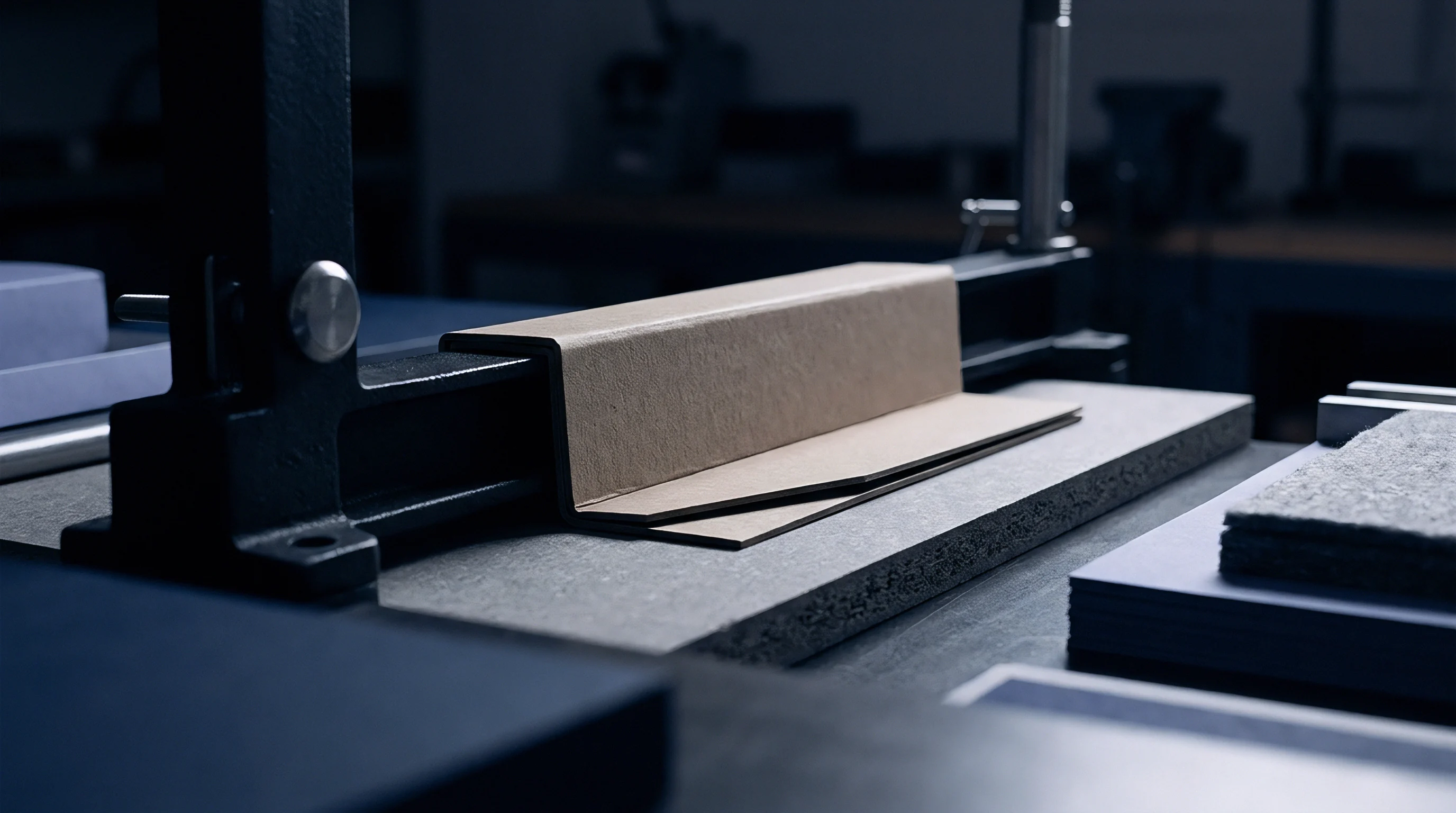
Die-cutting make-ready parameters govern the survival rate of dispersion barrier coatings. Scoring tools do not cut fibers; they compress and split internal fiber bonds to form an engineered hinge. A crease that is too shallow forces the board to fracture randomly along its outer surface during final carton erection, snapping the brittle dispersion layer.
A crease that is too deep crushes the fiber matrix completely, cutting the surface plies and shearing the polymer film before folding even begins.
The relationship between male rule thickness, female matrix channel width, and creasing counter channel depth controls the strain profile. Counter channels cut into steel plates or phenolic counter-boards must match board caliper precise to hundredths of a millimeter.
Why Do Sharp Female Dies Destroy Dispersion Barriers?
Narrow female matrix channels pinch the paperboard along the score shoulders, creating sharp shear planes that cut the coating layer. Expanding the female matrix width reduces localized shear, allowing the paperboard to form a smooth, continuous bend radius that distributes tensile strain across a larger area of the polymer film. Matrix width formula calculations for standard paperboard multiply board caliper by one point5 plus rule thickness.
For dispersion-coated substrates, the multiplier increases to one point8 or two point0 to minimize shear forces along the crease shoulder.
- Mount precision ground creasing rules with rounded, polished crowns to eliminate sharp surface points that pierce the thin dispersion coating during impression.
- Calibrate scoring depth using zero-clearance micrometer adjustments until internal ply delamination occurs without cracking the top liner fiber structure.
- Select phenolic counter-boards over channel matrix tape to maintain consistent groove geometry across long production runs without channel shoulder collapse.
- Align score lines strictly parallel or perpendicular to the substrate machine grain direction, avoiding oblique angles that create uneven torsional stresses in the polymer layer.
- Maintain converting room ambient conditions at twenty-three degrees Celsius and fifty percent relative humidity to preserve native moisture in both board fibers and latex coating.
Machine grain orientation heavily dictates crease durability. Creasing parallel to the machine direction requires narrower female channels because fibers align along the fold axis, making the liner prone to high tensile strain. Creasing cross-machine direction bends over aligned fiber bundles, distributing the mechanical stress across broader, interlocking structures.
Scores run parallel to the machine grain direction demand wider female channel matrix geometries to prevent coating split under tensile strain.
Press running speeds impact barrier survival rates through strain-rate sensitivity. Latex polymers display viscoelastic behavior; rapid deformation under high-speed platen impact increases effective glass transition temperature, making a flexible coating behave like a rigid solid. Running a die-cutter at maximum speed can turn an acceptable bench drawdown crease into a cracked failure line across the entire production run.
Polished rule crowns combined with wider female matrix channels maintain barrier continuity on dispersion coated boards.
Bench
Accurate evaluation of bent barrier resistance requires precise lab protocols that mirror converting stress states. Testing flat sheets produces useless barrier numbers for carton packaging. Standard laboratory methods mandate preparing creased specimens under repeatable mechanical conditions before measuring moisture flux.
Testing protocols rely on standardized creasing equipment, such as the TAPPI T 557 spring-loaded roller apparatus or the ISO 24033 creasing motor. These devices apply defined linear loads across specified bend angles, generating consistent mechanical damage along the score path. Once creased, specimens mount into test cells where water vapor flux is measured.
| Standard Code | Measurement Principle | Detection Limit (g/m²·day) | Sample Orientation & Setup |
|---|---|---|---|
| ASTM F1249 | Modulated Infrared Sensor | 0.005 | Creased mask with defined fold length exposed to humidity gradient |
| ISO 2528 | Gravimetric Dish Method | 0.5 | Desiccant-filled dish sealed with creased specimen, weighed periodically |
| TAPPI T 448 | Gravimetric Cup (Dry Desiccant) | 1.0 | Standard atmosphere cup test with creased fold spanning active area |
| DIN 53122-2 | Electrolytic Sensor Method | 0.05 | Flow-through cell measuring moisture pickup across standardized score lines |
Infrared detection sensors according to ASTM F1249 offer speed and precision, detecting minute water vapor leakage through micro-cracks long before gravimetric cups record a measurable weight gain. The test cell housing must seal securely around the score line, ensuring moisture flux passes strictly through the creased zone rather than leaking around cell edge gaskets.
Chemical staining provides immediate visual confirmation of coating breakdown prior to quantitative instrument testing. Applying a solution of isopropyl alcohol, water, and red dye to the creased surface highlights pinholes and micro-fractures within seconds. The dye penetrates exposed fibers through splits in the polymer film, mapping crack density under low-power optical magnification.
Colorimetric stain analysis allows press operators to evaluate score quality directly on the converting floor without waiting twenty-four hours for analytical lab results. High digital crack area percentages directly correlate with elevated moisture transmission rates in subsequent cell testing.
Coatings pass flat gravimetric bench tests easily, but real folding lines always degrade the polymer structure on real converting lines.
Yield
Calculating the effective barrier performance of a converted carton requires modeling the total moisture flux across both undamaged flat panels and damaged score lines. Treating a package as a uniform barrier surface leads to massive errors in shelf-life prediction. The total water vapor entering a package equals the sum of the flat panel flux plus the creased line flux.
Consider a standard folding carton with total surface area Atotal of 0.08 square meters. The total length of all creased scores Lcrease measures 1.2 meters. The affected width of the creased zone wcrease extends 0.002 meters to either side of the fold, giving a total creased zone area Acrease of 0.0024 square meters.
The remaining flat panel area Aflat equals 0.0776 square meters.
Assume the measured flat water vapor transmission rate WVTRflat is 2.0 grams per square meter per day under tropical test conditions (38°C, 90% RH). Bending the dispersion coating across the score lines increases the local transmission rate WVTRcrease to 25.0 grams per square meter per day due to micro-cracking.
The effective area-weighted transmission rate WVTReff for the entire carton is calculated as:
WVTReff = frac(Aflat · WVTRflat) + (Acrease · WVTRcrease)Atotal
Substituting the values into the formula yields:
WVTReff = frac(0.0776 · 2.0) + (0.0024 · 25.0)0.08
WVTReff = frac0.1552 + 0.06000.08 = 2.69 g/m2·day
The score lines account for only three percent of the total carton surface area, yet they contribute over twenty-seven percent of the total moisture entering the package. If a sensitive dry food product allows a maximum moisture gain of 0.5 grams over a 180-day shelf life, calculating shelf life based on flat sheet numbers yields an overoptimistic prediction:
Flat Shelf Life = frac0.5 g0.08 m2 · 2.0 g/m2·day = 3.125 days quad (Calculation Error)
Correcting for score line degradation using the calculated WVTReff yields the true package shelf life:
True Shelf Life = frac0.5 g0.08 m2 · 2.69 g/m2·day = 2.323 days
The creasing damage reduces real package shelf life by over twenty-five percent compared to flat panel expectations. Balancing coat weight against mechanical compliance dictates optimal unit costs. Increasing coat weight improves flat barrier metrics but thickens the dry film, making it more rigid and prone to severe cracking during folding.
Increasing coat weight beyond optimal mechanical thresholds degrades creased barrier retention while escalating raw material costs.
- Optimized coat weight balance maintains dry film thickness between ten and twelve grams per square meter to maximize barrier while minimizing bending stiffness.
- Pre-coat mineral smoothing applies an inexpensive calcium carbonate layer to cover board rough spots, preventing localized barrier thinning that splits under tension.
- Plasticizer inclusion trade-offs demand precise dosing to retain film elasticity without causing reel blocking or breaching global food migration limits.
- Tooling offset adjustments widen female die channels to preserve barrier integrity, avoiding costly chemical formulation changes.
Can double-pass thin dispersion application strategies out-perform single-pass thick coating runs in creased barrier retention?

Audit
Converting dispersion-coated paperboard into commercially viable packaging requires strict adherence to regulatory schemes governing food contact safety and recyclability certification. Replacing traditional plastic laminates with aqueous dispersions aims to simplify recycling streams, but chemical compliance must remain intact after mechanical converting passes.
Recyclability evaluation schemes, such as the CEPI Recyclability Laboratory Test Method Version 2 or the PTS-RH 021/97 standard, assess repulpability and stickies formation. Dispersion coatings must break down cleanly during standard hydrapulping into coarse flakes that separate easily from re-usable cellulose fibers without clogging fine screen baskets.
| Assessment Scheme | Primary Evaluation Criteria | Mass Yield Threshold | Impact of Micro-Cracks |
|---|---|---|---|
| CEPI Version 2 | Coarse reject percentage and macro-stickies screening | Greater than 90% fiber recovery | Exposes un-sized board interior to pulping liquor, accelerating disintegration |
| PTS-RH 021/97 | Repulpability and sheet formation capability | Category A (Fully Repulpable) | Cracked coatings detach faster, improving fiber liberation rate |
| Aticelca 501/19 | Level A+, A, B, or C recyclability index scoring | Class A requirement (<1.5% reject) | Minimal impact on score, but mineral fillers increase sludge mass |
| EU PPWR Tier Fee | Extended Producer Responsibility (EPR) fee modulation | <5% non-paper material target | Determines fee scale based on certified plastic mass percentage |
While mechanical micro-cracks along score lines harm water vapor barrier resistance, they often aid industrial pulping by allowing water to enter the board core rapidly during pulping operations. Synthetic polymers containing cross-linkers to resist water vapor can create micro-stickies that contaminate paper machine wires, triggering heavy Extended Producer Responsibility fee penalties under modulated packaging waste directives.
Food contact compliance under European Regulation 1935/2004 and Regulation 10/2011 demands rigorous testing on finished, converted packages. Mechanical creasing can force functional barrier coatings to split, allowing sub-layer additives, sizing chemicals, or recycled fiber contaminants to migrate into dry or dry-fatty food contents.
Standard packaging supply contracts incorporate specific quality assurance clauses to cover creased barrier performance. A standard compliance clause specifies that delivered substrates must maintain a maximum creased water vapor transmission rate under defined test atmospheres, explicitly placing financial liability for package shelf-life failure on the coating converter if scoring parameters deviate from certified specifications.