Calibrating Crease Depth Ratios to Prevent Liner Cracking on Coated Cartons
Maintain crease depth penetration between 0.45 and 0.65 of board caliper with a 1.4 to 1.6 channel multiplier to promote internal shear and eliminate cracking.

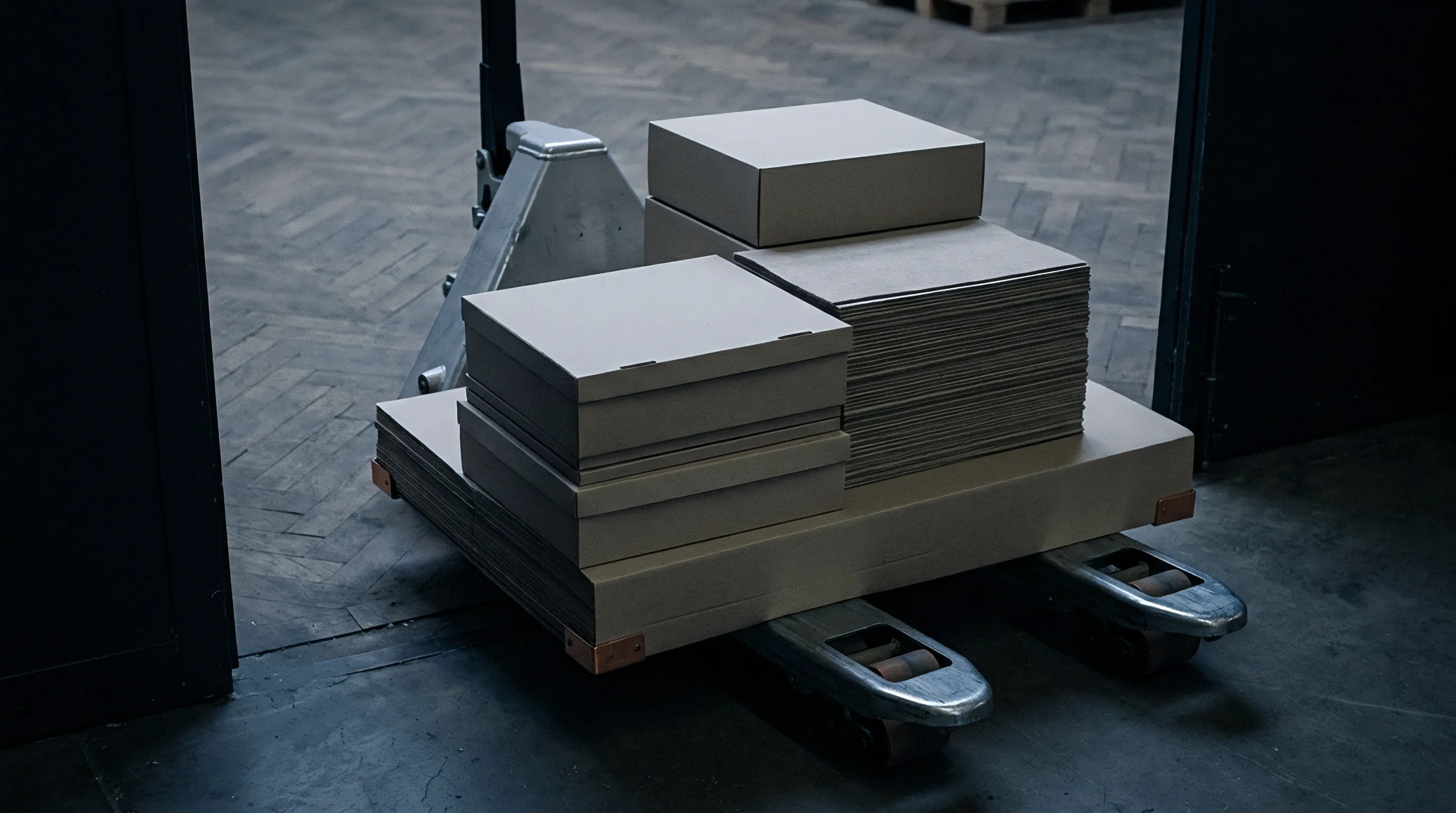
Rule
Precision folding of mineral-coated paperboard requires controlled internal shear rather than simple compression. When a scoring rule enters a carton blank against a counter matrix, the board experiences localized vertical displacement. That displacement must break the internal ply bonds while preserving the structural integrity of the outer liner and its mineral coating layer.
Setting the penetration depth of the creasing rule to an arbitrary press standard generates either unyielding hinge resistance or fractured white coatings across the carton bead. The mathematical relationship between creasing rule penetration and board thickness governs this physical balance.
Creasing rule penetration depth represents the distance the steel rule tip travels past the surface plane of the counter plate into the matrix channel. Calibrating this value requires establishing the crease depth ratio, defined as rule penetration divided by uncompressed board caliper. On solid bleached sulphate and folding boxboard substrates ranging from 350 to 550 microns, the functional operating window for crease depth ratio spans 0.45 to 0.65.
Setting penetration below 0.45 leaves internal plies intact, forcing the exterior liner to absorb excessive tensile elongation during ninety-degree carton erection. Setting penetration above 0.68 pinches the liner against the matrix shoulder, crushing the cellulose matrix and severing outer fibers.
The top liner splits.
Rule width interacts directly with channel depth to establish local strain distributions. Standard commercial flatbed steel rules present a rounded profile with a tip radius equal to half the rule thickness. A two-point rule measures 0.71 millimeters in thickness, whereas a three-point rule measures 1.07 millimeters.
Matching rule thickness to caliper prevents shearing at the channel shoulder. For folding boxboards between 300 and 420 microns, a two-point rule maintains sufficient contact area without inducing edge shear. Above 450 microns, three-point rules distribute the downward displacement load over a broader area, preventing premature rupture of the underlying bleached kraft plies.
Thicker board plies demand wider counter channels to fold without rupturing the outer coating.
Substrate composition dictates the precise depth calibration point. Solid bleached sulphate consists of virgin chemical pulp with long, flexible fibers capable of substantial z-directional deformation. Folding boxboard incorporates mechanical pulp in its center layers, flanked by chemical pulp liners.
Coated recycled board features shorter fibers with lower internal tear resistance. Each furnish requires a specific downward stroke calibration on the die-cutting platen to achieve clean creasing without exterior fracture.
Inadequate creasing penetration generates immediate functional rejection at high-speed erecting machines through carton bulge, skewing, and split printed corners that expose unprinted raw furnish.


Delamination
Tensile failure in clay coatings stems from suppressed delamination within the structural core of the cartonboard. When a flat sheet undergoes folding to ninety or one hundred eighty degrees, the exterior surface expands in tension while the interior surface contracts in compression. Solid mineral coating layers, comprising kaolin clay, calcium carbonate, and styrene-butadiene latex binders, exhibit an ultimate elongation at break below two percent.
Raw virgin cellulose fibers withstand elongation values between five and eight percent before rupture. Preventing coating fracture requires the carton core to shear horizontally, forming an internal delamination bead that relieves surface strain.
The scoring rule forces middle plies to shear along their horizontal interfaces. This controlled mechanical failure separates the individual fibrous layers between the top liner and the back liner. As the scored area bends, the internal plies slide over one another, creating an open hollow bead toward the interior fold angle.
That delamination bead shifts the neutral axis of bending outward, shrinking the total tensile strain exerted upon the exterior mineral layer. Where internal plies fail to separate, the entire cross-section bends as a monolithic plate, instantly exceeding the two percent tensile elongation limit of the dry coating.
Internal plies shear under load.
Fiber orientation relative to the scoring rule dramatically alters delamination behavior. Machine direction fibers lie parallel to the web flow during board manufacture, offering high tensile stiffness and low stretch. Cross direction fibers lie perpendicular to web flow, providing higher elongation and reduced bending resistance.
Scoring parallel to the machine direction forces bending across stiff, aligned fibers, demanding deeper penetration to initiate horizontal shear. Scoring perpendicular to the machine direction separates plies readily but leaves fewer continuous fibers bridging the crease width.

Do Symmetrical Creasing Channels Prevent Liner Delamination?
Symmetrical channel profiles produce uniform bilateral shear only when fiber alignment matches the creasing axis exactly. In cross-direction creases, a symmetrical channel drives balanced internal delamination on both flanks of the male rule. On diagonal or machine-direction scores, asymmetrical shear frequently occurs because fiber pull resistance varies across the sheet plane.
When shear concentrates on one shoulder of the crease, the opposite shoulder remains rigid. That concentrated stiffness forces all rotational elongation into a single localized stripe of mineral coating, fracturing the clay surface along the ink boundary.
| Grade Designation | Caliper Microns | Tensile Energy Absorption MD Joules per Square Meter | Internal Bond Strength Scott Joules per Square Meter | Primary Failure Mode at Suboptimal Crease Ratio |
|---|---|---|---|---|
| Solid Bleached Sulphate | 380 | 210 | 195 | Coating micro-fissuring from excessive penetration |
| Folding Boxboard GC1 | 450 | 165 | 140 | Liner peeling through middle mechanical pulp fracture |
| Folding Boxboard GC2 | 500 | 145 | 125 | Outer liner split along cross direction crease bead |
| Coated Recycled Board | 420 | 115 | 95 | Complete z-directional shear separation and score rupture |
Coating composition determines the threshold where micro-cracking becomes visible to the unaided eye. Formulations utilizing high proportions of calcined clay and ground calcium carbonate maximize opacity, brightness, and ink holdout. Those same pigments create a brittle mineral matrix.
Formulations utilizing precipitated calcium carbonate with high-molecular-weight elastomeric latex binders provide superior flexural strain tolerance. However, converters rarely possess authority over the coating recipe applied at the pulp mill wet end. Press operators adjust die impression depth to manage the specific flexural characteristics of each delivered batch.
- Surface crazing reveals inadequate internal delamination where the rigid coating develops hundreds of microscopic fissures without substrate fiber rupture.
- Tear flaking describes the physical detachment of pigment flakes from the bleached liner along the apex of the fold line.
- Corner bursting arises during high-speed tray erection when excessive penetration depth shears both the mineral coating and the supporting bleached liner plies.
- Hinged peeling occurs when weak recycled furnish plies separate completely, causing the crease to collapse into an unsupported paper membrane.
Board suppliers regularly argue that coating split complaints represent improper press make-ready rather than inadequate elasticity in their delivered clay formulation.

Humidity
Cellulose fibers absorb and desorb atmospheric water continuously, altering their viscoelastic performance. In carton converting, equilibrium moisture content dictates whether a fiber matrix yields elastically or shatters under shear stress. Equilibrium moisture content for coated cartonboard conditioned according to ISO 187 at twenty-three degrees Celsius and fifty percent relative humidity sits between 6.5 and 7.5 percent by weight.
When ambient plant conditions drop to thirty percent relative humidity during winter operations, board moisture falls below five percent within forty-eight hours.
Fibers lose flexibility rapidly.
Dry cellulose exhibits elevated elastic modulus accompanied by depressed elongation at break. As internal moisture drops, hydrogen bonds between adjacent cellulose microfibrils lock into fixed positions. A dry sheet resists initial rule penetration, requiring greater platen pressure to force the board into the matrix channel.
This added force crushes the brittle top liner rather than generating progressive delamination. Furthermore, the synthetic latex binders within the exterior mineral coat stiffen as temperature drops and moisture dissipates, reducing allowable elongation below 1.2 percent.
ISO 187 conditioning at twenty-three degrees Celsius and fifty percent relative humidity stabilizes equilibrium board moisture between 6.5 and 7.5 percent.
Storage conditions prior to conversion establish baseline cracking risks. Pallets wrapped in intact polyethylene film maintain mill-shipped moisture for extended transit periods. Stripping protective wrap inside an unconditioned press room initiates immediate edge desorption.
Edge moisture loss creates non-uniform tension across the sheet, producing dimensional warp and localized brittleness. Crease calibrations established on the exterior sheets of a fresh pallet fail entirely once the die cutter reaches the dry core sheets fifty impressions later.
Whether seasonal coating elasticity variations can be fully countered through dynamic matrix depth adjustments remains an unresolved question on converting floors.

Matrix
Counter matrix selection defines the female channel geometry that supports the board during rule impact. The matrix channel width formula accounts for rule thickness, board caliper, and a material displacement factor. The standard calculation sets channel width equal to the creasing rule thickness plus board caliper multiplied by a grade-specific constant.
For virgin folding boxboard, that constant equals 1.5. For solid bleached sulphate, the factor shifts to 1.4. For dense coated recycled board, converters increase the multiplier to 1.6 to accommodate fragmented fiber bulk within the channel cavity.
Channel depth must match or slightly exceed the uncompressed board caliper. When channel depth falls below board thickness, the female groove base compresses the back liner against the entering rule tip. That secondary compression arrests z-directional fiber sliding and forces the board into tensile elongation across the channel shoulders.
Conversely, excessive matrix depth fails to support the underside of the sheet, allowing the board to stretch unsupported over the channel gap rather than delaminating internally.

Will Deeper Anvil Penetration Compromise Bending Moment?
Deep rule penetration reduces crease stiffness, measured as bending resistance under DIN 55437. Calibrating depth to eliminate liner cracking inevitably lowers the residual force necessary to fold the carton panel. A carton exhibiting zero coating cracks but ninety percent stiffness reduction collapses under packaging machine tuck-in plows.
Die cutters balance penetration depth to retain between thirty and fifty percent of the original uncreased board bending moment while eliminating visible top-liner fissures.
| Board Caliper Millimeters | Rule Thickness Points | Matrix Channel Width Millimeters | Matrix Channel Depth Millimeters | Resulting Crease Depth Ratio |
|---|---|---|---|---|
| 0.35 | 2 pt (0.71 mm) | 1.20 | 0.35 | 0.62 |
| 0.40 | 2 pt (0.71 mm) | 1.30 | 0.40 | 0.58 |
| 0.45 | 2 pt (0.71 mm) | 1.40 | 0.45 | 0.54 |
| 0.50 | 3 pt (1.07 mm) | 1.80 | 0.50 | 0.52 |
| 0.60 | 3 pt (1.07 mm) | 2.00 | 0.60 | 0.48 |
Phenolic resin counters and milled pertinax plates provide dimensional stability superior to adhesive-backed composite matrix strips. In high-speed autoplaten die cutters processing over six thousand sheets per hour, composite matrix strips experience shoulder rounding. As the channel edge rounds, the effective channel width widens dynamically.
That widening alters the crease depth ratio over the production run, shifting clean folds into loose, ragged creases that crack at subsequent folding stages.
Accurate calibration follows an explicit machine setup sequence:
- Micrometer caliper verification establishes true delivered sheet thickness across three points on the parent sheet, bypassing nominal catalog numbers.
- Channel dimension calculation applies the substrate multiplier to determine theoretical channel width and counter depth before mounting tools.
- Counter plate zeroing aligns the female channels with cutting and creasing rules under minimal contact pressure to avoid edge shearing.
- Stepped platen impression advances penetration depth upward in twenty-micron increments until internal delamination initiates across all crease lines.
- Fold inspection evaluates ninety-degree and one hundred eighty-degree manual bends under ten-times optical magnification to check for white pigment fracture.
Worn matrix shoulders always widen channel clearances and ruin fold accuracy.

Spoilage
Cracked carton creases directly inflate conversion waste and trigger product rejections from automated packaging lines. A carton blank displaying microscopic coating fissures at the gluer stage absorbs ambient air and moisture along the raw fiber fracture. Liquid contents or barrier coatings applied over cracked board wick into the exposed pulp core, causing edge swell and panel delamination.
On high-speed filling lines running at four hundred cartons per minute, weakened creases skew during vacuum pickup, generating carton jams that halt production lines.
Rejects spike during filling.
Downstream converting waste mounts through progressive finishing steps. When top liner cracking occurs on a printed carton, foil stamping or spot varnishes crack along the exact fracture axis. In cold-foil applications, micro-fractured coatings shed adhesive, dropping metallic flakes into processing machinery.
The financial waste compounds because failure manifests after raw board purchasing, multi-color lithographic printing, and offline coating stages have already absorbed machine hours and labor costs.
Crease recovery torque thresholds govern automated carton erectability on commercial packaging lines.
The relationship between raw sheet cost and waste mitigation centers on maintaining narrow process windows for tool geometry and ambient control. Sourcing a higher-cost virgin folding boxboard with elevated tensile energy absorption often lowers overall landed packaging costs compared to cheaper, brittle recycled boards that demand frequent die re-shimming and slow platen cycle speeds. Operating with calibrated crease ratios protects structural carton performance across variable filling environments.
Contractual supply specifications stipulate DIN 55437 crease recovery limits to ensure rejected packaging lots transfer financial liability directly to the converting facility.